Top 5 Repeated CBSE Class 10 Maths Previous Year Questions
The syllabus of board exams can be quite vast, and students are purely stressed about this topic when it comes to vulnerabilities. Now, the best way to get rid of this ambiguity is by practising CBSE Class 10 maths previous year questions. The new pattern, when observed from past papers, reflects a very specific insight: the Central Board of Secondary Education never seems to come up with an outrightly different style of questions.
This systematic approach allows you to learn the exact formatting required to earn full marks from the examiners.
Importance of Class 10 Maths Previous Year Questions
Learning the formulas is rarely enough to score full marks in a practical subject such as maths. Solving the CBSE Class 10 Maths previous year paper gives a reality check to your revision; it is the mirror reflecting how concepts convert into exam questions.
This frees up a number of vital exam-day advantages you get by spending time to analyse a real CBSE Class 10 Maths past year paper.
-
Clear Blueprint Familiarity: You understand how questions are distributed across multiple-choice questions, short calculations, and comprehensive long-answer problems.
-
Accurate Chapter Weightage Tracking: Get to know which exact sub-topics most frequently translate into 4-mark questions, and accordingly, you can focus on the high-weight sections while preparing those last-minute notes.
-
Strategic Time Management: Completing real tasks within a time constraint hones your ability to pace yourself so you can complete the whole paper well under the official three-hour limit.
-
Reduction in Presentation Errors: Step-by-step solutions will break down how to write your assumptions, working and flow of the question precisely, ensuring minor point deductions from the examiner are avoided.
What are the Most Repeated CBSE Class 10 Maths Previous Year Questions
Below are the five most stable, theory-heavy conceptual structures that have appeared consistently in previous years' CBSE Class 10 Maths question papers over the last decade. These question formats frequently carry 3-mark and 4-mark weightage and form an important foundation for board exam preparation.
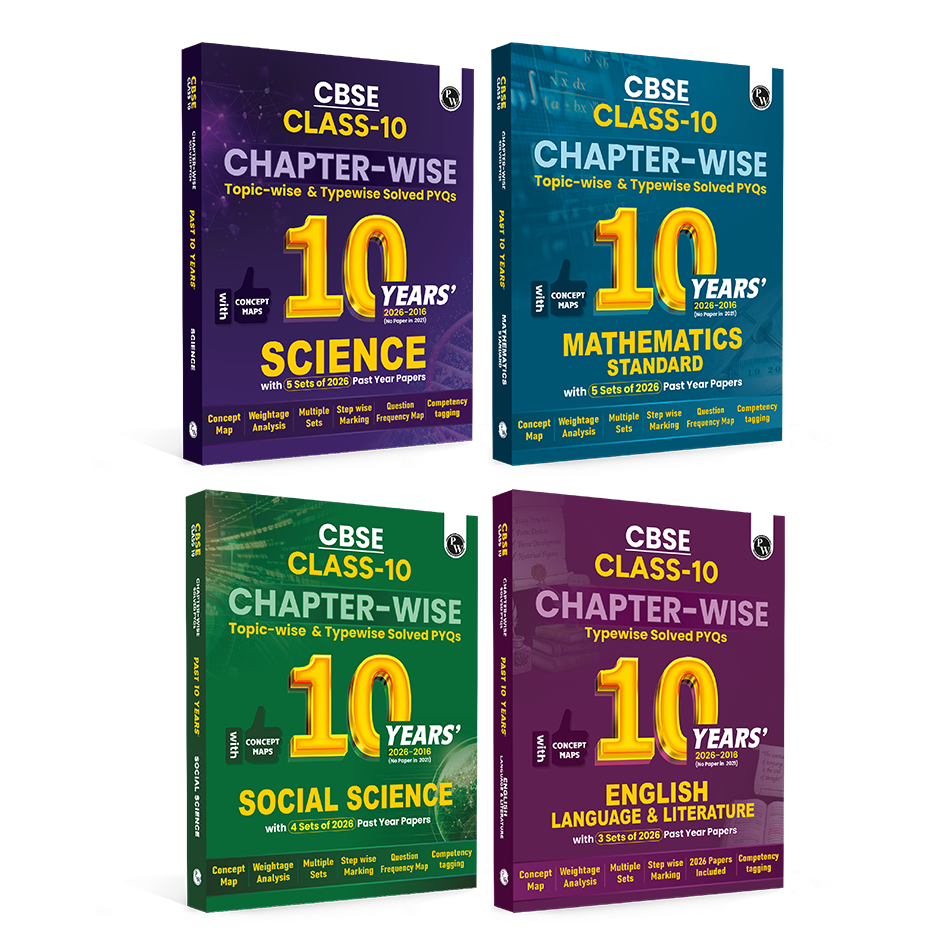
To strengthen understanding and become familiar with recurring patterns, students should also practice CBSE Class 10 PYQs, as previous year questions help improve concept application, answer-writing confidence, and exam readiness.
1. Real Numbers: Proving an Irrational Number
Question: Prove that (2 + √3) / 5 is irrational.
To prove the statement, assume that (2 + √3) / 5 is a rational number.
So, let
(2 + √3) / 5 = a/b
where aaa and bbb are integers and b≠0.
Multiply both sides by 5:
2 + √3 = 5a/b
Now subtract 2 from both sides:
√3 = 5a/b − 2
Taking LCM:
√3 = 5a - 2b/b
The right side is rational because aaa and bbb are integers. But √3 is irrational.
This statement is a contradiction.
Therefore, (2 + √3) / 5 is an irrational number.
2. Applications of Trigonometry: Lighthouse Problem
Question: A 100 m high lighthouse observes two ships at angles of depression of 30° and 45°. Find the distance between the ships.
Let AB be the lighthouse height.
Height of lighthouse = 100 m
For the nearer ship:
tan45°=100/BD
Since tan45° = 1,
BD = 100 m
For the farther ship:
tan30°=100/BC
We know:
tan30° = 1/√3
So,
BC = 100/√3
Distance between ships:
CD=BC−BDCD=BC-BDCD=BC−BD
CD = 100/√3 - 100
Taking √3 = 1.732
CD=100(1.732−1)=73.2
Therefore, the distance between the ships is 73.2 m.
3. Surface Areas and Volumes: Cone on Hemisphere
Question: A cone is placed on a hemisphere. Radius = 3.5 cm and total height = 9.5 cm. Find total volume.
Radius:
r = 3.5 cm
Total height = 9.5 cm
Height of hemisphere = radius = 3.5 cm
So, height of cone:
h = 9.5 − 3.5 = 6 cm
Total volume:
V=1/3πr²h+2/3πr³
Substitute values:
V=1/3×22/7×3.5²×6+2/3×22/7×3.5³
After calculation:
V = 166.83 cm³
Therefore, the total volume of the solid is 166.83 cm³.
4. Statistics: Finding Missing Frequencies
Question: The median of the grouped data is 525, and the total number of observations is 100. Find missing frequencies xxx and yyy.
From the cumulative frequency table:
76+x+y=100
So,
x+y=24
The median class is 500–600.
Values:
-
L=500
-
f=20
-
cf=36+x
-
h=100
-
N=100
Using the median formula:
Median=L+((N/2−cf)/f)h
Substitute values:
525=500+(50−(36+x)/20)100
Simplifying:
25=(14−x)5
5=14−x
x=9
Now substitute in the equation:
9+y=24
y=15
Therefore, the missing frequencies are:
-
x=9
-
y=15
5. Probability: Cards Problem
Question: The king, queen and jack of clubs are removed from a deck of 52 cards. Find probabilities.
Cards removed = 3
Remaining cards:
52−3=49
(i) Probability of drawing a spade
There are 13 spades.
P=13/49
(ii) Probability of drawing a black king
Only the king of spades remains.
P=1/49
(iii) Probability of drawing a club
Originally, 13 clubs.
3 clubs removed.
Remaining clubs:
13−3=10
Probability:
P=10/49
(iv) Probability of drawing a jack
Originally 4 jacks.
1 removed.
Remaining jacks:
4−1=3
Probability:
P=3/49
Therefore, the required probabilities are:
-
Spade = 13/49
-
Black king = 1/49
-
Club = 10/49
-
Jack = 3/49
Benefits of CBSE Class 10 Maths Previous Year Questions
When you practice with structured revision tools like CBSE 10th math previous year question papers, your exam preparation stops being an erratic guessing game and becomes a proactive study routine that supports relevant learning.
When you go through past paper books to read the best-solved papers, there are clear advantages:
-
Step-by-Step Marking Insight: Official reference materials tell you exactly what marks are for, giving intermediate steps meaning; one doesn't lose points by skipping certain aspects of an algebraic proof.
-
Syllabus Tagging: Questions are tagged with the relevant textbook chapters so you can practise those topics immediately after studying them.
-
Typology Sorting: Old questions are organised very systematically based on the way they're laid out — multiple choice, short calculations, detailed case studies and so forth.
-
NCERT Cross-Referencing: Whenever you face difficulty in solving a question, it will point clearly back to the theory of any basic textbook.
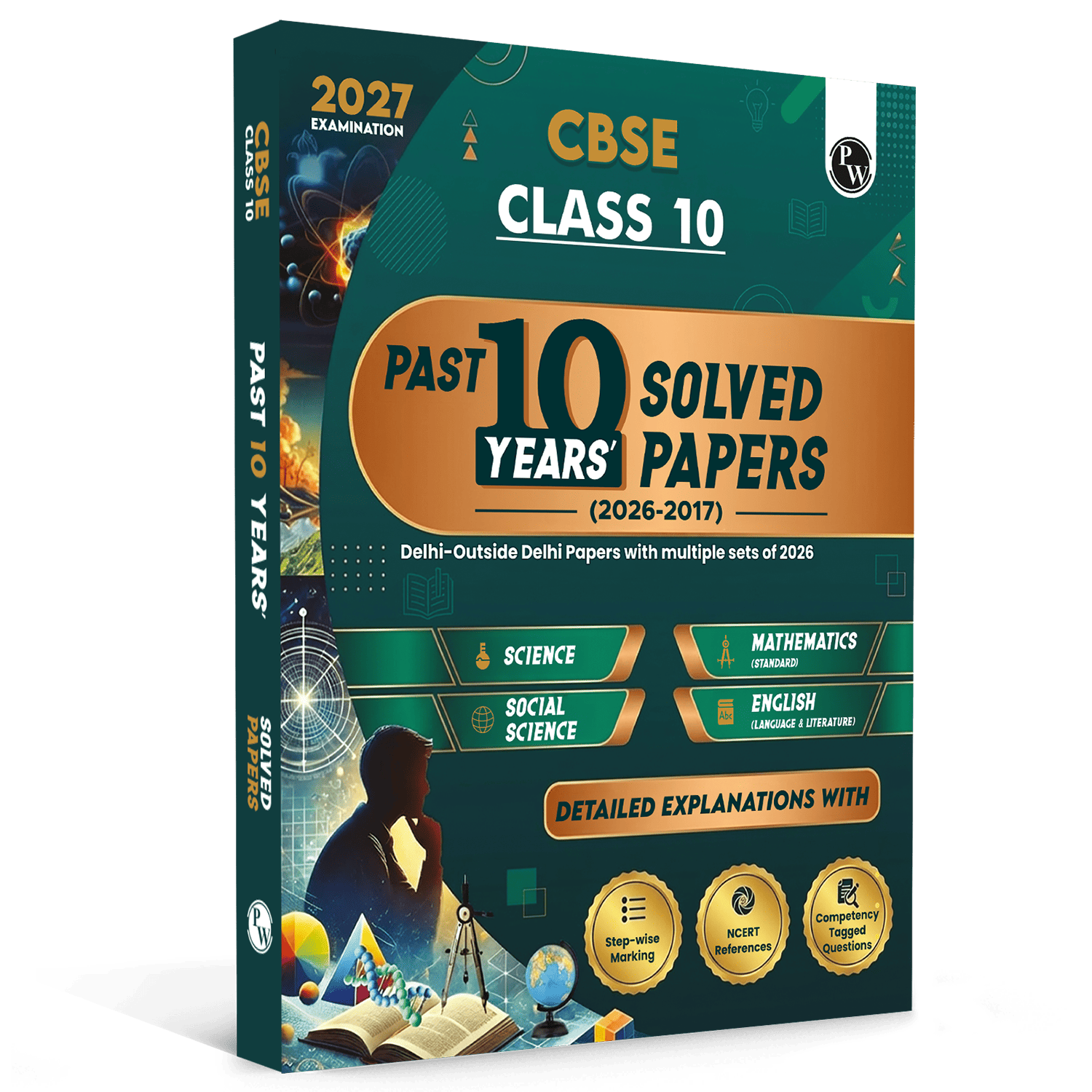
For more structured practice and revision, students can also use the CBSE Class 10 PYQ Combo 2027, which provides organised previous year questions to improve confidence, exam familiarity, and scoring potential.
CBSE Class 10 Maths Previous Year Questions FAQs
How many marks from CBSE Class 10 Maths previous year questions are repeated in board exams?
Even though the specifics differ each year, approx 70% to 80% of underlying question structures/logical frameworks/types of concepts match CBSE Class 10 Maths previous year questions in both formats.
Will solving CBSE board previous-year question papers for class 10 maths help me with case study questions?
Modern revision books do so by tagging past questions with their official competency levels. This allows you to carry out practical questions on contextual problems and is great preparation for some of the long case studies that appear in Section E.
Is it enough to solve the CBSE Class 10 PYQs Maths to pass the exam?
Although working on past papers is fantastic for your revision, you should always reference them with your main NCERT textbooks to make sure that you have covered the basics of all math concepts and are clear.
How many past years should I cover from CBSE 10th Maths previous year question papers?
Although working on past papers is fantastic for your revision, you should always reference them with your main NCERT textbooks to make sure that you have covered the basics of all math concepts and are clear.