Why Class 10 Maths PYQ Book Is Essential for Board Exam Speed and Accuracy
Many students understand the mathematical formulas perfectly well during regular classes but struggle to apply them under the strict time constraints of the formal exam room. This common issue leads to unattempted questions, careless errors, and a sudden drop in confidence during the final assessment.
To bridge the gap between knowing a mathematical concept and writing it out flawlessly, working through a dedicated CBSE Class 10 maths PYQ book becomes absolutely vital.
Overview of CBSE Class 10 Maths PYQ
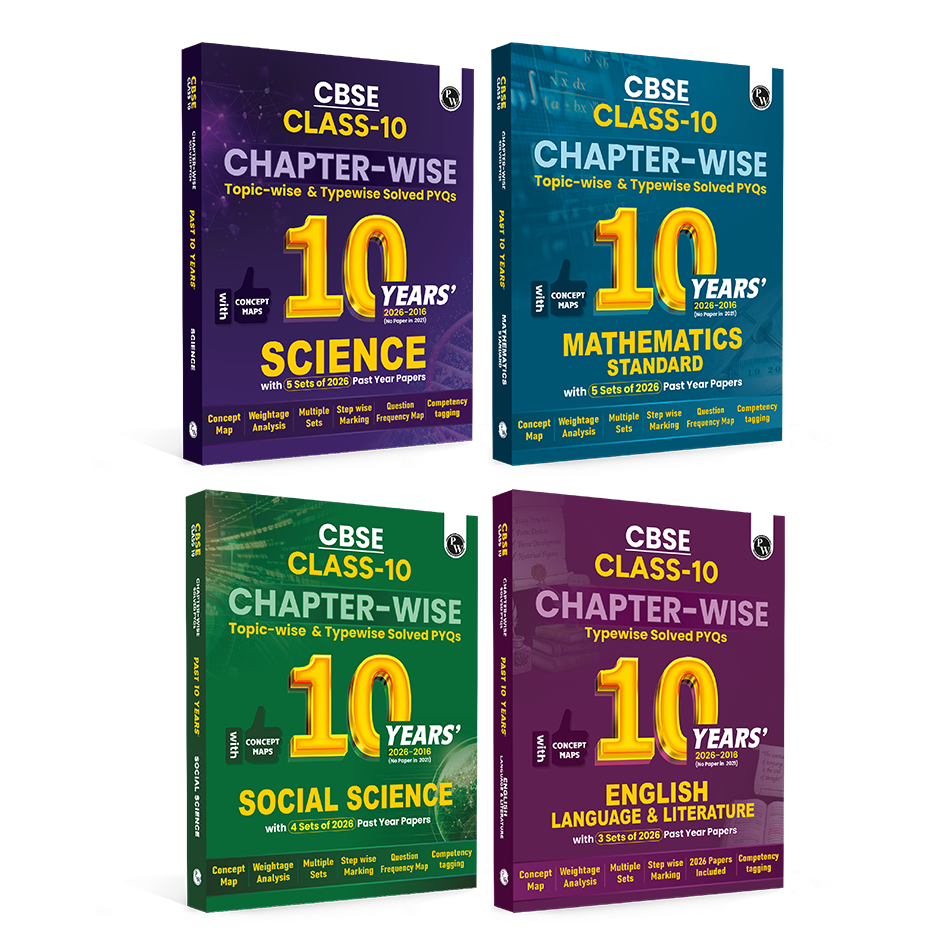
An authentic repository of previous-year questions serves as a practical mirror to the actual board examinations. A comprehensive CBSE Class 10 maths PYQ resource covers a full 10-year span of solved papers from 2016 to 2026. This deep archive ensures that every single shift in the examination pattern is documented clearly for the learner.
Rather than presenting questions in a confusing, unorganised format, a proper maths PYQ book arranges the contents systematically to support progressive learning. The structural breakdown includes:
-
Chapter-wise organisation: Allows students to finish an individual topic from their main textbook and immediately solve the corresponding board questions.
-
Topic-wise sorting: Breaks down chapters into smaller, manageable subtopics so learners can pinpoint their specific analytical weaknesses.
-
Type-wise segregation: Group questions by their structural format, such as multiple-choice items, short answer types, and long descriptive problems.
-
Multiple paper sets: include various distinct sets from the latest 2026 board sessions to give a wide view of question variations.
Why is CBSE Class 10 Maths PYQ Essential for Board Exam Preparation?
Relying solely on standard school textbooks often leaves a student unprepared for the exact phrasing and structural formatting used by board examiners. A premium CBSE Class 10 maths PYQ toolkit is essential because it transitions a student from basic conceptual familiarity to complete board exam maths practice readiness.
The CBSE Class 10 PYQ helps decode the structural trends of the exam by providing:
|
Feature |
Student Benefit |
|
Trend Analysis |
Maps out how question weights have evolved over the last decade. |
|
Concept Maps |
Offers clear visual summaries to connect distinct geometric or algebraic ideas quickly. |
|
Bloom's Taxonomy Classification |
Categorises questions across six distinct cognitive learning levels to boost analytical thinking. |
|
Step-by-Step Solutions |
Offers precise clarity aligned directly with official evaluation expectations. |
How Does CBSE Class 10 Maths PYQ Improve Calculation Speed?
Time management is one of the most significant hurdles in any mathematics paper. A student might know how to solve every problem on the page, but if they spend too long on initial arithmetic, they will run out of time before reaching the high-scoring long-answer questions at the back. Regular use of a CBSE Class 10 maths PYQ book actively drives maths speed improvement through structured familiarity.
When you solve ten years of recurring question structures, your brain starts to recognise numerical patterns instantly. For example, when dealing with trigonometry or quadratic equations, you no longer spend valuable minutes deciding which identity to apply. The visual trigger of the question type immediately brings the correct method to mind.
Furthermore, timing yourself while working through these historical papers trains your internal clock. You learn exactly how many minutes you can afford to spend on a 2-mark question versus a 5-mark case study, allowing you to complete the entire paper with plenty of time left to spare.
How Does CBSE Class 10 Maths PYQ Increase Accuracy?
Speed is useless if your final numerical answers are incorrect due to silly calculation errors or misread signs. Cultivating true accuracy in maths requires a deliberate practice environment where you can make mistakes safely and correct them before exam day. This is where a reliable CBSE Class 10 maths PYQ volume becomes an invaluable diagnostic tool.
Every time you complete a set of questions from the past papers, you can check your working against the detailed solutions linked directly to NCERT references. This process helps you identify specific personal error trends, such as:
-
Misapplying the section formula in coordinate geometry.
-
Dropping negative signs during complex algebraic expansions.
-
Forgetting to write down the final units of measurement in mensuration problems.
Benefits of CBSE Class 10 Maths PYQ
Using a targeted CBSE Class 10 maths PYQ system changes how a student interacts with difficult mathematical theorems. Instead of reading through solutions passively, learners engage in active recall, which cements numerical methods in their long-term memory.
The primary advantages of integrating these papers into your revision routine include:
-
Understanding the marking scheme: Detailed solution guides show exactly how marks are distributed for step-by-step working, helping students avoid skipping crucial logical links.
-
Identifying high-weightage topics: Spending time on questions that appear year after year ensures that high-yield chapters receive the attention they deserve.
-
Exposure to diverse question typologies: Facing real historical questions removes the surprise factor when encountering complex application-based problems.
These curated collections also include official sample papers for recent sessions alongside term-specific papers, providing an all-inclusive framework for comprehensive revision.
When to Start Solving Using CBSE Class 10 Maths PYQ?
Timing your entry into CBSE Class 10 PYQ 2027 Combo revision determines how effective your overall strategy will be. Waiting until the final weeks before the board exams to open your CBSE Class 10 Maths PYQ book creates unnecessary stress and leaves no time to fix deeper conceptual gaps.
The ideal timeline to begin using these papers is during the mid-term phase of the academic year. As soon as your school finishes the first half of the syllabus, you should immediately start solving the corresponding chapter-wise past questions.
This early integration ensures that you are not trying to swallow ten years of exam data all at once. Instead, you build your exam endurance incrementally, transforming past paper analysis into a natural extension of your daily homework routine rather than an overwhelming task at the end of the year.
Study Plan with CBSE Class 10 Maths PYQ
To get the absolute most out of your CBSE Class 10 Maths PYQ resource, you need a highly structured revision plan rather than a random approach.
Here is an effective weekly plan designed to build a consistent operational rhythm:
Phase 1: Topic Isolation
Dedicate the first few days of your weekly study block to solving past questions from just one or two specific chapters. Focus entirely on understanding how the board has altered the phrasing of these specific topics over the past decade.
Phase 2: Time-Bound Simulation
At the end of the week, select a complete 3-hour question paper from a previous year. Sit in an isolated room without your textbook, set an alarm, and complete the entire paper under genuine exam conditions to test your speed limits.
Phase 3: Error Auditing
Spend at least one full hour reviewing your completed paper against the provided marking keys. Highlight every step where your logic deviated from the official solution and write down the corrected method in a dedicated revision notebook.
Tips to Score Higher Using CBSE Class 10 Maths PYQ
To transform your CBSE maths previous papers practice into top-tier marks, you must look closely at how your final answers are presented on the page.
-
Prioritise clean presentation: Keep your calculation margins clearly separated on the right side of your answer sheet so the examiner can follow your primary steps easily.
-
State formulas explicitly: Write down the general algebraic or geometric formula you are using before plugging in the specific numbers. This protects your step-marks if a calculation error happens later.
-
Utilise visual tools: Review the official concept maps provided in your prep books to master drawing clean, proportional diagrams for triangles and circles.
-
Track question frequency: Keep a close eye on the frequently asked question trackers in your material to know exactly which subtopics require the most intensive review.
Read More: CBSE Class 10 Study Timetable 2026-27
CBSE Class 10 Maths PYQ FAQs
How does a CBSE Class 10 Maths PYQ book help with final board exam preparation?
A past-year question book exposes you directly to real historical exam papers, helping you understand the exact marking trends, chapter weightage, and question styles used by examiners. This targeted exposure ensures your maths preparation focuses on high-yield topics.
Can solving previous papers bring about noticeable maths speed improvement?
Yes, regularly working through timed past papers trains your brain to recognize recurring algebraic and geometric patterns instantly. This pattern recognition significantly cuts down the time spent deciding which formula to use during the real exam.
Where can I find detailed solutions that help maintain accuracy in maths?
High-quality revision books offer step-by-step solutions linked directly with standard NCERT concepts. Reviewing these explanations helps you identify personal calculation errors and ensures your step-by-step writing matches official expectations.