How to Crack CTET Exam in First Attempt?
The Central Teacher Eligibility Test (CTET) is the gateway for aspiring teachers seeking positions in prestigious government schools such as KVS and NVS Many candidates wonder how to crack CTET exam in first attempt without spending years in the preparation cycle.
While the exam does not have negative marking, the vast syllabus and application-based questions often make it challenging. It is quite difficult, but with a structured CTET preparation strategy, you can easily clear the qualifying cut-off.
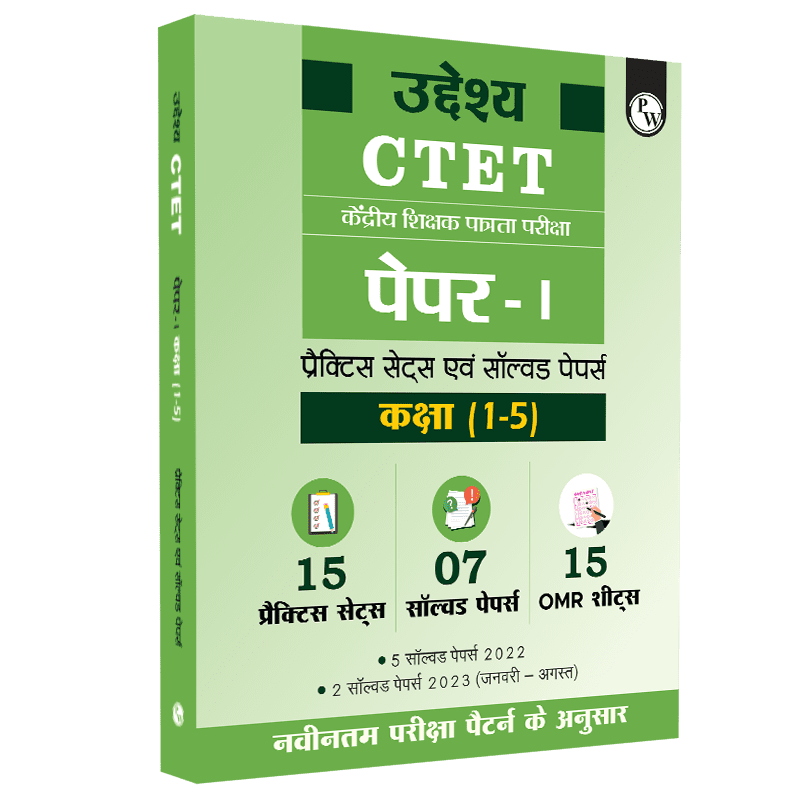
Check Out - CTET Books
CTET Exam Pattern 2026
It is important to understand the exam's format before learning the material. Depending on the level you wish to teach, the CTET (Central Teacher Eligibility Test) consists of two papers.
|
Paper 1 (For Classes I–V) |
|
|---|---|
|
Number of Question |
150 MCQs |
|
Total Marks |
150 |
|
Marking Scheme |
+1 for Correct; 0 for Wrong |
|
Duration |
2.5 Hours |
|
Sections |
5 Sections (30 questions each) |
|
Mode of Exam |
Online CBT |
|
Paper 2 (For Classes VI–VIII) |
|
|---|---|
|
Number of Question |
150 MCQs |
|
Total Marks |
150 |
|
Marking Scheme |
+1 for Correct; 0 for Wrong |
|
Duration |
2.5 Hours |
|
Sections |
4 Sections (one section has choice) |
|
Mode of Exam |
Online CBT |
CTET Syllabus 2026
The CTET syllabus is intended to assess both subject-matter expertise and pedagogical skills. Below is a summary of both:
Paper 1 Syllabus (Primary Level: Class I–V)
This syllabus focuses on fundamental ideas and how to properly instruct this to young children:
-
Child Development & Pedagogy: Child development (0–11 years), learning theories, teaching methods, and inclusive education & understanding learners
-
Language I (Compulsory): Reading comprehension, grammar, vocabulary, and teaching methods for language development
-
Language II (Compulsory): Comprehension, communication skills and language teaching pedagogy
-
Mathematics: Basic arithmetic (numbers, addition, subtraction, etc.), geometry, measurement, and pedagogy of mathematics
-
Environmental Studies (EVS): Everyday topics (family, food, water, travel), basic science, social concepts, and EVS teaching methods
Paper 2 Syllabus (Upper Primary Level: Class VI–VIII)
Along with instructional strategies, this syllabus is more intellectual and subject-focused:
-
Child Development & Pedagogy: Child development (11–14 years), learning, teaching strategies, classroom management, and inclusive education
-
Language I: Reading, grammar, and pedagogy
-
Language II: Language skills, and teaching methods
-
Mathematics & Science (for Math/Science teachers): Algebra, geometry, mensuration. data handling, pedagogy, physics, chemistry, biology basics, scientific concepts, and pedagogy
-
Social Studies/Social Science (for Arts teachers): History, geography, political science, social issues, and teaching pedagogy
Check Out: UGC-NET Books
CTET Exam Preparation Strategy
Success in a competitive exam is 40% knowledge and 60% strategy. Here is how you should plan your schedule.
Prepare Child Development and Pedagogy (CDP) Thoroughly
CDP is the heart of the CTET. If you master this, you automatically improve your scores in other subjects like maths pedagogy or language pedagogy. Focus on key theorists:
-
Piaget, Vygotsky, and Kohlberg: Expect direct and indirect questions from their theories.
-
Inclusive Education: Understand the needs of specially-abled children.
-
Learning and Motivation: Focus on how children think and learn in a classroom environment.
Choose Your Languages Wisely
Candidates often struggle with Language I and Language II. Usually, Language I should be the language you are most proficient in (like English or Hindi), as the unseen passages in Language I are slightly more complex than those in Language II. Proficiency here is a shortcut to how to crack CTET in first attempt.
Solve Previous Year Papers
Nothing beats the effectiveness of solving papers from the last 5 to 10 years. This helps you identify the examiners' "favourite" topics. It also familiarises you with the framing of situational questions, which is common in CTET exam preparation.
Study Material for CTET Exam
The right CTET study material prevents you from feeling overwhelmed by irrelevant information.
-
NCERT Books: For Paper I, stick to the NCERT Class 1-5 books. For Paper II, thoroughly read the NCERT Class 6-8 books for your chosen subject (Science/Maths or Social Science).
-
Standard Pedagogy Books: Use books that explain concepts in simple UK English to ensure you grasp the nuances of teaching methods.
-
Online Mock Tests: Since the exam has moved to an online format in recent years, practising on a computer helps build the stamina and speed needed.
Check Out: 22 CTET Paper 1 Previous Year Question (Class 1 – 5)
Tips on How to Crack CTET Exam in First Attempt
As the exam date approaches, your CTET exam preparation should shift from learning to testing.
-
Analyse Mock Tests: Don't just solve a test and move on. Spend an hour analysing why you got certain questions wrong. Was it a lack of knowledge or a misunderstanding of the question?
-
Focus on Weak Links: If you find Mathematics or Science tough, dedicate the first half of your day to these subjects when your brain is most fresh.
-
Revision Notes: Create one-page charts for theories and formulas. These are lifesavers in the final 48 hours before the exam.
-
Stay Updated with NEP 2020: Recent exams have shown an increase in questions based on the National Education Policy (NEP) 2020 and the National Curriculum Framework (NCF).
Common Mistakes to Avoid to Crack CTET Exam in First Attempt
To crack CTET exam on your first go, avoid these frequent pitfalls:
-
Ignoring the Language Section: Many students focus so much on maths or science that they miss out on the 60 marks available in languages. These are high-scoring sections.
-
Rote Learning: CTET questions are rarely direct. They test your "teaching aptitude". Instead of memorising definitions, ask yourself, "How would I apply this in a classroom?"
-
Over-complicating Concepts: The exam tests basic understanding. Don't waste time on PhD-level topics and stick to the school-level syllabus.
Learning how to crack CTET exam in first attempt is about smart work rather than just hard work. By prioritising child development and pedagogy, sticking to NCERT textbooks, and maintaining a rigorous practice schedule with previous year papers, you can comfortably cross the 90-mark threshold (for the general category) or 82.5 (for reserved categories). Believe in your CTET preparation strategy, stay consistent, and approach the exam hall with a calm mind.
Read More - CTET Previous Year Question Papers with Solutions, Download PDF
Crack CTET Exam in First Attempt FAQs
Q1. What is the minimum qualifying mark for the CTET exam preparation?
For the general category, candidates must score at least 60% (90 out of 150 marks). The typical qualifying score for OBC/SC/ST candidates is 55% (82.5 out of 150).
Q2. Can I clear the exam using only the NCERT CTET study material?
Yes, NCERT books are the foundation for the content sections (Maths, Science, EVS, Social Science). However, for the pedagogy sections, you will need additional teaching-specific resources.
Q3. How many hours a day are needed for CTET exam preparation?
If you start 2–3 months in advance, 4–5 hours of dedicated study daily are sufficient to cover the syllabus and practice enough mock tests to crack CTET exam comfortably.
Q4. Is there any negative marking in the CTET?
No, there is no negative marking in the CTET. So, even if you're unsure, you should answer every question.
Q5. Is the CTET certificate valid for a lifetime?
Yes, the CTET qualifying certificate is now valid for a lifetime. Once you crack CTET in first attempt, you don't need to take the exam again unless you wish to improve your score.