Revise UPSC Indian Geography Faster with PW Mindmaps
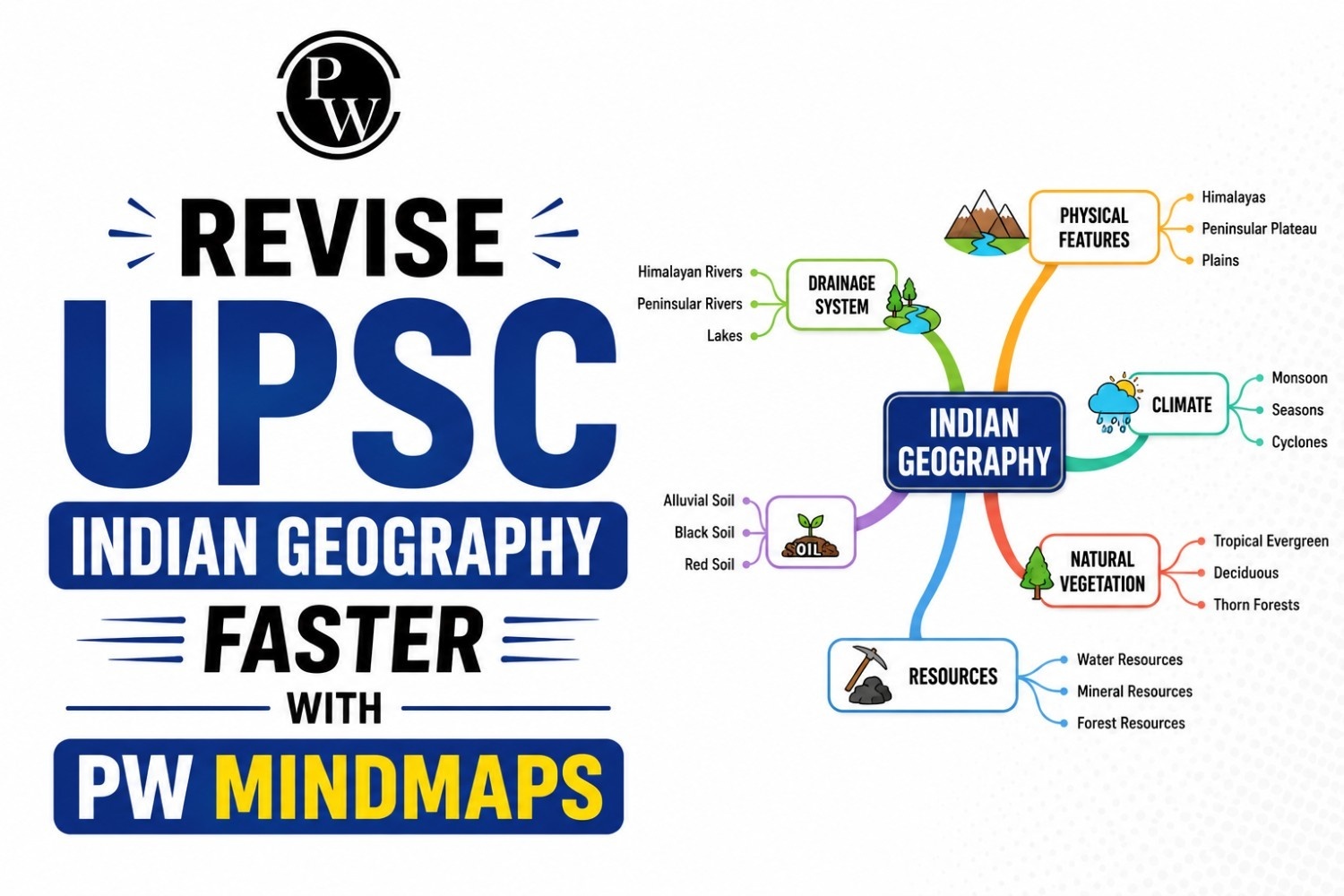
Preparing for the Civil Services Examination means tackling a lot of information. Using UPSC Indian Geography Mindmaps can help you remember important spatial details and physical features across India.
This article shows how good visual tools can make the syllabus easier and help you review key concepts quickly and accurately as you prepare.
Check Out: UPSC Books
Importance of UPSC Indian Geography Mindmaps
The Civil Services syllabus covers a wide range of topics, from geomorphology to economic geography. Traditional textbooks often have long, dense paragraphs that are hard to go through, especially close to the exams. Geography mindmaps help connect detailed study with quick recall.
Visual learning tools help you see the overall picture while still focusing on details like river tributaries, mountain passes, and soil types. Breaking down the geography syllabus into connected parts lets you link climate patterns with things like agricultural output, which often comes up in exam questions.
Features of UPSC Indian Geography Mindmaps
When searching for the right study material, it is important to look for resources that provide more than just summaries. Effective visual guides should offer the following:
-
Spatial Hierarchy: Clearly defined regions such as the Northern Mountains, Peninsular Plateau, and Coastal Plains.
-
Data Integration: Inclusion of Census data, mineral locations, and National Park coordinates directly within the map branches.
-
Clarity and Readability: Use of distinct colours and fonts to separate physical geography from human and economic geography.
-
Syllabus Alignment: Content that maps directly to the latest exam patterns and previous year question trends.
Check Out: UPSC Revision Books
Topics Covered in UPSC Indian Geography Mindmaps
A well-structured set of maps will cover the primary pillars of the Indian landscape. Understanding these pillars is crucial for scoring well in both the GS Paper I of Prelims and the Geography section of Mains.
Physical Features and Geology
This section focuses on the tectonic evolution of the Indian plate and the formation of the Himalayas. Mindmaps help in categorising the different rock systems—like the Archaean, Puranic, and Dravidian systems—without getting lost in geological jargon.
Drainage Systems of India
Rivers are a recurring theme in the UPSC exam. A good visual guide will map out the Himalayan rivers (Indus, Ganga, Brahmaputra) and the Peninsular rivers (Mahanadi, Godavari, Krishna, Kaveri). Key details like left-bank and right-bank tributaries are often highlighted for quick memorisation.
Climate and Vegetation
The Indian Monsoon is perhaps the most complex topic in the syllabus. Visualising the "Onset" and "Withdrawal" phases, along with the impact of El Niño and La Niña, simplifies the atmospheric dynamics. Similarly, categorising forests from Tropical Evergreen to Alpine becomes a matter of looking at a colour-coded chart.
Resources and Industries
Mapping the location of iron ore, coal, and petroleum reserves is vital. Instead of listing names of mines, a mindmap places them geographically, helping you understand why certain industries are concentrated in the Chota Nagpur Plateau or the Mumbai-Pune cluster.
How to Use the UPSC Indian Geography Mindmaps
While a standard indian geography book for IAS provides the necessary depth, it can be overwhelming. The most successful candidates use a hybrid approach. First, read a comprehensive chapter from a geography book to build a conceptual foundation. Once the chapter is understood, switch to a mindmap for daily or weekly revisions.
This method reinforces the memory of specific locations, such as the arrangement of Himalayan peaks from West to East or the sequence of West-flowing rivers. Instead of re-reading hundreds of pages, an aspirant can glance at a single visual sheet to refresh their entire understanding of a particular drainage system or climatic zone.
Standard Textbooks Vs UPSC Indian Geography Mindmaps
|
Feature |
Traditional Indian Geography Book for UPSC |
UPSC Indian Geography Mindmaps |
|
Detail Level |
High (Explanatory) |
Medium (Fact-based) |
|
Revision Speed |
Slow |
Very Fast |
|
Visual Aids |
Limited Diagrams |
Entirely Visual |
|
Portability |
Heavy Volumes |
Easy-to-carry Sheets/PDFs |
|
Application |
Concept Building |
Last-minute Recall |
Benefits of UPSC Indian Geography Mindmaps
Below are some of the benefits of using the geography mindmaps:
-
Reduced Cognitive Load: Mindmaps present information in bite-sized chunks, making it easier for the brain to process and store data.
-
Improved Retention: Visual associations create stronger neural pathways than plain text alone.
-
Faster Recalculation: During the exam, your brain is more likely to "see" a map layout when trying to recall the location of a specific biosphere reserve.
-
Integrated Learning: You can easily see how the monsoon affects different regions by looking at a single interconnected diagram.
Check Out - UPSC Previous Year Papers
Tips for UPSC Indian Geography Mindmaps
To get the most out of your geography of India for UPSC resources, follow these steps during the final months of your preparation:
Step 1: Identify Weak Areas
Go through previous year papers. If you find yourself struggling with the location of mountain passes or the characteristics of black soil, find the corresponding mindmap.
Step 2: Active Recalling
Cover the branches of the mindmap and try to state the facts out loud. For example, look at the "Ganga River" node and try to name all the tributaries before uncovering them.
Step 3: Custom Annotation
Add your own small notes or current affairs updates to the margins of your mindmaps. If a specific wetland was recently added to the Ramsar list, mark it on your physical map sheet.
Step 4: Practice Mapping
Use the mindmaps as a reference to draw rough maps of India. This is a skill that is highly rewarded in the UPSC Mains exam, where a quick sketch can add 1-2 extra marks per question.
Check Out: UPSC PYQ Book
Mistakes to Avoid in UPSC Indian Geography Mindmaps
Many students feel that geography is too "factual." While facts are important, understanding the underlying spatial logic makes the facts easier to remember. For instance, knowing the path of the Western Ghats explains the rainfall patterns in the Deccan interior.
Using geography mind maps helps reveal these connections that are often buried in long chapters of an UPSC Indian geography book.
Another challenge is the sheer volume of map-based questions in the Preliminary exam. Candidates are often asked to arrange cities by longitude or identify states through which the Tropic of Cancer passes.
Having a mental image of the Indian map, reinforced by regular use of visual tools, ensures these "low-hanging fruit" questions are answered correctly without hesitation.
Check Out: UPSC Test Series
How to Select the Right UPSC Indian Geography Mindmaps
With so many options available, choosing the best indian geography book for IAS can be confusing. Focus on materials that are updated with the latest economic surveys and forest reports. Ensure the maps are not cluttered and that the font is legible. High-quality paper or high-resolution digital files are preferred, as you will be spending many hours looking at these details.
Remember that while mindmaps are powerful, they are meant to complement, not replace, your core reading. Use them to distil the wisdom found in your primary textbooks into an actionable format that fits the fast-paced nature of the Civil Services Examination.
Read More: UPSC Geography Previous Year Papers with Downloaded PDF
Revise UPSC Indian Geography FAQs
Are mindmaps enough to cover the geography of India for UPSC?
Mindmaps are excellent for revision and memorising facts, but you should first read a core textbook to understand the fundamental concepts. They work best as a secondary resource for quick recall.
Which is the right geography book for IAS for beginners?
Most experts recommend starting with the NCERT books from Class 6 to 12. Once those are finished, you can move to more advanced reference books and use mindmaps to keep the information fresh.
How do I remember the tributaries of major rivers using Geography mindmaps?
Visualise the river as a main branch and its tributaries as smaller offshoots. Use different colours for left-bank and right-bank tributaries to create a strong visual memory of the river system.
Can I use mindmaps for the UPSC Mains exam?
Yes, the structure of a mindmap can help you organise your thoughts before writing a long-form answer. Practising with them also makes it easier to draw relevant maps and diagrams in your answer sheet.
Is it better to buy physical mindmaps or use digital versions?
Physical mindmaps are often better for long study sessions as they reduce eye strain and allow for easy handwritten annotations. However, digital versions are convenient for studying while on the go.