UPSC Economics Syllabus for 2026 Exam
UPSC Economics Syllabus
UPSC Economics syllabus is an important part of both the UPSC Prelims and Mains exams. It covers important topics like microeconomics, macroeconomics, Indian economic development, fiscal and monetary policy, national income, growth and planning, and sustainable development, among others.
The Union Public Service Commission (UPSC) is India’s renowned body that selects officers for services like IAS, IPS, IFS, and other central government jobs. The UPSC Civil Services Exam is one of the most difficult exams in the country. It has three stages: prelims, mains, and the interview or personality test.
Therefore, understanding the UPSC Economics syllabus for prelims and mains helps applicants focus on topics that are most important for the exam. So, keep reading to know the complete economics syllabus for UPSC along with key topics and preparation tips.
Check Out: UPSC Books
Economics Syllabus for UPSC Overview
Economics syllabus for UPSC is divided into two main parts: General Studies and Optional Subject. It checks applicants' understanding of how the economy works, how the government plans growth, and how different sectors develop.
For General Studies, the UPSC economics syllabus for prelims and mains includes topics such as economic planning, resource mobilisation, employment, growth, government budgeting, food security, etc. For Optional Subject in Mains (Paper 1 and Paper 2):
-
Paper 1 focuses on basic concepts like microeconomics, macroeconomics, and theories of growth and development.
-
Paper 2 covers the Indian economy before and after liberalisation. It includes topics such as industrial policy, land reforms, and food processing industries.
To check the detailed UPSC economics syllabus for prelims and mains, continue reading.
UPSC Economics Prelims Syllabus
UPSC economics prelims syllabus is part of the General Studies Paper 1 in the first stage of the examination. This paper checks applicants' basic understanding of the Indian economy, government policies, and important economic terms. By learning these topics in prelims, it becomes easy to understand the UPSC Mains economics syllabus later.
The economics syllabus for UPSC Prelims includes both basic and applied topics. It teaches how the Indian economy works, how money moves, and how government planning supports growth. Check the complete topic-wise UPSC Economics Prelims Syllabus given below:
|
Topic-Wise UPSC Economics Prelims Syllabus |
|
|
Topics |
Subtopics |
|
1. Introduction to Economics |
Definition and scope of economics Basic concepts Role of the State in an Economy Sectors of an Economy Types of Economies Idea of National Income- GDP, NDP, GNP, NNP, Cost and Price of National Income Comparing GVA & GDP Characteristics of the Indian Economy |
|
2. Macroeconomics |
Gross Domestic Product (GDP) Unemployment Inflation Fiscal Policy Monetary Policy Economic Growth Exchange Rates |
|
3. Microeconomics |
Supply and Demand Market Structures (Perfect Competition, Monopoly, Oligopoly, Monopolistic Competition) Elasticity Consumer Behaviour Producer Behavior Market Failures |
|
4. Growth, Development and Happiness |
Economic growth vs. development Measurement of development Insights into Human Behaviour, Social Norms, Culture and Development, Values and Economics |
|
5. Evolution of the Indian Economy |
Pre-independence economy Post-independence economy Prime Moving Force: Agriculture vs. Industry Planned and Mixed Economy Economic reforms since independence |
|
6. Economic Planning |
Concept of economic planning Different Types of Economic Planning Objectives and Strategies Five-Year Plans, Twenty-Point Programme, MPLADS |
|
7. Planning in India |
Pioneer Plans: The Visvesvaraya Plan, The Congress Plan, The Bombay Plan, The Gandhian Plan, The People's Plan, The Sarvodaya Plan. Planning Commission and Its Functions NDC Grassroot Planning NITI Aayog and Its Functions Inclusive Growth Resource Mobilisation Investment Models |
|
8. Economic Reforms |
Washington Consensus Mixed Economy Obligatory Reform Measures The LPG-Liberalisation Privatisation Globalisation Reforms in India Generations of Economic Reforms Disinvestment New economic policies |
|
9. Inflation and Business Cycle |
Causes and types of inflation Measurement Effects Business cycle theory Inflationary Gap, Deflationary Gap, Inflation Tax, Inflation Spiral, Inflation Accounting, Inflation Premium, Phillips Curve, Reflation, Stagflation. Skewflation, GDP Deflator, Base Effect, Effects of Inflation. WPI and CPI Producer Price Index, Housing Price Index, and Service Price Index. |
|
10. Agriculture and Food Management |
Cropping System and Types of Crops in India Agricultural Policies Green Revolution Minimum Support Price Market Intervention Scheme Procurement Prices Issue Price Economic Cost of Foodgrains Open Market Sale Scheme Price Stabilisation Fund Agriculture Marketing, Model APMC Act, Model Contract Farming Act Irrigation, Farm Mechanisation, Seed Development, Fertilisers, Pesticides, Agri-Credit WTO and the Indian Agriculture: Prospects and Challenges, WTO and Agricultural Subsidies AMS National Food Security Act, Climate Smart Agriculture |
|
11. Industry and Infrastructure |
Industrial development Industrial Policies Up to 1986, New Industrial Policy, 1991 Disinvestment Types of Disinvestment Current Disinvestment Policy Proceeds of Disinvestment: Debate Concerning the Use. MSME Sector, Ease of Doing Business, Make in India, Start-up India, Indian Infrastructure, UDAY Scheme, Railways, Roads, Civil Aviation, Smart Cities, Private Sector and Urbanisation PPP Models Concerns of Petroleum Sector, Renewable Energy, Logistics Sector, Housing Policy, PMAY-U National Infrastructure Pipeline |
|
12. Services Sector |
Growth and contribution IT and ITES Sector Tourism industry Offshore Fund Management, Global Negotiations, WTO Negotiations, Bilateral Agreements |
|
13. Indian Financial Market |
Indian Money Market, Financial intermediaries Mutual Funds DFHI, Indian Capital Market Project Financing 1. Financial Institutions 2. Banking Industry 3. Insurance Industry 4. Security Market Financial Regulation in India, Establishment of FSDC |
|
14. Banking in India |
Types of banks RBI and its functions RBI's Reserves & Surplus Capital, Cash Reserve Ratio Statutory Liquidity Ratio Bank Rate Repo Rate Long Term Repo Reverse Repo Rate Marginal Standing Facility (MSF) Other Tools Base Rate MCLR Nationalisation and Development of Banking in India, Regional Rural Banks (RRBs), Co-operative Banks, Financial Sector Reforms, Banking Sector Reforms Resolution of NPAs and Stressed ASSETS SARFAESI Act, 2002, Capital Adequacy Ratio, Basel III Compliance of the PSBs & RRBs Non-Resident Indian Deposits, Nidhi, Chit Fund, Small & Payment Banks, Financial Inclusion Gold Investment Schemes Mudra Bank |
|
15. Insurance in India |
Types of insurance IRDA and regulation Insurance penetration in India LIC and GIC Public Sector Insurance Companies Reinsurance, Deposit Insurance and Credit Guarantee Corporation (DICGC), Export Credit Guarantee Corporation (ECGC), National Export Insurance Account (NEIA) New Insurance Schemes |
|
16. Security Market in India |
Stock exchanges and Important Terms of the Stock Market Primary and Secondary Markets IPOs Mutual funds SEBI and regulation, Commodity Trading, Spot Exchanges in India Foreign Financial Investment, Angel Investor, QFIs Scheme, Participatory Notes (PNs) Credit Default Swap (CDS), Securitisation, Corporate Bond in India, Inflation-Indexed Bonds, Gold Exchange Traded Funds |
|
17. External Sector in India |
Foreign trade policy Definitions of Forex Reserves, External Debt, Fixed Currency Regime, Floating Currency Regime, Managed Exchange Rates, Foreign Exchange Market, Exchange Rate in India, Trade Balance, Trade Policy, Depreciation, Devaluation, Revaluation, Appreciation, Current Account, Capital Account, Balance of Payment (BoP) Convertibility in India LERMS, NEER, REER Hard Currency, Soft Currency, Hot Currency, Heated Currency Cheap currency, Dear Currency Special Economic Zone ECB Liberalised New Foreign Trade Policy, |
|
18. International Economic Organisations & India |
IMF World Bank WTO BRICS India's role and memberships Asian Development Bank Nairobi Negotiations & India Buenos Aires Conference and India Trade Facilitation By India BRICS Bank Asian Infrastructure Investment Bank |
|
20. Tax structure in India |
Incidence of Tax and Impact of Tax Direct and indirect taxes Progressive Taxation, Regressive Taxation, Proportional Taxation VAT and GST Commodities Transaction Tax, Securities Transaction Tax Capital Gains Tax, Minimum Alternate Tax Corporate Tax, Reform, Dividend Distribution Tax, Tax Expenditure Collection Rate Income and Consumption Analysis Tax reforms Tax administration in India |
|
21. Public Finance in India |
Developmental and Non-developmental Expenditure Plan and Non-Plan Expenditure Tax and Non-tax Revenue Receipts Revenue Budget, Revenue and Non-revenue Receipts, Revenue Expenditure Revenue Deficit, Effective Revenue Deficit, Capital Budget, Capital Receipts, Capital Expenditure, Capital Deficit Fiscal Deficit, Primary Deficit, Primary Surplus, Monetised Deficit, Deficit and Surplus Budget Government budgeting, Types of Budgets, Golden Rule, Balanced Budget, Gender Budgeting Public Debt, Independent Debt Management, Central Government Debt FRBM Act, 2003. Means of Deficit Financing Fiscal Policy and Deficit Financing in India |
|
22. Sustainability and Climate Change: India and the World |
Environmental policies Green Finance, Climate Finance, Green Climate Fund, Global Environment Facility, INDCs, Climate change mitigation and adaptation Renewable Energy Sustainable development |
|
23. Human Development in India |
Health and education indicators Demographics, Socio-Economic and Caste Census, Education for All, Skill Development, Employment Scenario in India Burden of Diseases, Health for All, Drinking Water & Sanitation Social welfare schemes Poverty alleviation programs Other Development Indicators |
|
25. Economic Survey 2024 |
Overview of key economic indicators, Government policies and initiatives |
|
26. Union Budget 2026-2026 |
Budgetary allocations, Tax proposals, Economic outlook |
Read More: How to Prepare for UPSC: Subject-Wise Preparation Strategy
UPSC Mains Economics Syllabus
UPSC Mains Economics Syllabus is part of the optional subjects offered in the Civil Services Mains exam. Economics is one of the 48 optional subjects that applicants can choose. Only those who pass prelims can appear for mains, and only those who clear the mains are eligible for the interview stage. This makes knowing the syllabus very important for in-depth preparation.
UPSC Mains Economics Optional Syllabus covers two papers: Paper I and Paper II, each carrying 250 marks, making a total of 500 marks. The UPSC economy syllabus for mains tells applicants about the main topics from which questions are generally asked, helping them prepare in a focused way. Let's now go through the detailed UPSC Mains economics syllabus for optional paper 1 and paper 2.
|
UPSC Mains Economics Syllabus |
|
|
UPSC Economics Optional Syllabus For Paper I |
|
|
Topics |
Subtopics |
|
Advanced Microeconomics |
Marshallian and Walrasian approaches to price determination; alternative distribution theories including Ricardo, Kaldor and Kalecki; market structures such as monopolistic, duopoly and oligopoly; modern welfare criteria including Pareto, Hicks and Scitovsky, Arrow’s Impossibility Theorem, and A.K. Sen’s Social Welfare Function |
|
Advanced Macroeconomics |
Approaches to employment and income rate determination, including Classical, Keynes (IS-LM curve), Neo-classical and New-Classical synthesis; theories of interest, rate determination and interest rate structures |
|
Money, Banking & Finance |
Demand for and supply of money including money multiplier, quantity theory of money (Fisher, Pigou and Friedman), Keynes’s theory on demand for money; goals and instruments of monetary management in closed and open economies; relation between the central bank and treasury; proposal for ceiling on growth rate of money; public finance and its role in a market economy such as stabilisation of supply, allocation of resources, distribution and development; sources of government revenue, forms of taxes and subsidies, their incidence and effects; limits to taxation, loans, crowding-out, effects and limitations of borrowing; public expenditure and its effects |
|
International Economics |
Old and new theories of international trade including comparative advantage, terms of trade and offer curve, product cycle and strategic trade theories; trade as an engine of growth and theories of underdevelopment in an open economy; forms of protection including tariff and quota; balance of payments adjustments including alternative approaches, price versus income adjustments under fixed exchange rates; theories of policy mix, exchange rate adjustments under capital mobility, floating rates and their implications for developing countries, currency boards; trade policy and developing countries, balance of payments adjustments and policy coordination in open economy macro-models, speculative attacks; trade blocks and monetary unions; WTO including TRIMS, TRIPS, domestic measures, and different rounds of WTO talks |
|
Growth & Development |
Theories of growth including Harrod’s model, Lewis model of development with surplus labour, balanced and unbalanced growth; human capital and economic growth, research and development; process of economic development of less developed countries including Myrdal and Kuznets on economic development and structural change, role of agriculture; economic development and international trade and investment, role of multinationals; planning and economic development including changing role of markets and planning, public-private partnership; welfare indicators and measures of growth such as human development indices and basic needs approach; development and environmental sustainability including renewable and non-renewable resources, environmental degradation and intergenerational equity development |
|
UPSC Economics Optional Syllabus For Paper 2 |
|
|
Topics |
Subtopics |
|
Indian Economy in the Pre-Independence Era |
Land systems and their changes, commercialisation of agriculture, drain theory, laissez-faire theory and critique, manufacture and transport, including jute, cotton, railways, money and credit |
|
Indian Economy after Independence – The Pre-Liberalisation Era |
Contribution of Vakil, Gadgil and V.K.R.V. Rao; agriculture including land reforms and land tenure system, green revolution and capital formation in agriculture; industry trends in composition and growth, role of public and private sector, small-scale and cottage industries; national and per capita income including patterns, trends, aggregate and sectoral composition and changes therein; broad factors determining national income and distribution, measures of poverty, trends in poverty and inequality |
|
Indian Economy after Independence – The Post-Liberalisation Era |
New economic reform and agriculture including agriculture and WTO, food processing, subsidies, agricultural prices and public distribution system, impact of public expenditure on agricultural growth; new economic policy and industry including strategy of industrialization, privatization, disinvestments, role of foreign direct investment and multinationals; new economic policy and trade including intellectual property rights, implications of TRIPS, TRIMS, GATS and new EXIM policy; new exchange rate regime including partial and full convertibility, capital account convertibility; new economic policy and public finance including fiscal responsibility act, twelfth finance commission, fiscal federalism and fiscal consolidation; new economic policy and monetary system including role of RBI under the new regime; planning including transition from central planning to indicative planning, relation between planning and markets for growth, decentralized planning, 73rd and 74th constitutional amendments; new economic policy and employment including employment and poverty, rural wages, employment generation, poverty alleviation schemes, new rural employment guarantee scheme |
Check Out: UPSC Question Banks
How to Prepare UPSC Economics Syllabus to Score Well
Preparing for the UPSC economics syllabus for the 2026 examination needs a proper plan, as both the Prelims and Mains exams have their own separate syllabi. The UPSC economics syllabus for prelims and mains covers a lot of topics, from basic economic concepts to detailed policy analysis. Let's understand how applicants prepare it effectively to score well:
Deeply Understand the UPSC Economics Syllabus & Exam Pattern
Before starting preparation, applicants must clearly understand the UPSC Economics syllabus for both Prelims and Mains.
-
In Prelims, economics questions come under General Studies Paper I and focus on basic economic concepts.
-
For Mains, economics appears as an optional subject with two papers and needs deeper analytical knowledge of both theory and policy. Knowing the exam pattern and weightage of topics helps applicants plan their preparation efficiently.
Build a Strong Conceptual Foundation
To build a strong base for Prelims, start with the NCERT books of Class XI and XII to get clarity in basic concepts such as GDP, inflation, fiscal policy, and microeconomic principles.
-
For Mains, along with NCERTs, also include some additional UPSC Study Materials to cover advanced topics like growth and development theories, international trade, public finance, economic planning, etc.
Prepare For Both Prelims and Mains Together
It is important and smart to prepare both Prelims and Mains economics together because they overlap in many topics.
-
While reading concepts for Mains, make notes that also help in revising for Prelims. For example, while studying macroeconomics for Mains, note important definitions, diagrams, and examples that can be used for Prelims.
-
Including newspaper reading while studying theory helps in linking current affairs with both exams.
Focus on Concept Clarity for Economics Prelims Syllabus
For prelims, focus should be on clarity of concepts and regular revision. Solve as many UPSC PYQ book as possible to understand the pattern of questions.
-
Consistent practice with mock tests will improve speed and accuracy. Regular revision sessions are also important to recall topics quickly before the exam.
Study Deep for UPSC Mains Economics Syllabus
For Mains, preparation must go deeper. Practise answer writing with a structure such as an introduction, an explanation with examples and data, and a conclusion.
-
Focus on connecting theory with real-world applications. Read the latest Economic Survey and Union Budget to understand economic trends and policies.
-
Make topic-wise notes and diagrams for quick revision, because the Mains needs analytical writing supported by examples.
Stay Updated
To stay updated with recent economic details, read a good newspaper daily and check the government reports; this is very important for both UPSC Prelims and Mains.
Also check: UPSC Current Affairs
Practice and Revision
Regular practice and revision can help a lot in scoring good marks. Solve past year questions from economics for both stages and take mock tests to test your exam prep level.
-
For Mains, practise writing full answers under exam conditions. Make a dedicated time slot for revising important topics daily rather than cramming at the last minute.
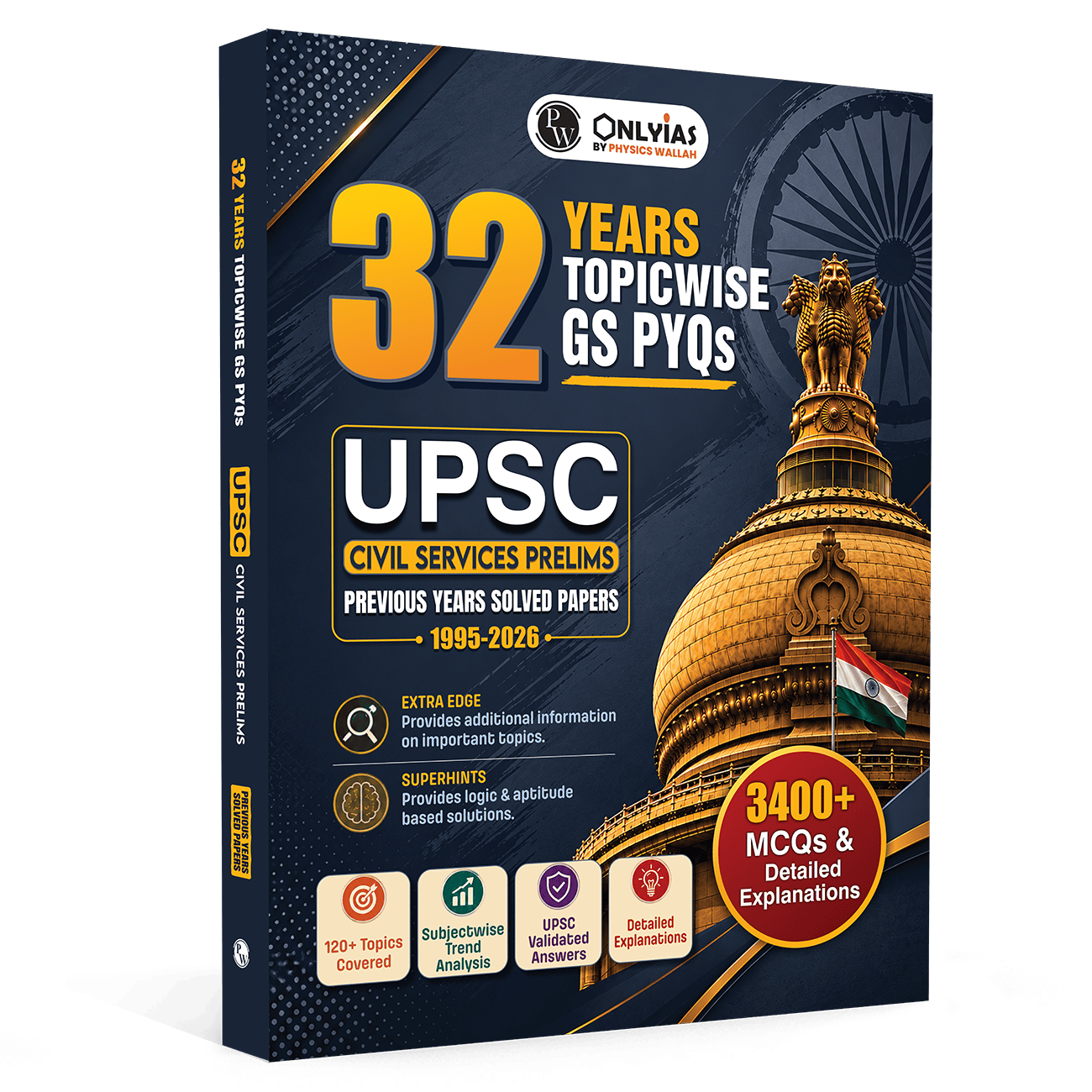
PW UPSC Economics Preparation Books
PW UPSC preparation books are curated to help applicants cover the complete UPSC economics syllabus for the upcoming 2026 exams. These books give clear subject-wise coverage for both Prelims and Mains, making it easy to understand and remember important topics.
With maps, diagrams, flowcharts, and timelines given in these UPSC study materials by PW, understanding tough topics becomes easy. These books are very useful for aspirants who want to prepare in a clear and organised way. Find the direct links to check the books and their PDF here:
|
PW UPSC Economics Preparation Books |
|
|
PWONLYIAS UPSC Wallah Economics and Social Development Combo Set of 3 |
|
UPSC Economics Syllabus FAQs
Q.1. What is the UPSC economics prelims syllabus?
Ans. The UPSC economics prelims syllabus includes basic economic concepts, macroeconomics, microeconomics, the Indian economy, economic planning, economic reforms, agriculture, industry, banking, etc.
Q.2. Is the UPSC economics syllabus for prelims and mains tough?
Ans. The UPSC economics syllabus for prelims and mains can be challenging, as it covers both theory and application. Prelims focuses on concepts and facts, while Mains needs a deeper understanding and analytical ability.
Q.3. Is NCERT enough to cover the UPSC economy syllabus?
Ans. NCERT books give a good base for the UPSC economics syllabus, but may not be sufficient for the mains. For effective preparation, aspirants should also include other reference books and PYQs.
Q.4. Can I cover the economics syllabus for UPSC in 3 months?
Ans. Covering the UPSC economics syllabus in 3 months is possible with a dedicated plan. It needs focused study, regular revision, solving previous year papers, and combining both prelims and mains preparation.
Q.5. What is the UPSC Mains economics syllabus?
Ans. The UPSC Mains economics syllabus is an optional subject with two papers. It includes advanced microeconomics, macroeconomics, growth and development, public finance, international economics, etc.