UPSC Prelims Syllabus for 2026 Exam
UPSC Prelims Syllabus tells you what topics to study and how to plan your preparation for the upcoming national-level Civil Services Examination (CSE). The UPSC Prelims Syllabus 2026 covers key topics from both General Studies (GS) and the Civil Services Aptitude Test (CSAT). The UPSC Preliminary Examination is the first stage of the UPSC Civil Services Examination (CSE). It is an objective-type test with two papers: General Studies Paper I and CSAT Paper II. The UPSC Prelims syllabus, subject-wise, includes Indian History, Geography, Polity, Economy, Environment, and Science. Along with understanding the syllabus, candidates can strengthen their preparation with UPSC Modules, which provide structured study material, topic-wise practice, and revision support for comprehensive Prelims preparation.
UPSC Prelims Syllabus 2026
UPSC Prelims Syllabus 2026 is divided into two parts: General Studies and Civil Services Aptitude Test (CSAT). Each paper carries 200 marks, making a total of 400 marks. Both papers are objective in nature, and one-third of a mark is deducted for every wrong answer.
The UPSC preliminary syllabus for Paper 1 checks your general awareness and knowledge about India and the world. It includes topics like current events, Indian history, geography, polity, economy, environment, and general science, among others. This paper mainly tests how well you are aware of daily news and social issues around you.
Moreover, the CSAT paper is qualifying in nature, where you must score at least 33% to pass. Questions from the IAS prelims syllabus are based on comprehension, reasoning, data interpretation, decision-making, and basic mathematics of the Class 10 level. The UPSC CSE prelims syllabus 2026 aims to test not only your knowledge but also your thinking and problem-solving skills needed for civil service roles. Let's now go through the UPSC prelims syllabus 2026 overview.
|
UPSC Prelims Syllabus 2026 |
|||
|
Paper |
Marks |
Duration |
Key Topics |
Paper I: General Studies (GS) |
200 |
2 hours |
• Current events (national and international) • History of India & Indian National Movement • Indian and World Geography (physical, social, economic) • Indian Polity & Governance (Constitution, institutions, rights, etc.) • Economic & Social Development (poverty, inclusion, sustainable development) • Environmental Ecology, Biodiversity, Climate Change (non-technical) • General Science |
Paper II: CSAT (Civil Services Aptitude Test) |
200 |
2 hours |
• Comprehension • Logical reasoning & analytical ability • Decision making & problem solving • Basic numeracy (at about Class X level) • Data Interpretation (charts, graphs, tables) • Interpersonal skills/comprehension skills |
UPSC Previous Year Papers to understand the exam pattern, analyse question trends, and identify important topics. Solving UPSC previous year papers regularly helps improve answer-solving skills, strengthen revision, build confidence, and prepare effectively for both the UPSC Prelims and Mains examinations.
UPSC Prelims Syllabus PDF
While the official UPSC Prelims Syllabus 2026 PDF will be available once the UPSC releases its notification in January 2026, you can start your exam preparations by referring to the UPSC Prelims Syllabus 2025, as the upcoming syllabus is expected to follow the same pattern and subjects for both General Studies and CSAT papers. You can also find the direct link to download the UPSC Prelims Syllabus PDF here:
UPSC Prelims Syllabus Subject-Wise 2026
UPSC prelims syllabus subject-wise weightage gives you a clear idea of how questions are divided among different subjects in the exam. Understanding this helps you focus more on the topics that carry higher marks.
Usually, questions from Current Affairs cover about 25–30% of the paper, making it the most important section. History carries around 15 to 20%, while Polity carries about 15% weightage. Geography and economy each carry 10–12%, and environment and ecology nearly 15%. The remaining 5 to 7% of the paper includes questions from science and technology.
That's why, to prepare smartly, it’s important to go through the complete UPSC Prelims Syllabus subject-wise for 2026 to make your exam preparation more focused.
UPSC Prelims Syllabus for Current Affairs
UPSC prelims syllabus for current affairs is one of the most important and changing parts of the exam. Questions from this syllabus are generally connected to government schemes, policies, and major international events, so staying updated from reliable news sources is very important.
Key topics to cover under UPSC Prelims Syllabus for Current Affairs:
-
Important government schemes, welfare programmes, and new policies.
-
Reports and indices are released by international organisations like the UN, World Bank, IMF, and WTO.
-
Major international organisations such as the WHO, BRICS, G20, and ASEAN.
-
Global events, including climate summits, peace agreements, and political or economic developments.
-
Awards and honours like the Nobel Prize, Bharat Ratna, and sports recognitions.
-
Recent updates in science and technology, including space missions, AI progress, and biotechnology developments.
Read More: How to Study Current Affairs for UPSC Exam
UPSC Prelims Syllabus History for IAS Exam
UPSC prelims syllabus History for IAS exam helps you understand India’s rich past and its connection with the freedom movement. UPSC prelims syllabus for history is divided into ancient, medieval, and modern history, which covers key events, dynasties, and cultural developments, as explained below:
Ancient History:
-
Prehistoric cultures and early human settlements.
-
Indus Valley Civilisation, its cities, society, and decline.
-
Vedic period – literature, religion, and social structure.
-
Major dynasties like the Mauryas, Guptas, and rulers of the Sangam Age.
-
Art, architecture, science, and philosophical developments of the ancient period.
Medieval History:
-
Delhi Sultanate and the Mughal Empire.
-
Vijayanagara Empire and Maratha power.
-
Bhakti and Sufi movements and their influence on Indian society.
-
Cultural, social, and administrative changes during the medieval period.
Modern History:
-
Arrival of Europeans and establishment of British power.
-
British economic policies and their impact on Indian society.
-
Revolt of 1857 and early freedom struggles.
-
Socio-religious reform movements by leaders like Raja Ram Mohan Roy and Swami Vivekananda.
-
Indian National Movement: Moderates, Extremists, Gandhian era, Non-Cooperation, Civil Disobedience, and Quit India Movement.
-
Role of key freedom fighters such as Mahatma Gandhi, Jawaharlal Nehru, Sardar Patel, Subhash Chandra Bose, and Bhagat Singh.
UPSC Revision Books to revise important concepts quickly, strengthen retention, and streamline your preparation. These books provide concise notes, topic-wise summaries, and exam-focused content to help you revise efficiently and perform better in both the UPSC Prelims and Mains examinations.
UPSC CSE Prelims Syllabus for Geography
UPSC CSE prelims syllabus for geography helps in understanding the natural features of the planet and how people interact with their surroundings. Questions from the UPSC CSE prelims syllabus for geography are generally based on maps, environmental issues, and the relationship between geography and daily life.
Physical Geography:
-
Structure of the Earth: atmosphere, hydrosphere, and lithosphere.
-
Landforms and geomorphological processes: volcanoes, earthquakes, and mountain formation.
-
Climate and weather patterns: monsoons, cyclones, jet streams, and El Niño/La Niña effects.
Indian Geography:
-
Major physiographic divisions: Himalayas, Indo-Gangetic Plains, Peninsular Plateau, Coastal Plains, and Islands.
-
River systems: Indus, Ganga, Brahmaputra, and the main Peninsular rivers.
-
Agriculture: types of crops, irrigation systems, the Green Revolution, and food security.
-
Mineral resources, major industries, transport, and communication networks.
-
Population: distribution, density, migration, and urban growth patterns.
World Geography:
-
Continents, oceans, and the distribution of natural resources.
-
Major landforms: deserts, forests, tundra, and grasslands.
-
Climatic zones of the world and their features.
-
Human geography: population growth, settlements, and economic activities across regions.
UPSC IAS Prelims Syllabus for Polity
Polity plays an important role in the UPSC Prelims exam. It checks your understanding of the Indian Constitution, political system, governance, and related issues. The key topics covered in the UPSC IAS Prelims Syllabus for Polity are:
-
Constitution of India: Preamble, Fundamental Rights, Directive Principles of State Policy, and Fundamental Duties.
-
Union and State Government: Structure and powers of the President, Prime Minister, Council of Ministers, Governors, and Chief Ministers.
-
Parliament and State Legislatures: Composition, powers, functions, and privileges of both houses.
-
Judiciary: Structure and roles of the Supreme Court and High Courts, judicial review, and judicial activism.
-
Local Governance: Panchayati Raj institutions and Urban Local Bodies (Municipalities).
-
Constitutional and Non-Constitutional Bodies: Election Commission, UPSC, CAG, Finance Commission, NITI Aayog, NHRC, SHRC, and others.
-
Governance and Rights: Current issues in governance, transparency, accountability, RTI, and RTE.
-
Policies and Welfare Programs: Understanding public policy implementation and major government welfare schemes.
UPSC Question Banks to practise a wide range of exam-oriented questions, strengthen conceptual understanding, and assess your preparation. These question banks help improve accuracy, build confidence, and reinforce important topics through systematic practice for both the UPSC Prelims and Mains examinations.
UPSC Prelims Syllabus for Economy
From the UPSC prelims syllabus for economy, questions that are asked test both your understanding of basic economic terms and your awareness of current policies and schemes. The main topics you need to cover here are:
-
Basic Concepts: GDP, GNP, Inflation, Deflation, Fiscal Policy, and Monetary Policy.
-
Economic Reforms in India: Liberalisation, Privatisation, and Globalisation (LPG reforms) and their impact on growth.
-
Budget and Fiscal System: Union Budget, taxation structure, subsidies, and disinvestment policy.
-
Agriculture and Rural Economy: Agricultural productivity, Minimum Support Price (MSP), credit system, and recent reforms.
-
Industries and Infrastructure: Key sectors contributing to India’s industrial growth and major infrastructure projects.
-
Banking and Finance: Role of RBI, money supply, financial inclusion, and recent banking initiatives.
-
External Sector: International trade, balance of payments, and foreign exchange reserves.
-
Government Reports and Surveys: Economic Survey, budget highlights, and important government programmes.
-
Social and Sustainable Development: Poverty reduction, employment schemes, education and health policies, and inclusive growth.
Understanding current affairs in addition to static concepts is very important for scoring well in the Economy section of UPSC Prelims 2026.
UPSC Prelims Syllabus for Environment and Ecology
UPSC prelims syllabus for environment and ecology checks your awareness of environmental issues, biodiversity, and sustainable development. The key topics from the syllabus are:
-
Ecology and Ecosystems: Structure and functions of ecosystems, energy flow, food chains, food webs, and ecological pyramids.
-
Biodiversity and Conservation: Biodiversity hotspots, endangered and endemic species, conservation efforts, and the role of organisations like WWF and IUCN.
-
Protected Areas: National parks, wildlife sanctuaries, biosphere reserves, and other conservation zones in India.
-
Climate Change and Global Efforts: Causes and effects of climate change, global warming, and initiatives like the Paris Agreement, Kyoto Protocol, Montreal Protocol, and the Convention on Biological Diversity (CBD).
-
Environmental Governance in India: Key laws and policies like the Environment Protection Act, Wildlife Protection Act, and the role of Pollution Control Boards.
-
Sustainable Development: Renewable energy sources, afforestation programs, waste management, and eco-friendly practices for long-term sustainability.
UPSC Prelims Syllabus 2026 for Science and Technology
The Science and Technology section of the UPSC Prelims syllabus tests both your basic science understanding and awareness of recent scientific developments. It includes questions from NCERT-level concepts and new innovations in space, health, and digital technology. Find the key topics here:
1. General Science:
-
Physics: Motion, work and energy, electricity, magnetism, and nuclear science.
-
Chemistry: Atomic structure, periodic table, acids and bases, polymers, and practical applications in daily life.
-
Biology: Human body systems, plant physiology, genetics, and basics of biotechnology.
2. Science and Technology in Current Affairs:
-
Space Technology: ISRO missions like Chandrayaan and Gaganyaan, NASA collaborations, and advancements in satellite technology.
-
Information Technology: Artificial Intelligence (AI), Machine Learning (ML), Blockchain, and Quantum Computing.
-
Biotechnology: Genetically Modified (GM) crops, cloning, stem cell research, and ethical issues in biotechnology.
-
Defence Technology: Missile systems, DRDO projects, and cybersecurity measures.
-
Health and Medicine: Vaccine development, epidemic control, and new healthcare innovations.
UPSC Prelims Syllabus Maths
Questions that are asked from the UPSC Prelims Syllabus Maths in CSAT check your logical thinking, calculation skills, and numerical problem-solving ability. This paper is qualifying in nature, but a good command of basic maths concepts helps you attempt questions faster and more accurately. Check the key topics to cover here:
1. Arithmetic and Basic Numeracy:
-
Number System, Rational Numbers & Ordering
-
Square Roots & Cube Roots
-
Decimals, Fractions, Surds & Indices
-
Simplification, Ratio & Proportion
-
L.C.M. & H.C.F., Averages
2. Commercial Maths:
-
Profit & Loss
-
Simple and Compound Interest
-
Partnership
-
Alligation & Mixtures
3. Time-Based Problems:
-
Time, Speed & Distance
-
Time & Work
-
Trains, Boats & Streams
-
Pipes & Cisterns
4. Geometry and Mensuration:
-
Lines, Angles, Triangles, Circles
-
Area, Perimeter, Volume, and Surface Area
5. Algebra and Probability:
-
Basic Algebraic Equations
-
Permutation & Combination
-
Probability and Set Theory
6. Data Interpretation:
-
Tables, Bar Graphs, Line Graphs, Pie Charts
-
Mixed Graphs and Caselets
-
Data Sufficiency, Comparison, and Calculation
Read More: Importance of Solving Previous Year Papers for UPSC Exam
UPSC Prelims Syllabus 2026 for CSAT Reasoning
UPSC Prelims Syllabus for CSAT Reasoning covers topics that check your ability to solve problems using reasoning rather than memorisation. Check the important topics from the UPSC Prelims Syllabus for CSAT Reasoning here:
1. Logical Reasoning:
-
Series Completion
-
Analogies
-
Blood Relations
-
Direction Sense
-
Coding-Decoding
-
Decision-Making
-
Statements and Assumptions
2. Analytical Reasoning:
-
Puzzles and Seating Arrangements (Linear & Circular)
-
Syllogisms
-
Data Interpretation (Charts, Graphs, Tables)
-
Analytical Puzzles and Case Studies
3. Verbal and Non-Verbal Reasoning:
-
Word Problems
-
Statements and Conclusions
-
Inferences and Cause-Effect Relations
-
Series and Patterns in Shapes and Figures
-
Visual Reasoning and Venn Diagrams
How to Cover the UPSC Prelims Syllabus 2026 to Score Well
Covering the UPSC prelims syllabus 2026 becomes easier for you when you know exactly what to study and how to study it. The syllabus is vast, but with the right plan, you can cover every subject on time and score well in the exam. So, here are some preparation tips to cover the UPSC prelims syllabus 2026 efficiently:
1. Understand the Complete UPSC Prelims Syllabus First
Before starting, read the UPSC preliminary syllabus carefully. Know what is asked in the General Studies Paper 1 and CSAT Paper 2. This helps you avoid wasting time on unnecessary topics.
-
Make a short note of subjects and subtopics.
-
Keep checking the syllabus while studying to stay on track.
2. Divide the Syllabus Subject-Wise
Covering the UPSC prelims syllabus subject-wise makes it easier to manage.
-
For History, revise from the ancient to the modern period in sequence.
-
For Geography, study India and World Geography together using maps.
-
For Polity, focus on the Constitution, Parliament, and governance.
-
For the economy, understand basic terms like GDP, inflation, and the budget.
-
For the Environment, study current issues and laws related to conservation.
-
For Science and Technology, focus on basic NCERT concepts and current developments.
3. Fix Your Daily Study Routine
Divide your day between reading, revising, and practice.
-
Spend at least 6 to 8 hours daily on focused study.
-
Keep one subject for revision and another for fresh learning.
-
Set weekly targets based on the syllabus portions.
4. Practice with UPSC Previous Year Papers
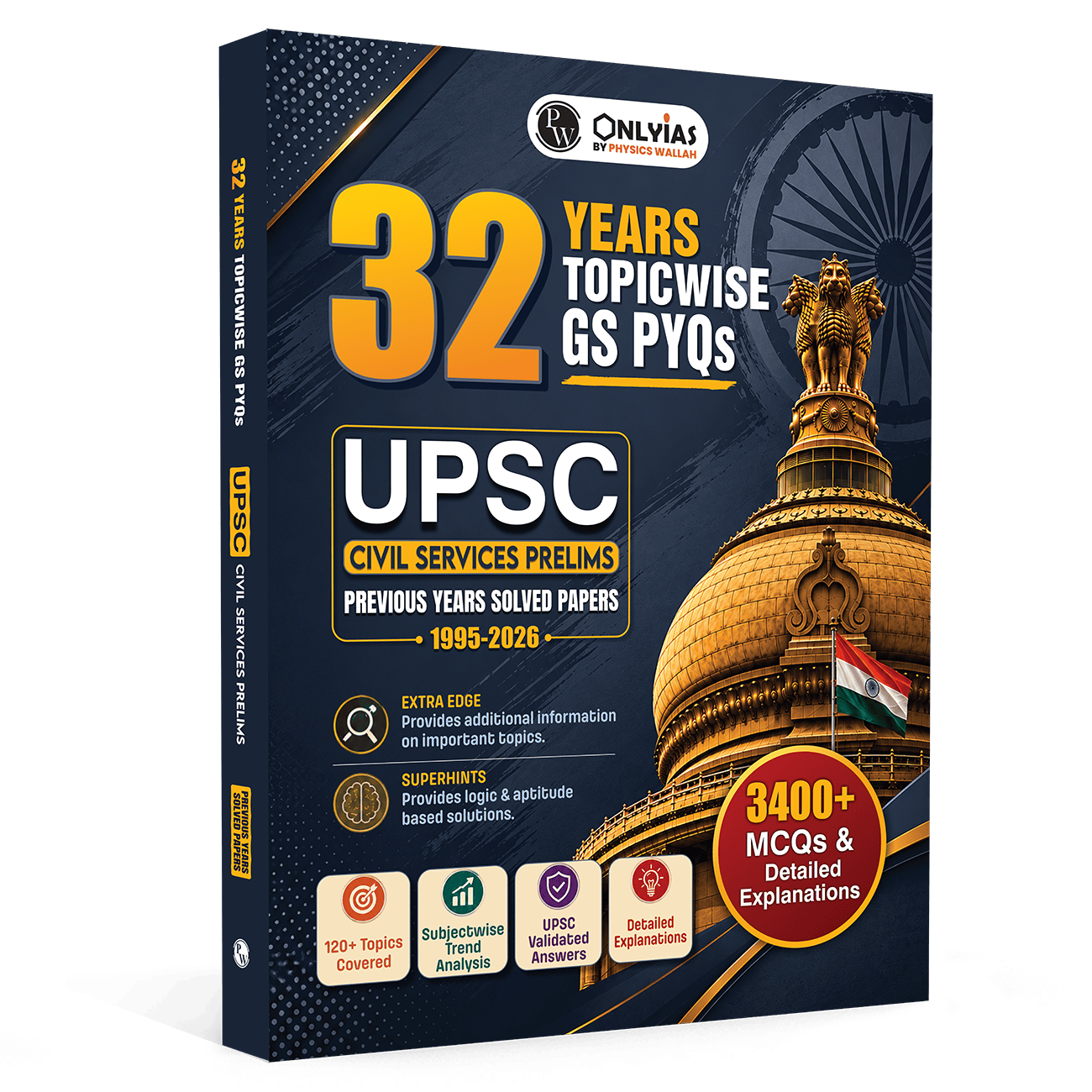
Solving 32 years UPSC PYQ book helps you understand the pattern and important topics.
-
Check which subjects have more weightage.
-
Learn how questions are framed from the same syllabus topics.
-
Revise mistakes and weak areas regularly.
5. Stay Updated with UPSC Current Affairs
Since the UPSC CSE prelims syllabus gives high weightage to current events, make sure to stay informed with current affairs.
-
Read newspapers or monthly current affairs magazines.
-
Link news topics with subjects like polity, economy, and environment.
-
Utilise monthly UPSC current affairs magazines by PW.
6. Do Your Revisions Consistently
Revision sessions can help you a lot in remembering learnt topics for a long time.
-
Revise short notes before starting new topics.
-
Make quick summary sheets for each subject.
-
Practice mock tests every weekend.
7. Use the Right Set of UPCS Prelims Syllabus Book
It is important to use additional reference UPSC Books along with the NCERTs because the NCERTs give you only a basic understanding of each subject. But the UPSC Prelims syllabus goes much deeper.
-
That's why utilising the reliable UPSC prelims syllabus books, such as those by PW, helps you study advanced topics, understand concepts in detail, and cover areas that NCERTs may not explain fully.
8. Use the 80/20 rule for UPSC Syllabus
Focus more on the topics that carry higher marks in the exam. Use the 80/20 rule for UPSC, which means spending 80% of your study time on 20% of the most important subjects from the UPSC prelims syllabus, like Polity, Economy, Environment, and Modern History.
UPSC Prelims Syllabus FAQs
Q.1. What is the UPSC Prelims Syllabus 2026?
Ans. UPSC Prelims Syllabus 2026 is yet to be released, but it is expected to be similar to the UPSC Prelims Syllabus 2025. It includes subjects like History, Geography, Polity, Economy, Environment, Science, and Current Affairs.
Q.2. Is the IAS Prelims Syllabus easy?
Ans. The IAS Prelims syllabus is vast and comparatively tough, but it becomes manageable when you plan properly, clear your basics, and do consistent revision.
Q.3. How to use the 80/20 rule for the UPSC Prelims Syllabus?
Ans. To use the 80/20 rule for UPSC, focus 80% of your time on 20% of high-scoring topics like Polity, Economy, Environment, and Modern History. Revise these more and practice from UPSC previous year papers.
Q.4. How can I download the UPSC Prelims Syllabus 2026 PDF?
Ans. You can download the UPSC Prelims Syllabus 2026 PDF from the official UPSC website once the official notification is released.
Q.5. What is the UPSC Prelims Syllabus 2026 for Paper 1?
Ans. UPSC preliminary syllabus for paper 1 includes topics like current affairs, History, Geography, Polity, Economy, Environment, general science and technology.