UPSC PYQ Strategy: Identify and Improve Your Weak Areas
The journey to clearing the UPSC Civil Services Preliminary Examination often feels like navigating a vast ocean. To find your way, you need more than just hard work; you need a compass. That compass is the UPSC PYQs (Previous Year Questions). A strategic UPSC PYQ based preparation strategy is the most effective way to transform your preparation from a coverage-driven mindset to a performance-driven results machine.
By 2026, the complexity of the exam has evolved, making it essential to identify exactly where your preparation is falling short. The exam has developed into a more difficult test by 2026 which requires you to pinpoint your study deficiencies for evaluation. The guide provides UPSC prelims weak area improvement plan, which allows you to use 31 years of historical data to enhance both your precision and confidence.
Check Out: UPSC CSE Books
How to Identify Weak Topics in UPSC Prelims
The primary step in any UPSC previous year question analysis strategy is self-assessment. Most aspirants make the mistake of solving a paper and only checking the final score. To truly identify weak areas, you must look deeper into your patterns of failure through a detailed review of every incorrect attempt.
-
Categorize Your Errors: When you solve UPSC PYQs, tag your incorrect answers into three buckets:
-
Lack of Content: You had no idea about the topic.
-
Conceptual Confusion: You knew the topic but got confused between two options.
-
Silly Mistakes: You misread the question or made a calculation error.
-
Thematic Mapping: Use UPSC subject wise PYQ analysis to see which specific themes are hurting you. You might be strong in "Parliament" but consistently weak in "Local Government."
-
Trend Tracking: Notice if your accuracy dips in specific types of questions, such as "Assertion-Reason" or "Matching Pairs."
UPSC Previous Year Question Analysis Strategy
While many candidates only look at the last five years, a UPSC PYQ based preparation strategy that spans 31 years (1995–2025) provides a massive competitive edge. The UPSC often recycles concepts from the late 90s and early 2000s, rephrasing them to suit modern contexts. Long-term analysis reveals the fundamental "thematic DNA" that remains constant regardless of yearly shifts.
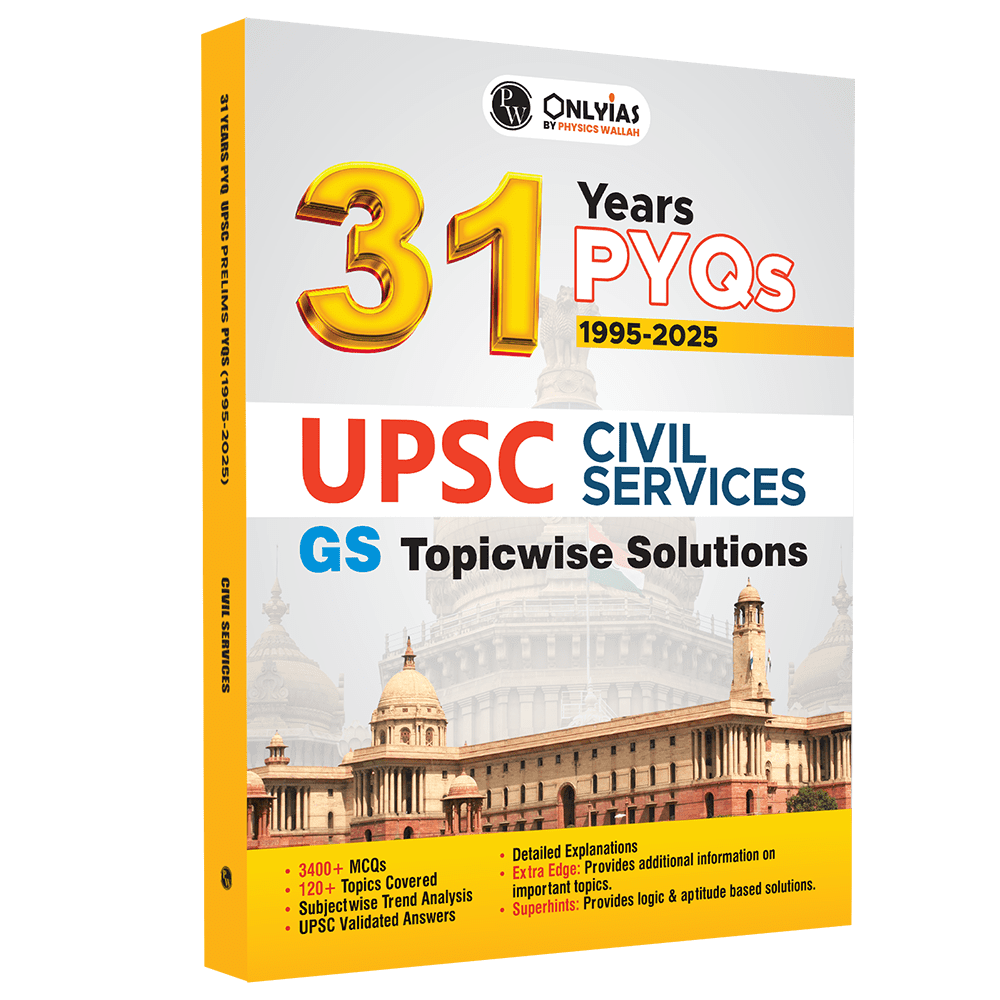
By using a comprehensive resource like the PW UPSC 31 Years PYQ GS book, you get access to over 3,400 solved questions. This volume of data allows you to see the "evolution" of a topic. For instance, questions on the "Preamble" have shifted from simple factual queries to deep philosophical interpretations of "Justice" and "Liberty." Tracking this evolution is the secret to predicting 2026 trends.
UPSC Prelims Weak Area Improvement Plan
Once you have identified your gaps, you need a structured plan to plug them. A successful UPSC PYQ based preparation strategy isn't about solving more questions; it’s about better revision.
Step 1: The "Reverse-Engineering" Method
Instead of re-reading an entire 500-page textbook, go back to the UPSC PYQs you missed. Research every option in that question—even the incorrect ones. Often, an incorrect option from a 2018 paper becomes the primary subject of a 2026 question.
Step 2: Subject-Wise Deep Dives
Allocate your study hours proportionally based on UPSC subject wise PYQanalysis. If your analysis shows you are consistently scoring below 50% in Environment, prioritize that subject in your weekly schedule.
-
High-Yield Static: Focus on Fundamental Rights (Polity), Inflation (Economy), and Modern History.
-
Dynamic Links: Connect static weak areas with current affairs. If you struggle with "National Parks," check which ones have been in the news lately.
Step 3: Improving Accuracy and Logic
To improve accuracy in UPSC prelims, you must master the "Art of Elimination." UPSC often uses "trap words" like only, all, or strictly. By analyzing 31 years of papers, you will develop an intuitive sense for these linguistic patterns, allowing you to turn a 50-50 guess into a calculated win.
Check Out: UPSC Textbooks
Features of a High-Quality UPSC PYQ
To implement an effective UPSC prelims weak area improvement plan, your reference material must go beyond providing a simple answer key. The PW OnlyIAS Extra Edge and Super Hints found in 31-year compilations provide:
-
Option-Wise Explanations: Understanding why an option is wrong is just as important as knowing why one is right.
-
Trend Analysis Infographics: Visual aids that show which topics are becoming more frequent (e.g., the rise of Agriculture in Geography).
-
Intelligent Guessing Guides: Practical tips on how to use common sense and general knowledge to navigate MCQs when you are unsure of the specific facts.
How to Improve Accuracy in UPSC Prelims Exam
Improving your hit rate is the fastest way to clear the cutoff. Accuracy is not just about knowledge; it is about exam temperament and logic.
1. Round-Wise Attempting
Divide your paper into three rounds. In Round 1, only attempt questions you are 100% sure of. This builds a "confidence floor" and reduces panic. In Round 2, tackle the 50-50 questions. In Round 3, address the ones where you can only eliminate one option or need to use "Super Hints."
2. Logic over Memory
UPSC is shifting toward application-based questions. Use UPSC PYQ strategy to improve weak areas to practice "Intelligent Guessing." If you can eliminate two options, the mathematical probability of a correct answer is 50%. In the long run, taking these calculated risks is what puts you above the cutoff.
3. Active Recall and the "Mistake Diary"
After solving a set of UPSC PYQs, close your eyes and try to recall the core concept behind each question. Maintain a "Mistake Diary" where you write down the reason for your failure. Reviewing this diary weekly is the most effective way to improve accuracy in UPSC prelims.
A successful UPSC subject wise PYQ analysis reveals that the weightage of subjects is not fixed. For example, over the last few years, the number of questions from Ancient and Medieval History has increased, while some traditional areas of Polity have become more predictable.
By analyzing the 31-year UPSC PYQs archive, you can see that Environment and Science & Tech questions are often derived from static concepts mentioned in old UPSC PYQs but updated with current context. For 2026, focus on how climate change protocols and emerging technologies like AI or CRISPR were tested in the past to anticipate how they will be tested next.
Read More: How to Prepare for UPSC Prelims 2026?
UPSC PYQs FAQs
1. How many years of UPSC PYQs should I analyze to identify weak areas?
While the last 10 years (2016–2025) are crucial for current trends, a UPSC subject wise PYQanalysis of the last 25–31 years is recommended for static subjects like History and Geography to see the full range of conceptual depth.
2. Can I use mock tests instead of UPSC PYQs to find my weak spots?
Mocks are good for testing speed, but UPSC PYQs are the only authentic source of the "UPSC language." Mocks can sometimes be unnecessarily tough or deviate from the actual pattern. Always prioritize PYQs for diagnostic purposes.
3. What should I do if I am consistently weak in a high-weightage subject like Economy?
Don't panic. Go back to basics (NCERTs). Use a UPSC prelims weak area improvement plan to solve topic-wise questions. Start with the "easiest" themes like Banking before moving to tougher ones like External Sector.
4. How does UPSC PYQ strategy to improve weak areas help in CSAT?
The difficulty of CSAT has increased drastically. Solving 15 years of CSAT papers will help you identify whether your weakness is in "Reading Comprehension" or "Quantitative Aptitude," allowing you to focus your limited prep time effectively.
5. How do I avoid "Silly Mistakes" that I find during PYQ analysis?
Silly mistakes are usually a sign of poor concentration or time pressure. To improve accuracy in UPSC prelims, practice solving papers in the actual exam slot (9:30 AM – 11:30 AM) to sync your brain's peak performance with the exam timing.
6. Does UPSC repeat questions from previous years?
Direct repetitions are rare, but themes and concepts repeat almost every year. For example, the "Parliamentary form of government" or "Preamble" are concepts that have appeared in various forms over the last 31 years.