When to Start Solving UPSC PYQs in Your Preparation?
In the arduous journey toward the Civil Services, the most frequent dilemma for a beginner is not "what" to study, but "how" and "when" to test that knowledge. UPSC PYQs (Previous Year Questions) are the only authentic evidence we have of the examiner's mindset. While many aspirants treat them as a final mock test to be taken in the last two months, top-ranking officers consistently suggest that this is a fatal mistake.
As we look toward the 2026 attempt, the complexity of the exam demands that you integrate pyq of upsc prelims and Mains into your daily routine from the very beginning. At PW Store, we believe that PYQs are the "lighthouse" that prevents you from getting lost in the vast sea of the UPSC syllabus. This guide outlines the definitive upsc pyq solving strategy for every stage of your preparation.
Check Out: UPSC CSE Books
What is the right time to start solving UPSC PYQs?
The answer to "when to solve upsc pyqs" isn't a single date on the calendar. Instead, it should be a phased integration that evolves alongside your knowledge base.
Phase 1: The "Syllabus Decoding" Phase (Day 1)
Before you even buy your first NCERT, you should read the last 5 years of upsc pyqs.
-
Goal: You aren't trying to "solve" them yet. You are observing the language and topics.
-
Benefit: When you later read a chapter on "Fundamental Rights," your brain will automatically flag the concepts that UPSC has asked about before. This is the foundation of upsc pyq preparation tips.
Phase 2: The "Topic-Wise" Phase (During 1st Reading)
As soon as you finish a specific topic (e.g., the 1857 Revolt or Inflation), immediately open a topic-wise ias prelims UPSC question bank.
-
Goal: Test if you understood the "depth" required.
-
Benefit: This prevents "passive reading." You learn to spot the traps and extreme words like only, all, or never that UPSC frequently uses to frame incorrect options.
Phase 3: The "Full-Length" Phase (Post-Syllabus Completion)
Once you have completed your second revision (usually 4–5 months before the exam), start solving full previous year prelims paper of upsc sets in a timed environment.
-
Goal: To build "Exam Temperament" and simulate the pressure of the two-hour window.
Importance of Solving UPSC PYQs
Why is there such a massive emphasis on upsc pyqs? In a world of unlimited mock tests, PYQs remain the gold standard for several reasons:
-
Decoding the "Themes": UPSC rarely repeats a question, but it frequently repeats a "Theme." For example, the "Governor’s Powers" or "Jainism/Buddhism" are themes that appear almost every year.
-
Developing Elimination Skills: The Prelims is often an "Elimination Game." By practicing pyq of upsc prelims, you learn the logic of why certain options are wrong, which no mock test can replicate perfectly.
-
Understanding "Directive Words": For Mains, PYQs teach you the difference between "Discuss," "Critically Examine," and "Evaluate."
-
Confidence Building: There is no greater confidence booster than realizing you can correctly solve actual questions from 2024 or 2025.
How to solve UPSC PYQs?
To get the maximum ROI (Return on Investment) from your time, follow this how to use UPSC previous year paper framework:
Step 1: Reverse-Engineering (The Options Research)
Don't just look at the correct answer. Research the other three options.
-
Example: If a question is about the "Reserve Bank of India," and the options mention "SEBI" or "NABARD," make sure you know the basics of those organizations too. UPSC often takes an incorrect option from Year 1 and makes it the subject of a question in Year 2.
Step 2: The "Mains Theme" Mapping
For the ias mains question bank, map the questions against the syllabus sub-headings. This allows you to create "Ready-to-Use" introductions and conclusions for recurring topics like "Urbanization" or "Self-Help Groups."
Step 3: Use the "Preview and Review" Method
-
Preview: Read the PYQs of a chapter before starting the chapter.
-
Review: Solve the same PYQs after finishing the chapter to check for retention.
How Many Years of UPSC PYQs should you Solve?
Here is the brief for the count of years of UPSC PYQs one should solve at each stage of the exam:
|
Stage |
Recommended Range |
Why? |
|
Prelims GS |
Last 25–30 Years |
To master core static concepts (Polity/History). |
|
Prelims CSAT |
Last 10 Years |
To understand the rising difficulty in Math/Reasoning. |
|
Mains (GS 1-4) |
Last 10 Years |
To track the shift toward analytical questions. |
|
Optional |
Last 15–20 Years |
Optional syllabi are rigid; questions repeat more often. |
Common mistakes to avoid while solving UPSC PYQs
Here are 4 common mistakes you should avoid while solving UPSC PYQs:
-
Waiting for the "Perfect" Time: There is no such thing as being "fully prepared." Start solving topic-wise PYQs as soon as you finish one unit.
-
Memorizing Answers: The goal is to learn the logic, not to memorize that "Option B was correct in 2018."
-
Ignoring the "Options": As mentioned, the 3 incorrect options are often the seeds for future questions.
-
Over-reliance on Mock Tests: Many mock tests are either too easy or unnecessarily tough. Always use upsc pyqs as your "Reality Check."
Check Out: UPSC Revision Books
Conclusion
The most effective upsc pyq solving strategy is one that treats these papers as a teacher rather than a test. By starting early and utilizing a topic-wise approach, you ensure that your preparation is always aligned with the "UPSC Frequency." In 2026, the competitive edge will not go to the person who read the most books, but to the person who understood the most questions.
At PW Store, we are dedicated to providing you with the most authentic, error-free upsc pyqs compilations with detailed explanations. Don't just study—study with direction. The roadmap to your success has already been written by the examiners; you just need to learn how to read it.
Read More: UPSC Previous Year Question Papers PDF
UPSC PYQs FAQs
1. Should I start with UPSC Prelims or Mains PYQs?
Ideally, both. When you study a topic like "Parliament," look at the pyq of upsc prelims for factual depth and the ias mains question bank for the analytical perspective. This "Integrated Approach" is what toppers recommend.
2. Are the questions from very old papers (e.g., 1995) still relevant?
For static subjects like History and Geography, yes. The fundamental concepts haven't changed. However, for Economy and Science & Tech, focus more on the last 10 years as the trends have shifted significantly.
3. Is it okay to use solved UPSC PYQ books?
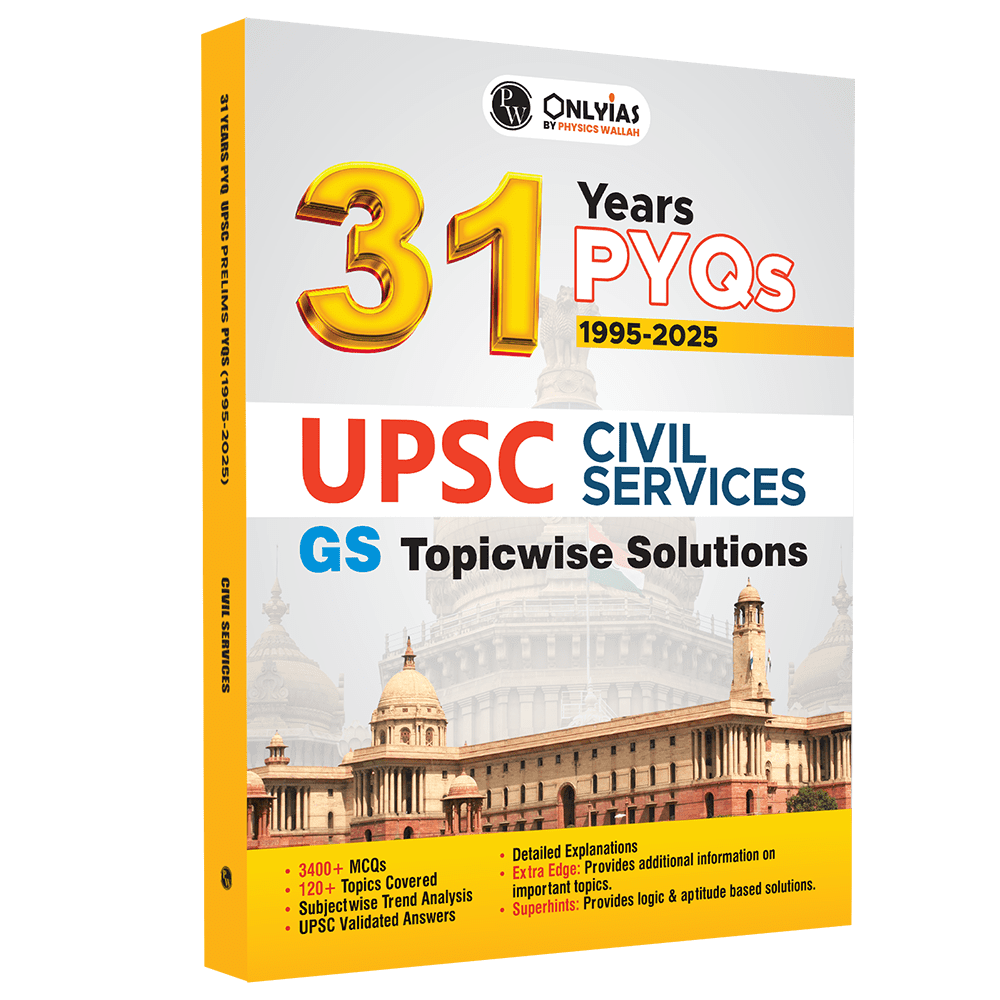
Yes! Solved books from the PW Store (like the UPSC 31 Years PYQ series) are highly beneficial because they provide "Extra Edge" hints and explain the rationale behind every option, saving you hours of research.
4. How do I manage negative marking using UPSC PYQs?
While solving pyq of upsc prelims, track how many "50-50" gambles you take. Analyzing these will help you realize if your intuition is helping or hurting your final score.
5. How do I use UPSC PYQs for Current Affairs?
You don't need to "solve" old current affairs questions. Instead, look at how UPSC framed them. Did they ask about the "Organization" involved, the "Location," or the "Objective" of the scheme? Use this to guide your current newspaper reading.