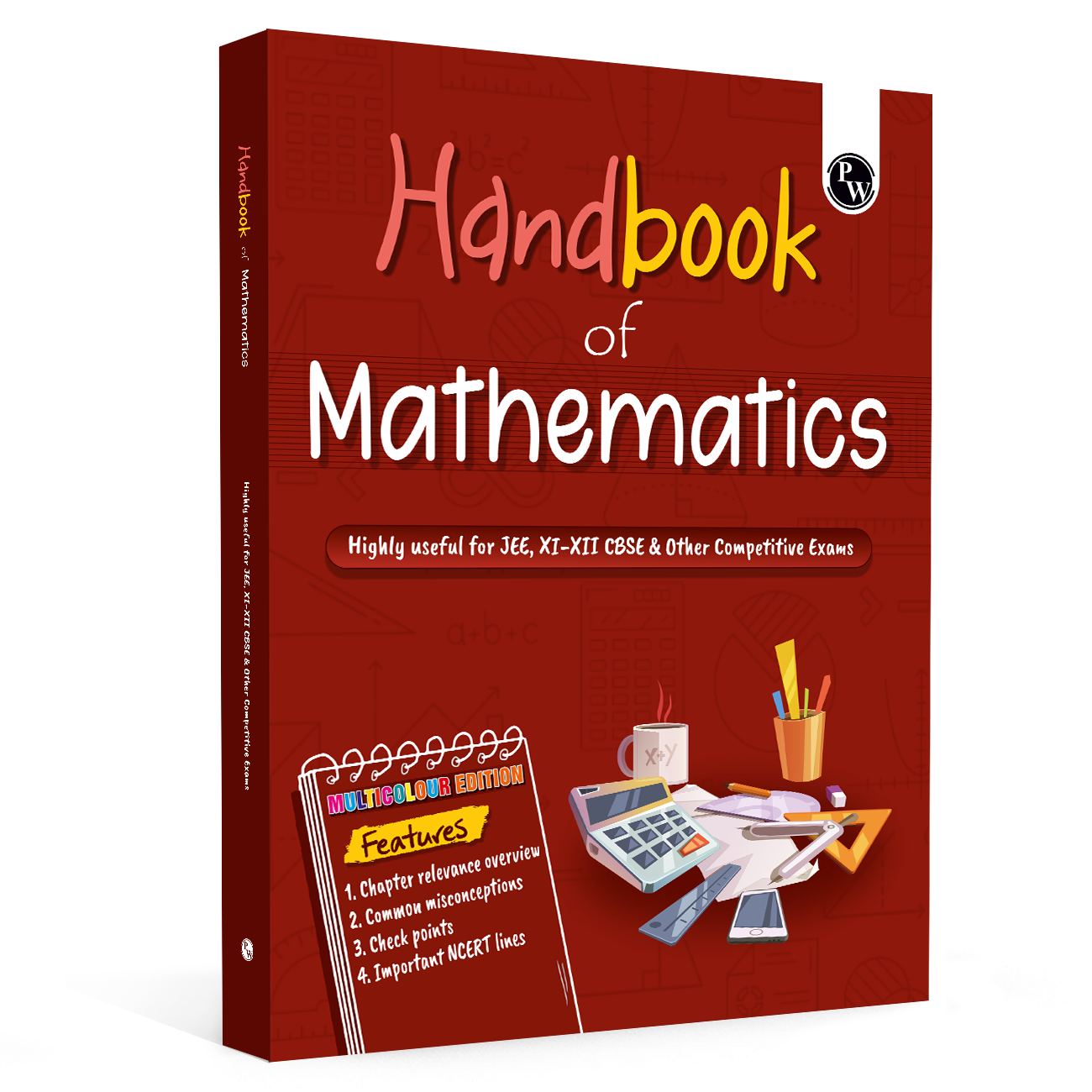
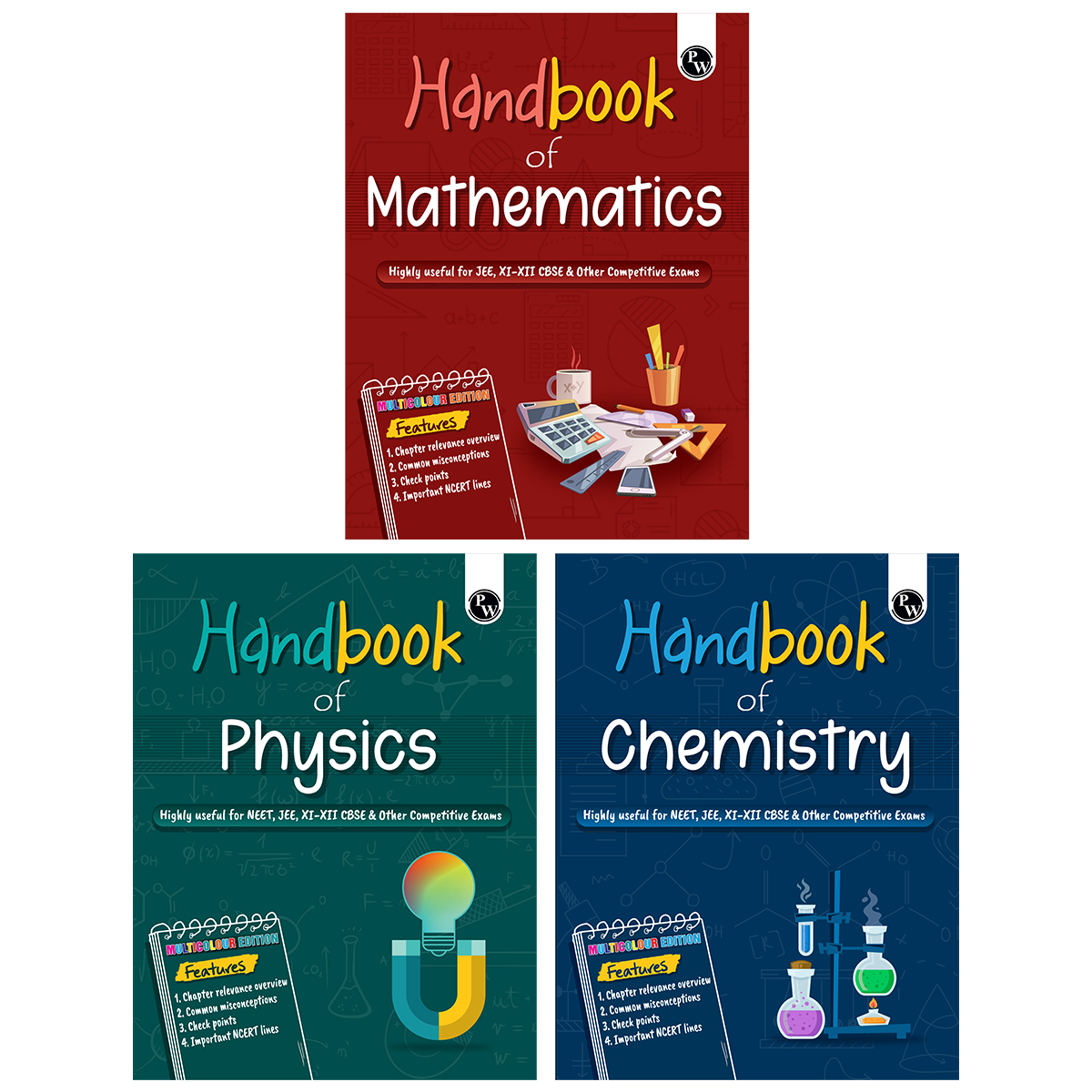
High-Weightage Maths Chapters to Revise with PW Handbook
Preparing for the engineering entrance exam can feel overwhelming when you have hundreds of complex formulas to memorise. Finding the right balance between learning new concepts and reviewing old ones is incredibly difficult.
This article highlights the key topics you must focus on and explains how to structure your study sessions using a comprehensive JEE maths handbook.
Importance of JEE Maths Handbook
Thick reference books are fantastic when you are learning a concept for the first time. They provide deep explanations, lengthy derivations, and historical context for mathematical theories. However, during the final months of preparation, these massive volumes become highly inefficient.
Trying to find a single trigonometric identity across five hundred pages wastes precious time. It creates unnecessary panic and disrupts your study flow.
Last-minute preparation requires speed and clarity. You need to see the core principles instantly without wading through pages of introductory text.
Which High-Weightage Chapters Are Covered in a JEE Maths Handbook?
To maximise your competitive score, you must know which topics carry the most marks. Focusing your energy on high weightage maths chapters ensures a better return on your limited study time.
Calculus, Algebra, and Coordinate Geometry form the absolute backbone of the entrance exam. They regularly account for a massive chunk of the question paper each year.
Let us look at the most critical topics you need to cover during your JEE maths preparation.
|
Chapter Name |
Approximate Weightage |
Core Focus Areas |
|
Matrices and Determinants |
Around 8 percent |
Cramer's Rule, Properties of Adjoint Matrices |
|
Definite Integration |
Around 7 percent |
Properties of definite integrals, Area under curves |
|
Vectors and 3D Geometry |
Around 11 percent |
Shortest distance, Scalar and Vector products |
|
Probability |
Around 6 percent |
Bayes' Theorem, Conditional Probability |
|
Sequence and Series |
Around 5 percent |
Arithmetic-Geometric Progressions, Special Series sums |
|
Quadratic Equations |
Around 5 percent |
Location of roots, Condition for common roots |
Which Important Algebra Topics Should You Revise with a JEE Maths Handbook?
Algebra often features highly analytical questions that require a mix of multiple formulas simultaneously. It is a section where structural clarity can save you from calculation traps.
For example, Matrices and Determinants might seem simple initially, but properties of adjoints can get tricky under immense exam pressure. A reliable JEE handbook separates these complex properties into clear, visual blocks that are easy to scan.
Make sure your daily review covers the following specific algebraic areas:
-
System of linear equations and conditions for consistency or inconsistency.
-
Properties of determinants regarding row and column transformations.
-
Application of complex numbers in coordinate geometry problems.
-
Sum formulas for special series and sigma notation properties.
Which Important Coordinate Geometry Topics Should You Revise with a JEE Maths Handbook?
Coordinate Geometry is a highly scoring area because many questions follow well-defined structural patterns. Once you understand the standard equations, conditions for tangency, and geometric properties, you can solve problems quickly and accurately.
Your JEE Maths Handbook serves as a quick reference for the standard forms of circles, parabolas, ellipses, and hyperbolas, reducing confusion caused by shifted origins, transformed coordinates, or rotated axes.
For more effective revision, students can also use JEE Revision Books, which provide concise chapter-wise notes, important formulas, shortcut techniques, and concept summaries. Combining a handbook with structured revision books helps strengthen conceptual clarity, improve recall, and enhance problem-solving speed for both JEE Main and JEE Advanced.
Focus your attention on these critical geometric principles:
-
The distance formulas, section formulas, and area of polygons.
-
Various forms of straight lines, including the parametric and normal forms.
-
Tangent and normal equations for standard conic sections.
-
Condition of tangency for a straight line touching a circle or parabola.
How to Revise Calculus Formulas Using a JEE Maths Handbook?
Calculus demands a deep understanding of limits, continuity, differentiability, and the application of derivatives. It is an area where visualising the graph helps immensely.
You must memorise standard limits and the exact conditions under which L'Hopital's rule applies. Missing a minor condition can lead to an incorrect answer choice.
For integral calculus, you need quick access to a vast array of substitution templates. Memorise the standard integrals for irrational functions and trigonometric combinations perfectly.
Ensure your daily calculus review includes:
-
Fundamental theorems of continuity and intermediate value properties.
-
Maxima and minima conditions for single-variable functions.
-
Leibnitz rule for differentiating under the integral sign.
-
Standard reduction formulas for complex trigonometric integrals.
How to Revise Vector and 3D Geometry with a JEE Maths Handbook?
Vectors and 3D geometry carry a massive weight relative to the effort required to master them. The questions are highly visual but rely heavily on standard formula templates.
Understanding the difference between dot products and cross products is just the beginning. You must master the physical meaning of scalar triple products and vector triple products.
In three-dimensional space, finding the shortest distance between two skew lines is a classic problem format. Having the determinant formula fresh in your mind prevents errors.
Keep these core vector formulas on your daily reading list:
-
Direction cosines and direction ratios of lines in space.
-
Equations of lines and planes under different given conditions.
-
Angle between two intersecting planes or a line and a plane.
-
Coplanarity conditions for lines and vectors.
Benefits of Using a JEE Maths Handbook
A structured JEE formula book compiles all essential identities, properties, and theorems into a highly compact space. This saves you from flipping through massive textbooks when you are stuck mid-problem.
Streamlining your maths formula revision helps you retain concepts much faster. When you have all notes organised visually, your brain maps formulas to specific problem types with ease.
Having a JEE maths handbook by your side ensures you do not waste hours searching for a forgotten coordinate geometry property or integration identity. It acts as a highly portable repository of knowledge that you can carry anywhere.
How does a JEE Maths Handbook Improve Speed and Accuracy?
The ultimate test of your revision is how quickly you can recall a formula under pressure. When the timer is ticking, your recall needs to be instantaneous.
A well-used reference tool creates muscle memory for your eyes. You will remember exactly where a formula sits on the page, helping you visualize it instantly during the test.
Combine your JEE books reading with timed mock tests to check your actual recall speed. This builds the stamina needed for the real exam environment.
How to Plan Daily Revision with a JEE Maths Handbook?
Efficiency is the ultimate secret to clearing engineering competitive exams. A messy JEE revision plan leads to confusion and high stress levels as the final exam day approaches.
Using a JEE maths handbook allows you to execute a highly effective, quick maths revision session every single day without feeling exhausted.
Here is a simple, proven routine you can follow to stay on top of your preparation:
-
Spend around twenty minutes every morning reviewing formulas from one high-weightage chapter.
-
Solve at least ten practice questions immediately after reading the formulas to cement the concepts.
-
Mark the formulas that you tend to forget frequently using a bright highlighter.
-
Revisit those specific highlighted sections before going to sleep to boost your long-term memory retention.
How to Avoid Common Mistakes When Using a JEE Maths Handbook?
Many students make the mistake of simply reading through formulas like a storybook. Mathematics requires active engagement, not passive reading.
Another common pitfall is trying to memorise formulas without understanding their underlying constraints. For instance, knowing a logarithmic property without checking the base conditions can cause major mistakes.
Do not try to learn entirely new topics during your revision sessions. Focus strictly on reinforcing the chapters you have already studied deeply.
Finally, avoid shifting between too many study materials. Stick to one trusted reference tool to maintain visual consistency in your memory maps.
Also Check, JEE Previous Year Papers
JEE Maths Handbook FAQ’s
Q1: How does a JEE maths handbook help in quick revision?
A JEE maths handbook compiles all essential formulas, theorems, and shortcut methods into a highly structured format. This enables rapid scanning and saves hours of manual compilation time before major exams.
Q2: Which maths chapters have the highest weightage for engineering exams?
Topics like Vectors, 3D Geometry, Definite Integration, and Matrices are considered high weightage maths chapters due to their consistent appearance and high mark distribution in past papers.
Q3: Can I rely entirely on a formula book for my JEE maths preparation?
A formula book is excellent for organizing your maths formula revision, but you must combine it with consistent problem-solving practice and mock tests to build true conceptual clarity.
Q4: How often should I schedule a quick maths revision session?
You should aim for a quick maths revision session daily for around twenty to thirty minutes. This keeps all critical mathematical identities and geometric properties fresh in your mind.
Q5: What is the best way to remember complex calculus formulas?
The right way is to review them daily using a structured summary guide and apply them to at least five practical problems immediately to build active neural recall.