JEE Important Question Maths With Solutions
JEE Important Question Maths With Solutions: The JEE Main exam is the first step for students aiming for top engineering institutes in India. After clearing JEE Main, students can appear for JEE Advanced, which is required for admission into the IITs. The JEE Main exam pattern includes three subjects: Physics, Chemistry and Mathematics, each carrying equal weightage. Among these, Mathematics is often seen as the toughest yet most scoring subject if prepared well.
Many aspirants struggle with JEE Maths questions in the beginning because they demand both strong concepts and quick problem-solving skills. However, consistent practice of JEE Mains Maths questions can turn this challenge into a strength. Focusing on JEE Mains Maths important questions allows students to identify common patterns, revise important formulas, and boost accuracy. Once the basics are clear and practice becomes a habit, Maths can shift from being a fear to being the section that pushes your score higher. With the right strategy, Mathematics in JEE can be your most powerful tool for success. Check out the article below for JEE Important Question Maths With Solutions.
Check Out: JEE Books
JEE Mains Maths Questions
1. Consider an A. P. of positive integers, whose sum of the first three terms is 54 and the sum of the first twenty terms lies between 1600 and 1800. Then its 11th term is:
(a) 84 (b) 90 (c) 108 (d) 122
2. In an A.P., the sixth term a₆ = 2. If the a, aₙ, aᵣ is the greatest, then the common difference of the A.P. is equal to
(a) 3/2 (b) 8/5 (c) 2/3 (d) 5/8
3. If log a, log b, log c are in an A.P. and logₐ 2b, log_b 2b, log_c 3c, log_c 3c – logₐ 2 are also in an A.P., then a : b : c is equal to
(a) 9 : 6 : 4 (b) 16 : 4 : 1 (c) 25 : 10 : 4 (d) 6 : 5 : 2
4. The number of common terms in the progressions 4, 9, 14, 19, ..., up to 25th term and 3, 6, 9, 12, ..., up to 37th term is
(a) 9 (b) 5 (c) 7 (d) 8
5. The 20th term from the end of the progression 113 1 20,19 ,18 ,17 ,......, –129 424 4 is
(a) –118 (b) –110 (c) –115 (d) –100
6. If each term of a geometric progression a1, a2, a3, ... with 118 a = and a2 ≠ a1, is the arithmetic mean of the next two terms and Sn = a1 + a2 + ... + an, then S20 – S18 is equal to
(a) 215 (b) –218 (c) 218 (d) –215
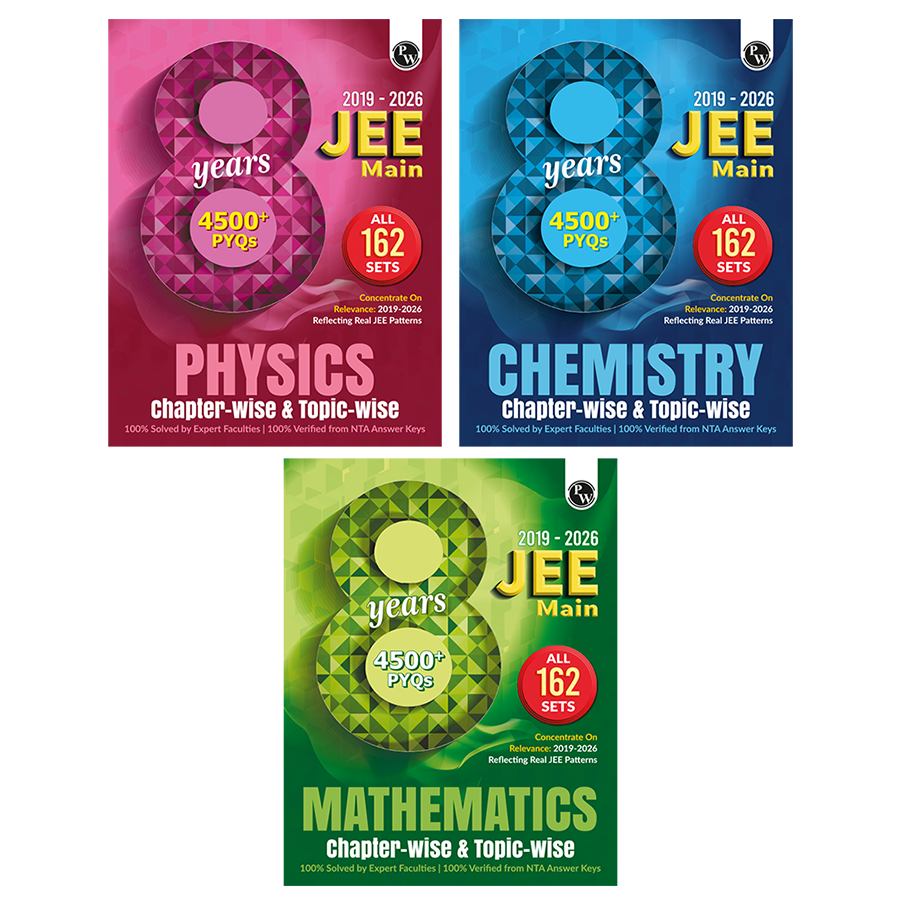
For more JEE Mains Maths important questions, click the link below: 8 Years JEE Mains Maths PYQ.
How to Prepare for JEE Main Exam?
Mathematics in JEE Main can feel tricky, but with the right preparation plan, it can actually become your strongest subject. Many students start with fear, but once they understand the pattern, focus on the right topics, and practice regularly, their confidence grows quickly.
1. Understand the JEE Main Exam Pattern for Maths
Before you even open your books, it’s important to know exactly how the JEE Main Maths paper works. This way, you will never feel lost during preparation. The paper has two sections. Section A has 20 multiple-choice questions (MCQs) and Section B has 10 numerical value questions, but you need to attempt only 5 from Section B.
Each correct answer gives you 4 marks, and each wrong answer in MCQs takes away 1 mark. Numerical value questions have no negative marking, so you can attempt them without fear.
|
Section |
Type of Questions |
Total Questions |
Marks per Question |
Negative Marks |
|
A |
MCQs |
20 |
4 |
-1 |
|
B |
Numerical Value |
10 (Attempt 5) |
4 |
0 |
2. Focus on Important Maths Topics
JEE Main covers the whole Class 11 and 12 Maths syllabus, but not all topics carry the same weight. Some topics appear almost every year and carry higher marks. By starting with these high-weightage topics, you can secure a good portion of your score early. Some important topics for JEE Main Maths are:
-
Coordinate Geometry
-
Calculus (Differentiation, Integration, Application of Derivatives)
-
Trigonometry
-
Vectors and 3D Geometry
-
Probability and Statistics
-
Algebra (Quadratic Equations, Complex Numbers, Progressions)
3. Make Short and Clear Notes
Good notes are like a map that guides you during revision. While studying, do not just read and move on. Take a few minutes to write down the key points in your own words. Keep one notebook for all formulas, theorems, and quick tricks.
-
Use bullet points for clarity.
-
Highlight formulas so they stand out.
-
Keep small solved examples for reference.
4. Practice JEE Mains Maths Important Questions Daily
The more you practice, the more comfortable you will feel in the exam. Start with simple questions to build confidence, then move to medium and difficult ones. Include JEE Mains Maths important questions from previous years because they show you the exact level and type of problems asked in the real paper.
When you solve questions daily, you not only improve your speed but also learn the tricks to handle tricky problems. Over time, you will notice that even difficult questions start feeling familiar.
5. Revise and Remember Formulas Regularly
Formulas are the building blocks of JEE Maths. If you forget a formula during the exam, you may lose an easy question. That’s why you should revise them every day, even if it’s just for 10–15 minutes. Keep a formula chart in front of your study table so you see it often.
Writing formulas again and again is another great way to remember them. You can even make flashcards to test yourself quickly before sleeping or after waking up.
6. Give Mock Tests and Analyse Your Mistakes
Mock tests are like rehearsals for the real exam. Take at least two mock tests per week once your syllabus is almost complete. Try to follow the exact JEE Main timing and conditions when you give the test. This habit will help you avoid repeating the same errors in the real exam.
Check Out: JEE Previous Year Papers
JEE Advanced Maths Questions
1. Let ℝ denote the set of all real numbers. Let a, b, x ∈ ℝ for i = 1, 2, 3. Define the functions f: ℝ³ → ℝ, g: ℝ³ → ℝ, and h: ℝ³ → ℝ by:
f(x) = a₁ + a₂x + a₃x² + x³
g(x) = b₁ + 3x – b₂x² + b₃x³
h(x) = f(x + 1) – g(x + 2)
If h(x) = g(x) for every x ∈ ℝ, then the coefficient of x³ in h(x) is:
(a) 8 (b) 6 (c) –4 (d) –6
2. Three students S₁, S₂, and S₃ are given a problem to solve. Consider the following events:
U: At least one of S₁, S₂, and S₃ can solve the problem.
V: S₁ can solve the problem, given that neither S₂ nor S₃ can solve it.
W: S₁ can solve the problem and S₃ cannot solve the problem.
For any event E, let P(E) denote the probability of E. If
P(U) = 1/2, P(V) = 1/2, and P(W) = 1/2,
then P(T) is equal to:
(a) 1/3 (b) 1/2 (c) 2/3 (d) 1/6
3. Let S be the set of all seven-digit numbers that can be formed using the digits 0, 1, 2. For example, 2210222 is in S, but 0210222 is not.
The number of elements x in S such that at least one of the digits 0 or 1 appears exactly twice in x is equal to:
4. If a, b, c are the sides of a triangle ABC such that ( ) ( ) 2 x a b c x ab bc ca − + + +λ + + = 23 0 has real roots, then λ < (b) 53
polynomial x2 + 20x – 2020 = 0 and suppose c, d denote the distinct complex roots of the quadratic polynomial x2 – 20x + 2020 = 0. Then the value of ac(a – c) + ad(a – d) + bc(b – c) + bd(b – d) is
(a) 0 (b) 8000 (c) 8080 (d) 16000
5. If α and β are the roots of 2 x px q + += 0 and 4 4 α β, are the roots of 2 x rx s − += 0 , then the equation 2 2 x qx q r − + −= 42 0 has always
(a) two real roots
(b) two positive roots
(c) two negative roots
(d) one positive and one negative root
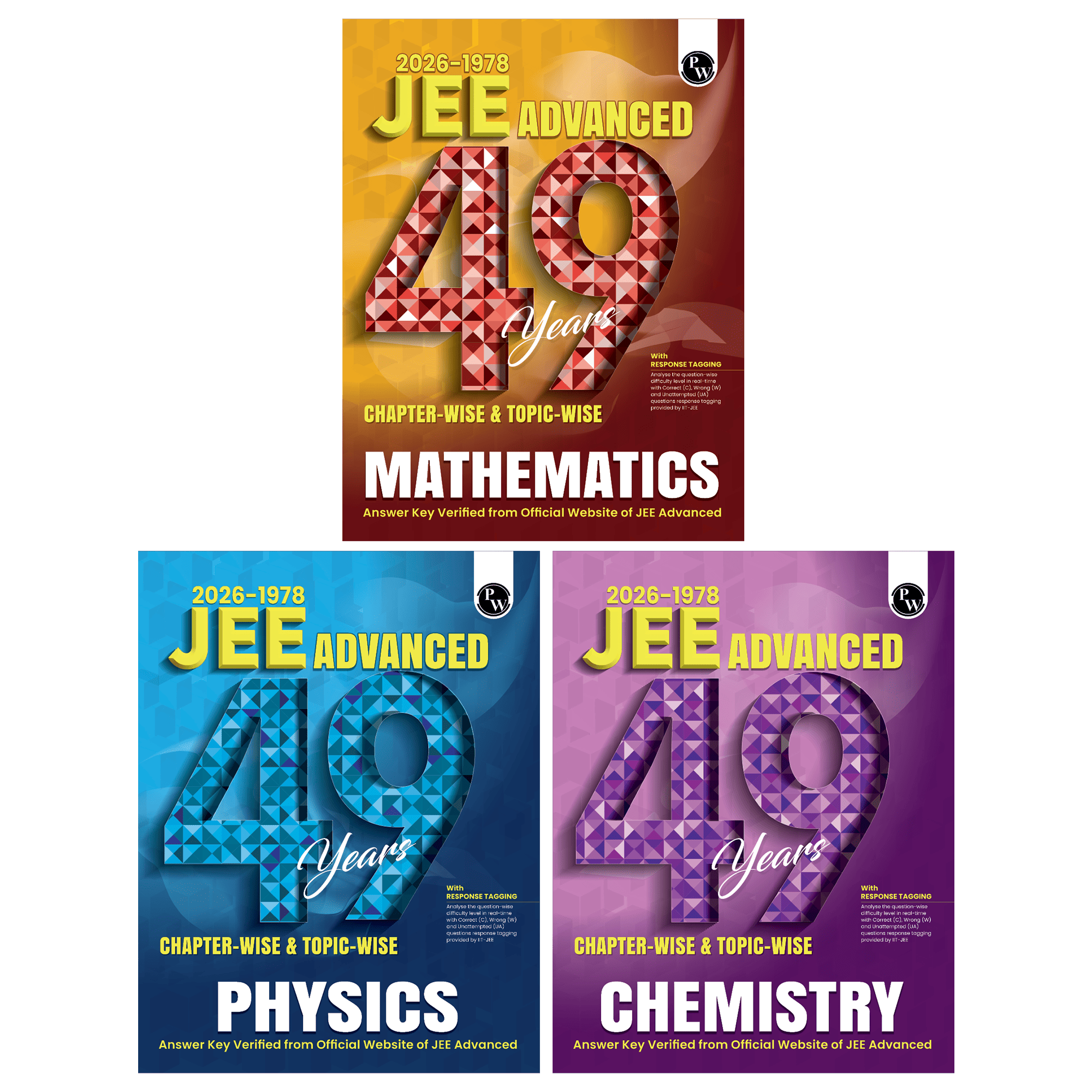
For more JEE Maths Questions with Solutions, check out the link below: JEE Advanced Maths PYQ 2027.
How to Prepare for JEE Advanced Maths Exam?
1. Understand the JEE Advanced Exam Pattern for Maths
JEE Advanced is different from JEE Main in terms of question style and difficulty. In Maths, questions are often multi-concept and require deeper thinking. The exam usually has a single correct answer, multiple correct answers, integer type, and matrix match type questions.
The marking scheme changes every year, so read the instructions carefully before attempting. Knowing the pattern will help you decide how to approach the paper and which questions to attempt first.
2. Strengthen Core Concepts in Each Topic
In JEE Advanced, direct formula-based questions are rare. You must understand why a formula works and how concepts connect across topics. For example, coordinate geometry problems may require calculus or algebra ideas.
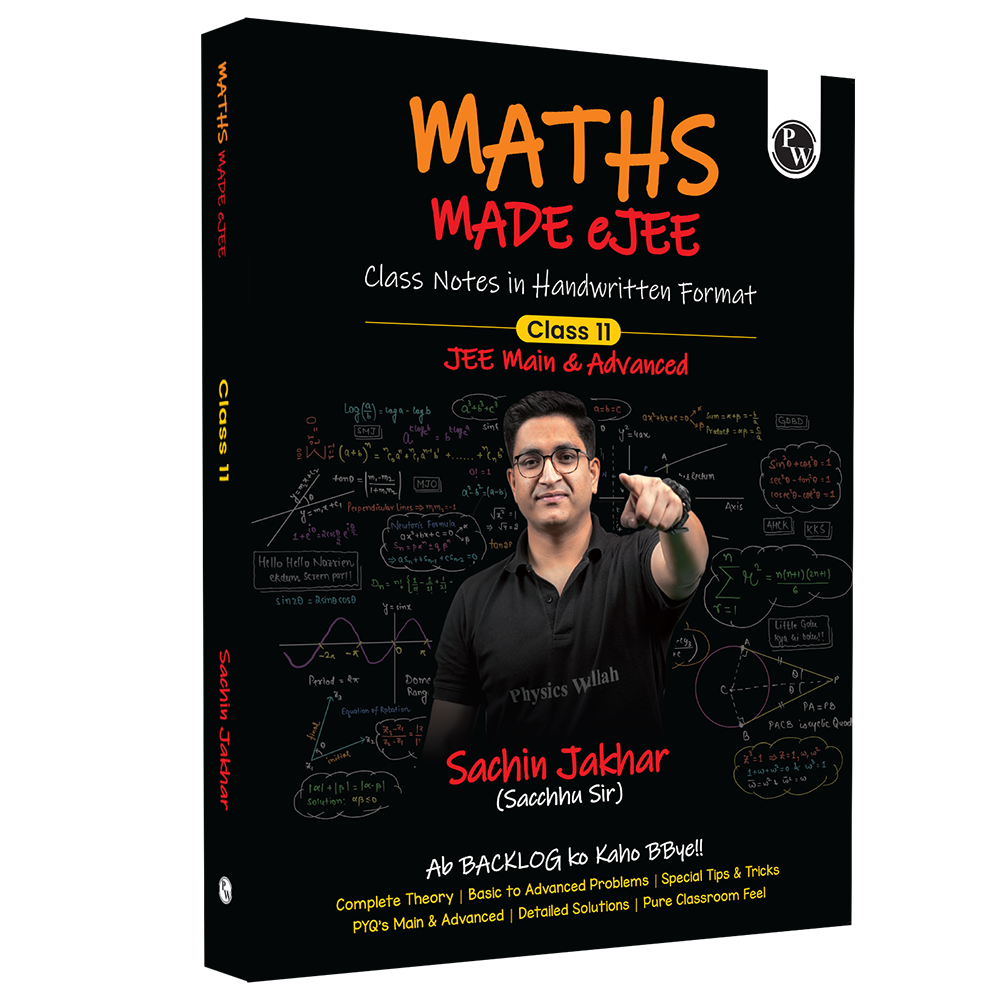
Go through NCERT and standard reference books such as PW JEE Maths Books, and try to solve derivations on your own. A strong base will make even complex problems feel more approachable.
3. Practice High-Level Problems Regularly
In JEE Advanced, practice is not just about quantity but also variety and difficulty. Use past year JEE Advanced maths questions and good quality mock papers.
Attempt mixed problem sets so you get used to switching between topics in the same sitting. This builds both problem-solving speed and flexibility in thinking.
4. Learn to Manage Time During Problem Solving
Some JEE Advanced maths questions are lengthy but easy, while others are short but tricky. Practice recognising which ones to solve first. In mock tests, time yourself for each section and try different strategies, like scanning the paper once to mark the questions you can solve quickly. This skill can help you avoid getting stuck and missing easier marks.
5. Revise Formulas and Tricks Before the Exam
Even though JEE Advanced tests deep understanding, you still need quick recall of important formulas, standard results, and shortcuts. Prepare a compact notebook with all key formulas from algebra, trigonometry, calculus, coordinate geometry, and probability. Revise it daily in the last few weeks. This will save time in the exam and reduce silly mistakes.
Check Out: JEE Question Banks
JEE Study Materials
When you’re preparing for JEE, the books you choose matter a lot. The right study material can save you time, clear your doubts faster, and help you score better. PW JEE Books are made to match exactly what the exam asks for.
They explain every concept in simple language, give you solved examples so you understand how to approach questions, and have lots of practice problems to make you exam-ready. For JEE Physics Books and JEE Chemistry Books, follow the table below:- Students can also refer to the 8 Years JEE Mains PYQ Combo and the JEE Advanced PYQ Combo 2027 for comprehensive previous year question practice and better exam preparation.
Read More: JEE Mains 2026 Syllabus
JEE Important Question Maths FAQs
1. Are PW JEE Books enough for JEE?
Yes, they cover the full syllabus for JEE Main and JEE Advanced, but you should also solve past year papers and give mock tests.
2. Do PW JEE Books follow the NCERT syllabus?
Yes, the content is aligned with NCERT so you can prepare for both board exams and JEE together.
3. Are there separate PW books for Physics, Chemistry, and Maths?
Yes, PW offers subject-wise books so you can focus on each subject individually.
4. Do these books have solutions for all questions?
Yes, detailed solutions are provided for practice questions so you can learn the right approach.
5. Can beginners use PW JEE Books?
Absolutely, they are written in simple language, so even if you’re starting fresh, you can follow along easily.