JEE Main Maths Chapter-Wise Weightage (2019–2026): 8 Years PYQs Analysis
Preparing for JEE Main Mathematics is not only about covering every chapter in the syllabus. It is also important to know which topics appear frequently in the examination so you can plan your preparation more effectively. Analysing JEE Main Maths chapter-wise weightage through previous year questions helps you understand exam trends, identify important chapters, and focus your revision on concepts that are tested regularly.
The latest eight years of JEE Main PYQs Book (2019–2026) provide valuable insights into question patterns, difficulty levels, and topic distribution across different shifts. Along with strengthening concepts, they help you become familiar with the actual examination format and improve your problem-solving approach.
JEE Main Maths Chapter-Wise Weightage (Based on 2019–2026 PYQs)
An analysis of JEE Main Mathematics previous year questions from 2019 to 2026 shows that some chapters appear more frequently across different sessions. While the exact number of questions varies from shift to shift, the following table provides a general idea of the chapters that are asked more consistently.
|
Chapter |
Expected Weightage Trend |
|
Calculus |
High |
|
Coordinate Geometry |
High |
|
Vectors and 3D Geometry |
High |
|
Algebra |
High |
|
Probability |
Moderate to High |
|
Matrices and Determinants |
Moderate |
|
Complex Numbers |
Moderate |
|
Sequence and Series |
Moderate |
|
Binomial Theorem |
Moderate |
|
Permutation and Combination |
Moderate |
|
Trigonometry |
Moderate |
|
Straight Lines |
Moderate |
|
Circle |
Moderate |
|
Statistics |
Low to Moderate |
|
Mathematical Reasoning |
Low |
|
Sets, Relations and Functions |
Low to Moderate |
|
Limits and Continuity |
Moderate |
|
Differential Equations |
Moderate |
Key observations from the 2019–2026 PYQs:
-
Calculus contributes a significant share of Mathematics questions across most sessions.
-
Algebra remains one of the most consistently tested sections.
-
Coordinate Geometry and 3D Geometry frequently appear together.
-
Probability, Matrices, and Complex Numbers are regularly included in the paper.
-
Smaller chapters such as Mathematical Reasoning and Statistics are asked less frequently but should not be ignored during preparation.
Check Out - JEE Books
Why JEE Main Maths Chapter-Wise Weightage Matters
The chapter-wise weightage analysis helps students understand which topics have appeared more consistently in the last eight years of JEE Main examinations. Although the number of questions changes across shifts, recognising these trends helps students prioritise revision without skipping any part of the syllabus.
-
Prioritise chapters that are asked regularly.
-
Allocate study time more efficiently.
-
Plan revision based on exam trends.
-
Build confidence before the examination.
Weightage analysis does not replace complete syllabus preparation. Instead, it helps students prepare in a more organised manner.
Check Out - JEE PYQ
What Can You Learn from 8 Years of JEE Main Maths PYQs?
Studying eight years of JEE previous year questions offers more than practice. It provides valuable insights into the examination.
Students can understand:
-
Frequently tested chapters and concepts.
-
Repeating question patterns.
-
Distribution of easy, moderate, and difficult questions.
-
The balance between conceptual and calculation-based questions.
-
Different styles of Multiple Choice Questions (MCQs) and Numerical Value Questions.
This approach helps students recognise how concepts are tested instead of memorising solutions.
Benefits of Topic-Wise JEE Main Maths PYQ Practice
Practising JEE Maths PYQs topic by topic makes preparation systematic. Instead of solving random papers, students can focus on one chapter at a time and strengthen their understanding before moving to the next topic.
Topic-wise practice helps students:
-
Improve conceptual clarity.
-
Identify weak areas quickly.
-
Track progress chapter by chapter.
-
Revise important formulas and methods.
-
Build confidence through consistent practice.
Once topic-wise preparation is complete, students can move to full-length papers for better exam readiness.
Read More - JEE Mains PYQs - 8 Years Physics, Chemistry & Maths Strategy
How Recent PYQs Reflect the Current JEE Main Exam Pattern
The JEE Main examination evolves over time. Recent PYQs provide the closest representation of the current paper pattern and difficulty level.
The 2019–2026 question papers help students:
-
Prepare according to the latest syllabus trends.
-
Understand the current difficulty level.
-
Experience actual shift-wise questions.
-
Practise both MCQs and Numerical Value Questions.
-
Avoid spending excessive time on outdated question patterns.
Recent papers are especially useful because they reflect the examination format students are most likely to encounter.
PW JEE Main 8 Years PYQ Combo for Planned Preparation
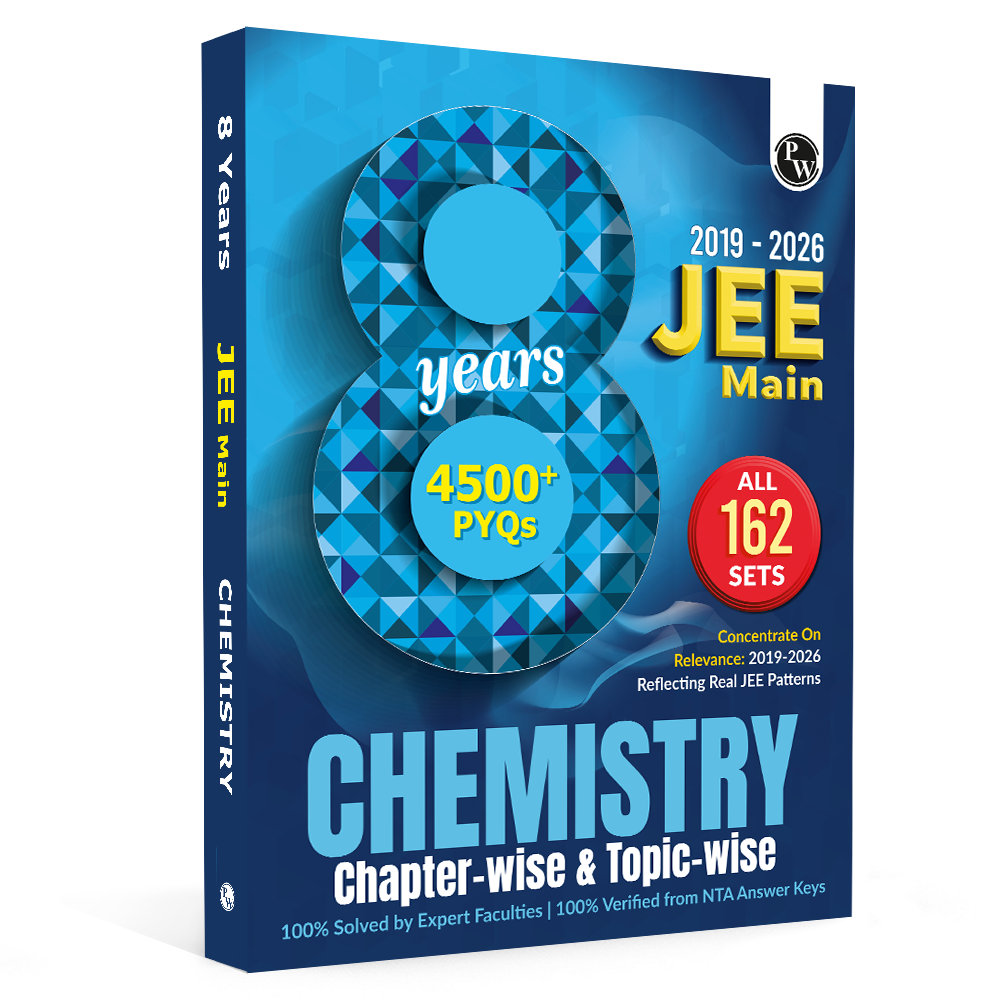
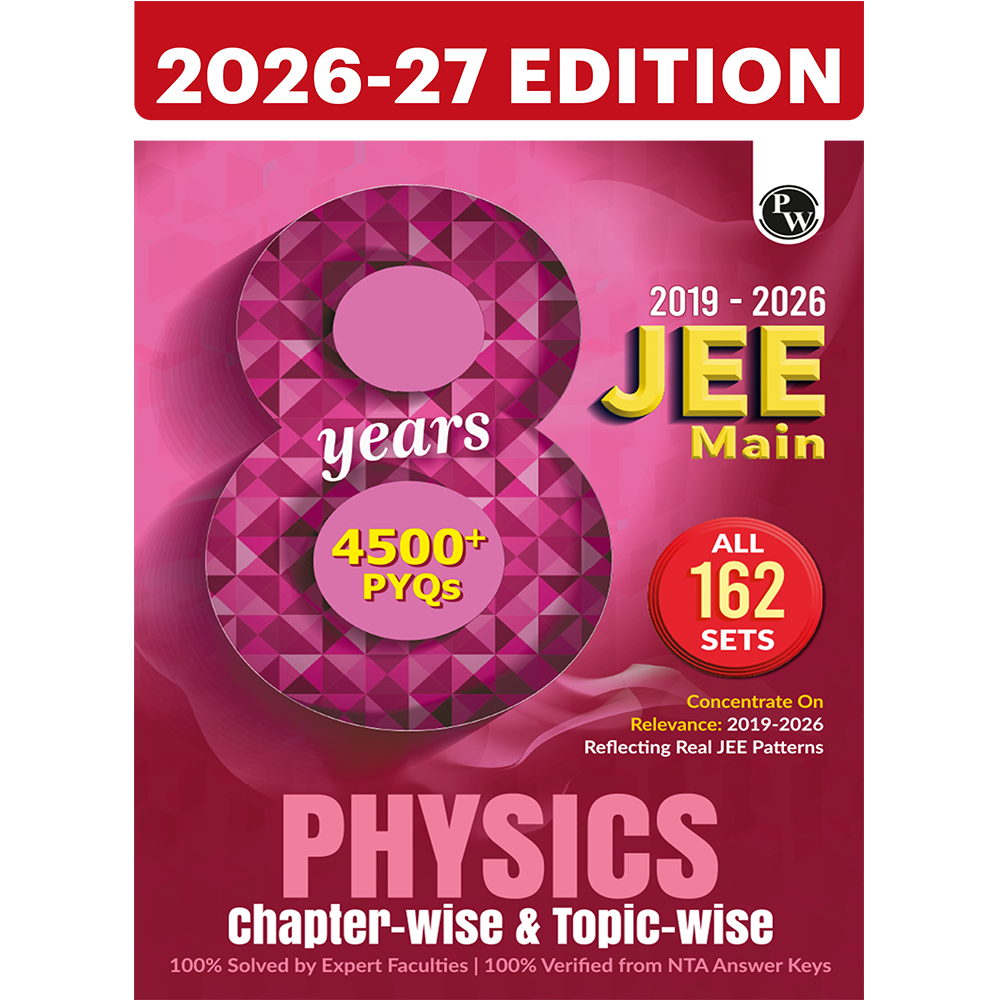
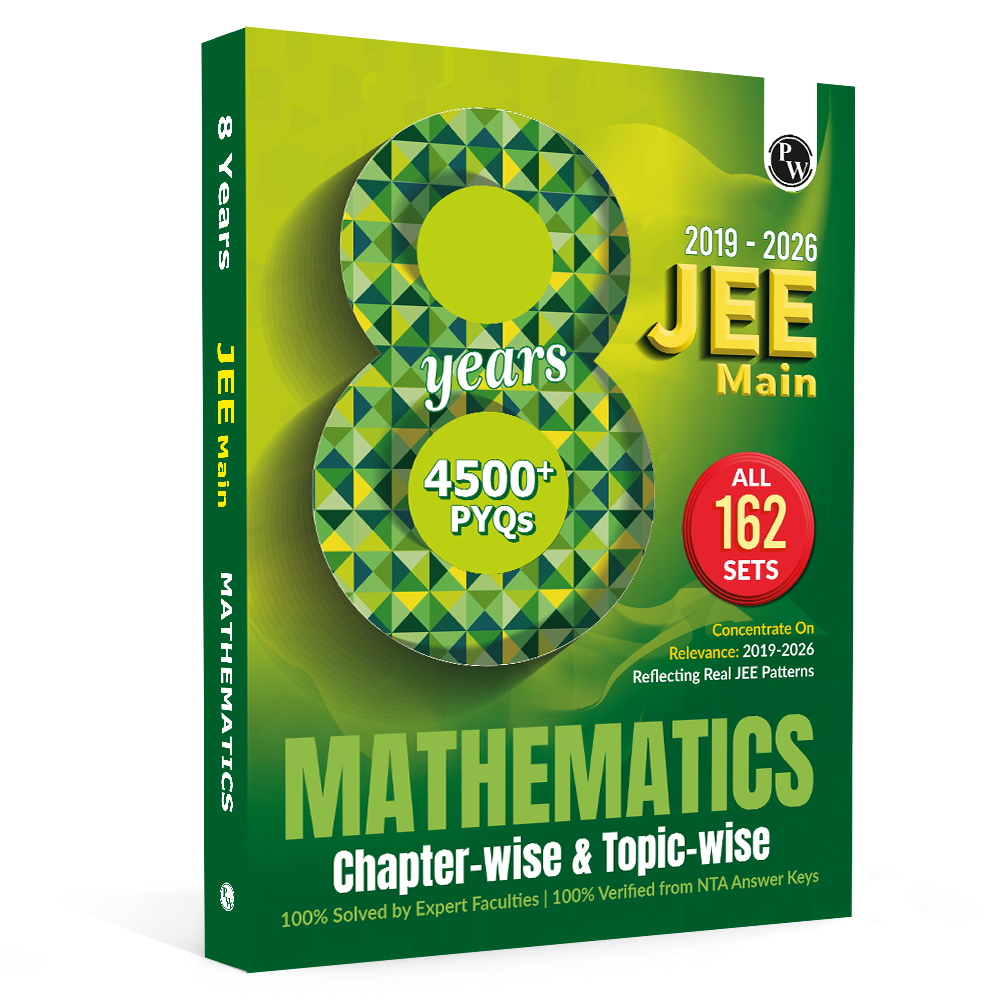
Students looking for organised practice can use the PW JEE Main 8 Years (2019–2026) PYQs Physics, Chemistry, Maths Combo Set of 3 Books. The set is designed to provide structured preparation using actual examination papers.
Some of its key features include:
-
Latest PYQ practice based on recent JEE Main examinations.
-
Coverage of all 162 shift-wise papers from 2019 to 2026.
-
Topic-wise and chapter-wise organisation for systematic learning.
-
Smart weightage analysis to support preparation planning.
-
Questions that match the actual JEE Main standard.
-
More than 13,500 questions with detailed and accurate solutions.
-
Practice for both MCQs and Numerical Value Questions.
The included maths PYQ book allows students to focus specifically on Mathematics while following a structured approach.
How to Use Chapter-Wise Weightage in Your Preparation
Knowing the chapter-wise weightage is useful only when combined with a proper study strategy.
Students should:
-
Complete the concepts of every chapter.
-
Begin practising topic-wise PYQs.
-
Analyse mistakes after every practice session.
-
Revise important formulas regularly.
-
Solve complete shift-wise papers before the examination.
-
Repeat difficult chapters until accuracy improves.
This method strengthens concepts while improving speed and accuracy.
Preparing for JEE Main Mathematics becomes more effective when you combine concept learning with consistent practice of previous year questions. The chapter-wise analysis of the 2019–2026 JEE Main Mathematics papers shows that chapters such as Calculus, Algebra, Coordinate Geometry, and Vectors & 3D Geometry appear consistently across multiple sessions. However, students should prepare the complete syllabus, as question distribution varies from shift to shift.
The PW JEE Main 8 Years (2019–2026) PYQs Physics, Chemistry, Maths Combo Set offers structured chapter-wise practice, all 162 shift-wise papers, detailed solutions, and weightage analysis in one place. By solving authentic JEE Main questions, you can strengthen your concepts, improve accuracy, and approach the examination with greater confidence.
JEE Main Maths PYQ FAQs
1. Why is chapter-wise weightage important for JEE Main Maths?
It helps students prioritise frequently asked chapters and plan their preparation more effectively.
2. How many years of JEE Main PYQs should students practise?
Practising the latest 8 years of PYQs (2019–2026) helps students understand current exam trends and patterns.
3. Does solving PYQs improve JEE Main Mathematics preparation?
Yes, PYQs strengthen concepts, improve accuracy, and familiarise students with the actual exam pattern.
4. What does the PW JEE Main 8 Years PYQ Combo include?
It includes all 162 shift-wise papers, topic-wise practice, smart weightage analysis, and detailed solutions across Physics, Chemistry, and Maths.
5. Can PYQs replace studying the complete JEE Main syllabus?
No, PYQs complement syllabus preparation by helping students revise concepts and understand question trends.