JEE Mains PYQs - 8 Years Physics, Chemistry & Maths Strategy
Preparing for the JEE Main exam often feels like navigating a maze without a map. Students frequently struggle with time management and identifying which topics carry the most weight. While textbooks provide the foundation, they don't always prepare you for the specific "twist" in questions that NTA is known for.
This is where JEE Mains PYQs become your most valuable asset. By analysing the last eight years of papers, you can decode the examiner's mindset, identify recurring themes, and build the stamina required for the actual test day. This article breaks down a subject-wise strategy to use these papers effectively for a rank.
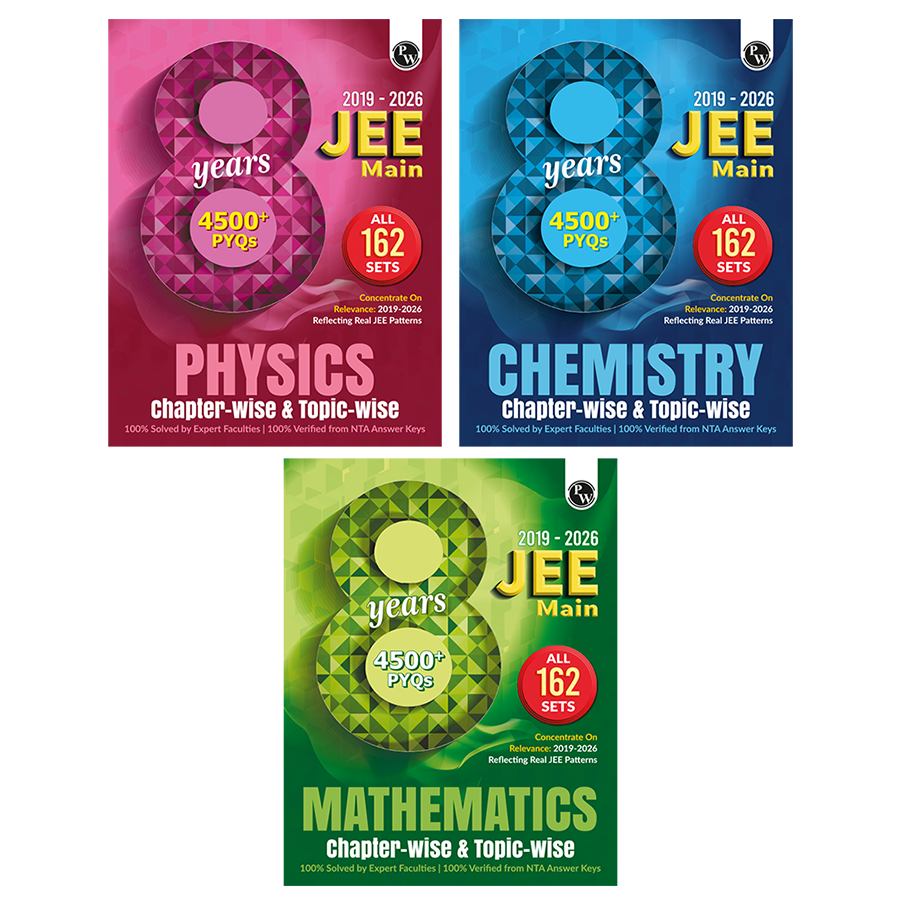
Check Out - JEE Books
Overview of JEE Mains PYQs
The landscape of the JEE Main exam has shifted significantly over the last decade, especially since the National Testing Agency (NTA) took over. Focusing on the last 8 years of PYQ JEE mains provides a contemporary view of the syllabus.
-
Pattern Recognition: You begin to notice that certain sub-topics are touched upon every single year.
-
Difficulty Scaling: You can track how the difficulty of Physics has decreased while Mathematics has become more lengthy and rigorous.
-
Time Management: Practising with a JEE Mains previous year question paper helps you gauge how much time to allot to each section.
-
Type of Questions: You get exposed to Multiple Choice Questions (MCQs) and Numerical Value Type questions that are currently in vogue.
Subject-Wise Strategy for JEE Mains PYQs
To make the most of your preparation, you shouldn't just solve questions randomly. A structured approach ensures you cover the entire syllabus while reinforcing high-weightage areas.
Physics Strategy
Physics in the JEE Main has lately been formula-based but conceptually deep. When solving JEE Main PYQs in Physics, focus on applying laws rather than rote learning.
-
Focus on Modern Physics: This section usually yields 3 to 4 questions every year and is relatively easier to score.
-
Mechanics Mastery: While Mechanics is vast, the previous year's paper archives show that questions on Work-Power-Energy and Rotation are consistent.
-
Formula Sheets: Create a short-note formula sheet for every chapter as you solve the JEE Mains Physics PYQ chapterwise sets.
-
Units and Dimensions: Never ignore the simple chapters; they often provide "free" marks in the exam.
Chemistry Strategy
Chemistry is often the "rank booster." It is the section where you can save time to invest in Mathematics.
-
Physical Chemistry: Focus on Numerical Value questions. Practising PYQs will show that chapters like Thermodynamics and Chemical Kinetics are favourites for integer-type questions.
-
Organic Chemistry: Follow the sequence of reactions. The JEE Mains Chemistry PYQ trend shows a heavy emphasis on Name Reactions and GOC.
-
Inorganic Chemistry: This is largely NCERT-based. Use the JEE Mains PYQ PDF to mark specific lines in your NCERT where questions have been picked from in previous years.
-
Coordination Compounds: This chapter consistently appears in almost every shift of the exam.
Mathematics Strategy
In recent years, Mathematics has been the toughest nut to crack. The questions are not necessarily "hard" but are extremely "lengthy."
-
Calculus and Algebra: These two form the backbone of the paper. Solving previous year question paper sets will help you find shortcuts for complex integrations.
-
Vector and 3D Geometry: These are high-weightage and relatively easier to visualise.
-
Coordinate Geometry: Practising JEE Main Maths PYQ chapterwise helps in remembering the various properties of Conic Sections.
-
Mock Environment: Always solve Math PYQs in a timed environment to improve your calculation speed.
Importance of JEE Mains PYQs
While chapter-wise practice is good for learning, solving a full previous-year paper is crucial for building exam temperament.
-
Simulated Pressure: Sit for 3 hours straight without any distractions.
-
Subject Switching: Learn how to quickly move your brain from the laws of Motion to Organic mechanisms to Complex numbers.
-
Selection Skills: The PYQs of JEE Main teach you which questions to leave. You don't need to solve all 75 questions to get a 99th percentile; you need to solve the right ones accurately.
-
Analysing Shifts: Since JEE is conducted in multiple shifts, solving various papers from the same year helps you understand the variation in difficulty.
How to Use JEE Mains PYQs Chapterwise
Randomly jumping between years can be confusing. A better strategy is to approach the JEE Main PYQ chapterwise. This allows you to finish a chapter in your coaching or self-study and immediately test your understanding against actual exam standards.
-
Complete the Theory: Finish your class notes and NCERT.
-
Solve Level 1: Do the basic exercises from your study material.
-
Engage with PYQs: Open your JEE mains PYQ pdf and solve at least 30-40 questions from that specific chapter.
-
Error Analysis: Mark the questions you couldn't solve. These represent your "weak spots."
-
Revisit: After two weeks, go back and solve only the "marked" questions to see if you have improved.
How to Find the Right JEE Mains PYQs
Having the right resources is half the battle won. You need papers that are not just collections of questions but also provide detailed solutions.
-
Accuracy Matters: Ensure the JEE Mains PYQ PDF you are using has verified answers.
-
Detailed Solutions: A good resource doesn't just give the option (A, B, C, or D) but explains "why" that is the answer.
-
Chapterwise Segregation: Look for books or digital platforms that categorise the PYQ by topic and difficulty level.
-
Online Platforms: Use reputable sites to access the latest JEE Mains previous year papers with video explanations.
Year-wise Analysis of JEE Mains PYQs
The shift from offline to online (CBT) mode and the change in conducting bodies have influenced the papers.
-
2017-2018: These were the last of the "offline style" papers. They are great for basic concept building.
-
2019-2021: This era saw a significant increase in the number of shifts. The JEE Mains PYQs from this period are excellent for seeing how NTA creates multiple versions of the same concept.
-
2022-2024: These are the most relevant. The Mathematics section became noticeably harder, and Physics became more direct. Focus heavily on these years.
Check Out: JEE Test series
JEE Mains PYQs Weightage
Data from the last 8 years suggests a certain "priority list" that can help you plan your final months.
|
Subject |
High Weightage Topics (Based on PYQs) |
|
Physics |
Modern Physics, Current Electricity, Magnetic Effects, Heat & Thermodynamics |
|
Chemistry |
Coordination Compounds, GOC, Chemical Bonding, p-Block Elements |
|
Mathematics |
Vectors & 3D, Sequences & Series, Definite Integration, Matrices & Determinants |
By focusing on these areas through JEE Main PYQ chapter-wise practice, you ensure you cover the bulk of the question paper.
Mock Tests vs. JEE Mains PYQs
A common debate is whether to solve mock tests or PYQs for JEE Main. The answer is a mix of both.
-
PYQs for Reality Check: These tell you exactly what has happened.
-
Mock Tests for Readiness: These prepare you for the "unexpected" that might happen in the upcoming session.
-
Balanced Diet: Use weekdays for JEE Main PYQ chapter-wise study and weekends for a full JEE Main previous-year question paper or a new mock test.
Preparation Tips with JEE Mains PYQs
As the exam approaches, your interaction with PYQs should become more intense.
-
Short Notes: Your notes should be a collection of tricky concepts you found while solving PYQ.
-
Timer Practice: Even when solving 5 questions, use a timer.
-
Health and Discipline: No amount of previous year paper practice will help if you are burnt out on the exam day. Maintain a steady sleep cycle.
-
Positive Mindset: Remember that thousands of others have solved these same PYQs and succeeded. You can too.
Mistakes to Avoid with JEE Mains PYQs
Many students "waste" their previous year's paper sets by using them incorrectly.
-
Reading Instead of Solving: Never just read the solution. If you can't solve a PYQ of JEE Mains, try it for at least 10 minutes before looking at the answer.
-
Ignoring the Syllabus: Some older questions might be from topics deleted in the latest 2024-2025 syllabus. Always cross-check with the current NTA curriculum.
-
Over-reliance: While PYQs are vital, don't forget to practice new, unseen questions from mock tests to keep your mind sharp.
-
Not Categorising: Don't treat a "silly mistake" the same as a "conceptual error." Identify why you got a question wrong.
Read More: How Many Hours to Study for IIT JEE?
JEE Mains PYQs FAQs
How many years of JEE Mains PYQs are enough for preparation?
Solving the last 8 to 10 years of JEE Mains PYQs is generally considered sufficient. It covers the transition from CBSE to NTA and gives a clear picture of the current trend and difficulty level of the exam.
Is it better to solve PYQ JEE mains chapterwise or year-wise?
Initially, you should solve JEE Main PYQs chapter-wise to strengthen individual topics. In the final two months before the exam, switch to solving the previous year's paper in a timed, 3-hour format to build exam stamina.
Are questions repeated from the PYQ of JEE Mains?
Direct questions are rarely repeated, but the concepts and "types" of questions are frequently recycled. By mastering PYQ of JEE mains, you will likely find many questions in your actual exam that follow a familiar logic or calculation pattern.
Where can I find a reliable JEE Mains PYQ PDF with solutions?
Reliable PDF resources are available on the official education websites. These provide verified answers and detailed step-by-step solutions, which are crucial for self-correction.
Why is the math section in recent JEE Mains previous year question paper sets so difficult?
Recent trends show that NTA has made the Mathematics section more calculation-intensive. Practising the previous year's question paper from 2022 to 2024 helps you learn how to manage time and identify which lengthy questions to skip.