JEE Mains PYQ (2018–2025) Patterns and Important Questions
Preparing for the Joint Entrance Examination is a rigorous journey where understanding the exam pattern is as vital as mastering the syllabus. Aspirants often struggle to filter out which topics carry the most weight and how the difficulty level has shifted over recent years.
By analysing JEE Mains PYQ from 2018 to 2025, students can identify recurring themes and question formats that the National Testing Agency (NTA) prefers. This guide breaks down the essential patterns found in PYQs to help you streamline your revision and focus on high-yield areas.
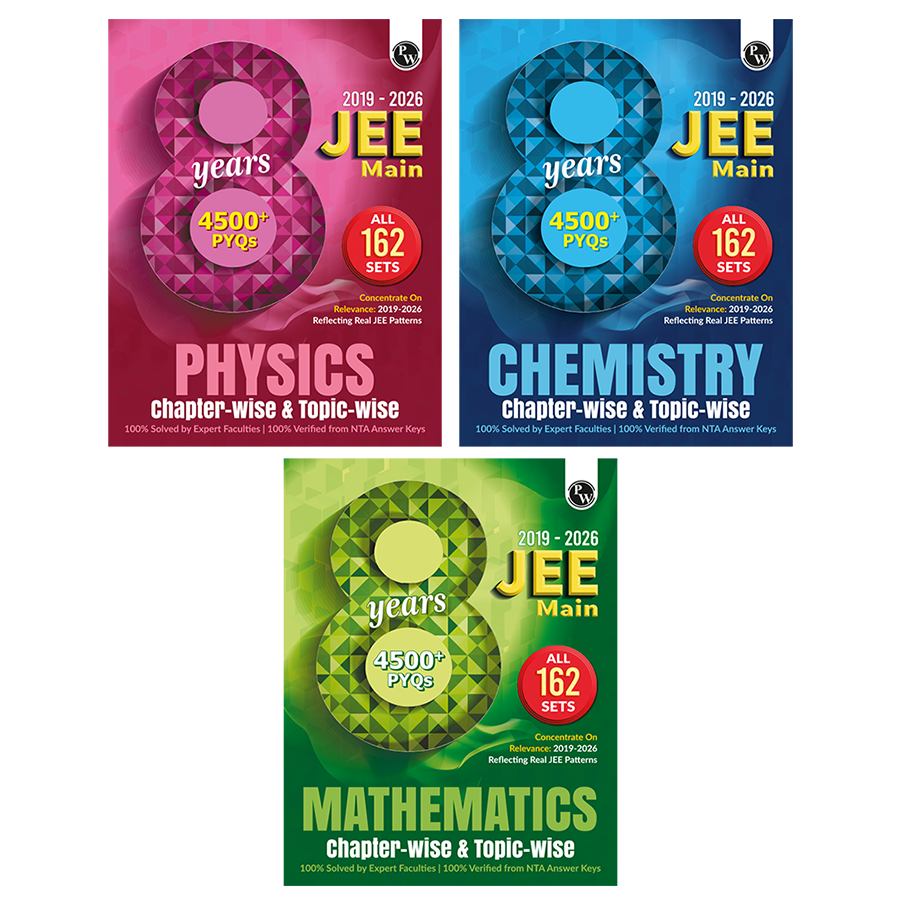
Check Out: PW IIT JEE Exam Preparation Books
Overview of JEE Mains PYQ
Every serious aspirant knows that solving a JEE Mains previous year paper is the closest experience to the actual exam day. These JEE previous year papers serve as a diagnostic resource, revealing your strengths and weaknesses under timed conditions. Since the transition to online testing, the variety of question sets has increased, making it crucial to review PYQs for JEE Main across multiple shifts.
Solving these questions helps in:
-
Familiarity with Question Language: Understanding how NTA twists simple concepts into complex-looking problems.
-
Time Management: Identifying which sections take longer and where you can save time.
-
Weightage Analysis: Recognising that certain chapters consistently contribute more marks than others.
Subjects Covered in JEE Mains PYQ
The period between 2018 and 2025 saw a significant evolution in the JEE Main ecosystem. Initially conducted by CBSE and later taken over by the NTA, the exam shifted from a single-day offline test to a multi-session online format. This shift necessitated a broader database of questions, leading to a more diverse range of topics covered in JEE Main PYQ chapter-wise sets.
-
Mathematics
In recent years, Mathematics has emerged as the most challenging section. The JEE Main previous-year question paper trends show a shift towards lengthier calculations and multi-concept questions.
-
Calculus: Remains the backbone of the paper, with a heavy focus on Definite Integration and Differential Equations.
-
Vector and 3D Geometry: Usually yields 2-3 straightforward yet calculation-heavy questions.
-
Coordinate Geometry: A shift from basic properties to complex intersections and tangent-normal problems.
-
Algebra: Sequence and Series, along with Matrices and Determinants, are frequent high-scoring areas in the JEE Mains maths PYQ.
-
Physics
Physics has generally stayed within the moderate difficulty range. However, the JEE Main physics PYQ chapterwise analysis suggests that NTA often combines two different units into a single numerical value question.
-
Modern Physics: High weightage with relatively simpler, direct formula-based questions.
-
Mechanics: While conceptually tough, the number of questions has stabilised, focusing more on Work-Power-Energy and Rotational Motion.
-
Electrodynamics: A major portion of the previous year's paper focuses on Current Electricity and Magnetic Effects.
-
Heat and Thermodynamics: Consistently provides 2-3 questions that are usually easy to solve if the signs and laws are clear.
-
Chemistry
Chemistry is often the section that determines the rank. Since 2018, the reliance on NCERT has peaked, especially for Inorganic and Organic Chemistry.
-
Physical Chemistry: Most questions now appear in the Numerical Value Section. Common topics include Chemical Kinetics, Thermodynamics, and Ionic Equilibrium.
-
Inorganic Chemistry: Direct questions from Coordination Compounds, Chemical Bonding, and p-block elements are staples in PYQ of JEE Mains chemistry.
-
Organic Chemistry: Focuses heavily on Named Reactions and GOC. Students must practice multistep synthesis questions from a JEE Main PYQ PDF.
How to Use JEE Mains PYQ Chapterwise
Randomly solving papers can be counterproductive if you haven't finished the syllabus. The most effective strategy is to use JEE Mains PYQ chapterwise books or digital resources.
-
Phase 1 (Topic Completion): As soon as you finish a chapter, solve the last 5 years of JEE Mains PYQ for that specific topic.
-
Phase 2 (Mixed Practice): Once a unit is over (e.g., Mechanics), take a sectional test using a previous year's question paper.
-
Phase 3 (Full Length): In the final two months, solve full 3-hour papers in the exact time slot of your actual exam (9 AM – 12 PM or 3 PM – 6 PM).
Where to Find JEE Mains PYQ PDF and Resources
Accessing high-quality resources is easier than ever. Students can download a PYQ PDF for offline study or use online platforms for an interactive experience. Some educational stores offer comprehensive collections of JEE Mains previous year paper sets that include detailed step-by-step solutions rather than just an answer key.
Using a physical book or a structured PYQ allows you to:
-
Highlight difficult questions for a second look.
-
Make short notes on the margins regarding the tricks used.
-
Track your progress across different years.
Shift-wise Analysis of JEE Mains PYQ
Since 2019, JEE Main has been conducted in multiple shifts. It is a common misconception that some shifts are "easier" than others. While the raw scores might vary, the NTA normalisation process ensures fairness. By reviewing a JEE Mains previous year question paper from various shifts, you will notice that the difficulty usually balances out across subjects. If Physics is hard in one shift, Chemistry might be easier to compensate.
Practising different shifts helps you prepare for the "unpredictability factor." For instance, the PYQ JEE Mains from the January session often differ slightly in flavour compared to the April/July sessions, with the latter sometimes seeing a marginal increase in difficulty.
Check Out: JEE Test series
High Weightage Topics in JEE Mains PYQ
Now, let’s see the high weightage topics that are covered in the JEE Mains PYQ that will help you prepare your study strategy in a better way:
|
Subject |
Most Important Chapters (Based on 2018-2025 Trends) |
Difficulty Level |
|
Mathematics |
Vector & 3D, Matrices, Sequence & Series, Integration |
High |
|
Physics |
Modern Physics, Current Electricity, Thermodynamics, Optics |
Moderate |
|
Chemistry |
Chemical Bonding, GOC, Coordination Compounds, Kinetics |
Easy-Moderate |
Mistakes to Avoid While Solving JEE Mains PYQ
Simply ticking off questions from a PYQ of the JEE Mains list isn't enough. To truly benefit, avoid these common pitfalls:
-
Looking at Solutions Too Early: Give yourself at least 5-10 minutes to struggle with a problem before checking the answer.
-
Ignoring Numerical Value Questions: With the change in pattern, these carry equal weightage and require high precision.
-
Skipping Analysis: After completing a JEE Mains previous year paper, spend at least an hour analysing your mistakes. Was it a calculation error or a conceptual gap?
-
Not Timing Yourself: Solving 30 questions in 3 hours is easy; solving them in 60 minutes is the real challenge.
Read More: Time Table for JEE Preparation 2027 Exam
JEE Mains PYQ FAQs
Q1. How many years of JEE Mains PYQ should I solve?
Ideally, you should solve the last 7 to 10 years of questions. However, focusing heavily on the PYQs of JEE Main from 2019 onwards is most beneficial, as the exam shifted to the NTA online format during this period.
Q2. Are JEE Mains PYQ repeated in the actual exam?
While exact questions are rarely repeated, the concepts and patterns are frequently reused. Solving a JEE Mains previous year paper helps you recognise these recurring patterns, making it easier to solve "new" questions on exam day.
Q3. Where can I find a reliable JEE Mains PYQ PDF?
You can find verified PYQ PDF files online. These resources provide chapter-wise bifurcations and detailed explanations for every problem.
Q4. Is solving the JEE Mains previous year question paper enough to score well?
PYQs are a crucial component, but should be used alongside standard textbooks and mock tests. Using JEE Main PYQ chapterwise ensures conceptual clarity, while mock tests improve your overall stamina for the three-hour duration.
Q5. Why is Mathematics considered tougher in recent PYQ JEE Mains?
The trend shows that NTA has increased the number of steps required to reach the final answer in Mathematics. Analysing the PYQ from 2018 to 2025 reveals a focus on "lengthy" algebra and calculus problems that test both patience and accuracy.