Perpendicular Axis Theorem Explained for JEE Physics
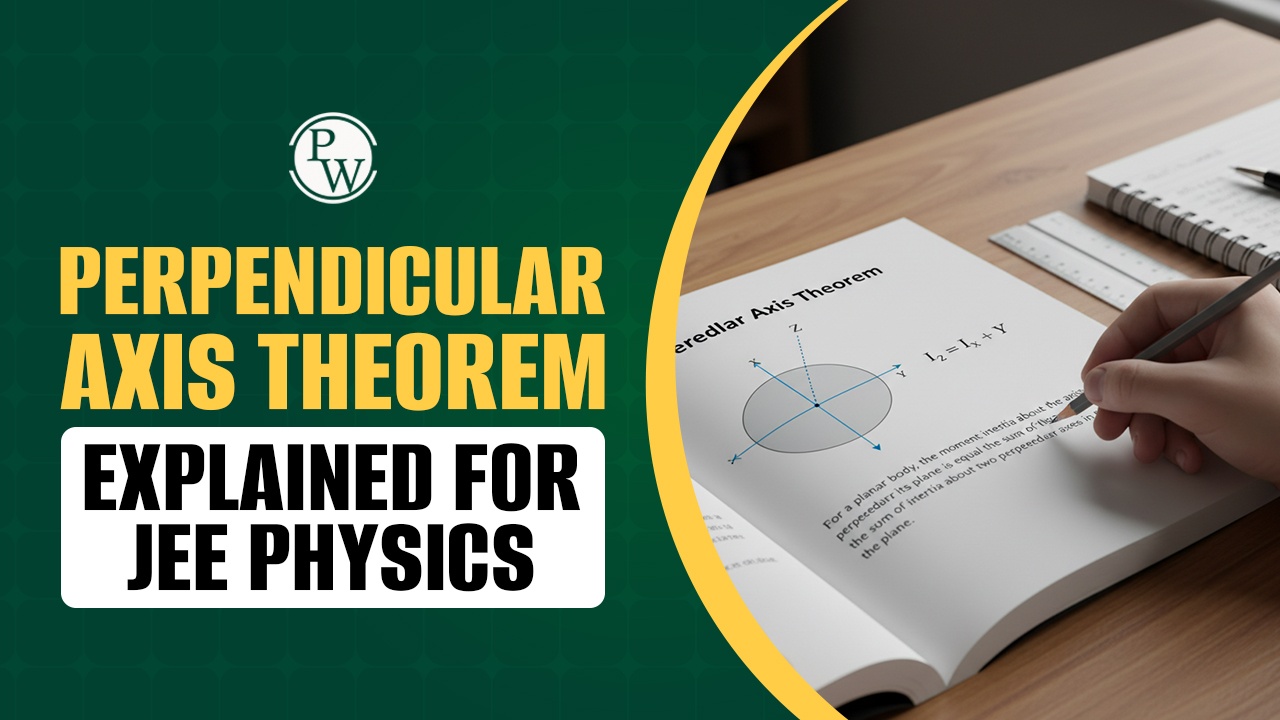
Perpendicular Axis Theorem
The JEE 2026 exam will be conducted in two sessions. The first session will be held from 21 January to 30 January 2026, and the second session will be conducted in the month of April 2026. The JEE exam checks students’ knowledge in three subjects: Physics, Chemistry and Mathematics. Out of these, many students often find Physics more challenging, while the Chemistry paper last year was rated moderate to difficult by most aspirants.
To score well in Physics, it is important to understand theorems, formulas and all the basic concepts clearly. One such important topic is the perpendicular axis theorem. In this article, you will find the perpendicular axis theorem explained in a very simple way, along with the perpendicular axis theorem statement and formula. This will help you prepare confidently for questions related to the Perpendicular Axis Theorem in your JEE Physics exam.
Check Out: IIT JEE Books
What is Perpendicular Axis Theorem?
The perpendicular axis theorem is a simple rule in Physics that helps us find the moment of inertia of a flat object. This theorem says that if a body lies in a plane (like a thin sheet or a disc), then the moment of inertia about a line coming out of the plane is equal to the sum of the moments of inertia about two lines in the plane that are at right angles to each other.
Rules: Iz = Ix + Iy
In easy words, it means if you know the moment of inertia along two axes on the surface of the object, you can add them to get the moment of inertia along the third axis, which is perpendicular to the surface. This rule is very useful in rotational motion problems in JEE Physics because it makes calculations easier and faster.
Check Out: JEE Previous Year Papers
What Is Moment Of Inertia
-
Definition:
Moment of inertia (also known as angular mass or rotational inertia) measures how an object's mass is distributed about an axis of rotation. It's a scalar value that takes into account not only the mass of the object but also the way that mass is distributed relative to the axis of rotation.
-
Calculation:
The moment of inertia of a point mass with respect to an axis of rotation is given by the formula:
I= m • r 2
Where:
- I is the moment of inertia
- m is the mass of the point mass
- r is the distance between the point mass and the axis of rotation.
For more complex objects, the moment of inertia depends on the distribution of mass and the shape of the object. The formula becomes more involved and might include integrals to sum up contributions from infinitesimal mass elements.
-
Parallel Axis Theorem:
This theorem states that the moment of inertia of an object about an axis parallel to an axis through the object's center of mass is given by the sum of the moment of inertia about the center of mass and the product of the object's mass and the square of the distance between the two parallel axes.
-
Rotational Kinetic Energy:
The moment of inertia plays a crucial role in rotational kinetic energy. The rotational kinetic energy KE of a rotating object can be calculated using the formula:
KE= 1/ 2 Iω 2
Where:
- I is the moment of inertia
- ω is the angular velocity of the object.
-
Application:
The concept of moment of inertia is applicable in various fields, including physics, engineering, and even in everyday situations. It's used in designing rotating machinery, analyzing the stability of structures, understanding the behavior of celestial bodies, and more.
-
Shapes and Moment of Inertia:
Different shapes have different formulas for calculating moment of inertia. For common shapes like cylinders, spheres, rods, and plates, there are established formulas to calculate their moment of inertia with respect to different axes.
The moment of inertia is a fundamental concept in rotational dynamics that helps us understand how objects respond to rotational motion. It's a vital tool for engineers and physicists when dealing with rotational systems and designing mechanisms that involve rotation.
Check Out: Physics JEE Handwritten Format Notes
Moment Of Intertia Of Some Common Shapes
The moment of inertia of an object depends on its shape and the distribution of its mass relative to the axis of rotation. Here are some common shapes and their corresponding formulas for calculating moment of inertia:
-
Point Mass (Particle):
The moment of inertia of a point mass with respect to an axis of rotation at a distance r is given by:
I=m r 2
Where m is the mass of the point mass.
-
Rod Rotating About an End:
For a thin rod of length L rotating about an axis perpendicular to the rod and passing through one end:
I= 1/ 3 m L 2
Where m is the mass of the rod.
-
Thin Rod Rotating About Its Center:
If the thin rod rotates about an axis perpendicular to the rod and passing through its center:
I= 1/ 12 m L 2
-
Hollow Cylinder:
For a hollow cylinder rotating about its central axis:
I= 1/ 2 m R 2
Where m is the mass of the cylinder and R is its outer radius.
-
Solid Cylinder:
For a solid cylinder rotating about its central axis:
I= 1/ 2 m R 2
Same formula as the hollow cylinder.
-
Sphere:
For a solid sphere rotating about its diameter:
I= 2/ 5 m R 2
Where m is the mass of the sphere and R is its radius.
-
Thin Circular Ring:
For a thin circular ring rotating about an axis perpendicular to the plane of the ring and passing through its center:
I=m R 2
Where m is the mass of the ring and R is its radius.
-
Rectangular Plate:
For a rectangular plate rotating about an axis perpendicular to the plane of the plate and passing through its center:
I= 1/ 12 m (a 2 + b 2 )
Where m is the mass of the plate, and a and b are the dimensions of the plate.
-
Solid Cone:
For a solid cone rotating about its central axis:
I= 3/ 10 m R 2
Where m is the mass of the cone and R is its radius.
These are just a few examples of common shapes. The moment of inertia can be calculated for more complex shapes by breaking them down into smaller components and summing up their contributions. Additionally, the moment of inertia depends on the axis of rotation, so the formulas might differ for different axes.
Check Out: JEE Revision Book
Steps to Apply the Perpendicular Axis Theorem
Check out the Steps to Apply the Perpendicular Axis Theorem:-
-
Check if the object is flat: First, make sure the object is a thin, flat shape like a disc, ring, or plate. This theorem only works for 2D objects. If the object has thickness or is 3D, then this theorem cannot be used.
-
Identify two axes on the surface: Choose two axes that lie on the plane of the object. These two axes must meet at a right angle (90°) and pass through the same point, usually the centre.
-
Find the moment of inertia about these two axes: Calculate or use the given values of the moment of inertia along these two axes. These values represent how the mass is spread along each direction in the plane.
-
Add both moment of inertia values: Now add the two values of moment of inertia. This sum gives the moment of inertia along the third axis, which goes straight out of the plane at the same point.
-
Write the final result using the formula: After adding, write the answer using the rule: Iz = Ix + Iy
How to Remember Perpendicular Axis Theorem?
Check how to remember the Perpendicular Axis Theorem:-
1. Make notes of the important points
When you study the perpendicular axis theorem, keep short and clear notes. This will help you remember the perpendicular axis theorem explained in an easy way and understand the perpendicular axis theorem statement and formula quickly.
-
Write the main formula: Iz = Ix + Iy
-
Note that it works only for flat 2D objects
-
Write that the axes must meet at 90° and pass through the same point
2. Start solving questions
After making your notes, start solving simple questions first. This will help you understand the applicability of perpendicular axis theorem and use it correctly in JEE Physics problems.
-
Begin with basic shapes like disc, ring and thin rod
-
Solve small examples to see how Iz = Ix + Iy works
-
Then move to JEE-level questions for better practice
3. Use a simple way to remember the theorem
Use a very easy trick to remember the perpendicular axis theorem statement and formula, so you never forget it in the exam.
-
Think: Z = X + Y
-
Remember: Flat shape, add two axes to get one
-
Imagine drawing a plus sign (x and y) on paper, and a pencil standing up as the z-axis
4. Understand the proof idea
You do not need the full proof of perpendicular axis theorem now. Just know the basic idea behind it, so it feels logical.
-
The object is flat, so mass spreads in the x and y directions only
-
Both directions add up to give the z-axis moment
Read More: Mole Concept Questions with Answers for JEE Exam
Perpendicular Axis Theorem FAQs
1. What does the perpendicular axis theorem say?
The perpendicular axis theorem says that for a flat object, the moment of inertia about a perpendicular axis is equal to the sum of the moments of inertia about two axes lying in the plane of the object.
2. What is the formula of this theorem?
The formula is very easy to remember. It is written as Iz = Ix + Iy, where Iz is the perpendicular axis and Ix and Iy are axes on the plane.
3. For which type of objects can we use this theorem?
We can only use this theorem for flat or two-dimensional objects like thin plates, discs, and rings.
4. Why can’t we apply this theorem to 3D objects?
We cannot apply this theorem to 3D objects because it works only when the mass is spread in a plane, not in all three directions.
5. What is the main idea behind this theorem?
The main idea is that a flat object has mass only along two directions, so the moment of inertia about the perpendicular axis is the sum of the effects from those two directions.