Raoult's Law Explained: Formula, Derivation, Graphs & Problems
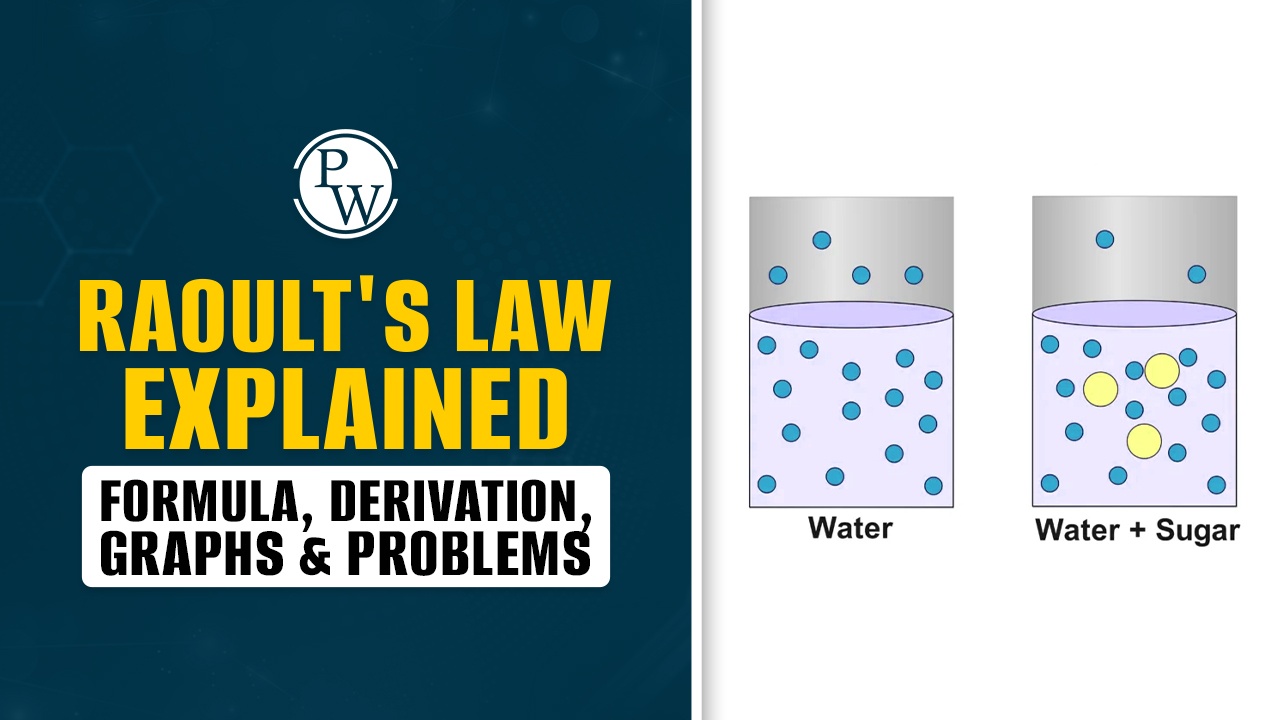
Raoult's Law
Physical Chemistry is an important and scoring section in JEE preparation, but it can be challenging for many students because it involves both concepts and calculations. Among the various topics in solutions and colligative properties, Raoult’s Law is considered one of the most important because a large number of questions are based on its formula, derivation, and applications.
Understanding what is Raoult’s Law is important, as it helps in solving problems related to vapour pressure and solution behaviour. Many questions in exams like JEE Main, JEE Advanced, and other competitive tests also involve the Raoult’s Law formula and its practical application.
Keeping all this in mind, PW has provided a complete guide covering everything about Raoult’s Law, including step-by-step derivations, formulas, graphs, and examples. These resources make it easier for students to revise effectively, solve numerical problems confidently, and score better in Physical Chemistry.
Check Out: PW JEE Books
What is Raoult’s Law?
Raoult’s Law is an important principle in Physical Chemistry that explains how the vapour pressure of a liquid solution depends on the concentration of its components. According to the law, the partial vapour pressure of each component in an ideal solution is directly proportional to its mole fraction in the solution. This means that when the amount of a substance in a solution increases, its contribution to the total vapour pressure also increases in the same proportion.
The law was proposed by the French chemist François-Marie Raoult in the late 19th century and has since become a key concept for understanding how real-world solutions behave. It provides the foundation for studying colligative properties, including lowering of vapour pressure, elevation of boiling point, and depression of freezing point. Raoult’s Law is also essential for distinguishing between ideal and non-ideal solutions, which is often tested in competitive exams like JEE Main, JEE Advanced, and NEET.
Check Out: JEE Previous Year Papers
Raoult's Law Formula
Using Raoult's Law Formula, students can calculate the total vapour pressure of a solution, determine the partial pressure of each component, and understand how mixing affects the behaviour of liquids. The formula is also the basis for many colligative property calculations.

The boxed formula is: P1 = X1 · P10
Similarly, for component 2: P2 = X2 · P20
The total vapour pressure, Ptotal = P1 + P2, for a binary ideal solution.
Graphical Representation of Raoult’s Law
The graphical representation of Raoult’s Law for a binary solution demonstrates how the partial vapour pressures of components A and B vary with their mole fractions. In an ideal solution, the partial vapour pressure of each component changes linearly with its mole fraction, with
𝑃𝐴 increasing as 𝑋𝐴 increases and 𝑃𝐵 decreasing as 𝑋𝐵 decreases.
The total vapour pressure of the solution, given by the sum of the partial pressures (𝑃=𝑃𝐴+𝑃𝐵), is represented by the upper line on the graph. At the extreme compositions, the total vapour pressure equals the vapour pressure of the pure component: 𝑃=𝑃𝐴0 when 𝑋𝐴=1 and 𝑋𝐵=0 and 𝑃=𝑃𝐵0 when 𝑋𝐴=0 and 𝑋𝐵=1. The straight lines in the graph confirm the linear relationship predicted by Raoult’s Law for ideal solutions, providing a clear visual representation of how vapour pressure depends on the composition of the mixture. Go through the graphical representation of Raoult's law here:-

Check Out: JEE Revision Books
Stepwise Derivation of Raoult's Law
Check out the Stepwise Derivation of Raoult's Law here:-
-
Consider a binary solution of two volatile liquids, 1 and 2, forming an ideal solution.
-
On mixing, the vapour above the solution contains both 1 and 2.
-
The escaping tendency of each depends on its proportion at the surface, i.e., mole fraction X1 and X2.
-
By the law, partial pressure of 1: P1 = X1 · P10
-
Partial pressure of 2: P2 = X2 · P20
-
Total vapour pressure: Ptotal = X1 · P10 + X2 · P20
-
These relations hold for every composition in an ideal solution.
Raoult's Law for Non Volatile Solute
When a substance that does not evaporate, like sugar or urea, is dissolved in a liquid solvent, only the solvent contributes to the vapour above the solution. The solute has no vapour pressure of its own. According to Raoult’s Law, the vapour pressure of such a solution depends on the fraction of solvent present:

In this formula, 𝑋solvent is the mole fraction of the solvent, and 𝑃solvent0 is the vapour pressure of the pure solvent. This explains why adding a non-volatile solute reduces the vapour pressure of the solution compared to the pure solvent.
Also Check, PW JEE Modules
Applications and Examples in JEE Chemistry
Raoult’s Law is an important concept in JEE Chemistry, especially for questions on solutions and their behaviour. It is commonly tested in both theory and numerical problems. Go through the applications and examples in JEE chemistry:-
-
Raoult’s Law allows you to determine the partial vapour pressures of each component in a binary solution and the total vapour pressure.
-
The law is fundamental in explaining how the addition of a solute lowers the vapour pressure of a solvent. This concept forms the basis for colligative properties such as boiling point elevation and freezing point depression, which are frequently asked in JEE questions.
-
Raoult’s Law helps in understanding how the vapour above a solution differs in composition from the liquid solution.
-
By using measured vapour pressures, you can calculate the mole fractions of components in a solution. This is a common type of problem in JEE numerical questions.
-
The law helps compare the volatility of components in a mixture, which is crucial in separation techniques like simple and fractional distillation.
-
Beyond exams, Raoult’s Law is used in industries for purifying organic solvents, designing distillation columns, and controlling compositions in chemical manufacturing.
Read More: Physics Formulas for JEE Exams
Raoult’s Law in JEE FAQs
1. What is the significance of Raoult’s Law in JEE?
It is used to calculate vapour pressures, mole fractions, and study colligative properties, distillation, and volatility of liquids.
2. What are ideal solutions?
Ideal solutions are those in which intermolecular forces between unlike molecules are similar to forces between like molecules. Raoult’s Law holds exactly for such solutions.
3. What are deviations from Raoult’s Law?
Real solutions may show:
-
Positive deviation: Weaker intermolecular forces → higher vapour pressure
-
Negative deviation: Stronger forces → lower vapour pressure
4. Can Raoult’s Law be applied to electrolytes?
No, it is not valid for strongly interacting or associating molecules like electrolytes or hydrogen-bonded compounds.
5. How does Raoult’s Law help in distillation?
It predicts the composition of vapour above a solution, helping determine which component vaporises first and guiding separation techniques.