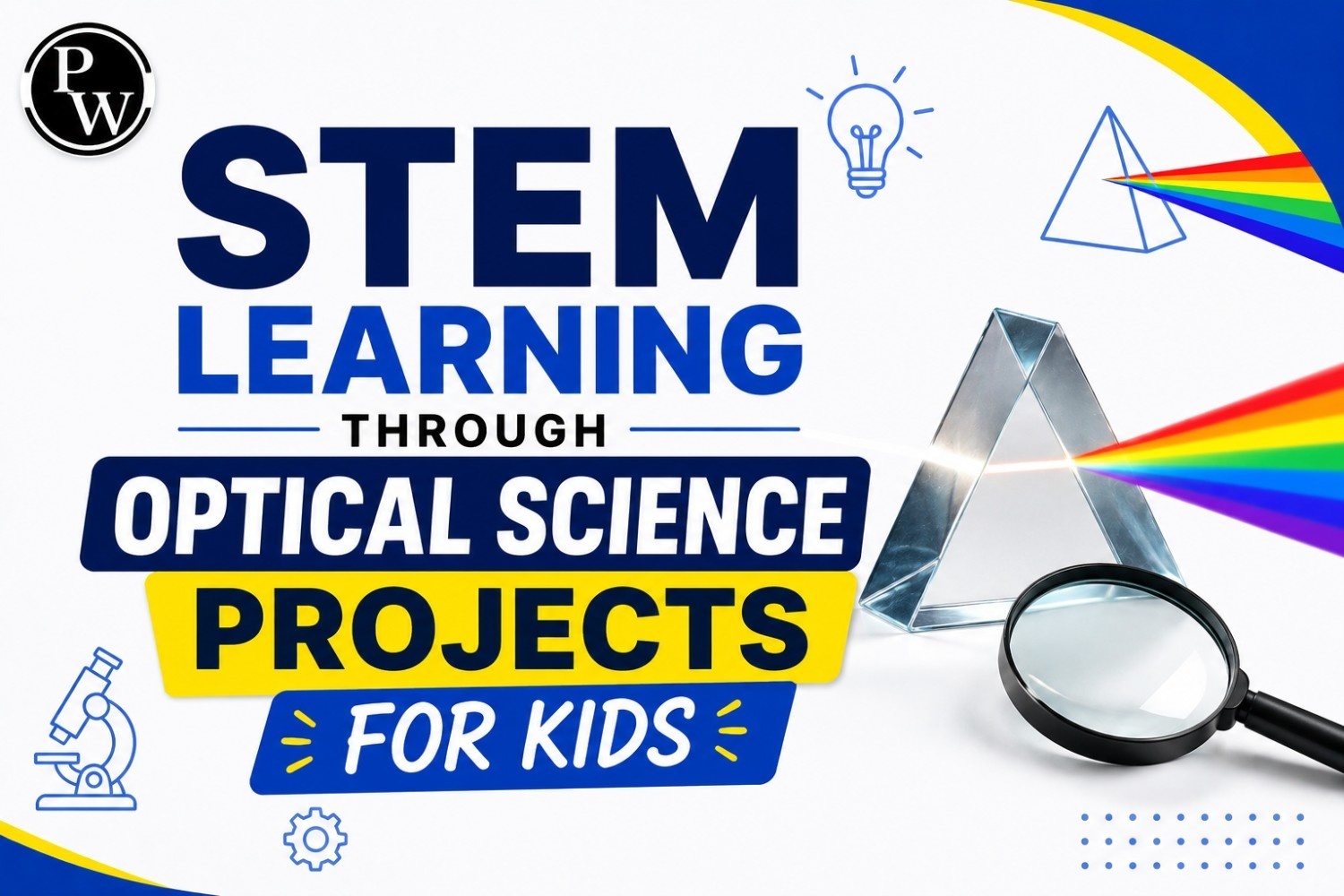
STEM Learning Through Optical Science Projects for Kids
Many students struggle to imagine how light can bend, reflect or split up into colours, and so they simply memorise instead of really understanding.
This is solved by introducing hands-on optics science projects that bring the abstract physics to visible, real-world experiences. Experimenting with shadows, lenses and mirrors, children develop critical thinking skills and a genuine interest in scientific discovery.
Check Out: Kids Experiment Kits
Importance of Optical Science Projects
Optical science projects are the bridge between theoretical definitions and everyday reality. When children play with light themselves, they see how it interacts with different materials. Active participation of this kind builds deeper cognitive links than passive reading ever could.
These STEM science projects for kids promote curiosity and observational skills. Students start to question why their reflection is seen upside down in a spoon, or how rain makes rainbows. They learn the answers by experimenting and develop a solid foundation in the scientific method that will help them in higher classes.
How do Optical Science Projects Help Understand Scientific Concepts?
Optical activities introduce several fundamental principles of physics. Understanding these concepts early makes advanced physics much easier to handle later on.
The Physics of Reflection and Refraction
Reflection occurs when light bounces off a smooth surface, such as a mirror or calm water. Refraction is when light moves from one material to another (like from air to water), and the speed of the light changes. The light bends.
Understanding Light Absorption and Transmission
Objects interact with light in three distinct ways:
-
Transparent: Materials allow around 100% of light to pass through clearly, like window glass.
-
Translucent: Materials scatter the light, making images blurry, like tissue paper or frosted glass.
-
Opaque: Materials block light entirely, creating distinct dark shadows on the opposite side.
Benefits of Optical Science Projects Kits
Investing in a dedicated science kit offers several distinct advantages for home education:
-
Safety: All items, including light sources and structural parts, are designed for child safety.
-
Accuracy: Lenses have correct focal lengths to ensure clear magnification and sharp focus.
-
Durability: Sturdy components allow children to repeat experiments multiple times without wear.
-
Guidance: Detailed manuals explain the background science clearly, helping parents guide the lesson easily.
Combining independent hands-on STEM experiments kits creates a rich learning environment that keeps children engaged for hours.
Optical Science Projects for Kids
Incorporating optics into home learning aids in the overall development of education. These activities combine science, technology, engineering and maths into one lesson.
|
Experiment Name |
Core Materials Needed |
Key Skill Developed |
Estimated Time |
|
Shadow Puppets |
Torch, cardboard shapes, wall |
Spatial awareness |
Around 15 minutes |
|
Water Lens |
Clear plastic wrap, drop of water, text |
Magnification analysis |
Around 10 minutes |
|
Colour Wheel |
Cardboard, markers, string |
Colour synthesis |
Around 20 minutes |
Using Optical Science Projects kits for kids helps students track data, measure angles of reflection, and design their own structural setups. This cross-disciplinary approach turns simple play into structured learning.
Optical Science Projects for the Visible Light Spectrum
For older primary school pupils, experiments can focus on advanced properties like the visible light spectrum. White light is actually an equal mixture of seven different colours.
Using a glass prism is the easiest way to show this splitting effect, known as dispersion. When a narrow beam of sunlight passes through a prism, the different wavelengths bend at slightly different angles. This separation creates a clear rainbow band on a white wall, showing red, orange, yellow, green, blue, indigo, and violet.
Optical Science Projects for STEM Learning
To get the most educational value from these tasks, parental guidance should focus on open-ended questioning. Instead of simply explaining the answer, ask children what they think will happen before the test begins.
Encourage them to change variables systematically. For instance, during light science projects for students, ask them to move the torch closer to an object and then further away. Let them measure the changing length of the shadow with a ruler to practice data collection and graphing.
Check out: PW Science Kit for School Projects
How to Set Up Optical Science Projects at Home
Setting up a dedicated workspace for optical science projects does not require an expensive laboratory. With a few simple adjustments to a standard room, you can create a perfect environment for safe and accurate optics experiments for kids. Follow these practical steps to prepare your home testing area.
1. Control the Light Levels
The most important factor in light-based STEM science projects for children is controlling external light. Find a room with dark curtains or blinds that can block out daylight completely. If a room is too bright, weak torch beams and faint reflections will be invisible, which often leads to confusion during hands-on STEM experiments.
2. Prepare a Level, Matte Testing Surface
Place a sturdy table against a plain, light-coloured wall. It is right to avoid shiny or polished wooden tables, as they cause secondary reflections that interfere with your observations. Covering the table with a sheet of matte black or white sugar paper provides an ideal backdrop for tracking light beams clearly.
3. Arrange Your Core Tools Safely
Before starting any STEM learning activities for kids, organise your components on one side of the table. Keep your torches, water tumblers, and lenses within arm's reach. If you are using science kits for kids, use the provided plastic trays to keep small mirrors from rolling off the table and scratching.
4. Create a Fixed Alignment Path
When conducting light science projects for students, slight movements can ruin your alignment. Use small pieces of removable blue tack or masking tape to fix your light source and targets to the table. This keeps the path steady, allowing children to measure angles accurately with a protractor without the equipment sliding around.
Optical Science Projects to Try at Home
You do not need an advanced laboratory to explore the properties of light. These simple activities use basic household items to deliver powerful educational results.
The Bending Pencil Trick
This activity demonstrates refraction in just a few seconds.
-
Fill a clear glass tumbler around three-quarters full with clean water.
-
Place a straight wooden pencil vertically into the water.
-
Look through the side of the glass at the water line.
The pencil appears broken or shifted at the point where the air meets the water. This happens because light travels faster through air than it does through water, bending the visual path.
DIY Cardboard Periscope
Kids learn how mirrors change the direction of light paths by building a periscope. To make one, take an old cereal box and fashion it into a long rectangular tube. Place two small pocket mirrors in the tube, one at the top and one at the bottom.
Position the two mirrors to face each other at about a 45° angle. Light comes in through the top opening and is reflected by the first mirror down the tube, striking the second mirror and passing straight into the observer's eye.
Read More: 21 Educational STEM Projects
Optical Science Projects for Kids FAQs
What age group is suitable for optical science projects?
Most basic light activities are perfect for children aged between 6 and 12 years old. Younger children enjoy exploring shadows and reflections, while older students can grasp complex ideas like refraction indices and light dispersion through prisms.
Do I need expensive equipment for optics experiments for kids?
No, many foundational concepts require nothing more than torches, mirrors, water glasses, and paper. However, using specialised educational science kits for kids provides cleaner results and allows for advanced technical setups.
How does learning about light help with STEM skills?
Light experiments involve measuring angles, observing changes, recording data, and designing devices like periscopes. This naturally combines physics, maths, and engineering design principles into practical lessons.
Can optical science projects be done safely indoors?
Yes, these projects are highly suited for indoor learning. You only need standard household torches or natural sunlight. Avoid using laser pointers or high-powered industrial lights to protect young eyes.
How do kits improve STEM science projects for children?
Kits provide precise, durable components like proper convex lenses and steady mounts. This reduces setup errors, ensuring that children observe clear, accurate scientific reactions every single time.