NEET Chemistry Questions for 2026 Exam
NEET Chemistry Questions for 2026 Exam: The National Eligibility cum Entrance Test (NEET) 2026 is expected to be held in the first week of May 2026, as per the usual exam schedule. It is a national-level medical entrance exam conducted for students who wish to pursue MBBS, BDS, or other medical courses in India. The NEET 2026 exam will be for a total of 720 marks and will cover three main subjects, Physics, Chemistry, and Biology. Among these, Biology carries the highest weightage of 360 marks, while Chemistry and Physics each carry 180 marks.
Chemistry plays a very important role in NEET, especially when students aim for high scores. A good number of NEET Chemistry questions are fact-based, formula-driven, and concept-oriented, which means they can be solved quickly if concepts are clear. Many toppers agree that mastering the chemistry NEET question types can significantly boost overall scores. Since every mark counts in this competitive exam, focusing on Chemistry is just as important as Biology. In this article, we will explore the types of NEET Chemistry questions, important topics, and tips to score well in this section.
Check Out: PW NEET Books
NEET Chemistry Important Topics
Preparing for NEET Chemistry can be easier and more effective if students know which topics to focus on. Every year, certain chapters carry more weight in the exam, and questions are often repeated or follow similar patterns.
Analysing NEET Chemistry PYQ (Previous Year Questions) is one of the effective ways to understand these trends. Many students find that the Chemistry NEET PYQ not only help with revision but also give a clear idea of which topics are more important. Since Chemistry holds 180 marks out of the total 720 in NEET, focusing on high-yield topics can make a big difference in your final score. Below is a table listing the most important NEET Chemistry topics along with their average weightage based on past year papers.
|
Chapter/Topic |
Branch |
Average No. of Questions |
Importance Level |
|
Chemical Bonding and Molecular Structure |
Physical + Inorganic |
3-4 |
High |
|
Organic Chemistry – Basic Principles |
Organic |
2-3 |
High |
|
Thermodynamics |
Physical |
2-3 |
Medium-High |
|
Coordination Compounds |
Inorganic |
2-3 |
High |
|
Electrochemistry |
Physical |
2 |
Medium |
|
p-Block Elements |
Inorganic |
2-3 |
High |
|
Biomolecules |
Organic |
1-2 |
Medium |
|
Chemical Kinetics |
Physical |
2 |
Medium |
|
Aldehydes, Ketones and Carboxylic Acids |
Organic |
2 |
High |
|
Equilibrium |
Physical |
2-3 |
Medium-High |
Check Out: NEET Previous Year Papers
NEET Chemistry Questions for 2026 Exam
1. If law of conservation of mass was to hold true, then 20.8 g of BaCl₂ on reaction with 9.8 g of H₂SO₄ will produce 7.3 g of HCl and BaSO₄ equal to:
a) 11.65 g
b) 23.3 g
c) 25.5 g
d) 30.6 g
2. Express the result of (0.582 + 324.65) to the appropriate number of significant figures:
a) 325.24
b) 325.23
c) 325.2
d) 325.232
3. The law of conservation of mass holds good for all of the following, except:
a) All chemical reactions
b) Nuclear reaction
c) Endothermic reactions
d) Exothermic reactions
4. 170 g of AgNO₃ reacts with 100 mL of 0.1M HCl to produce 1.435 g of AgCl and 0.63 g of HNO₃.
This data illustrates:
a) Law of conservation of mass
b) Law of constant proportions
c) Law of multiple proportions
d) Law of reciprocal proportions
5. The number of significant figures in value 5.041 is:
a) 5
b) 2
c) 3
d) 4
6. The correctly reported answer of the addition of 29.4406, 3.2 and 2.25 will have significant figures:
a) 3
b) 2
c) 4
d) 5
7. Two students X and Y report the mass of the same substance as 7.0 g and 7.00 g respectively. Which of the following statements is correct?
a) Both are equally accurate
b) X is more accurate than Y
c) Y is more accurate than X
d) Both are inaccurate scientifically
8. 36 g of S reacts with 16 g of O₂ to produce 48 g of SO₃.
This illustrates:
a) Law of constant proportions
b) Law of conservation of mass
c) Law of reciprocal proportions
d) Law of multiple proportions
9. The number of significant figures in value of π is:
a) 1
b) 3
c) 4
d) ∞
10. Two elements X and Y combine in gaseous state to form XY in the ratio 1:3.5 by mass. The mass of Y that will be required to react with 2 g of X is:
a) 7.1 g
b) 3.55 g
c) 71 g
d) 35.5 g
11. If an object has a mass of 0.2876 g, then find the mass of six such objects:
a) 2.5884 g
b) 2.5886 g
c) 2.5 g
d) 2.589 g
12. Which of the following data illustrates the law of conservation of mass?
a) 56 g of C reacts with 32 g of O₂ to produce 44 g of CO₂
b) 12 g of C is heated in vacuum and on cooling, there is no change in mass
c) 170 g of AgNO₃ reacts with HCl to produce AgCl and HNO₃
d) 36 g of S reacts with 16 g of O₂ to produce 48 g of SO₃
13. 44 g of an oxide of nitrogen gives 22.4 L of nitrogen and 60 g of another oxide gives 22.4 L of nitrogen at S.T.P.
The data illustrates:
a) Law of conservation of mass
b) Law of constant proportions
c) Law of multiple proportions
d) Law of reciprocal proportions
14. The correctly reported answer of the area of rectangle which is 12.34 cm long and 1.23 cm wide is:
a) 15.2 m²
b) 15.2 cm²
c) 15.1 cm²
d) 15.17 cm²
15. Hydrogen and oxygen gases combine to form H₂O and H₂O₂ containing 5.93% and 11.2% hydrogen respectively. The data illustrates:
a) Law of constant proportions
b) Law of reciprocal proportions
c) Law of multiple proportions
d) Law of conservation of mass
For more NEET Chemistry Questions for 2026 Exam, click the link below.
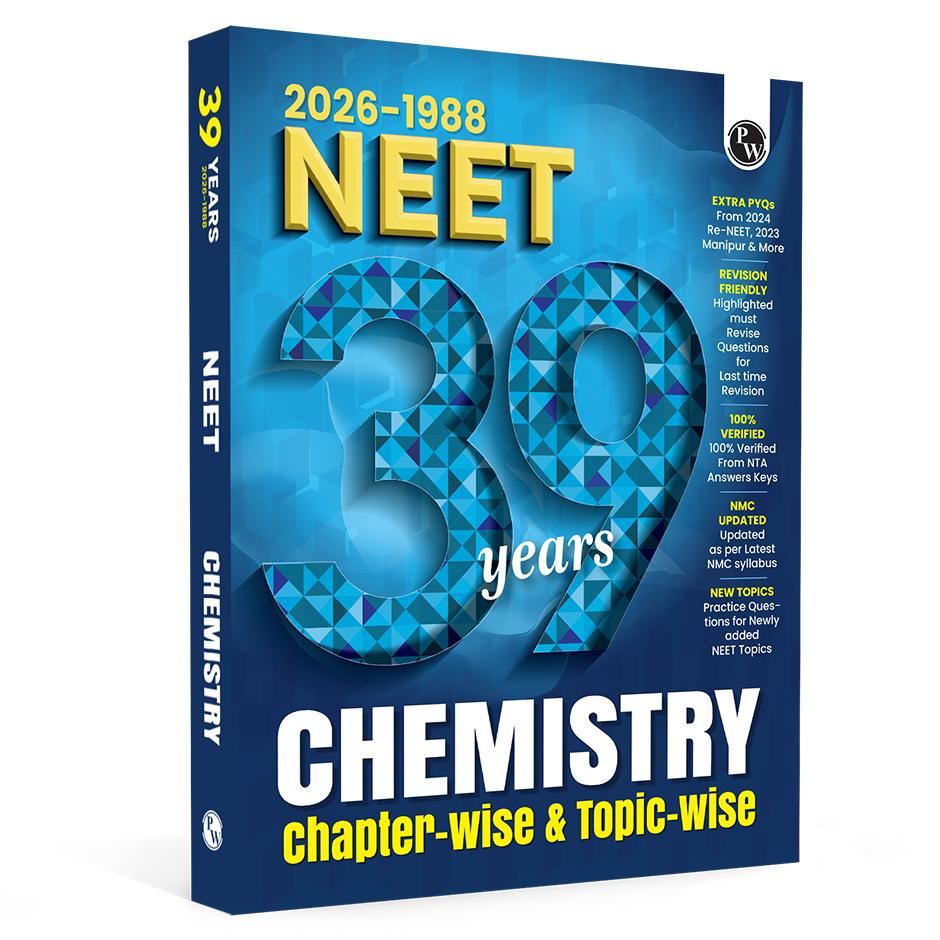
The NEET MedEasy Handwritten Notes Chemistry helps students revise important Chemistry concepts quickly and effectively, while the 39 Years NEET PYQ Chemistry book provides extensive previous year question practice to help you understand exam trends, improve accuracy, and strengthen your preparation for NEET 2026.
How to Prepare for NEET 2026?
Preparing for NEET Chemistry can be easy and effective if you follow the right strategy. Chemistry is often considered a scoring subject in NEET because many questions are direct and based on formulas or facts. With 45 questions worth 180 marks, Chemistry can give you a big advantage in your total score.
1. Understand the Structure of NEET Chemistry
NEET Chemistry is divided into three parts: Physical, Organic, and Inorganic Chemistry. Each part requires a different way of studying. Chemistry carries 180 marks out of 720, with 45 questions in the NEET paper. Many of these NEET chemistry questions are directly picked or twisted from NCERT. Before starting preparation, know what each part includes and what it demands:
-
Physical Chemistry – Numerical-based and concept-heavy.
-
Organic Chemistry – Based on reactions, mechanisms, and memory.
-
Inorganic Chemistry – Mostly fact-based, from NCERT.
2. Study NCERT Books Thoroughly
NCERT textbooks for Class 11 and 12 are the most important books for NEET Chemistry. Every line can be turned into a question. For Inorganic and Organic Chemistry, especially, NCERT is the ultimate source. Go through each line carefully and underline important facts. Make short notes for revision.
-
Read the CERT line by line.
-
Highlight key facts, definitions, and examples.
-
Revise the NCERT frequently, especially for the Inorganic chapters.
3. Focus on Important Topics from NEET PYQs
Not all chapters have the same weightage. Some topics are frequently repeated in NEET chemistry pyq papers. Analysing these past year questions helps you understand which chapters to prioritise.
You should practise chemistry NEET pyq regularly and focus more on topics from which more questions are asked.
-
Chemical Bonding and Molecular Structure
-
Thermodynamics
-
Coordination Compounds
-
Aldehydes, Ketones, and Carboxylic Acids
-
p-block Elements
4. Practice Physical Chemistry Regularly
Physical Chemistry involves formulas, calculations, and concepts. If you understand the basics well, you can easily solve these NEET chemistry questions quickly in the exam. You must practise numerical problems daily and memorise formulas.
-
Start with concepts before jumping to questions.
-
Maintain a formula notebook.
-
Solve 5–10 numerical problems from each topic daily.
-
Practice NEET chemistry pyq for Physical Chemistry chapters.
5. Master Organic Chemistry with Reactions and Mechanisms
Organic Chemistry is scoring but requires consistent revision. You need to remember reactions, named reactions, reagents, and mechanisms.
Understand the reaction logic. Don’t just memorise blindly. Make flowcharts for reaction types.
-
Understand General Organic Chemistry (GOC) first.
-
Learn IUPAC naming and isomerism.
-
Prepare notes of named reactions and their mechanisms.
-
Use chemistry NEET questions from previous years to revise.
Check Out: NEET Question Banks
6. Memorise Inorganic Chemistry with Smart Tricks
Inorganic Chemistry is full of facts and trends from the periodic table. Most questions are directly picked from NCERT, so revising NCERT regularly is the key. Use mnemonics and mind maps to remember groups, blocks, and trends.
-
Focus on s-block, p-block, d-block, and Coordination Compounds.
-
Use NCERT-based chemistry NEET PYQ to revise.
-
Make short notes for every group and element properties.
7. Solve NEET Chemistry Questions Every Day
Practising daily builds confidence and helps you stay exam-ready. Don’t wait till you finish the syllabus. Start solving NEET chemistry questions from the beginning. Solve chapter-wise questions first and then move on to full-syllabus practice.
-
Use books like NCERT, PYQs, or a question bank at your Fingertips.
-
Solve 30–40 questions every day.
-
Check answers and learn from mistakes.
-
Use NEET PYQ to test real exam patterns.
8. Take Chapter-wise and Full Mock Tests
After completing a chapter, take a test on that chapter. This helps in checking your understanding and improves speed and accuracy. In the last months, focus on full syllabus mock tests. Use only NEET-based test series or NEET Chemistry PYQ to stay aligned with the actual exam.
9. Make a Personal Revision Notebook
A separate notebook for formulas, short tricks, and important reactions will help during revision. You can carry it everywhere and revise anytime.
-
All formulas from Physical Chemistry.
-
Organic name reactions and mechanisms.
-
NCERT-based facts from Inorganic Chemistry.
-
Mistakes made in tests or mock papers.
Read More: NEET Previous Year Question Papers with Solutions PDF
NEET Chemistry Question FAQs
1. What is the weightage of Chemistry in the NEET exam?
Chemistry carries 180 marks in NEET, with 45 questions out of the total 180. These questions are spread across Physical, Organic, and Inorganic Chemistry.
2. Are NCERT books enough for NEET Chemistry?
Yes, NCERT books for Class 11 and 12 are more than enough for chemistry neet questions, especially in Inorganic and Organic Chemistry.
3. How can I score 160+ in NEET Chemistry?
To score high:
-
Master NCERT
-
Solve NEET Chemistry PYQ regularly
-
Practice numerical problems
-
Revise important reactions and formulas often
4. Which topics are most important for Chemistry NEET questions?
High-weightage topics include:
-
Chemical Bonding
-
Thermodynamics
-
Organic Reactions
-
Coordination Compounds
-
p-Block Elements
5. When will NEET 2026 be conducted?
NEET 2026 is expected to be held in the first week of May 2026, following the usual NTA pattern.