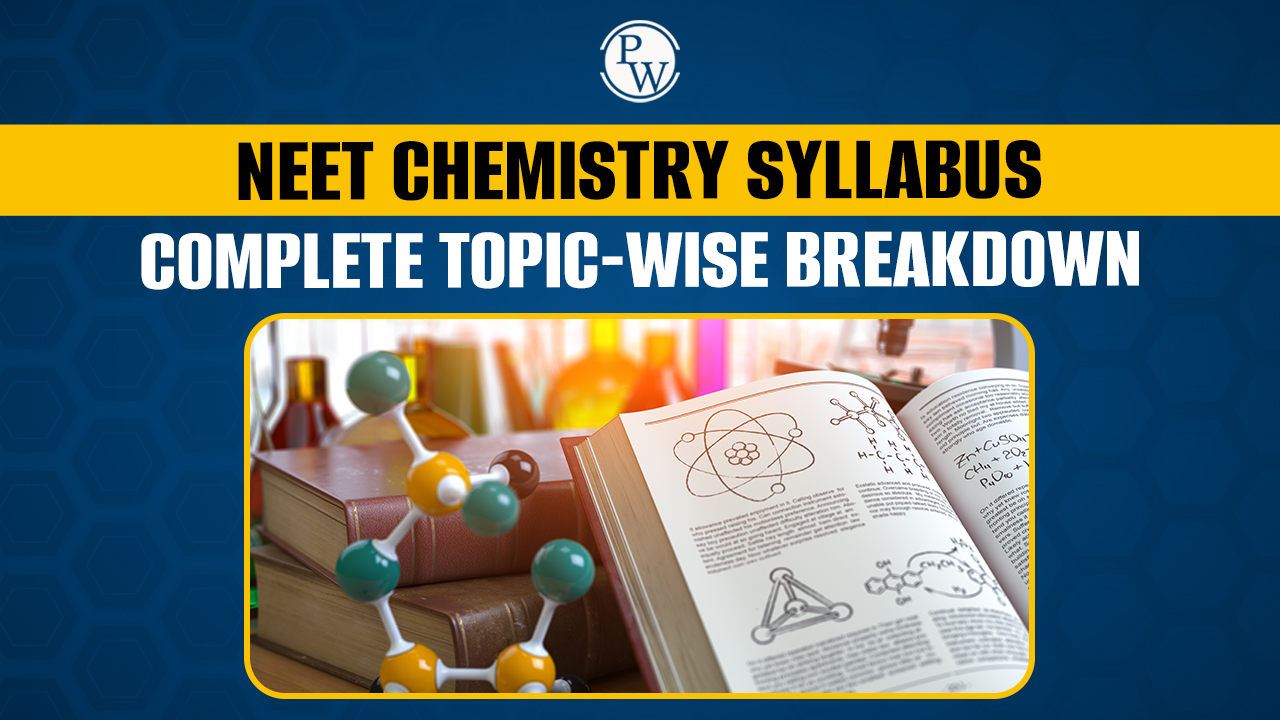
NEET Chemistry Syllabus - Complete Topic-wise Breakdown
NEET Chemistry Syllabus: The NEET exam is held every year for students who wish to get admission into medical and dental colleges across India. It is one of the most competitive exams and includes three main subjects: Physics, Chemistry, and Biology. Among these, Chemistry is often seen as a scoring subject because many questions are based on direct facts and simple concepts.
The NEET Chemistry syllabus covers chapters from both Class 11 and Class 12. It is divided into three main parts: Physical Chemistry, Organic Chemistry, and Inorganic Chemistry. All the topics in the chemistry NEET syllabus are taken from the NCERT textbooks, so going through each chapter carefully is very important.
Knowing the complete NEET syllabus 2027 for Chemistry helps students make a good study plan. When you are clear about what to study, it becomes easier to revise regularly and solve practice papers with confidence. A strong grip on Chemistry can help improve your overall NEET score.
Check Out: NEET Books
NEET Chemistry Exam Pattern
In the NEET exam, Chemistry is one of the three main subjects along with Physics and Biology. The Chemistry section plays an important role in your final score. It is divided into two sections: Section A and Section B. Section A has 35 questions and Section B has 15 questions. Out of the 15 questions in Section B, you can attempt any 10. Each question is of 4 marks, and 1 mark is deducted for every wrong answer. Check out the details here:-
|
Particulars |
Details |
|
Subject Name |
Chemistry |
|
Total Questions |
50 (45 to be attempted) |
|
Sections |
Section A – 35 questions Section B – 15 questions (Attempt any 10) |
|
Question Type |
Multiple Choice Questions (MCQs) |
|
Marks for Correct Answer |
4 Marks |
|
Marks for Wrong Answer |
-1 mark |
|
Total Marks |
180 marks |
|
Syllabus Covered |
Class 11 & 12 NCERT-based |
NEET Chemistry Syllabus 2027 For Class 11
The NEET Chemistry syllabus 2027 for Class 11 forms the basic foundation for Chemistry in NEET. These topics help students understand important concepts that are used in higher-level chapters. The syllabus includes chapters like Some Basic Concepts of Chemistry, Structure of Atom, Thermodynamics, Chemical Bonding, Equilibrium, and more.
These topics focus on understanding chemical principles, reactions, and calculations. Most questions are concept-based and directly taken from NCERT books. Check out the NEET Chemistry Syllabus 2027 For Class 11:-
|
NEET Chemistry Syllabus 2027 For Class 11 |
|
|
Chapter Name |
Topics |
|
Some Basic Concepts of Chemistry |
Mole Concept, Determination of Formula of Compound, Stoichiometric Calculations, Concentration Terms, Relation Between Molarity and Normality |
|
Redox Reactions |
Oxidation Number, Redox Reactions, Balancing of Redox Reactions, Electrochemical Cell |
|
Structure of Atom |
Subatomic Particles, Concept of Atomic Number and Mass Number, Bohr's Model of an Atom, Particle Nature of Electromagnetic Radiation, Photoelectric Effect, Quantum Mechanical Model, Quantum Numbers, Electronic Configuration of Atoms |
|
Thermodynamics |
P-V Work, Heat Capacity, Thermochemistry, Second Law of Thermodynamics |
|
Equilibrium |
Applications of Equilibrium Constant, Equilibrium Constant, Factors Affecting State of Equilibrium, Expressing Hydrogen Ion Concentration, Buffer Solution, Solubility of Sparingly Soluble Salts |
|
Organic Chemistry – Some Basic Principles and Techniques |
Naming the Organic Compounds, Isomerism in Organic Compounds, Electronic Displacements in Covalent Compounds, Reaction Intermediates, Hybridisation |
|
Hydrocarbons |
Conformations of Hydrocarbons, Isomerism in Alkenes, Stability of Alkene, Chemical Reactions of Alkenes, Chemical Reactions of Alkynes, Aromatic Hydrocarbons, Chemical Reactions of Aromatic Hydrocarbons |
|
Classification of Elements and Periodicity in Properties |
Modern Periodic Table, Periodic Trends in Properties of Elements |
|
Chemical Bonding and Molecular Structure |
General Introduction, Polarity of Bonds, Covalent Character in Ionic Bonds, Geometry or Shapes of Molecules, Concept of Orbital Overlap in Covalent Bonds, Molecular Orbital Theory (MOT), Hydrogen Bond |
|
Principles Related To Practical Organic Chemistry |
Analysis of Organic Compounds, Volumetric Analysis, Qualitative Salt Analysis, Enthapy |
|
The p-Block Elements Part 1 |
Group-13 Elements, Group-14 Elements |
Check Out: NEET Previous Year Papers
NEET Chemistry Syllabus 2027 For Class 12
The NEET Chemistry syllabus 2027 for Class 12 includes more advanced and scoring topics. It builds on the basics learnt in Class 11 and focuses on deeper understanding and application. Chapters like Solid State, Solutions, Electrochemistry, Chemical Kinetics, Coordination Compounds, Haloalkanes, Aldehydes and Ketones, Biomolecules, and others are a part of this syllabus.
These topics often involve chemical reactions, mechanisms, numerical problems, and factual data, especially in Inorganic Chemistry. Questions from the Class 12 Chemistry NEET syllabus are commonly seen in NEET and are sometimes direct from the NCERT textbook.
|
NEET Chemistry Syllabus 2027 For Class 12 |
|
|
Chapter Name |
Topics |
|
Solutions |
Solubility of Gases in Liquids, Vapour Pressure of Liquid Solutions, Colligative Properties, Abnormal Molar Masses |
|
Chemical Kinetics |
Dependence of Reaction Rate on Concentration, Integrated Rate Expressions, Dependence of Reaction Rate on Temperature |
|
Electrochemistry |
Electrolytic Conduction, Variation of Conductivity and Molar Conductivity with Concentration, Kohlrausch's Law, Electrochemical or Galvanic Cell, Electrochemical Series, Dependence of Cell and Electrode Potentials on Concentration, Electrolytic Cells and Electrolysis, Fuel Cells |
|
Haloalkanes and Haloarenes |
Chemical Properties of Haloalkanes, Chemical Properties of Haloarenes, Polyhalogen Compounds |
|
Alcohols, Phenols and Ethers |
Alcohols: Reactions Involving Cleavage of (O-H) Bond, Alcohols: Reactions Involving Cleavage of (C-O) Bond, Alcohols: Reactions Involving Cleavage of Both Alkyl & Hydroxyl Groups, Phenols: Reactions of Phenolic Group, Phenols: Reactions of Benzene Ring, Phenols: Special Reactions, Distinction Between Alcohols and Phenols |
|
Aldehydes, Ketones and Carboxylic Acids |
Aldehydes & Ketones: Nucleophilic Addition Reactions, Aldehydes & Ketones: Oxidation Reactions, Aldehydes & Ketones: Reduction Reactions, Aldehydes & Ketones: Reaction with Base, Carboxylic Acids |
|
Amines |
Preparation Methods, Chemical Properties, Ring Substitution in Aromatic Amines, Distinction Between Amines |
|
Biomolecules |
Glucose and Fructose, Glucose: Reaction Due to Open Chain Structure, Disaccharides, Proteins, Nucleic Acids |
|
Coordination Compounds |
Ligands, Werner's Theory, Coordination Compounds, Isomerism in Coordination Compounds, Bonding in Coordination Compounds |
|
The d- and f- Block Elements |
Introduction, General Properties of Transition Elements, Compounds of Transition Metals, Inner Transition Elements (Lanthanoids), Inner Transition Elements (Actinoids) |
|
The p-Block Elements Part 2 |
Group-15 Elements, Group-16 Elements, Group-17 Elements, Group-18 Elements |
Check Out: NEET Question Banks
Section-wise NEET Chemistry Syllabus 2027
The NEET Chemistry Syllabus 2027 is divided into three main sections: Physical Chemistry, Organic Chemistry, and Inorganic Chemistry. Each part of the Chemistry syllabus has topics from both Class 11 and Class 12 NCERT books. Knowing how the syllabus is divided helps students pay proper attention to every area.
Physical Chemistry includes chapters that need practice with numerical questions, like Thermodynamics and Equilibrium. Organic Chemistry is about carbon compounds and how they react, so it needs a good understanding of reaction steps and types. Inorganic Chemistry mostly has facts and trends from the periodic table, so it requires good memory and revision.
|
Section |
Topic |
Sub-Topics |
|
Physical Chemistry |
Basic Concepts of Chemistry |
Atomic structure, Elements, and Classification of Elements |
|
States of Matter: Gases and Liquids |
Kinetic theory, Real gases, Liquid state |
|
|
Thermodynamics |
Work, Heat, Enthalpy, First and Second Law, Entropy, Gibbs energy, Gibbs-Helmholtz equation, Thermochemistry |
|
|
Chemical Equilibrium |
Law of mass action, Le Chatelier’s principle, pH scale, Solubility product, Buffer solutions, Hydrolysis |
|
|
Redox Reactions |
Balancing redox equations, Nernst equation, EMF of cells, Electrolysis, Fuel cells, Corrosion |
|
|
Chemical Kinetics |
Rate of reaction, Arrhenius equation, Factors affecting rate, Collision theory, Catalysis |
|
|
Surface Chemistry |
Adsorption, Colloids, Emulsions, Micelles |
|
|
Organic Chemistry |
Basic Principles of Organic Chemistry |
Tetravalency, Hybridization, Resonance, Inductive effect, Hyperconjugation, Acid-Base properties, Isomerism |
|
Hydrocarbons |
Alkanes, Alkenes, Alkynes, Aromatic hydrocarbons, Electrophilic substitution |
|
|
Organic Compounds Containing Halogens |
Haloalkanes, Haloarenes – Preparation, Properties, C–X bond, Uses |
|
|
Organic Compounds Containing Oxygen |
Alcohols, Phenols, Ethers, Aldehydes, Ketones, Carboxylic acids, Reactions like Reimer-Tiemann, Clemmensen reduction, Oxidation, Esterification |
|
|
Organic Compounds Containing Nitrogen |
Amines, Diazonium salts, Hofmann bromamide reaction, Basicity, Structure, Classification |
|
|
Polymers |
Types of polymers, Addition and condensation polymers, Copolymerization, Biodegradable and Conducting polymers |
|
|
Biomolecules |
Carbohydrates, Proteins, Enzymes, Vitamins, Nucleic acids, Hormones |
|
|
Chemistry in Everyday Life |
Drugs and their action, Food additives, Soaps and detergents |
|
|
Principles Related to Practical Chemistry |
Detection of elements and functional groups, Analysis of food components, Chromatography, Spectrometry |
|
|
Inorganic Chemistry |
Classification of Elements & Periodicity |
Modern periodic table, Trends in properties, Electronic configuration, Ionisation energy, Electronegativity |
|
General Principles of Isolation of Metals |
Metallurgy basics, Extraction and refining of metals, Enrichment of ores |
|
|
Hydrogen |
Properties, Isotopes, Uses, Position in the periodic table, Hydrides |
|
|
s-Block Elements |
Group 1 and 2 elements – Alkali and alkaline earth metals |
|
|
p-Block Elements |
Group 13 to 18 – Boron family, Carbon family, Nitrogen family, Oxygen family, Halogens, Noble gases |
|
|
d- and f-Block Elements |
Transition and inner transition metals, Properties, Compounds, Colour, Magnetic behaviour |
|
|
Coordination Compounds |
Nomenclature, Bonding (VBT & CFT), Isomerism, Werner’s theory |
|
|
Environmental Chemistry |
Pollution types, Ozone depletion, Green chemistry practices |
Also Check, NEET Revision Books
1. Know What to Study First: Before starting your preparation, check the full NEET Chemistry syllabus properly. It includes all chapters from Class 11 and 12 and is divided into Physical, Organic, and Inorganic Chemistry. When you know what’s included in the NEET 2027 syllabus or even the NEET 2027 syllabus, it becomes easier to plan your studies.
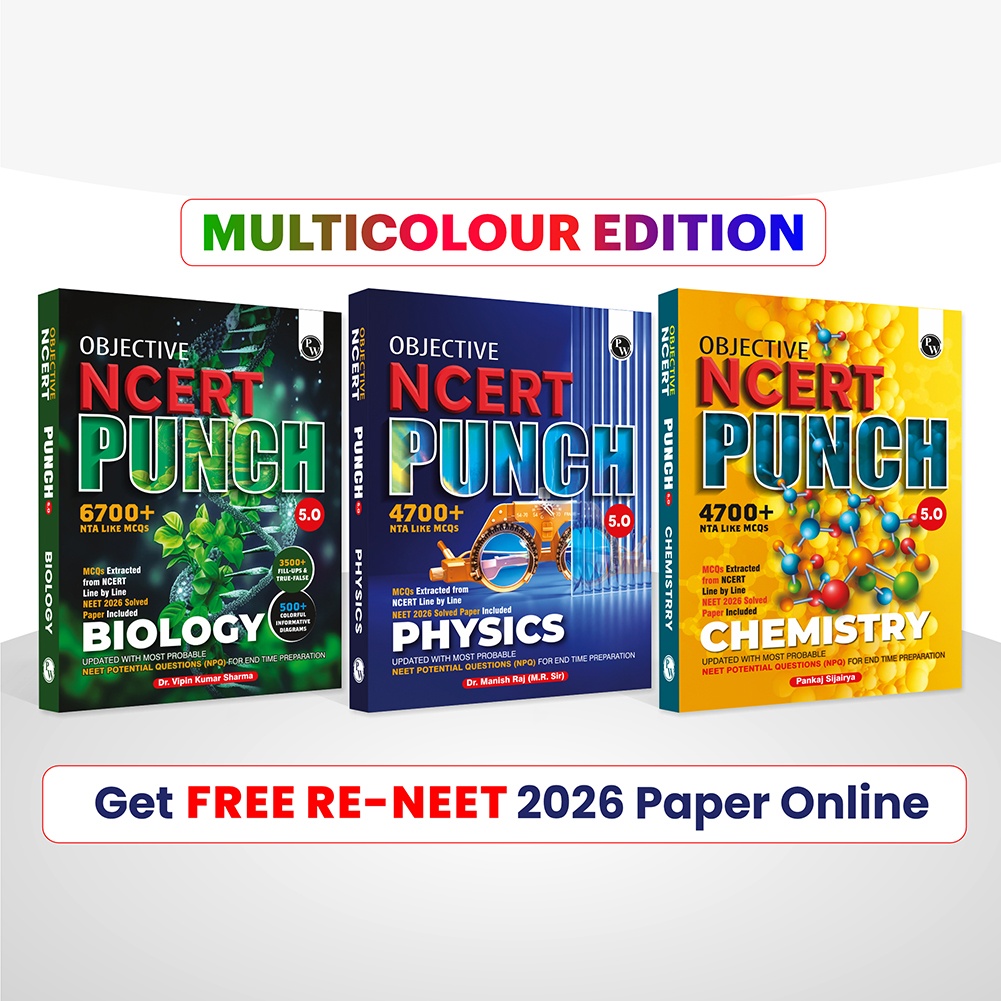
2. Stick to NCERT Books: Most of the questions in the exam come from NCERT. Whether it’s Inorganic Chemistry chapters or any other topic, reading NCERT line by line is very important. Try to understand the concepts clearly while reading and pay attention to important facts, reactions, and examples. To strengthen your NCERT-based preparation and practice exam-oriented questions, you can also use the NEET Objective NCERT Punch Chemistry book, which is designed to reinforce key concepts through topic-wise questions and targeted practice.
3. Make Notes in Your Own Words: While reading, write down short notes. You can note important formulas, reactions, or points. This will help you revise faster later, especially during the last few weeks before the exam.
4. Practise Numerical Questions Regularly: Physical chemistry chapters for NEET include many calculations. Try to practise sums from Thermodynamics, Equilibrium, and Chemical Kinetics daily. This will improve your speed and confidence.
5. Revise Inorganic Chemistry Often: Inorganic chemistry chapters have many facts and trends that are easy to forget. Try to revise them again and again. Use coloured pens or charts to make them easy to remember.
6. Understand Organic Chemistry Reactions: Organic chemistry is not just about memorising. Try to understand how and why reactions happen. Learn the name reactions and practice conversions, so you don’t get confused in the exam.
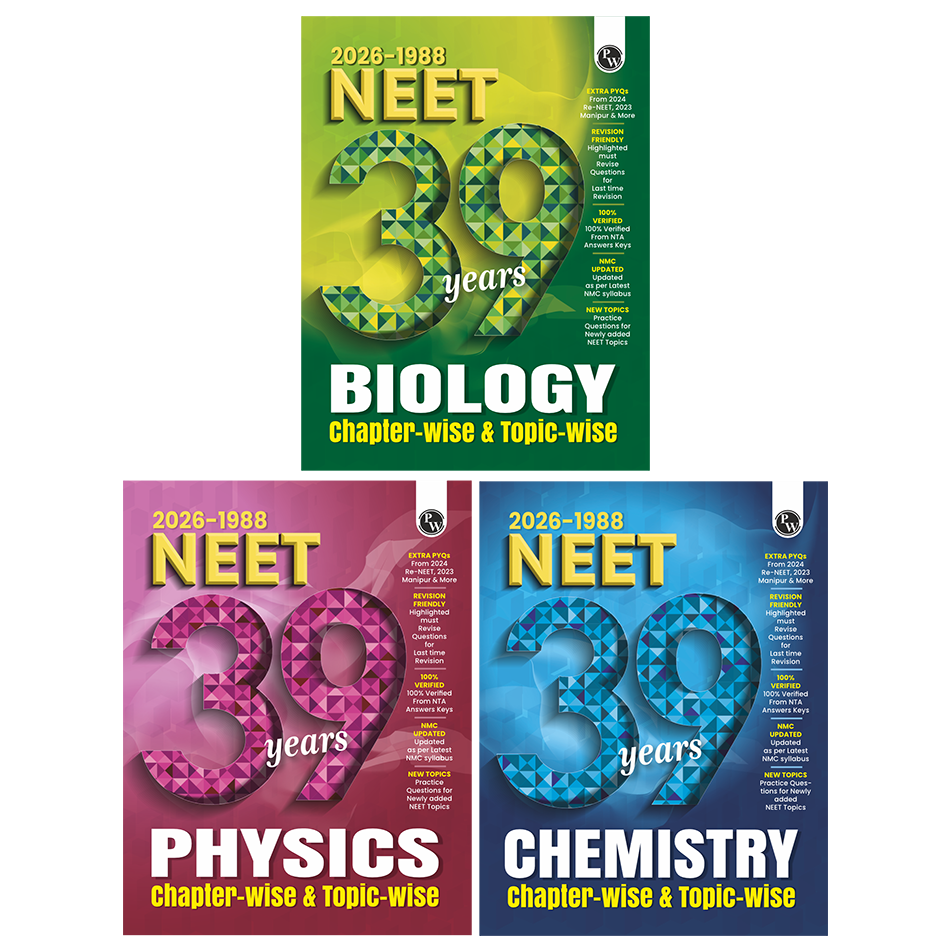
7. Solve Old Papers and Mock Tests: Try to solve past years’ NEET question papers regularly. This will help you understand the types of questions asked from the Chemistry NEET syllabus, identify important topics, and improve your exam strategy. For extensive previous year question practice, students can use the 39 Years NEET PYQ Chemistry book, which contains chapter-wise and topic-wise NEET questions. Along with PYQs, take weekly mock tests to evaluate your preparation, improve time management, and identify areas that need more revision.
8. Make a Simple Timetable: Don’t study everything in one day. Divide your time between Physical, Organic, and Inorganic Chemistry. Give more time to the topics you find tough. Don’t forget to take small breaks too.
9. Use Simple Tricks to Remember: Some parts, like periodic trends or reactions, can be hard to learn. Try to use tricks, short forms, or diagrams to remember them easily. It works well, especially in inorganic chemistry chapters.
Read More: NEET Previous Year Question Papers with Solutions PDF
NEET Chemistry Syllabus FAQs
1. What is the total number of questions from Chemistry in NEET 2027?
A total of 50 questions are asked from Chemistry, out of which you need to attempt 45 questions.
2. What are the main sections of the NEET Chemistry syllabus 2027?
The syllabus is divided into Physical Chemistry, Organic Chemistry, and Inorganic Chemistry.
3. Is the NEET Chemistry syllabus 2027 based on NCERT books?
Yes, the entire Chemistry syllabus is strictly based on Class 11 and Class 12 NCERT textbooks.
4. Which chapters are most important in Physical Chemistry for NEET?
Key chapters include Thermodynamics, Equilibrium, Chemical Kinetics, and Solutions.
5. What is the right way to prepare for Organic Chemistry?
Focus on reaction mechanisms, naming reactions, conversions, and solving previous year MCQs.