NEET Physics Syllabus 2027: Detailed Chapter-wise Weightage
NEET Physics Syllabus 2027: When it comes to NEET, students have to prepare three main subjects: Physics, Chemistry, and Biology. Among these, many aspirants often find Physics a bit tough compared to the other two. The reason is simple: Physics is not only about theory but also about formulas, concepts, and solving numerical problems. Whether it is mechanics, optics, or modern physics, the subject demands both conceptual clarity and problem-solving speed.
That is why having a clear idea of the NEET Physics syllabus is very important for every aspirant. The syllabus includes both the Class 11 Physics NEET syllabus and the Class 12 NEET Physics syllabus, which together cover a wide range of topics that form the base of the exam. Knowing the chapter-wise weightage helps students plan their studies smartly, as they can focus more on high-weightage chapters without ignoring the rest. With a proper understanding of the syllabus, chapter importance, and the right preparation tips, students can turn Physics from a difficult subject into a scoring one in the NEET 2027 exam. Check out the NEET Physics Syllabus 2027 and Detailed Chapter-wise Weightage from the article below.
Check Out: NEET Books
NEET Physics Syllabus 2027
The NEET Physics syllabus 2027 is mainly based on the NCERT books of Class 11 and Class 12. Aspirants should first focus on completing the NCERT syllabus in detail, as it builds the basic concepts that are directly tested in the exam. Only after a strong grip on NCERT should one move towards reference or advanced books for more practice. Since the NEET syllabus 2027 combines both theory and numerical-based questions, following the right preparation strategy is important. With a clear idea of the topics and weightage, students can easily plan their study routine and improve their overall score.
NEET Physics Syllabus 2027 for Class 11
The Class 11 Physics NEET syllabus plays an important role in the overall preparation. Some of the key chapters from Class 11 include Laws of Motion, Work, Energy and Power, Thermodynamics, Oscillations, Gravitation, and Physical World & Measurement.
These topics are the base of Physics and are often linked with the Class 12 syllabus as well. Many numerically based questions are asked directly from these areas in the exam. A good understanding of these concepts will help aspirants solve tricky problems with ease. Below, you can find the detailed NEET Physics syllabus for Class 11.
|
NEET Physics Syllabus 2027 for Class 11 |
|
|
Chapter Name |
Topics |
|
Units and Measurements |
Significant Figures, Errors in Measurement, Measuring Instruments |
|
Mathematical Tools |
Binomial Expression and Approximation, Functions & Graphs, Logarithms, Differentiation and Integration |
|
Motion in a Straight Line |
Frame of Reference, Motion under Gravity (Free Fall Motion), Graph of 1D Motion, Variable Acceleration |
|
Motion in a Plane |
Vector Addition, Resolution of Vectors, Vector Projection, Projectile Motion, Relative Motion, Circular Motion |
|
Newton's Laws of Motion |
Newton's First Law of Motion, Linear Momentum, Free Body Diagram, Working with Newton's Second Law, Calculation of Acceleration, Frame of Reference, Rocket Propulsion, Types of Friction, Graph between Applied Force and Force of Friction, Angle of Friction and Angle of Repose, Acceleration of Body on Rough Surface, Dynamics of Circular Motion |
|
Work, Energy & Power |
Work, Work Energy Theorem, Conservative and Non-Conservative Force, Potential Energy, Equilibrium, Law of Conservation of Energy, Power, Vertical Circular Motion |
|
Centre of Mass & System of Particles |
Centre of Mass, Head-on Collision, Oblique Collision |
|
Rotational Motion |
Moment of Inertia, Theorems of Moment of Inertia, Radius of Gyration, Angular Momentum, Rolling Motion, Rolling Motion on Inclined Plane |
|
Gravitation |
Law of Gravitation, Acceleration due to Gravity, Gravitational Potential Energy, Gravitational Potential, Relation between Field and Potential, Escape Velocity, Satellite Motion, Kepler's Laws of Planetary Motion, Weightlessness |
|
Mechanical Properties of Solids |
Hooke's Law, Modulus of Elasticity, Young's Modulus |
|
Mechanical Properties of Fluids |
Pressure, Buoyancy, Buoyant Force, Equation of Continuity, Bernoulli's Theorem, Viscosity, Surface Tension |
|
Thermal Properties of Matter |
Thermal Expansion, Application of Thermal Expansion, Specific Heat Capacity, Latent Heat, Calorimetry, Conduction, Radiation |
|
Kinetic Theory of Gases |
Ideal Gases, Kinetic Theory of Gases, Different Speeds of Gas Molecules, Maxwell's Law, Degree of Freedom, Law of Equipartition of Energy |
|
Thermodynamics |
Thermal Equilibrium and Zeroth Law, First Law of Thermodynamics, Different Types of Processes, Carnot Cycle and Carnot Engine, Heat Pump |
|
Oscillations |
Periodic Motion and Oscillatory Motion, Some Basic Terms Related to Oscillatory Motion, Simple Harmonic Motion (SHM), Equations of SHM, Energy in SHM, Calculation of Time Period of Spring Block System, Time Period of Pendulum, Oscillation of Liquid Column |
|
Waves |
Characteristics of Waves, Progressive Wave on String, Characteristics of Sound Wave, Principle of Superposition of Wave, Stationary Waves, Echo |
Check Out: NEET Previous Year Papers
NEET Physics Syllabus 2027 for Class 12
The class 12 NEET Physics syllabus focuses more on applied concepts and numerical solving. Important topics include Current Electricity, Electromagnetic Induction, Optics, Dual Nature of Matter, Atoms and Nuclei, and Electronic Devices. These chapters carry high weightage in the NEET syllabus 2027 and often decide the overall marks in Physics.
With more practice in problem-solving and revision of formulas, aspirants can score well in this section. These chapters also connect with the Class 11 concepts, so a proper balance between both years is necessary. Below, you can find the detailed NEET Physics syllabus for Class 12.
|
NEET Physics Syllabus 2027 for Class 12 |
|
|
Chapter Name |
Topics |
|
Electric Charges and Fields |
Charge, Coulomb's Law, Electric Field of a Continuous Charge Distribution, Motion of a Charged Particle in Uniform Electric Field, Electric Field Lines, Electric Flux, Gauss Law, Application of Gauss's Law, Electric Dipole, Dipole in a Uniform External Field, Short Dipole in Non-Uniform Electric Field |
|
Electrostatic Potential and Capacitance |
Electrostatic Potential/Potential Difference, Equipotential Surface, Electric Potential Due to Dipole, Electrostatics of Conductor |
|
Current Electricity |
Kirchhoff's Laws and Combination of Resistances, Wheatstone Bridge and Symmetric Circuits, Electrical Measuring Instruments, RC Circuit |
|
Moving Charges and Magnetism |
Biot-Savart's Law, Magnetic Field Due to a Current Carrying Ring and Problems on Combination of Ring and Rod, Ampere's Law and Its Applications, Force on a Moving Charge in a Magnetic Field, Helical Path, Lorentz Force and Velocity Selector, Magnetic Force on a Current Carrying Conductor, Gyromagnetic Ratio, Torque on a Current Carrying Loop |
|
Magnetism and Matter |
Bar Magnet and Its Properties, Circular Coil as Magnetic Dipole, Tangent Galvanometer, Oscillation Magnetometer, Magnetisation and Magnetic Intensity, Classification of Magnetic Materials, Ferromagnetism and Hysteresis |
|
Electromagnetic Induction |
Magnetic Flux and Lenz's Law, Calculation of Induced EMF, Induced Electric Field, Self Inductance, Mutual Inductance, LC Oscillations and Transformer, Faraday's Law |
|
Alternating Current |
Introduction to Alternating Current, Average and RMS Values, Types of AC Circuits, Power & Power Factor, Choke Coil, Series LCR Circuit and Resonant Frequency, LC Oscillations and Transformer |
|
Electromagnetic Waves |
Characteristics of Electromagnetic Waves |
|
Ray Optics and Optical Instruments |
Reflection from Plane Mirror, Reflection from Spherical Mirror, Refraction from Plane Surface, Total Internal Refraction, Newton's Formula, Combination of Lens and Mirror, Displacement Method to Find Focal Length, Dispersion of Light, Optical Instruments |
|
Wave Optics |
Nature of Light, Interference of Light, Diffraction of Light, Polarisation |
|
Dual Nature of Radiation and Matter |
Quantum Theory of Light, Photoelectric Effect |
|
Atoms |
Bohr's Model |
|
Nuclei |
Mass Energy, Nuclear Size, Nuclear Stability, Binding Energy, Nuclear Energy |
|
Semiconductor Electronics: Materials, Devices and Simple Circuits |
PN Junction Diode, Application of PN Junction Diode, Logic Gate |
Check Out: NEET Question Banks
NEET Physics Chapter Wise Weightage 2027
When preparing for NEET, knowing the syllabus alone is not enough; understanding the chapter-wise weightage is equally important. The NEET syllabus covers Class 11 and 12 NCERT topics, but not all chapters carry the same marks in the exam. Some areas, like Mechanics, Modern Physics, and Electrostatics, usually have more questions, while others have a lighter weightage.
Analysing the syllabus of NEET 2027 with its topic distribution helps aspirants create a smart study plan and focus more on high-scoring chapters. In this section, you can explore the detailed NEET Physics Chapter Wise Weightage for better preparation.
|
Chapters/Topics |
Weightage (%) |
|
Mechanical Properties of Solids |
2% |
|
Moving Charges and Magnetism |
5% |
|
Center of Mass & System of Particles |
2% |
|
Wave Optics |
2% |
|
Electromagnetic Induction |
3% |
|
Mechanical Properties of Fluids |
3% |
|
Electromagnetic Waves |
3% |
|
Rotational Motion |
6% |
|
Oscillations |
3% |
|
Ray Optics and Optical Instruments |
6% |
|
Kinetic Theory of Gases |
3% |
|
Dual Nature of Radiation and Matter |
3% |
|
Gravitation |
3% |
|
Current Electricity |
10% |
|
Semiconductor Electronics: Materials, Devices and Simple Circuits |
5% |
|
Units and Measurements |
5% |
|
Work Energy and Power |
3% |
|
Electric Charges and Fields |
3% |
|
Magnetism and Matter |
1% |
|
Atoms |
3% |
|
Nuclei |
4% |
|
Motion in a Plane |
3% |
|
Mathematical Tools & Vectors |
1% |
|
Laws of Motion |
2% |
|
Thermodynamics |
2% |
|
Waves |
1% |
|
Electrostatic Potential and Capacitance |
5% |
|
Alternating Current |
4% |
|
Thermal Properties of Matter |
1% |
|
Motion in a Straight Line |
3% |
Check Out: NEET Revision Books
NEET Physics Preparation Tips
Below are some effective preparation tips to help you plan wisely and score better.
1. Understand the NEET Physics Syllabus Thoroughly
Before you begin your preparation, the first thing you need to do is understand the syllabus. The NEET Physics section has chapters from both Class 11 and Class 12, and both are equally important.
-
Go through the Class 11 Physics NEET syllabus (Mechanics, Heat and Thermodynamics, Waves, etc.) and identify high-weightage chapters.
-
Cover the Class 12 NEET Physics syllabus (Electrostatics, Magnetism, Current Electricity, Modern Physics, etc.) in detail since many direct questions are asked.
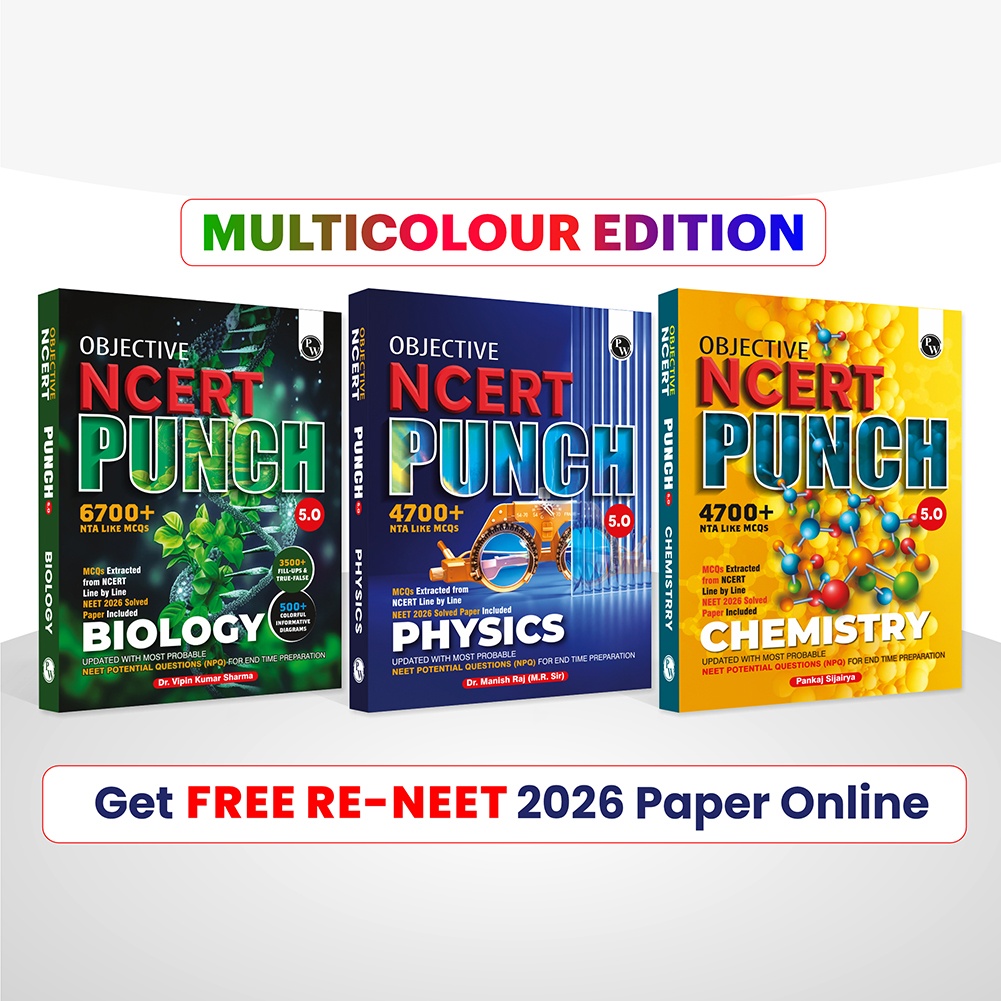
- For additional practice and concept reinforcement, students can use the NEET Objective NCERT Punch Physics book, which provides topic-wise NCERT-based questions and helps strengthen Physics fundamentals.
2. Build Your Base with NCERT Books
For Physics in NEET, the NCERT books are where you should always begin. The NEET Physics syllabus is mainly from Class 11 and Class 12 NCERT, and the explanations there are simple but very important. Before picking up any reference book, make sure you read every chapter’s theory properly.
-
Always complete NCERT chapters first before moving to advanced books.
-
Highlight key formulas, diagrams, and solved examples for quick recall.
-
Keep making your own notes while studying instead of depending on someone else’s.
3. Practice Numerical Problems Daily
The NEET Physics syllabus 2027 has a lot of chapters where numericals form the main part of questions. To improve speed and accuracy, try solving at least 25–30 problems every day. Begin with basic-level problems and then slowly move to harder ones.
-
Keep a fixed daily time for Physics numericals, even if it’s just one hour.
-
Cover questions from both the Class 11 Physics NEET syllabus and the Class 12 NEET Physics syllabus.
-
After solving, review your mistakes so you don’t repeat them in the exam.
-
Use advanced books such as PW NEET Modules Books.
4. Focus on High-Weightage Chapters First
Not every chapter carries equal marks in NEET. Some chapters are asked more often and carry more weightage. Giving priority to these topics helps you secure more marks in less time.
-
Check previous years’ NEET papers to identify repeated chapters.
-
Allocate more study hours to high-weightage topics in your timetable.
5. Make Short Notes and Formula Sheets
Since Physics involves many formulas, equations, and definitions, keeping a handy formula sheet helps a lot during revision. Short notes also make last-minute preparation stress-free.
-
Write down all important formulas of Mechanics, Thermodynamics, Electricity, and Optics in one place.
-
Use colour codes or highlighters to separate Class 11 and Class 12 formulas.
6. Strengthen Conceptual Clarity
In NEET, Physics questions are not just memory-based. Most of them test your understanding of concepts. That is why you should focus on the “why” behind formulas instead of just memorising them.
-
Relate every law or formula with a simple example from daily life.
-
If you learn a formula, also revise its derivation for better clarity.
-
Never skip concepts from the Class 11 physics NEET syllabus, as they are often the base for Class 12 topics.
7. Solve Previous Year NEET Physics Papers
One of the effective ways to prepare is by solving NEET PYQs. It helps you see the actual level of difficulty and the types of problems asked. Solving papers also improves time management. Try to complete at least the last 10 years’ NEET papers.
-
Solve previous papers in a timed manner, like in the real exam.
-
Analyse your performance and list weak chapters for extra practice.
-
Use previous papers as revision material before the final exam.
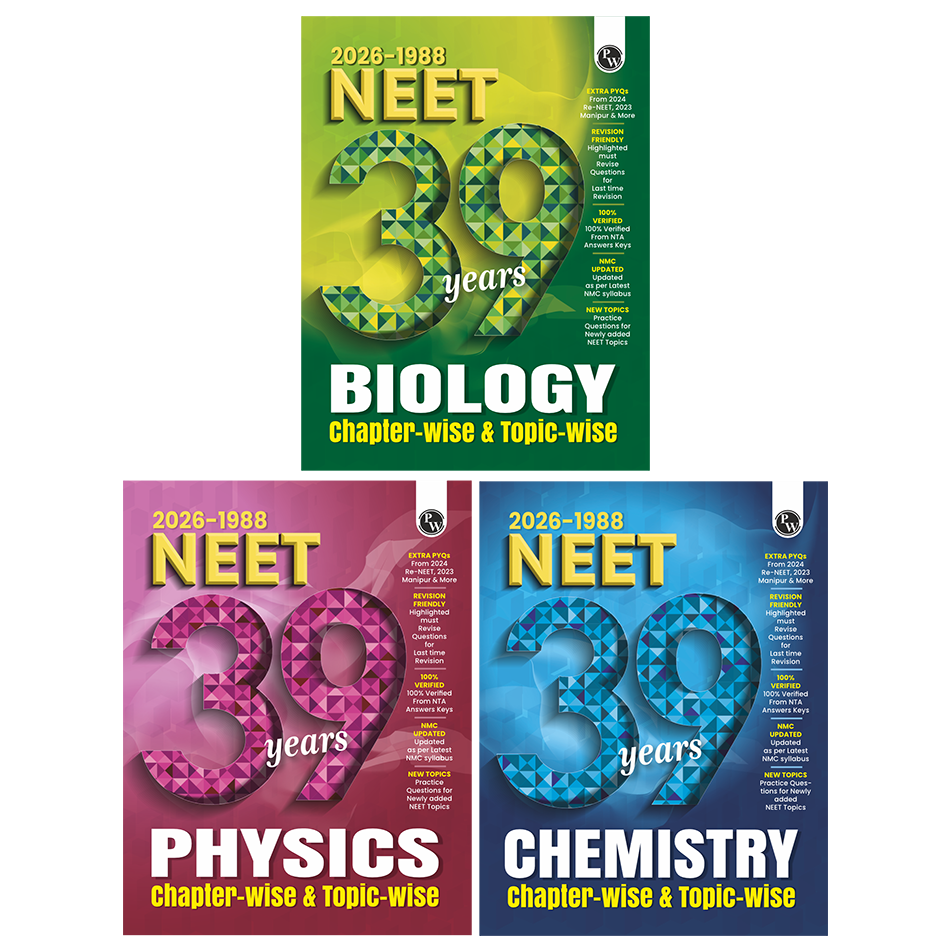
For comprehensive practice, students can refer to the 39 Years NEET PYQ Physics book, which contains extensive chapter-wise and topic-wise previous year questions to help strengthen concepts and boost exam confidence.
8. Revise Regularly and Smartly
The syllabus of NEET 2027 is huge, and without regular revision, it is easy to forget formulas and concepts. That’s why you should plan weekly and monthly revisions. Keep weekends for revising what you studied during the week. Make flashcards, flowcharts, or even sticky notes to quickly revise before tests.
-
Revise Class 11 and Class 12 Physics notes regularly, not just before exams.
-
Use formula sheets, flashcards, and quick charts for fast revision.
9. Take Mock Tests and Analyse Performance
Mock tests are very useful for practice in a real exam-like setup. They help improve your speed and accuracy under time pressure. After every mock test, spend time checking your mistakes and weak areas. This way, each test will help you improve. Take at least one full mock test every week from the NEET syllabus 2027.
-
Simulate exam conditions by solving mock tests in 3 hours without breaks.
-
Analyse mistakes after every test and revise weak topics immediately.
Read More: NEET Physics Questions
NEET Physics syllabus FAQs
Q1. What is the NEET Physics syllabus for 2027?
The NEET Physics syllabus 2027 is based on both the Class 11 Physics NEET syllabus and the Class 12 NEET Physics syllabus. It includes topics like Laws of Motion, Gravitation, Electrostatics, Current Electricity, Optics, Modern Physics, and many more.
Q2. Is Physics tough in the NEET syllabus 2027?
Many students find Physics a bit difficult compared to Biology and Chemistry because of formulas and numbers. But with regular practice and a clear understanding, Physics can become scoring.
Q3. How can I prepare Class 11 Physics NEET syllabus effectively?
Start with the NCERT Class 11 chapters. Focus on concepts like Laws of Motion, Work-Energy, and Thermodynamics. Solve previous year NEET questions from these topics.
Q4. What is the effective way to study the Class 12 NEET Physics syllabus?
For Class 12, give more time to topics like Current Electricity, Magnetism, Optics, and Modern Physics. Practice numericals daily and revise formulas regularly.
Q5. Should I make notes while studying NEET Physics?
Yes, short notes are very useful. Write formulas, important definitions, and shortcuts for revision. It saves time before the exam.