Newton's Laws of Motion - A Complete Guide
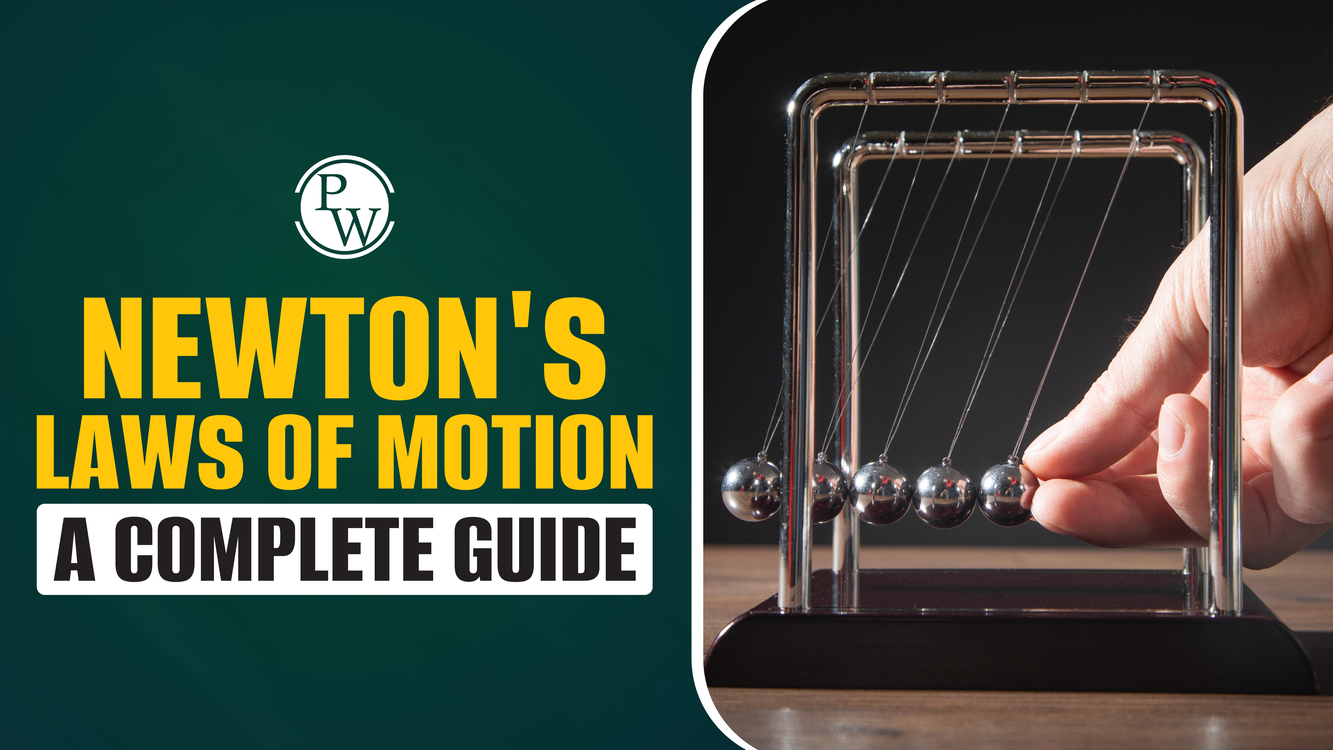
Newton's Laws of Motion: Sir Isaac Newton was a famous scientist who made many great discoveries in science. One of his biggest contributions was the three laws of motion, which help us understand how objects move and how forces affect them. These laws are known as Newton's laws of motion. Today, they are an important part of Physics and are taught in many classes, like Class 9 and Class 11. These laws are also very useful when preparing for competitive exams like JEE and NEET.
For this reason, it is important for students to understand these laws clearly. Many exam papers include both theory and numerical questions from this topic. These laws are also useful in real life, for example, they explain why a person leans forward when a vehicle stops suddenly or why an object moves when force is applied to it. Learning Newton’s laws not only helps improve exam performance but also builds a strong understanding of how things work in the world around us. Check out the article below for a complete guide on Newton's Laws of Motion.
Check Out: NEET Books
What are Newton's Laws of Motion?
Newton’s Laws of Motion are three basic principles that explain how forces affect the motion of objects. These laws were introduced by Sir Isaac Newton in the 17th century and form the foundation of classical mechanics.
Each law describes a different aspect of how objects move when forces act upon them. These laws help us understand not only how things move in our daily life but also how motion works in machines, vehicles, and even in space.
Newton's Laws of Motion
-
Newton’s First Law (also called the Law of Inertia) states that an object will remain at rest or continue to move in a straight line at constant speed unless a force acts on it. This means that objects do not change their state of motion unless something causes that change.
-
Newton’s Second Law of Motion explains how the force applied to an object is directly related to its mass and acceleration. In simple words, this law shows that a stronger force causes more acceleration, and heavier objects require more force to move. It is often written as the formula: F = ma, where F is force, m is mass, and a is acceleration.
-
Newton’s Third Law states that for every action, there is an equal and opposite reaction. This means that whenever one object applies a force on another, the second object applies the same amount of force in the opposite direction. For example, when you push a wall, the wall pushes back with the same force.
Check Out: NEET Previous Year Papers
Newton’s First Law
Newton’s first law of motion, also known as the Law of Inertia, states that a body at rest will remain at rest, and a body in motion will continue to move in the same direction with the same speed unless an external force acts on it. The tendency of a body to resist any change in its state of motion or rest is called inertia. Before Newton, it was widely believed that a force is required to keep a body in motion.
-
However, it was Galileo Galilei who first introduced the idea of inertia by observing the motion of objects on the Earth's surface. Later, René Descartes generalised Galileo’s idea.
-
According to this law, the state of motion or rest cannot change without an external force.
-
For example, a ball kept on the floor remains still unless someone kicks it, and a moving object like a car will keep moving unless a force such as friction or brakes is applied. This explains why seat belts are necessary, they prevent passengers from continuing to move forward when a vehicle stops suddenly.
Newton’s Second Law of Motion
Newton’s second law explains how much force is needed to move an object. It also helps us understand something called momentum, which is the result of an object’s mass × velocity. Since velocity includes direction, momentum also tells us which way the object is moving.
When we apply a force to something, it changes its speed, its direction, or both, which means its momentum changes too. According to this law, if the same force is applied to two objects with different masses, the one with less mass will speed up more.
-
For example, if you apply the same force (15 Newtons) to a football and a car, the football moves more because it weighs much less than a car.
-
In daily life, a shopping cart moves faster when it’s empty and slower when it’s full, that’s Newton’s second law in action.
This law is very important for solving problems in physics and also helps us understand how things move in real life.
Newton’s Third Law of Motion (Action and Reaction)
Newton’s third law is very simple and powerful: For every action, there is an equal and opposite reaction.
This means that when one object pushes or pulls another, the second object pushes or pulls back with the same amount of force, but in the opposite direction.
-
For example, when you jump off a boat, you push the boat backward. At the same time, the boat pushes you forward, both forces are equal but opposite.
-
Another simple example is a laptop on a table. The laptop pushes down on the table due to its weight, and the table pushes back up with the same force to support it. This upward force comes from the table slightly pressing back against the weight.
This law helps explain everything from standing still on the ground to how rockets launch into space, by pushing gases down, the rocket moves up.
Check Out: NEET Question Banks
Numerical Based on Newton’s First Law (Law of Inertia)
Q1. A book is lying on a table and remains at rest. Which force is responsible for keeping the book at rest, and what does this indicate about Newton’s first law?
Solution: The book remains at rest because there is no unbalanced external force acting on it.
-
The forces acting are: Gravitational force pulling it down (weight of the book)
-
Normal reaction from the table pushing it up
-
These forces balance each other, so the book stays at rest.
-
This proves Newton’s First Law an object remains at rest unless acted upon by an external force.
Numerical Based on Newton’s Second Law (F = ma)
Q2. A force of 20 N is applied to a mass of 5 kg. What is the acceleration produced?
Solution: We use the formula:
F = ma
Given:
F = 20 N,
m = 5 kg
So,
a = F/m = 20 / 5 = 4 m/s²
Answer: The acceleration is 4 m/s².
Q3. A cricketer throws a ball of mass 0.5 kg with an acceleration of 8 m/s². Find the force applied.
Solution: Using F = ma,
m = 0.5 kg,
a = 8 m/s²
F = 0.5 × 8 = 4 N
Answer: Force applied is 4 Newtons.
Numerical Based on Newton’s Third Law
Q4. A person jumps from a boat with a force of 60 N. What is the reaction force experienced by the boat?
Solution: According to Newton’s third law, for every action, there is an equal and opposite reaction. So, the boat experiences an opposite force of 60 N.
Check Out: NEET Revision Books
Common Misconceptions About Newton’s Laws
Misconception: A force is always needed to keep an object in motion.
Correction: According to Newton’s first law, an object in motion will stay in motion unless a force (like friction or air resistance) acts on it.
Misconception: Heavier objects fall faster than lighter ones.
Correction: In a vacuum, all objects fall at the same rate regardless of mass. The confusion arises due to air resistance.
Misconception: Action and reaction forces cancel each other out.
Correction: These forces act on different objects, so they don’t cancel out. For example, when you push a wall, the wall pushes back, but the effects are on different bodies.
Misconception: If an object is at rest, no forces are acting on it.
Correction: Forces may still be acting, but are balanced (like gravity and normal force on a book resting on a table).
Read More: Important NEET Physics Questions for 2026 Exam
FAQs on Newton’s Laws of Motion
Q1. What is inertia?
Inertia is an object’s tendency to stay at rest or keep moving in the same direction unless something changes it.
Q2. Who gave the laws of motion?
Sir Isaac Newton, in the 17th century.
Q3. Why is Newton’s second law written as F = ma?
Because Force equals Mass × Acceleration. It shows how force affects motion.
Q4. What is the SI unit of force?
It is called Newton (N).
Q5. Do Newton’s laws work in space too?
Yes, Newton’s laws work everywhere, even in outer space.