Benefits of Solving Last Year CBSE Class 10 PYQ

CBSE Class 10 PYQ
CBSE Class 10 PYQs (Previous Year Questions) help students understand exam patterns and important topics. By practicing these questions, students can improve time management and accuracy. It also builds confidence for exams. Regular revision of PYQs makes concepts clear and helps in scoring better marks in the final board exams. One of the most effective tools for preparation is solving the CBSE Class 10 PYQ.
Previous Year Question Papers help students become familiar with the exam format, marking scheme, and the kind of questions that are often repeated. By practising CBSE 10 PYQ, students can revise their syllabus in a practical way, test their understanding of concepts, and identify areas that need more focus. It also helps in learning proper time management while attempting a full paper. Along with regular study and NCERT reading, solving PYQs ensures that preparation stays organised and closer to the actual exam style.
Check Out: CBSE Class 10 Books
CBSE Previous Year Question Papers Class 10
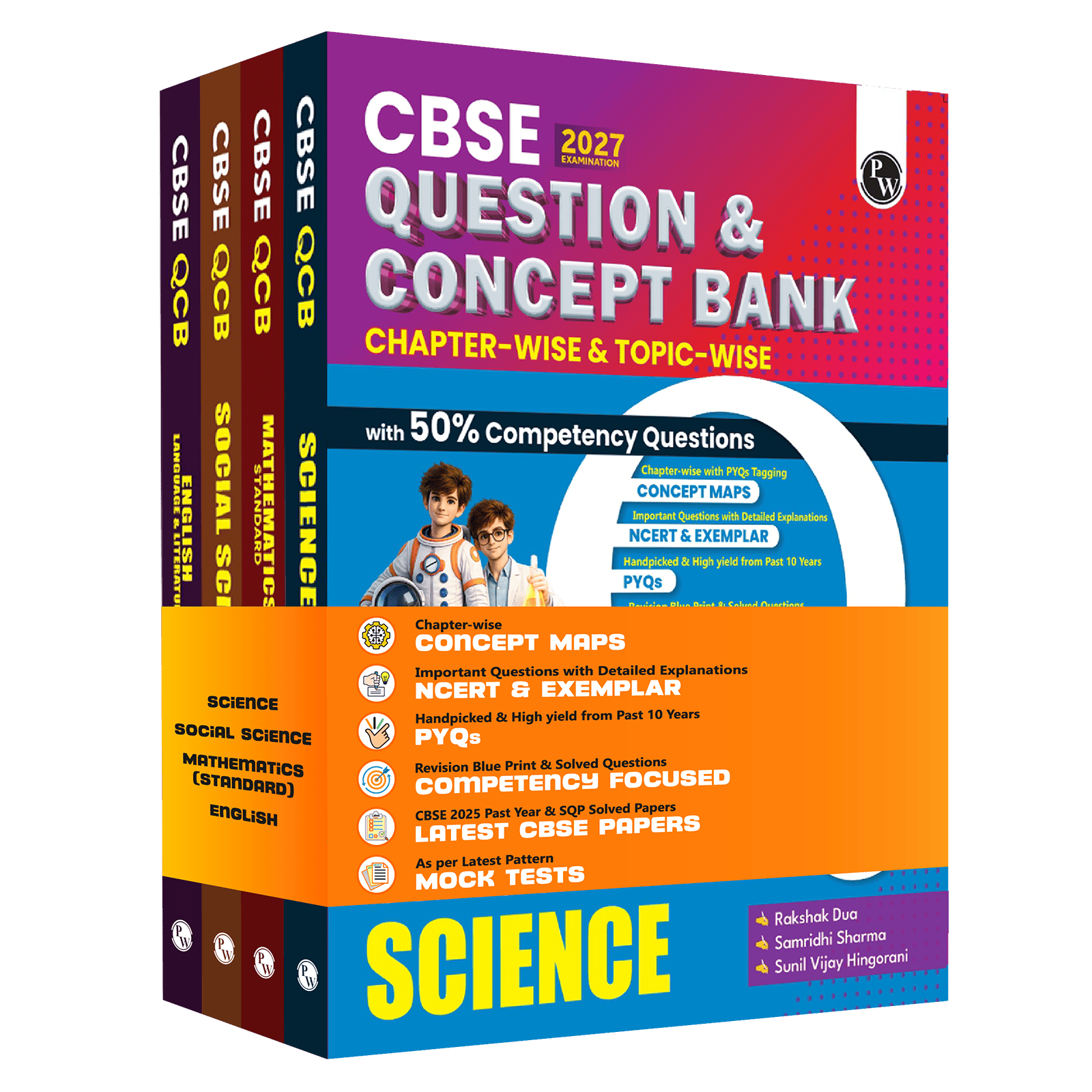
PW has brought CBSE Previous Year Question Papers Class 10 to make preparation more structured and exam-focused for students. Solving these CBSE class 10 PYQ helps in understanding the real exam pattern and the type of questions that are frequently repeated.
With features like chapter-wise trend analysis and clear NCERT references, students can strengthen their basics while also identifying important topics. The CBSE 10 PYQ collection also comes with stepwise marking and detailed explanations, making it easier to learn how answers are evaluated in board exams. Click the link and get multiple sets of CBSE PYQs Class 10, including original Delhi and Outside Delhi papers.
Benefits of Solving Last Year CBSE Class 10 PYQ
1. Understand the Question Paper Pattern Clearly
By solving CBSE class 10 previous year question papers, students will gain a clear understanding of how the board designs questions across subjects.
-
For example, in Mathematics, 1-mark questions are often based on algebra or coordinate geometry, while 4-mark questions usually come from trigonometry or probability.
-
In Science, the distribution of marks shows that Life Processes and Electricity carry higher weightage compared to smaller chapters.
-
In languages like English and Hindi, unseen passages and essay writing sections have fixed marks. Practising CBSE PYQs class 10 will help students understand this pattern better and plan their time accordingly.
-
To further strengthen preparation, students should also attempt CBSE class 10 sample papers, which reflect the latest competency-based exam style.
2. Revise the Entire Syllabus in a Structured Way
Solving CBSE 10 PYQ is one of the most effective ways to revise the syllabus chapter by chapter.
-
For Mathematics, repeated questions often come from Polynomials, Quadratic Equations, and Statistics.
-
In Science, chapters such as Heredity and Evolution, Magnetic Effects of Electric Current, and Carbon Compounds appear frequently in 3-mark and 5-mark questions.
-
Social Science papers commonly feature long-answer questions from Democratic Politics and Economics chapters.
-
In English and Hindi, regular practice of PYQs helps students deal with unseen passages and long writing tasks, which can otherwise take extra time in exams.
3. Improve Time Management in Exams
One of the biggest challenges in the board exam is finishing the paper on time. By solving previous year question paper class 10, students will learn how to manage their time according to different sections.
-
For example, in English, the reading comprehension section requires quick reading and accurate interpretation, which becomes easier with repeated PYQ practice.
-
In Science, writing concise and stepwise answers for numericals in Electricity or Light – Reflection and Refraction saves valuable minutes.
-
Practising the CBSE class 10 Question Bank in addition to PYQs will further refine their time management.
4. Identify Important and Repeated Topics
Solving CBSE PYQs class 10 helps students easily spot which topics are most important.
-
For Mathematics, PYQs show that questions on Triangles, Arithmetic Progression, and Surface Areas & Volumes are often repeated.
-
In Science, Acids, Bases and Salts, Control and Coordination, and Our Environment are frequent favourites for examiners.
-
Social Science PYQs highlight recurring questions from Nationalism in India, Sectors of the Indian Economy, and Outcomes of Democracy.
-
By practising CBSE previous year question papers class 10, students will not only revise but also understand the examiner’s pattern of repeating concepts in different formats. This way, students can prepare strategically and focus more on chapters that will most likely appear in exams.
5. Develop Strong Writing and Presentation Skills
In board exams, it is not only about knowing the answer but also about presenting it properly. Solving CBSE 10 PYQ helps students practise writing answers in the format expected by examiners.
-
For Science, presenting numericals with stepwise solutions in chapters like Light or Electricity is important to secure full marks.
-
In Mathematics, diagrams in Mensuration or graphs in Statistics should be drawn neatly.
-
Social Science answers demand well-structured paragraphs, especially for long 5-mark questions in History or Civics.
-
In English, PYQs train students in writing grammatically correct letters, articles, and reports, as per the CBSE format. By practising CBSE previous year question papers class 10, students will develop consistency in answer writing.
Read More: CBSE Sample Papers Class 10 2025-26 (Released) for Board Exams
CBSE Class 10 PYQ FAQs
Q1. What is the use of solving CBSE class 10 PYQ before exams?
Solving CBSE class 10 PYQ helps students understand the exam pattern, marking scheme, and the type of questions that are asked in board exams.
Q2. Are CBSE 10 PYQ questions repeated in board exams?
Yes, some questions from CBSE class 10 previous year question papers are repeated either directly or in a slightly modified form.
Q3. How many years of CBSE PYQs class 10 should students solve?
Students should ideally solve at least the last 5 to 10 years of CBSE previous year question papers class 10, for thorough preparation.
Q4. Do previous year question paper class 10 cover all subjects?
Yes, CBSE class 10 previous year question papers are available for all subjects, including Mathematics, Science, Social Science, English, and Hindi.
Q5. Can solving CBSE PYQs class 10 improve time management?
Yes, solving PYQs trains students to divide their 3-hour exam effectively across short, medium, and long-answer questions.