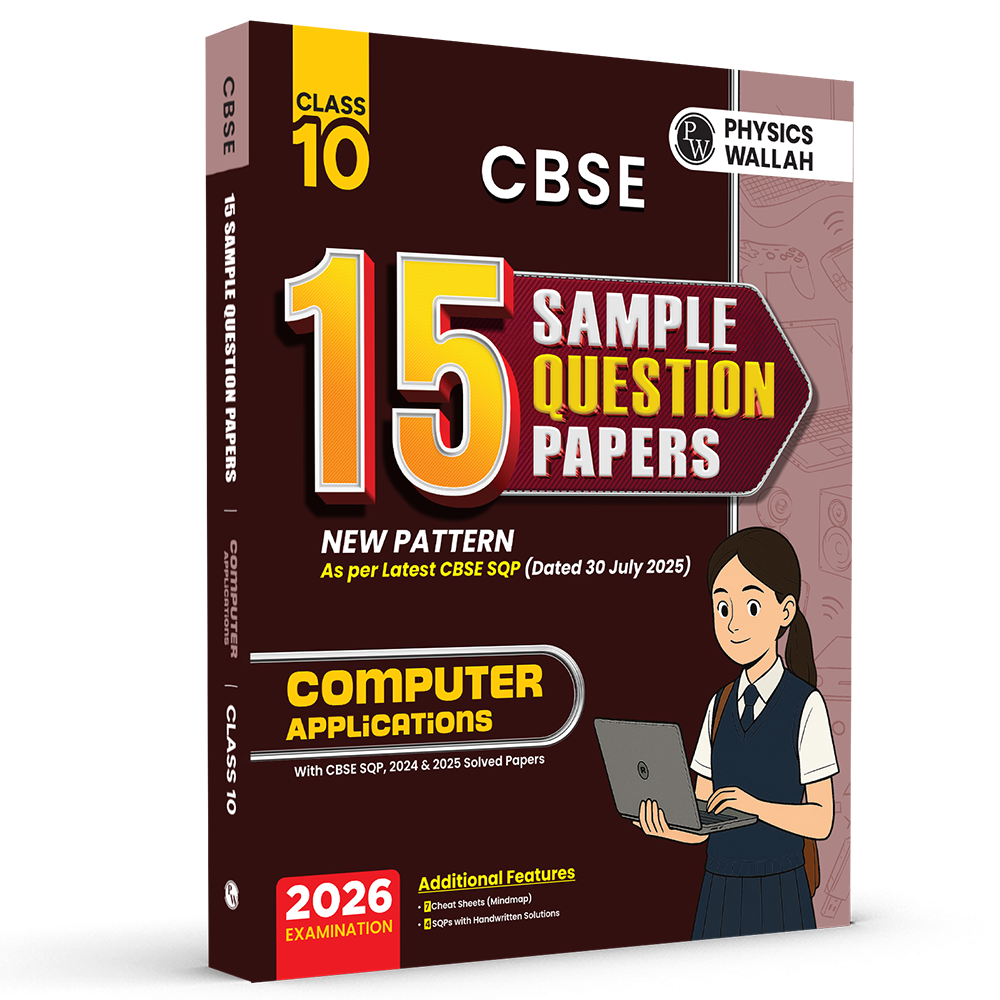
CBSE Class 10 Computer Sample Papers for 2026 Exams

CBSE Class 10 Computer Sample Papers
CBSE Class 10 board exams are expected to be conducted in 2026 in two phases. Phase 1 will be held from February 17 to March 9, 2026, while Phase 2 is scheduled between May 15 and June 1, 2026. As every year, these exams will be conducted in pen-and-paper format, giving students enough time to carefully attempt each question.
Apart from core subjects like Maths, Science, Social Science, and Languages, CBSE Class 10 students are now expected to perform well in other important subjects such as Computer Applications. Keeping this in mind, PW has introduced comprehensive resources for CBSE Class 10 Computer.
To prepare effectively, students can practise using CBSE Class 10 Sample Papers. These CBSE class 10 sample papers help familiarise students with the exam pattern, marking scheme, and important types of questions. By attempting sample papers, Class 10 CBSE, students can improve their speed, accuracy, and time management for the CBSE Computer Paper Class 10.
CBSE Class 10 Computer Syllabus
Check out the CBSE Class 10 Computer Syllabus included in the CBSE Class 10 Computer Sample Papers:
|
Unit |
Topics |
Details |
|
UNIT I: NETWORKING |
Basics of Internet |
Introduction to Internet, Internet Protocols |
|
Internet and Web Services |
Services available on Internet, Web Services, Mobile Technologies |
|
|
UNIT II: HTML |
Introduction to HTML |
Web page designing using HTML, HTML elements |
|
Lists and Images |
HTML lists, HTML images |
|
|
Working with Links, Forms & Tables |
HTML links, HTML tables, HTML forms |
|
|
Cascading Style Sheets (CSS) |
Basics of CSS for styling web pages |
|
|
UNIT III: CYBER ETHICS |
Cyber Ethics |
Netiquettes, Software licenses, Plagiarism |
|
Digital Awareness |
Digital divide, Freedom of information |
|
|
Practice & Revision |
Mock Tests & Question Banks |
Chapter-wise & topic-wise questions, concept maps for better understanding |
Check Out: CBSE Class 10 Books
CBSE Class 10 Computer Exam Pattern
The CBSE Class 10 Computer Exam is of 2 hours duration and carries a maximum of 50 marks. Going through CBSE sample papers for Class 10 will help students to get a clear idea about the type of questions, the marks distribution, and how to plan their answers. The paper is divided into five sections: A, B, C, D, and E:
-
Section A: This section has 12 questions, each carrying 1 mark, covering simple concepts and definitions that test basic understanding.
-
Section B: It includes 7 very short answer questions, with 2 marks each, where students are expected to give brief but clear answers.
-
Section C: This part contains 4 short-answer questions, each worth 3 marks, requiring students to explain concepts in a bit more detail.
-
Section D: There is 1 long-answer question carrying 4 marks, which asks students to provide a detailed explanation or solution.
-
Section E: This section has 2 case-based or passage-based questions, 4 marks each, where students need to apply their knowledge to a given scenario.
CBSE 10 Computer Sample Paper
PW has introduced the CBSE Class 10 Computer Sample Papers for the 2026 exams, including all the latest changes in the CBSE Class 10 syllabus. With these 10 CBSE sample papers, students can practise CBSE 2025 past year and SQP solved papers to understand the exam pattern and improve their readiness. Each paper comes with chapter-wise concept maps that help visualise key ideas, along with important questions to strengthen understanding. Click the link and get the CBSE 10 Computer Sample Paper:-
CBSE Class 10 Computer Sample Papers
How to Prepare for CBSE Class 10 Computer Exam?
The CBSE Class 10 Computer exam is an important part of your board exams, and preparing well can help you score better. PW has brought CBSE 10 computer sample paper, but using it effectively is more important:-
1. Complete the Syllabus First
Before you start practising any CBSE sample papers class 10, it is important to complete your entire syllabus. Without a clear understanding of all chapters and topics, solving sample papers will not be as effective.
-
Cover all three main units: Networking, HTML, and Cyber Ethics.
-
Make sure you understand the topic codes, subtopics, and important concepts. For example, in HTML, learn lists, tables, forms, and basic CSS thoroughly.
-
Finish all chapters and practice the examples in your textbooks and reference notes.
2. Understand the Exam Pattern
Once the syllabus is complete, you should familiarise yourself with the CBSE computer paper class 10 pattern. Knowing the format will help you plan time and prioritise sections.
-
The exam usually has five sections: A, B, C, D, and E, including very short, short, long, and case-based questions.
-
Check how marks are distributed in each section to focus on high-weightage topics.
-
Practice questions from CBSE sample papers for Class 10 to see how questions are framed in different sections.
3. Make Your Own Notes While Studying
While completing the syllabus, it is useful to create your own notes. Personal notes are easier to revise later and can make sample paper practice more effective.
-
Write down key points, formulas, HTML tags, CSS properties, and Cyber Ethics rules in a notebook.
-
Use sticky notes for very important points or tricky topics. Stick them on your study table for quick revision.
-
Organise your notes unit-wise: Networking, HTML, and Cyber Ethics. This will help when revising before practising CBSE Class 10 Computer sample papers.
4. Start Practising PW CBSE Sample Papers
After completing the syllabus and making notes, begin practising CBSE 10 computer sample paper questions. This is where you apply your learning and get a feel of the real exam.
-
Solve one sample paper at a time under timed conditions to simulate the exam.
-
Use CBSE Class 10 Computer sample papers that come with solved answers to check your work and learn the correct way to attempt questions.
-
Practising regularly helps improve speed, accuracy, and confidence.
Also Check: CBSE Class 10 Question Banks
5. Identify and Work on Weak Areas
While practising CBSE sample papers for Class 10, you will notice topics or question types that are difficult for you. Focus extra time on these areas to improve.
-
Keep a separate notebook to note down topics you find hard or make mistakes in frequently.
-
Revise these weak topics using your own notes, sticky notes, and concept maps.
-
Attempt similar questions from other CBSE 10 computer sample paper sets to reinforce understanding.
6. Revise Regularly and Track Progress
Revision is crucial to retain all the information you have studied. Using sample papers in revision makes it more practical.
-
Solve a sample paper every few days to see if your speed and accuracy are improving.
-
Use your CBSE Class 10 sample papers to track progress and identify if certain topics still need attention.
-
Revise notes, sticky notes, and concept maps alongside solving papers to keep key points fresh in your memory.
7. Combine Sample Papers with Mock Tests
Finally, use mock tests along with the PW CBSE Class 10 Computer sample papers to simulate the real exam environment.
-
Set a timer and solve the full paper in one go. This will improve your time management skills.
-
Analyse your mistakes and revise those topics from your notes or sticky notes.
-
Practice different sets of sample papers class 10 CBSE to get familiar with varying question patterns.
Read More: How Sample Papers Can Help You Cover CBSE Class 10 Syllabus
CBSE Class 10 Computer Sample Paper FAQs
1. What is the CBSE Class 10 Computer exam pattern?
The CBSE computer paper class 10 is usually 2 hours long and carries 50 marks. It has five sections, very short, short, long, and case-based questions.
2. How can the CBSE Class 10 computer sample paper help in preparation?
Solving the CBSE 10 computer sample paper gives students a clear idea of the exam format, helps improve speed, and identifies weak areas for revision.
3. What topics are included in the CBSE Class 10 Computer syllabus?
The syllabus includes Networking, HTML, and Cyber Ethics. Important subtopics are Internet basics, web services, HTML tags, lists, tables, forms, CSS, and netiquette.
4. How should I use my own notes with sample papers?
While practising CBSE sample papers class 10, use your notes to revise key points like HTML commands, CSS properties, and Cyber Ethics rules.
5. Should I solve past year papers along with sample papers?
Yes. Combining CBSE sample papers for Class 10 with past year papers helps understand question trends and important topics, improving readiness for the board exam.