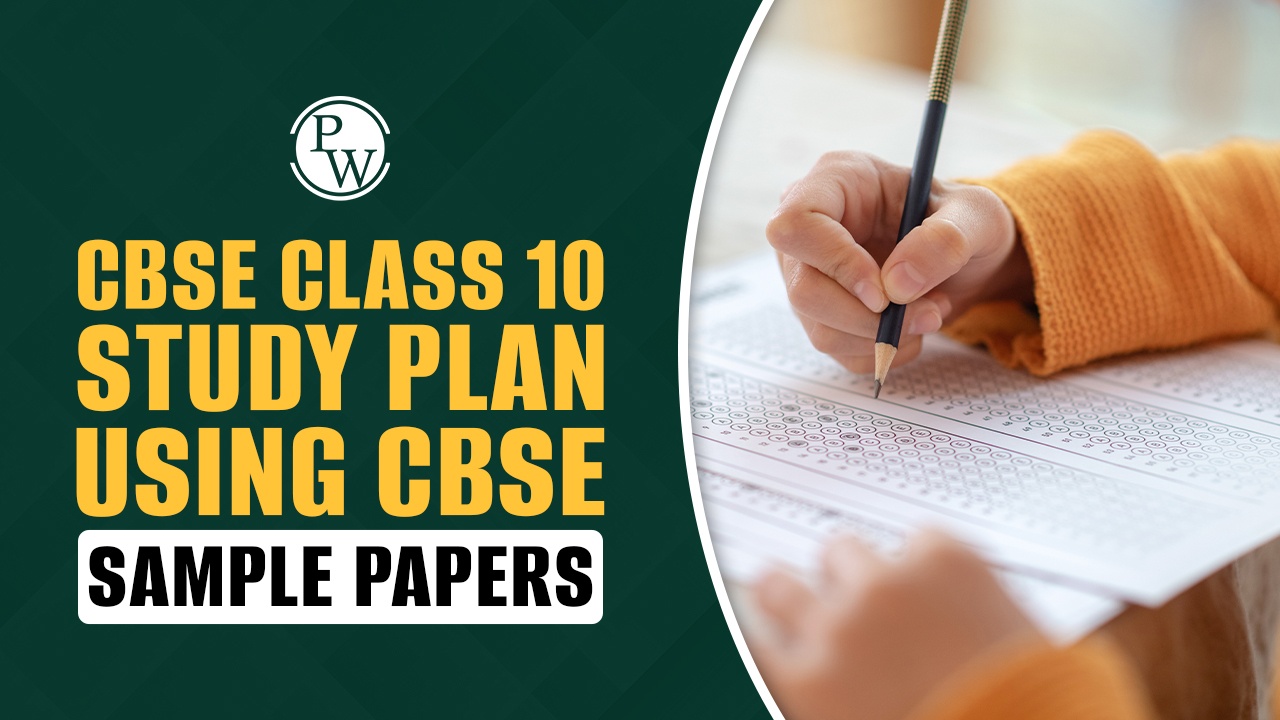
CBSE Class 10 Study Plan Using CBSE Sample Papers
CBSE Class 10 Study Plan
The CBSE Class 10 2027 board exams will take place in two phases. Phase 1, which is mandatory for all students, is scheduled from February to March 2027, while Phase 2, meant for optional improvement, will be held from May to June 2027. This time, the exam pattern will include more competency-based questions, so students need strong understanding rather than rote learning. It is also important to maintain 75% attendance to be eligible for the exam.
Now that the exam dates are confirmed, it is very important for students to start preparing with a proper CBSE Class 10 study plan. Subjects like Maths and Science need daily practice because they have many questions that require understanding and regular revision. Even subjects like Social Science, English and Hindi become easier when students study a little every day. Using CBSE Class 10 sample papers helps students know what type of questions may come and how much time they take to solve them. Go through the article here to get the PW Class 10 Sample Paper and a CBSE Class 10 Study Plan.
Check Out: CBSE Class 10 Books
CBSE Class 10 2027 Overview
Before going through the CBSE Class 10 Study Plan and pw class 10 sample paper, check out the CBSE Class 10 2027 Overview:-
|
Category |
Details |
|
Conducting Body |
Central Board of Secondary Education (CBSE) |
|
Academic Year |
2026–27 |
|
Mandatory Exam Dates (Phase 1) |
February – March 2027 |
|
Optional Improvement Exam Dates (Phase 2) |
May – June 2027 |
|
Minimum Attendance Required |
75% |
|
Type of Questions |
Mostly competency-based, application-focused questions |
|
Total Subjects |
5 Main Subjects + Optional |
|
Total Marks |
100 marks per subject (80 written exam + 20 internal assessment) |
|
Written Exam Marks |
80 marks |
|
Internal Assessment |
20 marks (Periodic tests, projects, practicals, activities) |
|
Exam Duration |
3 hours |
|
Passing Marks |
33% in each subject |
CBSE Class 10 Date Sheet
According to the official timetable, the Class 10 exams will start on February 2027 and will continue till March 2027. Check out the CBSE Datesheet for class 10 from the table here:-
|
CBSE Class 10 Date Sheet |
|
|
Subjects |
Dates |
|
Mathematics (Standard/Basic) |
February 2027 |
|
English |
February 2027 |
|
Science |
February 2027 |
|
Hindi (Course A & B) |
March 2027 |
|
Social Science |
March 2027 |
|
CBSE Class 10 Exam End Date |
March 2027 |
CBSE Class 10 Sample Paper
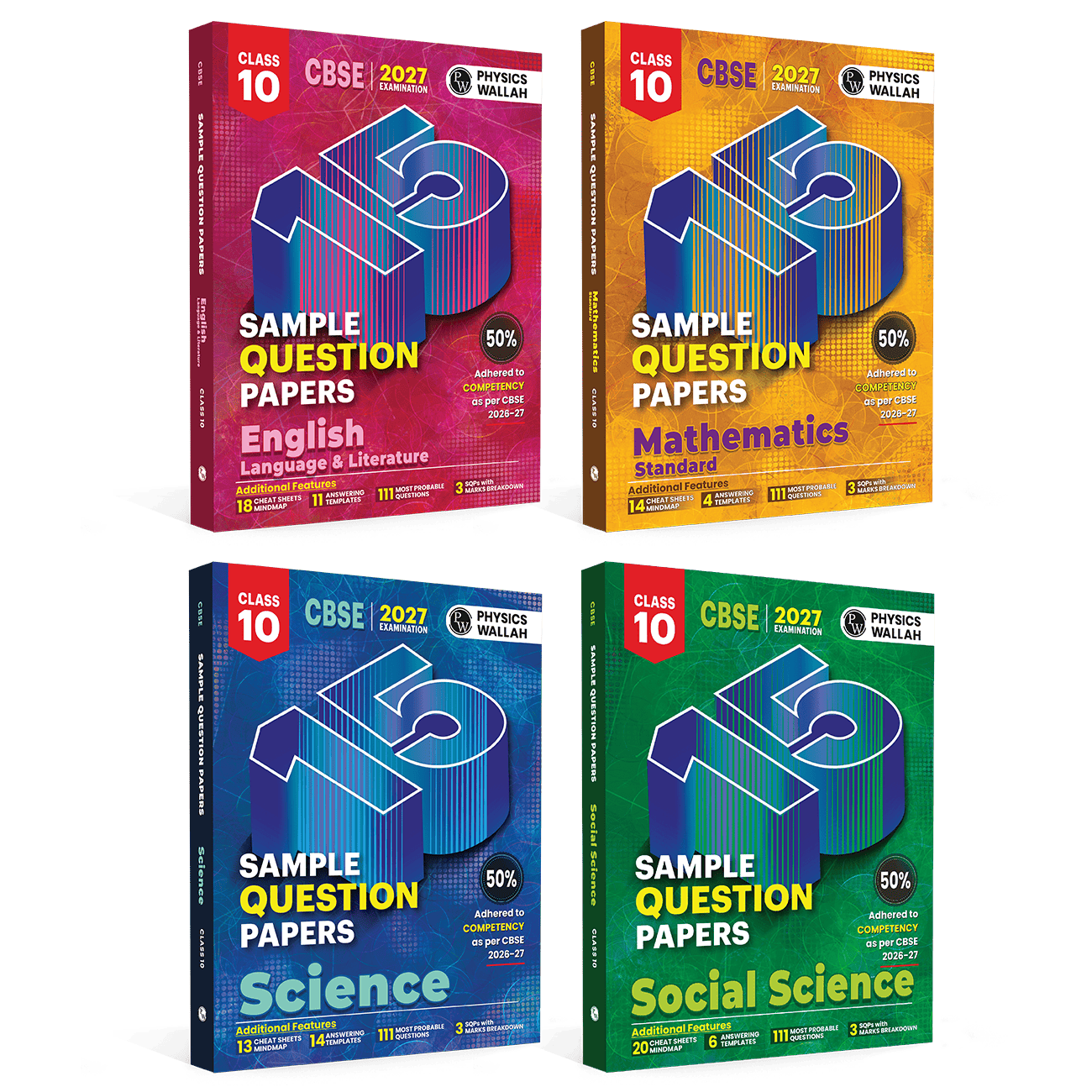
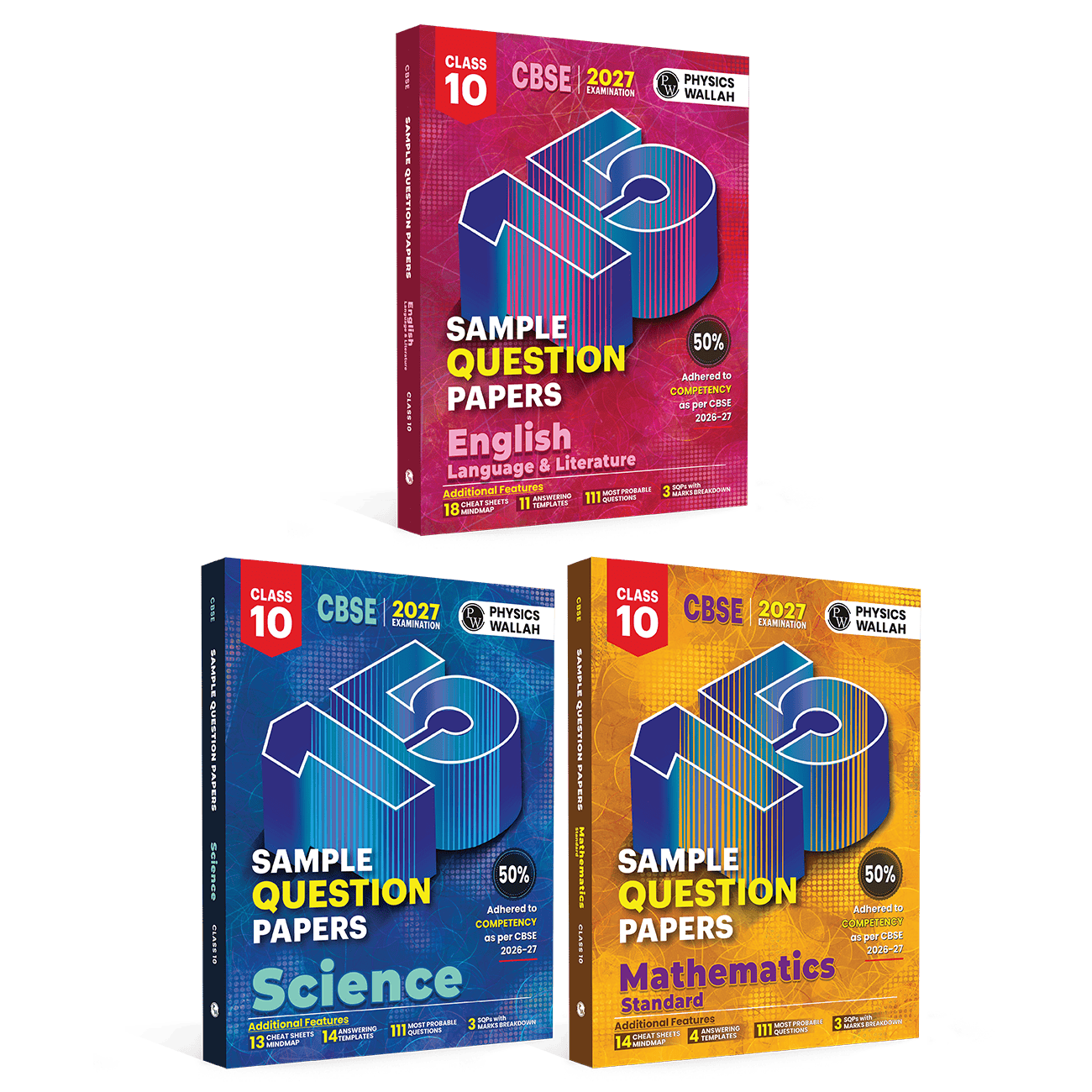
PW’s CBSE Class 10 Sample Paper book is a very helpful resource for students who want to score well and follow a proper study plan for Class 10 CBSE. The book is based on the latest CBSE 2026–27 syllabus and includes past exam trends to highlight important topics. It provides level-wise practice sets, official CBSE Class 10 sample paper, and topper-style solutions to improve answer writing. With mind maps, OMR guidance, and self-assessment sheets, it will help with quick revision and helps students prepare in a more organised way.
| CBSE Class 10 Sample Papers Maths |
| CBSE Class 10 Sample Papers Science |
| CBSE Class 10 Sample Papers Social Science |
| CBSE Class 10 Sample Papers English |
CBSE Class 10 Study Plan Using CBSE Sample Papers
Preparing for the CBSE Class 10 board exams becomes much easier when students follow a simple and smart study routine. Class 10 is an important stage, and subjects like Maths, Science, Social Science, English, and Hindi need regular practice. One of the most effective ways to prepare is by using CBSE Class 10 sample paper books such as the PW CBSE Class 10 Sample Paper, which helps students understand the real exam pattern.
1. Create a Real Study Timetable
A good timetable will help students stay organised and reduces last-minute stress. It will also make it easier to focus on all subjects without feeling overloaded.
-
Divide your study hours between tough and easy subjects. For example, give extra time to Maths chapters like Algebra, Geometry, and Mensuration, and Science chapters like Chemical Reactions, Electricity, and Human Physiology.
-
Include daily practice of reading and writing in English and Hindi to improve comprehension and answer writing skills.
-
Take short breaks after every 45–50 minutes to stay fresh, and use the break to revise formulas, diagrams, or keywords.
2. Start With NCERT
NCERT is the main book for the CBSE board exam, and most questions come from it. Before attempting any sample papers, make sure the NCERT chapters are well understood.
-
Read each chapter carefully and highlight important lines, definitions, and formula.
-
Solve all NCERT questions including intext and exercise questions to strengthen your understanding.
-
Prepare short notes for each chapter, especially on important diagrams, chemical equations, and historical dates, for quick revision.
3. Use CBSE Class 10 Sample Papers for Better Practice
Once you have finished studying the NCERT books, it’s a good idea to start solving Class 10 sample paper sets. These papers give you a clear idea of how questions are asked and how marks are divided.
-
Start with one sample paper per week, trying to cover all subjects. Pay extra attention to important topics, like Quadratic Equations and Probability in Maths, or Electricity and Chemical Reactions in Science.
-
After solving each paper, check your mistakes carefully and revise the chapters where you struggled. For example, practise Geography maps, go over key historical events, or review Maths chapters that have a lot of formulas.
4. Practise with PW CBSE Class 10 Sample Paper Book
The PW CBSE Class 10 sample paper book is designed as per the latest syllabus and includes trend analysis, answer templates, and different levels of practice.
-
Start with easier sets, then move to medium and difficult ones. Focus on high-scoring chapters like Polynomials, Surface Areas, and Volumes in Maths, or Light and Human Eye in Science.
-
Read the topper-style solutions to learn how to write precise and well-structured answers.
-
Use mind maps and quick notes provided in the book to revise topics like Political Science and Geography quickly before exams.
5. Solve Question Banks and Previous Year Papers
CBSE Class 10 Previous year papers help students understand which topics are most common and how the difficulty level changes each year.
-
Identify frequently asked chapters like Algebra and Triangles in Maths, or Chemical Reactions and Metals in Science, and give them extra practice.
-
Solve one previous year paper every weekend and focus on time management, making sure you complete all sections.
-
Compare answers with the official marking scheme to understand scoring and which sections need more practice.
6. Revise Regularly with Notes and Mind Maps
Revision is very important for scoring high marks. Without regular revision, students may forget formulas or key points.
-
Revise formulas, diagrams, and definitions every day. For example, revising chapters like Heredity and Evolution in Science or Civics topics like Fundamental Rights.
-
Use mind maps for complex chapters like History’s Freedom Struggle or Geography’s Climate Zones to remember quickly.
-
Keep a separate notebook only for important points, which will save time during last-minute revision.
7. Focus on Daily Practice for Maths and Science
Maths and Science require regular practice because they include numerical questions, diagrams, formulas, and concepts.
-
Solve 5 to 10 Maths questions daily, covering chapters like Trigonometry, Geometry, Probability, and Statistics.
-
Practise diagrams like the Human Digestive System, Circulatory System, Electric Circuits, or Magnetic Field Lines in Science.
-
Use sample papers to check if your steps and explanations are correct, especially for long-answer questions.
8. Improve Writing Speed
Many students lose marks because they write slowly or leave questions unfinished. Solving sample papers helps improve speed.
-
Write answers in neat points and highlight keywords to make them stand out.
-
Practise completing the entire paper within the time limit, giving at least 35–40 minutes to Maths and 25–30 minutes to Science.
-
Review your answers quickly to check for any skipped questions or errors in calculations.
9. Practise MCQs and Use OMR Sheets
CBSE has increased the number of MCQ and competency-based questions. Practising on OMR sheets helps avoid errors.
-
Solve MCQs from sample papers and question banks to improve accuracy and speed.
-
Use OMR sheets to practise marking answers correctly, which is useful for subjects like Science and Social Science.
-
Read each question carefully before marking your choice, especially for questions involving dates, definitions, or formulas.
10. Take Weekly Mock Tests
Mock tests will help students understand how ready they are for the exam. This will also help in identifying the weak areas that need more practise.
-
Take at least one full-length mock test every week covering all subjects.
-
Analyse your marks and focus on weak chapters such as Modern History, Algebra, or Light and Sound in Science.
-
Maintain a record of your marks to track improvement and adjust your study plan accordingly.
CBSE Sample Papers FAQs
1.How can CBSE sample papers help in Class 10 preparation?
CBSE sample papers give a clear idea of the exam pattern, types of questions, marks distribution, and difficulty level.
2. How can PW CBSE Class 10 sample papers help me?
PW sample papers follow the latest syllabus and include trend analysis, topper-style solutions, OMR guidance, and mind maps, which make revision faster and focused.
3. When should I start following a study plan for Class 10 CBSE?
It’s best to start after completing NCERT chapters for all subjects. Students can then begin solving sample papers at least 2–3 months before the exams for better preparation.
4. How often should I solve CBSE Class 10 sample papers?
Students should aim to solve one full sample paper per week initially, then increase the frequency as exams approach.
5. Should I focus on all subjects equally?
Yes, but more time should be given to difficult subjects or chapters, such as Maths (Algebra, Geometry), Science (Chemical Reactions, Human Physiology), and Social Science (History and Geography maps).