Chapter-Wise Chemistry Practice Using Class 11 Question Bank
Many students often rely too much on passive reading, where they spend hours reading without active practice, convinced that reading a page three times means they have learned it.
They highlight every sentence and feel productive, but the moment they face a blank answer sheet, that confidence disappears.
Relying solely on your notes can lead to confusion during exams. To fix this, you need a good Class 11 Chemistry question bank.
It forces you to stop just looking at the information and start using it, which is the only way to make sure your hard work actually turns into high marks.
Importance of Chemistry Question Bank
The jump in complexity during eleventh grade is significant. Chemistry has three main branches: Physical, Organic, and Inorganic. Each requires a different mental approach.
A question bank gives you the structure you need to get through this change. Students often fall into the "passive familiarity" trap, where they think they know something until they have to solve a problem based on it.
By using a Chemistry Class 11 question bank, you align your preparation with the specific marking schemes and question styles favoured by examiners.
Features of Chemistry Question Bank
A good question bank should help people learn, not just test them. A lot of resources have chapter-by-chapter questions that help students practice topics in a structured way.
Some question banks also have solved examples with step-by-step instructions that show you how to answer different kinds of questions. Also, question banks with different levels of difficulty help students get better at solving problems over time.
Before tests, quick revision notes and summaries can also help you remember important ideas.
Benefits of Using a Chemistry Question Bank
Integrating a Chemistry question bank into your daily routine offers several advantages that go beyond just getting the right answer:
|
Benefits |
Academic Impact |
|
Error Identification |
Locates specific weaknesses in logic or calculation before they cost marks in finals. |
|
Time Management |
Teaches you how to allocate time between 1-mark and 5-mark questions effectively. |
|
Confidence Building |
Solving a variety of problems reduces "exam phobia" and builds mental resilience. |
|
Language Precision |
Helps in learning the exact technical keywords that examiners look for in answers. |
Moreover, a Class 11 Chemistry question bank PDF allows for portable learning. You can review difficult reactions or formulas during a commute or a short break, ensuring that your preparation never hits a standstill.
How to Use Class 11 Chemistry Question Bank?
Don't use your Chemistry question bank as a last-minute study tool if you want to get the most out of it. Instead, use this methodical approach:
-
Sync with the Classroom: As soon as a chapter is finished in school, open your question bank to that specific section.
-
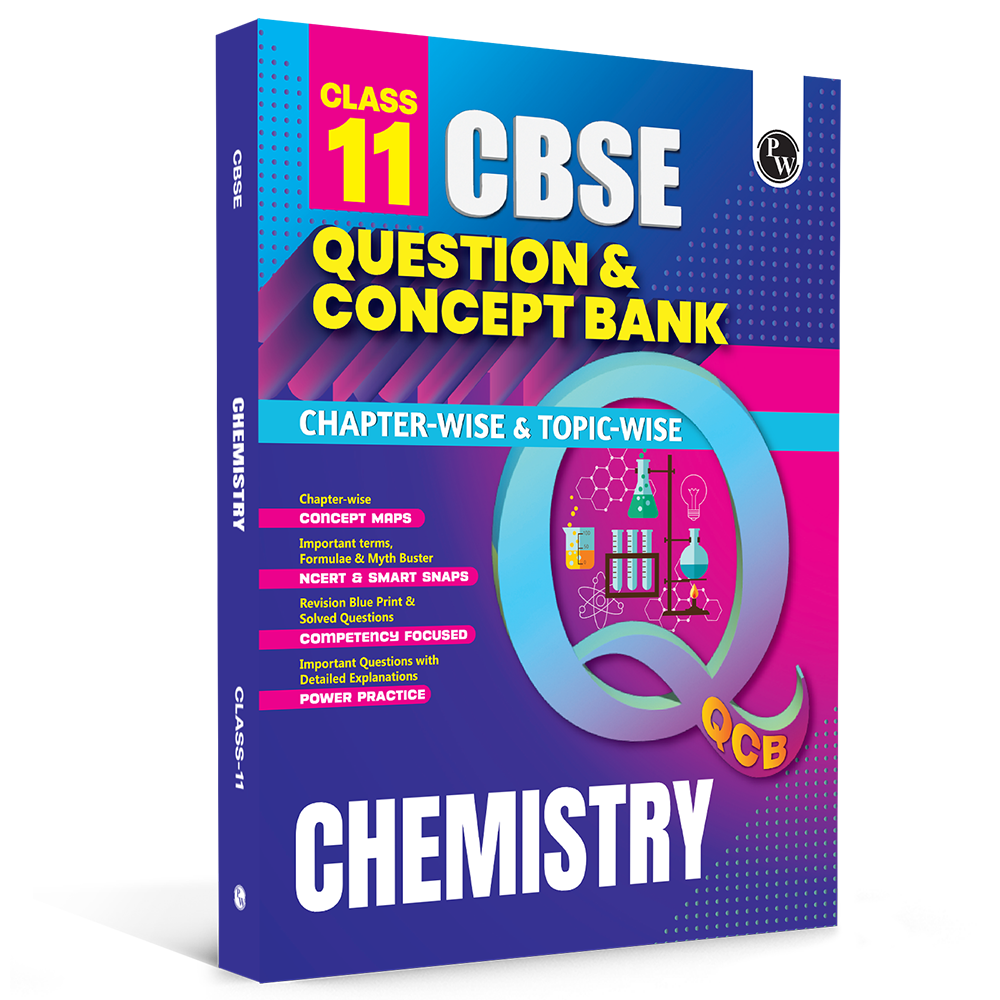
Study the Concept Maps: Use the visual maps to verify if you have missed any subtopics from your notes.
-
Analyse the Solved Questions: Don't just read the solution. Cover the answer, try solving it yourself, and then compare your steps with the provided blueprint.
-
Use the Smart Snaps: Pay close attention to the Myth Busters. These often address the exact points where students lose marks due to silly mistakes or conceptual confusion.
-
Gradual Escalation: Start with the basic "Power Practice" questions and slowly move toward the complex, multi-concept problems.
Who Should Use a Chemistry Question Bank?
A chemistry question bank can help a lot of students, especially those who want to get better with regular practise.
-
Students preparing for competitive exams: If you are aiming for exams like JEE or NEET, it's a good idea to practice different kinds of questions early on. This will help you become better at solving problems and understanding concepts.
-
Students who have trouble remembering theory: If reading alone doesn't help you remember things, answering questions can help you learn more actively and make things clearer.
-
Students who prefer learning by practice: Some students understand topics better when they apply them. For such students, a Chemistry question bank Class 11 keeps them engaged and helps them stay consistent with their preparation.
When to Use Class 11 Chemistry Question Bank
Consistency is the key to mastering Chemistry. Integrate your question bank at these three critical stages:
-
The Initial Phase: Use it while learning the chapter to solidify individual concepts as they are introduced.
-
The Weekend Review: Use the "Power Practice" section every Sunday to revisit the topics covered throughout the week. This prevents the "forgetting curve" from setting in.
-
The Pre-Exam Crunch: Two weeks before your finals, switch entirely to the Class 11 Chemistry question bank PDF to simulate real exam conditions and check your speed.
Study Plan for Chemistry Question Bank
If you feel behind, use this four-week sprint to get back on track using your Chemistry question bank:
Week 1: The Foundations (Physical Chemistry)
Focus on mole concepts and atomic structure. Use the solved questions to master the art of numerical substitution and unit conversion. Aim for 20 numericals a day.
Week 2: The Logic of Elements (Inorganic Chemistry)
Use the concept maps to study Periodic Trends and Chemical Bonding. Focus on the "Smart Snaps" to understand the exceptions in the S and P blocks, which are frequent exam targets.
Week 3: The World of Carbon (Organic Chemistry)
Organic Chemistry is all about patterns. Use your cbse 11th Chemistry question bank to practice IUPAC naming and basic electronic effects (Inductive, Electromeric). Draw every mechanism at least three times.
Week 4: Integration and Mock Testing
Move to the "Revision Blueprint" and solve full-length chapter tests. Focus on mixed-bag questions where you have to identify which concept to apply. This builds the agility needed for the final paper.
FAQs
1. How do concept maps help in a Chemistry question bank?
Concept maps provide a visual summary of the entire chapter. They help you connect different topics, which makes it much easier to remember things during tests than reading long paragraphs.
2. Should you use a physical book or a PDF of a Class 11 Chemistry question bank?
A physical book is great for long study sessions because it keeps you from getting tired of the screen. A Chemistry question bank PDF is great for quick reviews and practising questions on the go.
3. Do question banks help in preparing for competitive exams like JEE and NEET?
Yes, a lot of question banks have both conceptual and application-based questions. Regular practice helps you get better at the analytical skills you need for entrance exams.
4. Why are solved questions useful in a CBSE Class 11 Chemistry question bank?
Answered questions serve as a guide. They teach you the best way to write an answer, how to use diagrams well, and how to break down hard math problems into smaller, easier-to-manage steps to get the most step-marks.
5. How many questions should I practise daily from a Chemistry question bank?
It's usually helpful to practice 15 to 25 questions every day. Instead of just doing more questions, the goal should be to understand the method and not make mistakes.