Important Questions for Class 10 Maths Chapter 9 Applications of Trigonometry
Trigonometry is often viewed as the most difficult aspect by Class 10 students, but Chapter 9, "Some Applications of Trigonometry," is actually the reward for climbing that mountain. While Chapter 8 introduces the identities and ratios, Chapter 9 shows you how these tools measure the height of a mountain or the width of a river without a measuring tape. The primary challenge students face is translating a word problem into a correct geometric diagram. One wrong angle placement can lead to an entirely incorrect answer. By practising trigonometry class 10 important questions, you learn the art of visualising these "Heights and Distances" problems, which is essential for scoring full marks in the 4-mark and 5-mark sections.
Check out: CBSE Class 10th Books
Concepts for Applications of Trigonometry
Before diving into the trigonometry class 10 important questions and their solutions, it is crucial to grasp three fundamental terms. These form the foundation of every single problem in this chapter:
-
Line of Sight: The imaginary line drawn from the eye of an observer to the point in the object viewed by the observer.
-
Angle of Elevation: The angle formed by the line of sight with the horizontal when the object is above the horizontal level (looking up).
-
When an object is below the horizontal level (looking down), the line of sight forms an "angle of depression."
Key Points For Practising Trigonometry Class 10 Important Questions with solutions
The CBSE board exam frequently repeats specific patterns of questions in this chapter. Practising these helps you in the following ways:
-
Identify Right Triangles: Most problems involve one or two right-angled triangles.
-
Master Ratios: You primarily use tan θ (perpendicular/base) because most heights and distances involve these two sides.
-
Speed Up Calculations: Recognising standard values for 30 degrees, 45 degrees, and 60 degrees saves precious time during the exam.
Important Questions for Trigonometry Class 10
To help you prepare, we have categorised the trigonometry class 10 important questions for board exam into three common scenarios.
Q.1: A tree breaks due to a storm and the broken part bends so that the top of the tree touches the ground making an angle of 30° with it. The distance between the foot of the tree to the point where the top touches the ground is 8 m. Find the height of the tree.
Solution:
Using given instructions, draw a figure. Let AC be the broken part of the tree. Angel C = 30 degrees. BC = 8 m To Find: Height of the tree, which is AB
Q.2: A tower stands vertically on the ground. From a point on the ground which is 25 m away from the foot of the tower, the angle of elevation of the top of the tower is found to be 45°. Then the height (in meters) of the tower is :
(a) 25 2 2 (b) 25 3 3 (c) 25 (d) 12.5
Solution:
Let the height of the tower be H m.
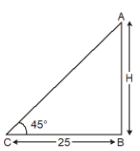
Thus, tan45°= Base/ perpendicular Or H/25 =1 Hence, H = 25m
Q.3: A ladder, leaning against a wall, makes anangle of 60° with the horizontal. If the foot of the ladder is 2.5 m away from the wall, find the length of the ladder. (2016OD)
Solution:
Let AC be the ladder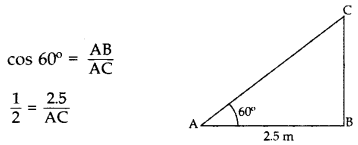 ∴ Length of ladder, AC = 5 m 2.5 m
Q.4: A ladder 15 m long just reaches the top of a vertical wall. If the ladder makes an angle of 60° with the wall, then calculate the height of the wall.
Solution:
∠BAC = 180° – 90° – 60o = 30° sin 30° = BCAC 12=BC15 2BC = 15 BC = 152m
Q.4: In the given figure, a tower AB is 20 m high and BC, its shadow on the ground, is 203–√ m long. Find the Sun’s altitude.
Solution:
AB = 20 m, BC = 20 3 –√ m,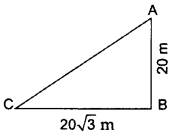 θ = ? In ∆ABC,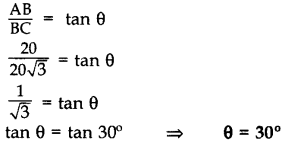
Q.5: The angles of depression of two ships from the top of a light house and on the same side of it are found to be 45° and 30°. If the ships are 200 m apart, find the height of the light house.
Solution:
Let AB be the height of the light house, D and C are two ships and DC = 200 m Let BC = x m, AB = h m In rt. ∆ABC,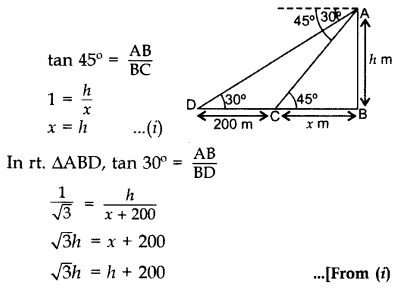
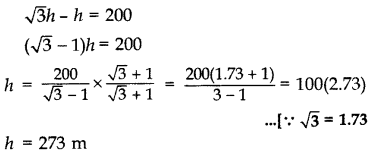 ∴ Height of the light house = 273 m
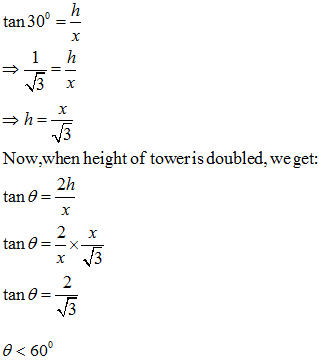
Q.6: The angle of elevation of the top of a tower is 30°. If the height of the tower is doubled, then the angle of elevation of its top will
(A) also get doubled (B) will get halved (C) will be less than 60 degree (D) None of these
Solution:
According to Question:
Q.7: If the height of a tower and the distance of the point of observation from its foot,both, are increased by 10%, then the angle of elevation of its top
(A) increases (B) decreases (C) remains unchanged (D) have no relation.
Solution:
Since tan θ = h/x Where h is height and x is distance from tower, If both are increased by 10%, then the angle will remain unchanged.
Q.8: As observed from the top of a 60 m high light house from the sea-level, the angles of depression of two ships are 30° and 45°. If one ship is exactly behind the other on the same side of the light-house, find the distance between the two ships. (Use 3 –√ = 1.732]
Solution:
Let AB = 60 m be the height of Light-house and C and D be the two ships. In right ∆ABC,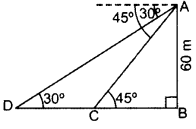
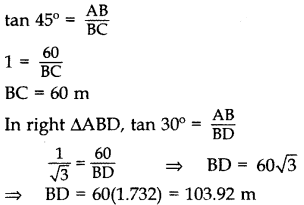 ∴ Distance between the two ships, CD = BD – BC = 103.92 – 60 = 43.92 m
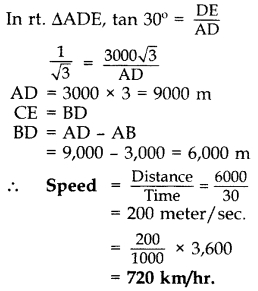
Q.9: The angle of elevation of an aeroplane from a point on the ground is 60°. After a flight of 30 seconds the angle of elevation becomes 30°. If the aeroplane is flying at a constant height of 3000 3 –√ m, find the speed of the aeroplane.
Solution:
Let A be the point on the ground and C be the aeroplane. In rt. ∆ABC,
Q.10: From the top of a 60 m high building, the angles of depression of the top and the bottom of a tower are 45° and 60° respectively. Find the height of the tower. (Take 3 –√ = 1.73] (2014OD)
Solution:
Let AC be the building & DE be the tower.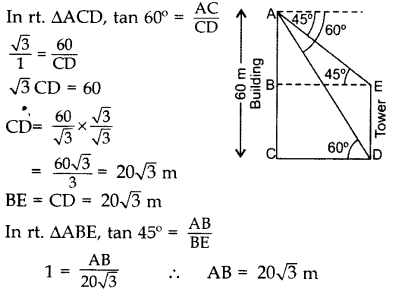 ∴ Height of the tower, DE = BC DE = AC – AB DE = 60 – 20 3 –√ = 20(3 – 3 –√ ) DE = 20(3 – 1.73) = 20(1.27) DE = 25.4 m
Q.11. The angles of depression of the top and bottom of a 50 m high building from the top of a tower are 45° and 60° respectively. Find the height of the tower and the horizontal distance between the tower and the building. [Use 3 –√ = 1.73].
Solution:
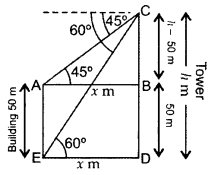 Let AE be the building and CD be the tower. Let height of the tower = h m and, the horizontal distance between tower and building = x m …[Given BD = AE = 50 m ∴ BC = CD – BD = (h – 50) m
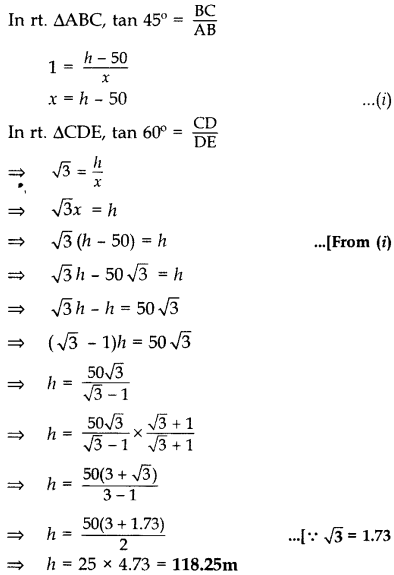 From (i), x = h – 50 = 118.25 – 50 = 68.25 m Height of the tower, h = 118.25 m ∴ Horizontal distance between tower and Building, x = 68.25 m
Q.12: A man standing on the deck of a ship, which is 10 m above water level, observes the angle of elevation of the top of a hill as 60° and the angle of depression of the base of hill as 30°. Find the distance of the hill from the ship and the height of the hill. (2016D)
Solution:
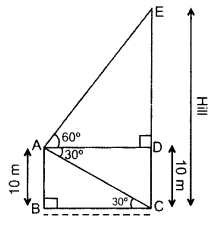 Let the man standing on the deck of a ship be at point A and let CE be the hill. Here BC is the distance of hill from ship and CE be the height of hill. In rt. ∠ABC, tan 30° = A B B C BC = 10 3 –√ m .(i) BC = 10(1.73) = 17.3 m …[:: 3 –√ = 1.73 AD = BC = 10 3 –√ m …(ii) [From (i) In rt. ∆ADE, tan 60° = D E A D ⇒ 3 –√ = D E 10 3 √ … [From (ii) ⇒ DE = 10 3 –√ × 3 –√ = 30 m ∴ CE = CD + DE = 10 + 30 = 40 m Hence, the distance of the hill from the ship is 17.3 m and the height of the hill is 40 m.
Q.13: From the top of a tower 100 m high, a man observes two cars on the opposite sides of the tower with angles of depression 30° and 45° respectively. Find the distance between the cars. (Use 3 –√ = 1.732]
Solution:
Let AB be the tower. In rt. ∆ABC, tan 45° = A B B C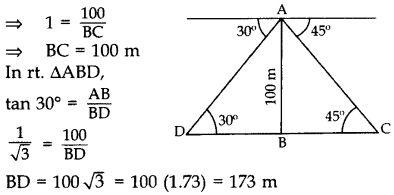 ∴ Distance between the cars, CD = BD + BC = 173 + 100 = 273 m
Q.14: Two poles of equal heights are standing opposite to each other on either side of the road, which is 100 m wide. From a point between them on the road, the angles of elevation of the top of the poles are 60° and 30° respectively. Find the height of the poles.
Solution:
Let AB and DE be the two equal poles and C be the point on BD (road). Let BC = x m Then CD = (100 – x) m Let AB = DE = y m In rt. ∆ABC,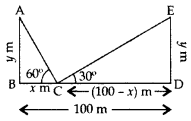
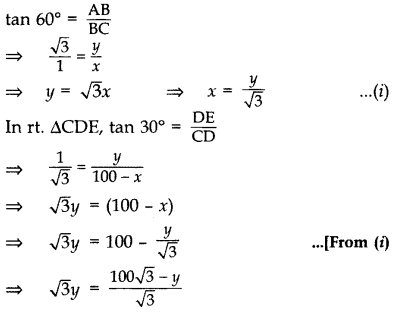 ⇒ 3y = 100 3 –√ – y ⇒ 4y = 100 3 –√ ∴ Height of the poles, y = 100 3 √ 4 = 25 3 –√ m = 25(1.73) = 43.25 m
Q.15: The angle of elevation of the top of a building from the foot of a tower is 30° and the angle of elevation of the top of the tower from the foot of the building is 60°. If the tower is 50 m high, find the height of the building.
Solution:
Let AB = 50 m be the tower and CD be the building. In rt. ∆ABC,

1. Single Observer, Single Object
These are the simplest problems where an observer at a certain distance from a building or tower looks at the top.
-
Example: A tower stands vertically on the ground. From a point on the ground, 15m away from the foot of the tower, the angle of elevation of the top of the tower is 60^{\circ}. Find the height of the tower.
2. Changing Angles (The "Moving" Problem)
In these trigonometry questions, an observer moves towards or away from an object, causing the angle of elevation to change.
-
Key Tip: As you move closer to the object, the angle of elevation increases. As you move away, it decreases.
3. Two Objects from a Single Point
These involve observing two different objects (like two ships in the sea) from a single high point (like a lighthouse). These usually require solving two separate trigonometric equations and then adding or subtracting the results.
Check out: CBSE Class 10th Sample Papers
Trigonometry Class 10 Most Common Chapter 9 Question Patterns
1) Shadow-Based Questions (Two Sun Altitudes)
These questions use the same object’s height but different angles of elevation (or different shadow lengths). You usually form two tan equations and solve for the height and shadow length.
2) Broken Tree or Bent Pole Questions
A tree/pole breaks and the top touches the ground, forming an angle with the ground. You may need to find the original height by adding the broken part and the remaining upright part, using tan or cos depending on what is given.
3) Two Poles or Two Objects from One Point
Two objects (two poles, two towers, two ships) are observed from the same point with different angles of elevation or depression. Solve two separate trigonometric relations and then compare or combine distances/heights.
4) Observer Height Included (Eye Level Correction)
If the observer’s height is given (for example, a 1.5 m tall student), use the effective height in the triangle. Add or subtract the observer’s height at the final step, depending on what the question asks.
5) Complementary Angles and “Prove That” Questions
Sometimes angles of elevation from two points are complementary. These questions often ask you to prove a relation between height and distances (a common pattern in board-style reasoning questions).
6) Moving Towards or Away from the Object (Angle Changes)
The observer changes position, so the angle of elevation changes (for example, from 30° to 45°). You write two tan equations using two distances and solve using the given movement distance.
7) Rope, Wire, or Ladder Questions (Hypotenuse Given)
If a rope/wire length is given along with an angle, sin or cos may be more suitable than tan. These questions test whether you can choose the correct ratio based on the sides provided.
8) Combined Elevation and Depression Questions
From the top of a building or a raised platform, you may get an angle of depression to the foot of an object and an angle of elevation to its top. These require a clean diagram and careful marking of equal angles to avoid mistakes.
Check out: CBSE Class 10th Previous Year Papers
Step-by-Step Guide to Solve Trigonometry Class 10 Important Questions
To make sure you do not lose step-marking points for trigonometry class 10 problems, follow this step-by-step guide:
First, create the diagram. It must be a clean, labelled diagram. Show distances as horizontal lines and heights as vertical lines.
Step 2: Determine the Values Provided. Note the observer's height (if available), the distance, and the angles.
Pick the ratio in step three. Typically, you'll use:
frac{\text{Height}}{\text{Distance}} = tan \theta
Step 4: Replace and resolve. For \tan 30^{\circ} (1/\sqrt{3}), \tan 45^{\circ} (1), and \tan 60^{\circ} (\sqrt{3}), use the precise values.
Step 5: The last unit. Always use the appropriate unit (centimetres or metres) at the end of your response.
Common Mistakes to Avoid in Trigonometry Class 10
Even with the best trigonometry important questions with solutions, students often make silly errors. Watch out for these:
-
Mixing Elevation and Depression: Remember that the Angle of Depression is measured from the horizontal line at the top, not the vertical line.
-
Ignoring Observer Height: If the question says "A 1.5m tall boy is standing...", you must subtract his height from the total height of the object before calculating the triangle's side.
-
Value Errors: Confusing \sin 60^{\circ} with \cos 60^{\circ} or \tan 60^{\circ} is a frequent mistake. Keep a small table of values ready on your rough sheet.
Recommended Practice Schedule for Trigonometry Class 10 Important Questions CBSE
To truly master trigonometry important questions, don't just read them; solve them.
|
Day |
Focus Area |
Resource |
|
Day 1 |
Basic Height/Distance Problems |
NCERT Examples |
|
Day 2 |
Double Triangle Problems |
Previous Year Questions |
|
Day 3 |
Case-Based Questions |
Trigonometry class 10 important questions PDF |
The more you practise, the more you will realise that every question is just a variation of the same basic triangle geometry. The limited number of possible question types makes this chapter a high-scoring area.
Read More: Topper Answer Sheet Class 10 CBSE PDF Download
Important Questions for Class 10 Maths Chapter 9 FAQs
Q1. What is the most important ratio to know for class 10 trigonometry questions?
The most frequently used ratio is tangent, as Chapter 9 mostly deals with the relationship between the height (perpendicular) and the distance (base) of objects.
Q2. Where can I find important questions for trigonometry class 10 with solutions?
You can find detailed solutions in your NCERT Exemplar, PW workbooks, and by exploring curated sets of important trigonometry questions for class 10 CBSE on educational platforms like Physics Wallah.
Q3. How do I handle angles of depression in the board exam?
When given an angle of depression, use the property of alternate interior angles to mark the same angle at the base of the triangle. This converts the depression problem into a standard elevation problem.
Q4. Are the questions from Chapter 9 compulsory in the board exam?
Yes, Chapter 9 usually carries 4 to 5 marks. You will often find one long-answer question or a case-study based question from trigonometry class 10 for the board exam.