Most Commonly Asked Questions in CBSE Class 10 Sample Papers

Most Commonly Asked Questions in CBSE Class 10 Sample Papers:- The Central Board of Secondary Education (CBSE) has released the final date-sheet for the Class 10 board exams on October. Phase 1 of the exams is scheduled to begin from February 2027 to March 2027, while Phase 2 will take place in May. As there are only two to three months remaining, it is very important that students begin serious revision and regular practice.
A highly advised way to prepare for CBSE Class 10 Boards is by solving Class 10 sample papers. While working through these papers, several questions often come to mind. Some of the most commonly asked questions are: How Many Class 10 Sample Papers to Solve? or When to Start Class 10 Sample Papers. So, we are here to answer all the commonly asked questions for Class 10 sample papers and to help you score 90+ with Class 10 sample papers.
Check Out: CBSE Class 10 Books
What Are Class 10 Sample Papers?
Class 10 sample papers are practice question papers that are designed according to the latest CBSE exam pattern and syllabus. These papers give you a clear idea of how the real board exam paper will look and what type of questions you will face.
In Class 10, students mainly study five to six major subjects such as Science, Maths, Social Science, English, and Hindi, along with some optional subjects. It is always advised that students first complete their NCERT textbooks, as NCERT is the primary and most important resource for CBSE exam preparation. However, once you finish studying your NCERT books, it becomes equally important to keep practising questions regularly. That is when CBSE Class 10 sample papers come into use.
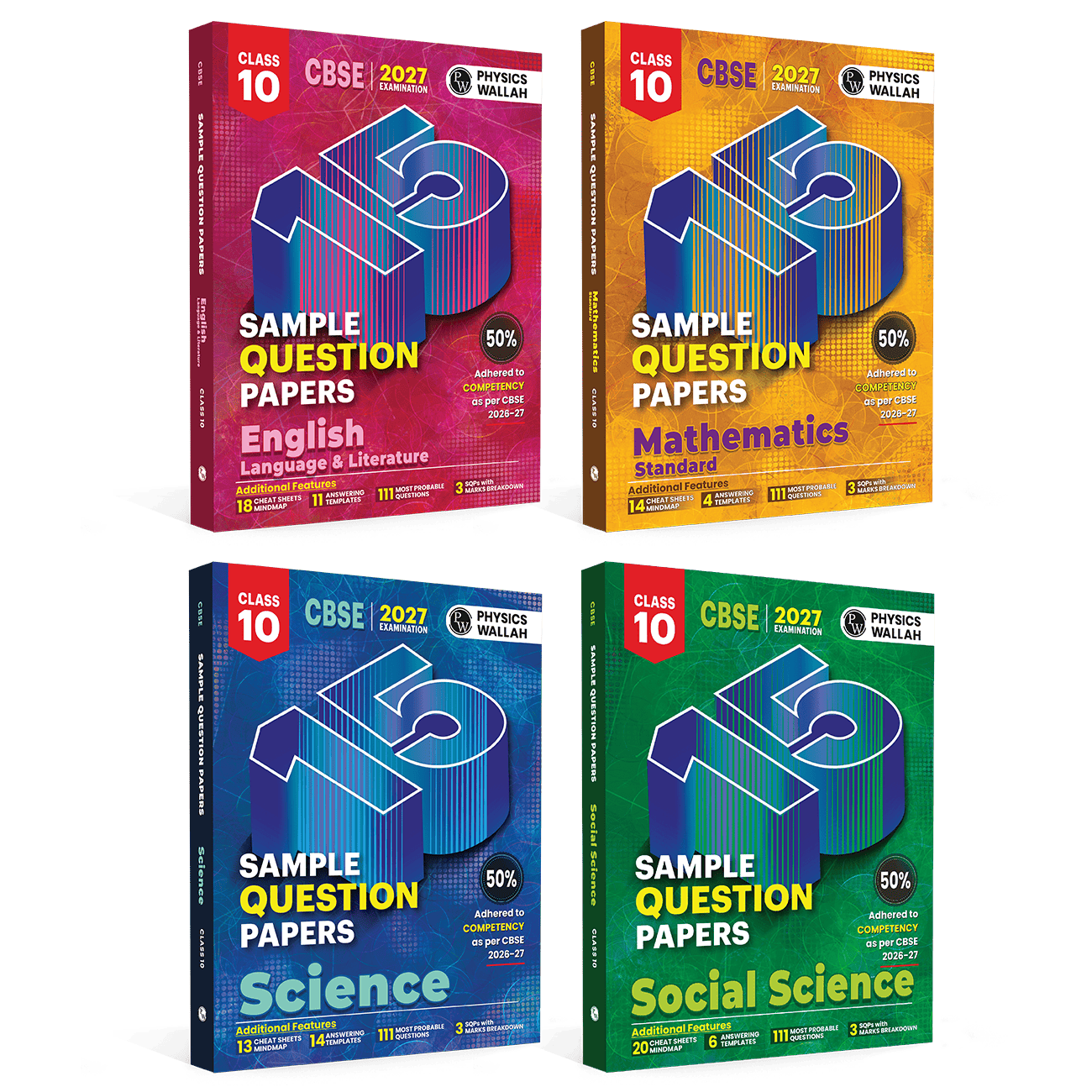
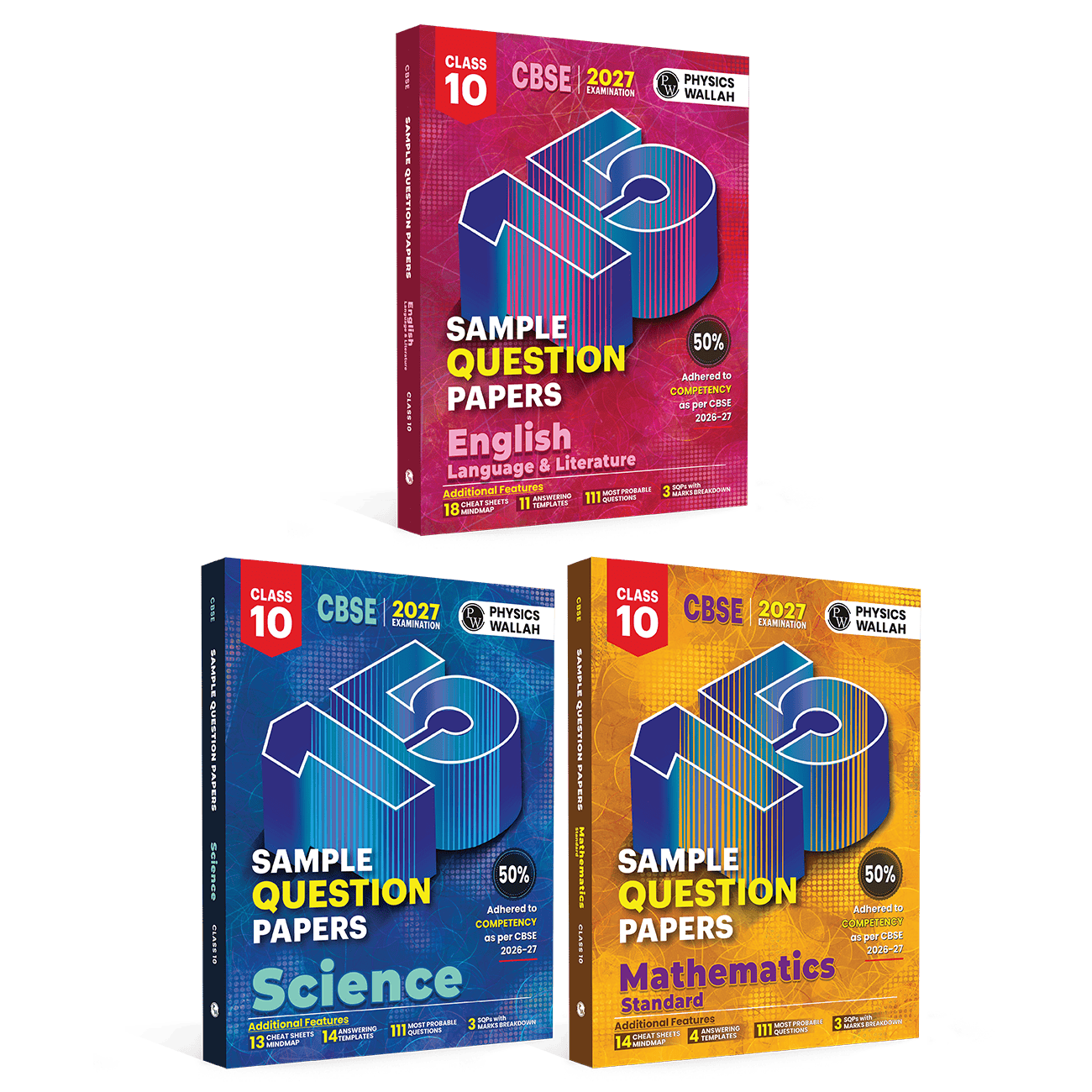
One such quality Sample Papers are PW Class 10 Sample Papers that include the same question types that appear in the board exams, such as objective questions, short-answer questions, long-answer questions, case-based problems, and competency-based questions.
Are Class 10 Sample Papers Enough?
Class 10 sample papers are very helpful for practice, but they are not enough on their own. Students should first study and revise their NCERT books properly and then use sample papers to test their understanding. Sample papers help you check your preparation, improve time management, and practise exam-style questions, but your base must always be strong with NCERT.
How Many Class 10 Sample Papers to Solve?
This is one of the most commonly asked questions by students. Ideally, you should solve at least 8–10 sample papers before your board exam.
-
Start with 1 paper per week, then increase to 2–3 papers per week closer to exams.
-
Always solve sample papers in exam-like conditions (3 hours, no breaks).
-
Check your answers with the marking scheme to understand how marks are given.
-
Analyse your mistakes after every paper and revise the weak topics again.
Are Sample Papers Helpful for Class 10?
Yes, sample papers are very helpful for Class 10 students. They help you understand the real exam pattern, question style, and marking scheme such as:-
-
Each subject carries 100 marks, 80 marks for the theory exam and 20 marks for internal assessment.
-
The time duration for each theory paper is 3 hours.
-
The exam paper includes different types of questions like MCQs, short-answer, long-answer and case-based questions.
-
As per the latest CBSE guidelines, the paper structure includes:
-
50% competency-based questions (case-based, source-based, MCQs etc.)
-
20% MCQs / objective-type questions
-
30% short-answer and long-answer questions
-
Students must score at least 33% marks in each subject to pass.
Check Out: CBSE Class 10 Question Banks
When to Start Class 10 Sample Papers?
Students should start solving Class 10 sample papers once they finish at least 80% of their syllabus. Starting around November or early December is ideal, so you get enough time to practise, analyse mistakes, and improve.
Class 10 Sample Paper Study Plan
A simple and effective way to prepare for Class 10 Boards is to solve sample papers regularly. Once you finish your NCERT textbook and notes, follow this weekly plan.
|
Day |
Task |
|
Monday |
Revise NCERT (2 chapters) + Solve Section-wise Questions (50 marks) |
|
Tuesday |
Solve 1 full sample paper (3 hours) |
|
Wednesday |
Check paper, analyse mistakes, rewrite incorrect answers |
|
Thursday |
Focus on weak topics + solve 20 MCQs & 2 writing tasks (English/SST) |
|
Friday |
Solve another full sample paper (3 hours) |
|
Saturday |
Paper analysis, corrections notebook, revise formulas/maps/diagrams |
|
Sunday |
Light revision, PYQ practice (2023/24), Mind Maps, Rest |
Read More: CBSE Date Sheet 2026
Class 10 Sample Paper or Question Bank
Many students often get confused about whether they should use Class 10 Sample Papers or a Question Bank. Both are useful, but they serve different purposes. Here are the clear benefits of Class 10 Sample Papers and questions banks:-
|
Class 10 Sample Papers |
Class 10 Question Bank |
|
Designed exactly like the real CBSE board paper |
Designed chapter-wise for detailed practice |
|
Best used after completing the entire syllabus |
Best used from the beginning of the year while studying each chapter |
|
Helps you practice full papers in 3-hour exam conditions |
Helps you learn and practice different question formats topic-by-topic |
|
Includes a marking scheme and model answers |
Includes MCQs, short answers, long answers, and competency-based questions |
|
Shows how CBSE questions are structured in real exams |
Gives you a wide range of extra practice questions for each topic |
|
Ideal for last 2–3 months before the exam |
Ideal for daily study and chapter-wise revision |
CBSE 10 CBSE Sample Papers
Here are Subject-Wise Class 10 CBSE Sample Papers:-
|
Subject-Wise Class 10 CBSE Sample Papers |
|
|
|
|
|
|
|
|
|
|
|
|
|
Score 90+ with Class 10 Sample Papers
Scoring 90+ in Class 10 is not about studying the whole day. It is about studying smartly, finishing your NCERT properly, and then practising sample papers regularly. Many students feel nervous when exams are near, but if you follow a proper study plan and solve sample papers the right way, you can easily build confidence and improve your marks. Here is a simple and effective Class 10 Sample Paper 2026 Tips you can follow:-
1. NCERT Textbook First
Before you even start sample papers, make sure your NCERT textbooks are fully completed. NCERT is the base for all CBSE exam questions, and most questions come directly or indirectly from these books. So understanding every concept, example question, and exercise is very important.
-
Read each chapter carefully and understand the meaning, not just memorise
-
Solve all NCERT exercise questions and in-text questions from every chapter
-
Highlight important lines and practice writing key definitions in your own words
2. Make Your Own Notes
Once you finish a chapter, create short notes for quick revision. Writing notes helps you remember better and makes revision much easier, especially during the last month before exams. Your notes should be simple, neat, and easy to read.
-
Divide notes into headings, formulas, definitions, and key points
-
Keep your notes short so you can revise an entire chapter quickly
-
Use colour pens to mark important points and keep your notes organised
3. Focus on Important Topics
Every subject has some high-weightage chapters that are asked every year. Make sure you revise these topics more than once and practice questions from them properly. This will help you secure strong marks even if some other questions feel tricky on exam day.
-
Check previous year questions to find repeated topics and question styles
-
Give extra practice to high-scoring chapters like Algebra, Chemical Reactions, Life Processes, History and Grammar
-
Revise important formulas, laws, map-locations, and definitions regularly
4. Start Solving PW Class 10 Sample Papers
Once your basics are clear, start solving PW Class 10 sample papers. These papers are aligned with the latest CBSE exam pattern and help you get used to the real question format. Practising PW sample papers will also help you understand expected questions and important topics.
-
Solve one paper at a time and do not check answers until you finish writing
-
Write answers properly like the board exam to learn time management
-
Review your paper and compare with the answer key or marking scheme
5. Work on Your Weak Areas
After solving each paper, you will understand where you are going wrong. Use this as a chance to fix your weak areas. It is okay to make mistakes in practice. What matters is that you learn from them and avoid repeating them in the final exam.
-
Mark questions you got wrong and revise those chapters again
-
Practice similar questions so you feel confident in that topic
-
Ask your teacher, friend or use PW videos to clear doubts immediately
6. Keep Revision Daily
Regular revision is more important than long study hours. Even if you learn a chapter once, you may forget it if you do not revise. Just 1 to 2 hours of revision daily can make a huge difference in your final score.
-
Revise formulas, key terms, diagrams and maps every day
-
Keep a fixed revision time slot so you stay consistent
-
Try short revision methods like flashcards, cheat sheets and written practice
7. Do Not Neglect Maps or Diagrams
In Class 10, maps and diagrams carry direct marks, especially in Social Science and Science. Many students ignore them and lose easy marks. So practice maps and diagrams regularly and learn to draw them neatly.
-
Practice India map locations like rivers, resources, national parks, states and cities
-
Draw diagrams for Science chapters like Life Processes, Electricity and Human Eye
-
Label everything neatly and keep diagrams simple and clean for full marks.
Benefits of Class 10 Sample Papers
-
PW Class 10 sample papers strictly follow the latest CBSE 2026–27 pattern, so you practise the exact paper style and marking method you will face in the boards, including official CBSE papers and solved 2026–27 board sets.
-
They also include past 5-year exam trend analysis and 111 most expected questions, which helps you focus on the most important topics and understand commonly asked questions for Class 10.
-
Topper-style handwritten answers, marking-scheme based solutions, and ready-to-use answer templates guide you on how to write neat, accurate and scoring answers in the board exam.
-
You get level-wise practice (easy, medium, hard) along with a Mistake-101 section to help you learn from common errors and improve speed, accuracy and confidence while practising sample papers.
-
PW also provides mind-map cheat sheets, self-assessment sheets, OMR practice and support for the new two-exam policy and competency-based questions, which makes revision smooth and helps you prepare in a structured way for the Class 10 board exams.
CBSE Class 10 Sample Papers FAQs
1. How do sample papers help in Class 10 preparation?
Sample papers help you practise real exam-style questions, improve speed, and understand where you need more revision.
2. How many sample papers should I solve before the Class 10 board exam?
You should solve at least 8–10 sample papers to feel confident and ready for the exam.
3. When should I start solving sample papers?
Start solving them 3–4 months before the exam, ideally after finishing most of your syllabus.
4. How to score 95%+ in Class 10?
Focus on understanding concepts, practise sample papers regularly, revise every day, and write answers neatly with proper steps and diagrams.
5. Is 70% good in CBSE Class 10?
Yes, 70% is a good score. But if you wish to take science, you will need score more marks.