NCERT Solutions for Class 10 Science Chapter 12: Electricity
NCERT Solutions for Class 10 Science Chapter 12
NCERT Solutions for Class 10 Science Chapter 12 help students understand one of the most important physics topics – electricity. These electricity class 10 NCERT solutions explain how electric current flows in a circuit, what potential difference means, and how both are connected through Ohm’s Law. The electricity class 10 questions and answers cover all concepts in a clear, step-by-step manner so students can easily learn theory and solve numerical problems.In CH Electricity Class 10 NCERT solutions, you will study important topics like electric current, potential difference, resistance, factors affecting resistance, and electric power. The chapter also explains how the length, area, and material of a wire change its resistance. Students also learn how electrical energy converts into heat and why devices heat up when current flows through them. These concepts become easy to understand with well-explained class 10 electricity question answers.
You will also learn about series and parallel circuits, and why parallel circuits are used in homes for safety and better efficiency. The Class 10 Science Chapter Electricity NCERT solutions help you understand how household circuits work and how current distributes in different branches. This makes the chapter easy for board exam preparation. These electricity Class 10 solutions are written in simple language so students can understand every topic quickly. Each numerical is solved step by step, and every formula is explained clearly. Whether you want to revise the chapter or practice more questions, these electricity Class 10 NCERT solutions will strengthen your basics.
By studying the NCERT Solutions for Class 10 Science Chapter 12, you can improve your problem-solving skills, learn proper methods, and gain full confidence before the final board exams. These well-structured electricity Class 10 questions and answers help you score better by making concepts easier, clearer, and exam-ready.
Check Out: CBSE Class 10 Books
NCERT Class 10th Science Chapter Electricity Question Answer
Find out important NCERT Class 10th Science Chapter Electricity Question Answers here that will help you understand the key ideas of the chapter. These answers explain electric current, potential difference, resistance, and Ohm’s Law in simple words to make your learning effective and exam preparation stronger.
Electricity Class 10 NCERT Solutions: Exercise Questions
Question 1. What does an electric circuit mean?
Solution: An electric circuit is a continuous closed path made up of various electrical components through which electric current can flow. In its simplest form, a circuit includes:
-
Conductors: Wires or other materials that allow current to flow through them.
-
Cell: A source of electrical energy that provides the voltage needed to drive the current.
-
Switch: A device used to open or close the circuit, controlling the flow of current.
-
Load: An electrical component or device that uses the electrical energy to perform work, such as a light bulb or resistor.
Question 2. Define the unit of current.
Solution: The unit of electric current is the ampere. One ampere is defined as the flow of one coulomb of electric charge passing through a conductor in one second. It is commonly abbreviated as A.
Question 3. Calculate the number of electrons constituting one coulomb of charge.
Solution: The value of the charge of an electron is 1.6 × 10 -19 C. According to charge quantization,
Q = nq e, where n is the number of electrons and q e is the charge of an electron.
Substituting the values in the above equation, the number of electrons in a coulomb of charge can be calculated as follows:Therefore, the number of electrons constituting one coulomb of charge is 6.25 × 10¹⁸.
Read More: NCERT Solutions for Class 10 Science Chapter 1
Class 10 Electricity Question Answers: Page 202
Question 1. Name a device that helps to maintain a potential difference across a conductor.
Solution: A battery is a device that helps maintain a potential difference across a conductor. It consists of one or more electric cells that provide the necessary voltage to drive the electric current through the circuit.
Question 2. What is meant by saying that the potential difference between two points is 1 V?
Solution: When it is said that the potential difference between two points is 1 volt (V), it means that 1 joule (J) of work is required to move a charge of 1 coulomb (C) from one point to the other.
Question 3. How much energy is given to each coulomb of charge passing through a 6 V battery?
Solution: We know that the potential difference between two points is given by the equation V = W/Q, where W is the work done in moving the charge from one point to another and Q is the charge. From the above equation, we can find the energy given to each coulomb as follows: W = V × Q. Substituting the values in the equation, we get W = 6V × 1C = 6 J. Hence, 6 J of energy is given to each coulomb of charge passing through a 6V battery.
Read More: NCERT Solutions for Class 10 Science Chapter 2
Electricity Class 10 Questions and Answers: Page 209
Question 1. On what factors does the resistance of a conductor depend?
Solution: The resistance of a conductor depends on several factors:
-
Temperature of the Conductor: As the temperature of the conductor increases, its resistance typically increases due to increased collisions between electrons and atoms.
-
Cross-Sectional Area of the Conductor: A larger cross-sectional area results in lower resistance, as more paths are available for the flow of electric current.
-
Length of the Conductor: The resistance is directly proportional to the length of the conductor. Longer conductors have higher resistance.
-
Nature of the Material of the Conductor: Different materials have different inherent resistivities. For example, metals generally have low resistivity, making them good conductors, while materials like rubber have high resistivity and serve as insulators.
Question 2. Will current flow more easily through a thick wire or a thin wire of the same material when connected to the same source? Why?
Solution: Resistance is given by the equation, R = ρ l/A where, ρ is the resistivity of the material of the wire, l is the length of the wire A is the area of the cross-section of the wire. From the equation, it is evident that the area of the cross-section of wire is inversely proportional to the resistance. This means that as the cross-sectional area increases, the resistance decreases, and vice versa. Therefore, a thick wire, having a larger cross-sectional area, has less resistance compared to a thin wire. Current flows more easily through a thick wire than through a thin wire when both are made of the same material and connected to the same voltage source.
Read More: NCERT Solutions Class 10 Science Chapter 3
Question 3. Let the resistance of an electrical component remain constant while the potential difference across the two ends of the component decreases to half of its former value. What change will occur in the current through it?
Solution: The change in the current flowing through the electrical component can be determined by Ohm’s Law. According to Ohm’s Law, the current is given by I = V/R Now, the potential difference is reduced to half keeping the resistance constant. Let the new voltage be V’ = V/2 Let the new resistance be R’ = R and the new amount of current be I’. The change in the current can be determined using Ohm’s law as follows:Therefore, the current flowing through the electrical component is reduced by half.
Question 4. Why are coils of electric toasters and electric irons made of an alloy rather than a pure metal?
Solution: The melting point of an alloy is generally higher than that of a pure metal due to its high resistivity. The high resistivity of alloys means they do not conduct electricity as easily as pure metals, and they generate more heat when an electric current passes through them. This property makes alloys ideal for use in heating appliances like electric toasters and electric irons. In these appliances, the alloys are used because they can withstand high temperatures and resist melting, ensuring that they effectively convert electrical energy into heat without quickly deteriorating.
Question 5. Use the data in the table given below and answer the following questions.
a. Which among iron and mercury is a better conductor?
b. Which material is the best conductor?
Solution:
a. Iron is a better conductor than mercury because the resistivity of mercury is higher than that of iron. Lower resistivity indicates better conductivity, meaning iron allows electric current to pass through more easily compared to mercury.
b. Among all the materials listed in the table, silver is the best conductor because the resistivity of silver is the lowest among all, i.e., 1.60 × 10⁻⁸.
Read More: NCERT Solutions for Class 10 Science Chapter 4
NCERT Solutions for Class 10 Science Chapter 12 Electricity Page: 213
1. Draw a schematic diagram of a circuit consisting of a battery of three cells of 2 V each, a 5 Ω resistor, an 8 Ω resistor, and a 12 Ω resistor, and a plug key, all connected in series.
Solution: A battery of three cells of 2 V each equals to battery of potential 6 V. The circuit diagram below shows three resistors of resistance 12 Ω, 8 Ω and 5 Ω connected in series along with a battery of potential 6 V.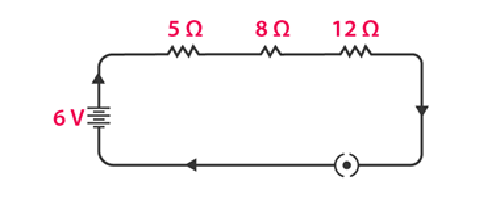
2. Redraw the circuit of Question 1, putting in an ammeter to measure the current through the resistors and a voltmeter to measure the potential difference across the 12 Ω resistor. What would be the readings in the ammeter and the voltmeter?
Solution: An ammeter should always be connected in series with resistors while the voltmeter should be connected in parallel to the resistor to measure the potential difference as shown in the figure below.
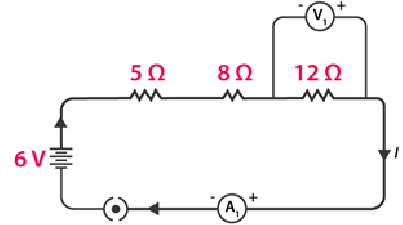
Using Ohm’s Law, we can obtain the reading of the ammeter and the voltmeter. The total resistance of the circuit is 5 Ω + 8 Ω +12 Ω = 25 Ω. We know that the potential difference of the circuit is 6 V, hence the current flowing through the circuit or the resistors can be calculated as follows: I = V/R = 6/25 = 0.24A Let the potential difference across the 12 Ω resistor be V 1 . From the obtained current V 1 can be calculated as follows: V 1 = 0.24A × 12 Ω = 2.88 V Therefore, the ammeter reading will be 0.24 A and the voltmeter reading be 2.88 V.
Read More: NCERT Solutions for Class 10 Science Chapter 5
NCERT Solutions for Class 10 Science Chapter 12 Electricity Page: 216
Here, we have provided NCERT Solutions for Class 10 Science Chapter 12 to help students prepare more effectively for their exams.
1. Judge the equivalent resistance when the following are connected in parallel – (a) 1 Ω and 10 6 Ω, (b) 1 Ω, 10 3 Ω, and 10 6 Ω.
Solution: (a) When 1 Ω and 10 6 are connected in parallel, the equivalent resistance is given by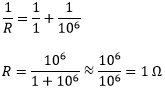 Therefore, the equivalent resistance is 1 Ω. (b) When 1 Ω, 10 3 Ω, and 10 6 Ω are connected in parallel, the equivalent resistance is given by
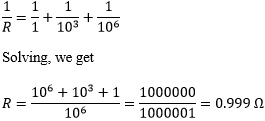 Therefore, the equivalent resistance is 0.999 Ω.
2. An electric lamp of 100 Ω, a toaster of resistance 50 Ω, and a water filter of resistance 500 Ω are connected in parallel to a 220 V source. What is the resistance of an electric iron connected to the same source that takes as much current as all three appliances, and what is the current through it?
Solution: The electric lamp, the toaster and the water filter connected in parallel to a 220 V source can be shown as using a circuit diagram as follows: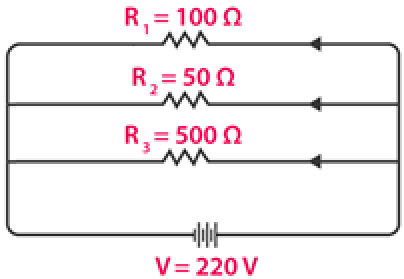
The equivalent resistance of the resistors can be calculated as follows: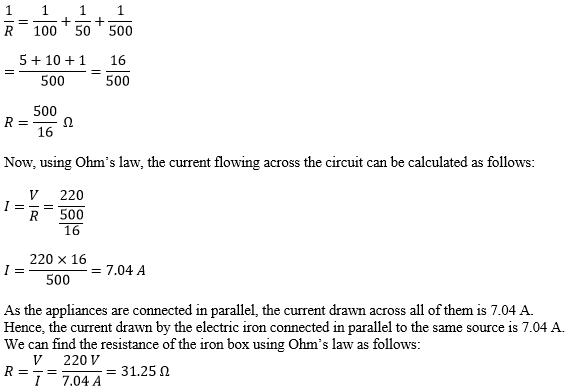
The resistance of the electric iron box is 31.25 Ω.
Read More: NCERT Solutions for Class 10 Science Chapter 6
3. What are the advantages of connecting electrical devices in parallel with the battery instead of connecting them in series?
Solution: When electrical devices are connected in parallel, the following key points apply:
Uniform Voltage : Each device connected in parallel experiences the same potential difference, which is equal to the supply voltage. This means that each appliance receives the full voltage from the power source, ensuring consistent performance across all devices.
Reduced Effective Resistance : The effective resistance of the circuit decreases when devices are connected in parallel. This is because the total resistance in a parallel circuit is less than the resistance of the smallest resistor connected. As more devices are added in parallel, the total resistance continues to decrease, allowing more current to flow through the circuit.
4. How can three resistors of resistances 2 Ω, 3 Ω, and 6 Ω be connected to give a total resistance of (a) 4 Ω, (b) 1 Ω?
Solution: (a) The circuit diagram below shows the connection of three resistors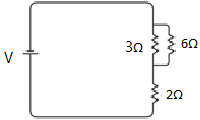
From the circuit above, it is understood that 3 Ω and 6 Ω are connected in parallel. Hence, their equivalent resistance is given by
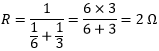 The equivalent resistor 2 Ω is in series with the 2 Ω resistor. Now the equivalent resistance can be calculated as follows: R eq = 2 Ω +2 Ω = 4 Ω Hence, the total resistance of the circuit is 4 Ω. (b) The circuit diagram below, shows the connection of three resistors.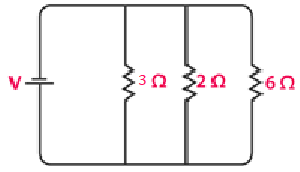
From the circuit, it is understood that all the resistors are connected in parallel. Therefore, their equivalent resistance can be calculated as follows: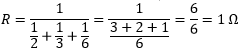 The total resistance of the circuit is 1 Ω.
Read More: NCERT Solutions for Class 10 Science Chapter 7
5. What is (a) the highest, (b) the lowest total resistance that can be secured by combinations of four coils of resistance 4 Ω, 8 Ω, 12 Ω, 24 Ω?
Solution: (a) If the four resistors are connected in series, their total resistance will be the sum of their individual resistances and it will be the highest. The total equivalent resistance of the resistors connected in series will be 4 Ω + 8 Ω + 12 Ω + 24 Ω = 48 Ω. (b) If the resistors are connected in parallel, then their equivalent resistances will be the lowest. Their equivalent resistance connected in parallel is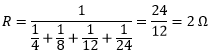 Hence, the lowest total resistance is 2 Ω.
Class 10 Electricity NCERT Solutions: Page 218
Question 1. Why does the cord of an electric heater not glow while the heating element does?
Solution: The heating element of an electric heater is designed with an alloy that has high resistance. When electric current flows through this high-resistance material, it encounters significant resistance, which converts electrical energy into heat.
-
As a result, the heating element becomes very hot and can even glow red due to the intense heat produced.
-
In contrast, the cord of the electric heater is made of materials like copper or aluminium, which have low resistance.
-
These materials are chosen for the cord because they efficiently conduct electricity with minimal resistance, generating little heat in the process.
-
Consequently, the cord remains cool and does not glow, ensuring safety and efficient operation of the heater.
Question 2. Compute the heat generated while transferring 96000 coulombs of charge in one hour through a potential difference of 50 V.
Solution: The heat generated can be computed by Joule’s law as follows: H = VIt, where V is the voltage, V = 50 V, I is the current, t is the time in seconds, 1 hour = 3600 seconds. The amount of current can be calculated as follows:
Read More: NCERT Solutions Class 10 Science Chapter 8
Question 3. An electric iron of resistance 20 Ω takes a current of 5 A. Calculate the heat developed in 30 s.
Solution:
-
The amount of heat generated can be calculated using Joule’s law of heating, which is given by the equation H = VIt.
-
Substituting the values in the above equation, we get, H = 100 × 5 × 30 = 1.5 × 10 4 J The amount of heat developed by the electric iron in 30 s is 1.5 × 10 4 J.
NCERT Solutions for Class 10 Science Chapter 12 Electricity: Exercises Page 220
Question 1. What determines the rate at which energy is delivered by a current?
Solution: Electric power is defined as the rate at which electrical energy is consumed or delivered by electrical appliances. It measures how quickly energy is used or transferred in a circuit. In simple terms, it represents the amount of energy an appliance consumes or provides per unit of time.
Question 2. An electric motor takes 5 A from a 220 V line. Determine the power of the motor and the energy consumed in 2 h.
Solution: The power of the motor can be calculated by the equation, P = VI Substituting the values in the above equation, we get P = 220 V × 5 A = 1100 W The energy consumed by the motor can be calculated using the equation, E = P × T Substituting the values in the above equation, we get P = 1100 W × 7200 = 7.92 × 10 6 J The power of the motor is 1100 W and the energy consumed by the motor in 2 hours is 7.92 × 10 6 J.
Read More: NCERT Solutions for Class 10 Science Chapter 10
Class 10 Science Electricity Question Answers: Page 221
Question 1. A piece of wire of resistance R is cut into five equal parts. These parts are then connected in parallel. If the equivalent resistance of this combination is R′, then the ratio R/R′ is _____.
(a) 1/25
(b) 1/5
(c) 5
(d) 25
Solution: Answer: d) 25
Explanation: The resistance is cut into five equal parts, which means that the resistance of each part is R/5. We know that each part is connected to each other in parallel, hence the equivalent resistance can be calculated as follows:
The ratio of R/R′ is 25.
Question 2. Which of the following does not represent electrical power in a circuit?
(a) I 2 R
(b) IR 2
(c) VI
(d) V 2 /R
Solution: Answer: b) IR 2
Explanation: Electrical power is given by the expression P = VI. (1) According to Ohm’s law, V = IR Substituting the value of V in (1), we get P = ( IR ) × I P = I 2 R Similarly, from Ohm’s law, I = V / R Substituting the value of I in (1), we get P = V × V / R = V 2 / R From this, it is clear that the equation IR 2 does not represent electrical power in a circuit.
Question 3. An electric bulb is rated 220 V and 100 W. When it is operated on 110 V, the power consumed will be _____.
(a) 100 W
(b) 75 W
(c) 50 W
(d) 25 W
Solution: Answer: 25 W
Explanation: The energy consumed by the appliance is given by the expression P = VI = V 2 /R The resistance of the light bulb can be calculated as follows: R = V 2 /P
-
Substituting the values, we get R = (220) 2 /100 = 484 Ω Even if the supply voltage is reduced, the resistance remains the same.
-
Hence, the power consumed can be calculated as follows: P = V 2 /R.
-
Substituting the value, we get P = (110 )2 V/484 Ω = 25 W
-
Therefore, the power consumed when the electric bulb operates at 110 V is 25 W.
Question 4. Two conducting wires of the same material and of equal lengths and equal diameters are first connected in series and then parallel in a circuit across the same potential difference. The ratio of heat produced in series and parallel combinations would be _____.
(a) 1:2
(b) 2:1
(c) 1:4
(d) 4:1
Solution: Let R s and R p be the equivalent resistance of the wires when connected in series and parallel, respectively. For the same potential difference V, the ratio of the heat produced in the circuit is given by:
Hence, the ratio of the heat produced is 1:4.
Question 5. How is a voltmeter connected in the circuit to measure the potential difference between two points?
Solution: To measure the voltage between any two points in a circuit, the voltmeter must be connected in parallel across those two points. This configuration ensures that the voltmeter accurately measures the potential difference without significantly altering the current flow in the circuit.
-
By connecting the voltmeter in parallel, it effectively measures the voltage drop across the components between the two points, providing an accurate reading of the electrical potential difference.
Question 6. A copper wire has a diameter of 0.5 mm and a resistivity of 1.6 × 10 –8 Ω m. What will be the length of this wire to make its resistance 10 Ω? How much does the resistance change if the diameter is doubled?
Solution: The resistance of the copper wire of length in meters and area of cross-section m 2 is given by the formula:
The length of the wire is 122.72 m, and the new resistance is 2.5 Ω.
Read More: Read More: NCERT Solutions for Class 10 Science Chapter 11
Question 7. The values of current I flowing in a given resistor for the corresponding values of potential difference V across the resistor are given below:
|
I (Ampere) |
0.5 |
1.0 |
2.0 |
3.0 |
4.0 |
|
V (Volts) |
1.6 |
3.4 |
6.7 |
10.2 |
13.2 |
Plot a graph between V and I and calculate the resistance of that resistor.
Solution: The plot that shows the relationship between voltage and current for a resistor is known as the I-V characteristic. In this graph, current (I) is plotted on the y-axis, and voltage (V) is plotted on the x-axis. The graph typically illustrates how the current through the resistor changes as the voltage across it is varied.
The slope of the line gives the value of resistance. The slope can be calculated as follows: Slope = 1/ R = BC / AC = 2/6.8.
-
To calculate R, R = 6.8/2 = 3.4 Ω The resistance of the resistor is 3.4 Ω.
Question 8. When a 12 V battery is connected across an unknown resistor, there is a current of 2.5 mA in the circuit. Find the value of the resistance of the resistor
Solution: The value of the resistor can be calculated using Ohm’s Law as follows:
Question 9. A battery of 9 V is connected in series with resistors of 0.2 Ω, 0.3 Ω, 0.4 Ω, 0.5 Ω and 12 Ω, respectively. How much current would flow through the 12 Ω resistor?
Solution: In a series connection, there is no division of current. The current flowing across all the resistors is the same. To calculate the amount of current flowing across the resistors, we use Ohm’s law. But first, let us find out the equivalent resistance as follows: R = 0.2 Ω + 0.3 Ω + 0.4 Ω + 0.5 Ω + 12 Ω = 13.4 Ω Now, using Ohm’s law,the current flowing across the 12 Ω is 0.671 A.
Question 10. How many 176 Ω resistors (in parallel) are required to carry 5 A on a 220 V line?
Solution: Let us consider the number of resistors required as ‘x.’ The equivalent resistance of the parallel combination of resistor R is given by:
The number of resistors required is 4.
Question 11. Show how you would connect three resistors, each of resistance 6 Ω, so that the combination has a resistance of (i) 9 Ω, (ii) 4 Ω.
Solution: If we connect all three resistors in series, their equivalent resistor would be 6 Ω + 6 Ω + 6 Ω =18 Ω, which is not the desired value. Similarly, if we connect all three resistors in parallel, their equivalent resistor would be ,
which is again not the desired value. We can obtain the desired value by connecting any two of the resistors in either series or parallel.
Case (i)
If two resistors are connected in parallel, then their equivalent resistance is
The third resistor is in series, hence the equivalent resistance is calculated as follows: R = 6 Ω + 3 Ω = 9 Ω
Case (ii)
When two resistors are connected in series, their equivalent resistance is given by R = 6 Ω + 6 Ω = 12 Ω The third resistor is connected in parallel with 12 Ω.
Hence, the equivalent resistance is calculated as follows:
Question 12. Several electric bulbs designed to be used on a 220 V electric supply line are rated 10 W. How many lamps can be connected in parallel with each other across the two wires of 2the 20 V line if the maximum allowable current is 5 A?
Solution: The resistance of the bulb can be calculated using the expression P 1 = V 2 /R 1, R 1 = V 2 /P 1. Substituting the values, we get:
Hence, 110 lamps can be connected in parallel.
Question 13. A hot plate of an electric oven connected to a 220 V line has two resistance coils, A and B, each of 24 Ω resistance, which may be used separately, in series, or in parallel. What are the currents in the three cases?
Solution: Case (i) When coils are used separately
Using Ohm’s law, we can find the current flowing through each coil as follows:
9.166 A of current flows through each resistor when they are used separately.
Case (ii) When coils are connected in series:
The total resistance in the series circuit is 24 Ω + 24 Ω = 48 Ω The current flowing through the series circuit is calculated as follows:
Therefore, a current of 4.58 A flows through the series circuit.
Case (iii) When coils are connected in parallel
When the coils are connected in parallel, the equivalent resistance is calculated as follows:
The current in the parallel circuit is 18.33 A.
Question 14. Compare the power used in the 2 Ω resistor in each of the following circuits: (i) a 6 V battery in series with 1 Ω and 2 Ω resistors, and (ii) a 4 V battery in parallel with 12 Ω and 2 Ω resistors.
Solution: (i) The potential difference is 6 V and the resistors 1 Ω and 2 Ω are connected in series, hence their equivalent resistance is given by 1 Ω + 2 Ω = 3 Ω. The current in the circuit can be calculated using the Ohm’s law as follows:
Therefore, the power consumed by the 2 Ω is 8 W.
(ii) When 12 Ω and 2 Ω resistors are connected in parallel, the voltage across the resistors remains the same. Knowing that the voltage across 2 Ω resistor is 4 V, we can calculate the power consumed by the resistor as follows:
The power consumed by the 2 Ω resistor is 8 W.
Question 15. Two lamps, one rated 100 W at 220 V, and the other 60 W at 220 V, are connected in parallel to electric mains supply. What current is drawn from the line if the supply voltage is 220 V?
Solution: Since both the bulbs are connected in parallel, the voltage across each of them will be the same. Current drawn by the bulb of rating 100 W can be calculated as follows: P = V × I I = P/V Substituting the values in the equation, we get I = 100 W/220 V = 100/220 A.
Similarly, the current drawn by the bulb of rating 60 W can be calculated as follows: I = 60 W/220 V = 60/220 A Therefore, the current drawn from the line is
Question 16. Which uses more energy, a 250 W TV set in 1 hr, or a 1200 W toaster in 10 minutes?
Solution: The energy consumed by electrical appliances is given by the equation H = Pt , where P is the power of the appliance and t is the time Using this formula, the energy consumed by a TV of power ratio 250 W, can be calculated as follows: H = 250 W × 3600 seconds = 9 × 10 5 J Similarly, the energy consumed by a toaster of power rating 1200 W is H = 1200 W × 600 s = 7.2 × 10 5 J From the calculations, it can be said that the energy consumed by the TV is greater than the toaster.
Question 17. An electric heater of resistance 8 Ω draws 15 A from the service mains 2 hours. Calculate the rate at which heat is developed in the heater.
Solution: The rate at which the heat develops in the heater can be calculated using the following formula P = I 2 R Substituting the values in the equation, we get P = (15A) 2 × 8 Ω = 1800 watt The electric heater produces heat at the rate of 1800 watt
Check Out: CBSE Class 10 Question Banks
Question 18. Explain the following.
a. Why is tungsten used almost exclusively for filament of electric lamps?
b. Why are the conductors of electric heating devices, such as bread-toasters and electric irons, made of an alloy rather than a pure metal?
c. Why is the series arrangement not used for domestic circuits?
d. How does the resistance of a wire vary with its area of cross-section?
e. Why are copper and aluminium wires usually employed for electricity transmission?
Solution:
a. Tungsten is used for lamp filaments because it has a very high melting point and resistivity. This means it can withstand high temperatures without melting and produces a lot of heat when electric current passes through it. This heat is essential for the filament to emit light.
b. Electric heating devices use alloys for their conductors because alloys have higher resistivity compared to pure metals. This means they produce more heat when electricity flows through them, which is necessary for heating appliances like toasters and irons.
c. Series arrangements are not used in domestic circuits because:
-
Voltage is divided among all devices, so each device gets less than its required voltage.
-
If one device fails, the entire circuit stops working.
-
The total resistance increases, reducing the current flowing through the circuit.
d. Resistance is inversely proportional to the wire's cross-sectional area. This means that as the cross-sectional area increases, the resistance decreases, and vice versa. A thicker wire has less resistance than a thinner one.
e. Copper and aluminum are used for electricity transmission because they are excellent conductors with low resistivity. This results in less power loss as heat and makes them efficient for carrying electricity over long distances.
Why Are NCERT Solutions for Class 10 Science Chapter 12 Important?
The NCERT Class 10 Science Chapter 12 has many formulas and numerical questions, which can sometimes be confusing. These Electricity class 10 questions and answers explain every topic step by step, helping you understand both theory and practical concepts with ease.
Here are some benefits of NCERT Solutions for Class 10 Science Chapter 12:
-
Simple explanation of tough topics: The electricity class 10 questions and answers explain concepts like current, potential difference, and Ohm’s Law in the simplest form so that you can learn without difficulty.
-
Step-by-step numerical solutions: Each class 10 electricity question answer includes clear steps for solving numerical problems. This helps you learn the right method for calculations and score better marks.
-
Based on the latest CBSE syllabus: These solutions follow the current CBSE syllabus and exam pattern, making sure that you study exactly what is needed for your exams.
-
Helpful for revision: Before exams, these class 10 science electricity question answers work as quick revision notes. They help you recall all the important formulas, definitions, and important ideas easily.
-
Builds strong concepts for higher classes: By reading and practising the Class 10th science chapter electricity question answers, you gain a strong base for Class 11 and Class 12 physics topics.
How to Score Well in Class 10th Board Science Exam?
Scoring well in the Class 10th Science board exam becomes easier when you study smartly and consistently. In addition to the NCERT Science textbook, you can also refer to Class 10th Modules by PW that cover detailed explanations of core concepts from all chapters.
Here are some effective tips to help you score 90+ marks in the Class 10th Science exam 2026:
-
Understand every concept clearly: Read all topics from the NCERT book properly, along with their NCERT solutions.
-
Practise sample papers regularly: Solving CBSE Class 10th Sample Papers helps you understand the exam pattern and improve your speed and accuracy.
-
Make short notes for revision: Prepare short notes of formulas and definitions from every science chapter. These notes will help you revise quickly before exams.
-
Focus on understanding, not memorising: Rather than just memorising, try to understand how you can apply each concept in real questions. This will help you write better answers in the exam.
-
Revise from previous year papers: Try solving CBSE Class 10th Previous Year Papers with solutions to see what kind of questions were asked in past exams. This helps you prepare well for important topics and manage time better.
NCERT Solutions for Class 10 Science Chapter 12 FAQs
Q.1. What are Class 10 Electricity NCERT solutions?
Ans. Class 10 Electricity NCERT solutions are detailed answers to all the questions given in Chapter 12 of the science book. These solutions explain every concept step by step, which helps you understand topics like current, voltage, resistance, and power easily.
Q.2. What key topics does Class 10 Science Chapter 12, Electricity, cover?
Ans. Class 10 Science Chapter 12 mainly covers important topics like electric current, potential difference, Ohm’s law, resistance, resistivity, the heating effect of electric current, and electric power.
Q.3. Why are Class 10th electricity question answers important?
Ans. Class 10th electricity question answers are important because they help you revise the whole chapter quickly and prepare better for exams.
Q.4. How does voltage differ from current?
Ans. Voltage is the electric potential difference between two points, which pushes the current to flow in a circuit. On the other hand, current is the actual flow of electric charge through the circuit.