NCERT Solutions For Class 11 Physics Chapter 8 Gravitation
For many students, Class 11 Gravitation can feel a little tough, especially topics like gravitational potential energy and satellites. That’s where NCERT Solutions For Class 11 Physics Chapter 8 Gravitation really help in making these ideas easier to understand. Students searching for class 11 gravitation NCERT solutions often begin their preparation from this chapter.
This chapter is one of the most important parts of physics. If you want to get high marks in your finals, you need to understand it well. Whether you are looking for gravitation class 11 questions and answers to finish your school project or need a deep look at class 11 gravitation NCERT solutions, this guide is for you. It also works as a complete resource for class 11 Physics gravitation NCERT solutions for thorough revision.
Check Out: Class 11th Books
NCERT Solutions For Class 11 Physics Chapter 8
Answer The Following Question Answer
Question 1. Answer the following:
a. You can shield a charge from electrical forces by putting it inside a hollow conductor. Can you shield a body from the gravitational influence of nearby matter by putting it inside a hollow sphere or by some other means?
b. An astronaut inside a small space ship orbiting around the earth cannot detect gravity. If the space station orbiting around the earth has a large size, can he hope to detect gravity?
c. If you compare the gravitational force on the earth due to the sun to that due to the moon, you would find that the Sun’s pull is greater than the moon’s pull. (You can check this yourself using the data available in the succeeding exercises). However, the tidal effect of the moon’s pull is greater than the tidal effect of sun. Why?
Solution :
(a) No (b) Yes
a. Gravitational influence of matter on nearby objects cannot be screened by any means. This is because gravitational force unlike electrical forces is independent of the nature of the material medium. Also, it is independent of the status of other objects.
b. If the size of the space station is large enough, then the astronaut will detect the change in Earth’s gravity (g).
c. Tidal effect depends inversely upon the cube of the distance while, gravitational force depends inversely on the square of the distance. Since the distance between the Moon and the Earth is smaller than the distance between the Sun and the Earth, the tidal effect of the Moon’s pull is greater than the tidal effect of the Sun’s pull.
Question 2. Choose the correct alternative:
a. Acceleration due to gravity increases /decreases with increasing altitude.
b. Acceleration due to gravity increases /decreases with increasing depth. (assume the earth to be a sphere of uniform density).
c. Acceleration due to gravity is independent of mass of the earth/mass of the body.
d. The formula –G Mm(1/r 2 – 1/r 1 ) is more/less accurate than the formula mg(r 2 – r 1 ) for the difference of potential energy between two points r2and r1distance away from the centre of the earth.
Solution :
a. Decreases
b. Decreases
c. Mass of the body
d. More
Read More: NCERT Solutions For Class 11 Chemistry Chapter 1
Question 3. Suppose there existed a planet that went around the sun twice as fast as the earth.What would be its orbital size as compared to that of the earth?
Solution :
Lesser by a factor of 0.63
Time taken by the Earth to complete one revolution around the Sun,
Te = 1 year
Orbital radius of the Earth in its orbit, Re = 1 AU
Time taken by the planet to complete one revolution around the Sun,T P = ½T e = ½ year
Orbital radius of the planet = Rp
From Kepler’s third law of planetary motion, we can write:
(R p / R e ) 3 = (T p / T e ) 2
(R p / R e ) = (T p / T e ) 2/3
= (½ / 1) 2/3 = 0.5 2/3 = 0.63
Hence, the orbital radius of the planet will be 0.63 times smaller than that of the Earth.
Question 4. Io, one of the satellites of Jupiter, has an orbital period of 1.769 days and the radius of the orbit is 4.22 × 10 8 m. Show that the mass of Jupiter is about one-thousandth that of the sun.
Solution :
Orbital period of I 0 , T I0 = 1.769 days = 1.769 × 24 × 60 × 60 s
Orbital radius of I 0 , R I 0 = 4.22 × 10 8 m Satellite I 0 is revolving around the Jupiter
Mass of the latter is given by the relation: M J = 4π 2 R I0 3 / GT I0 2 .....(i)
Where, M J = Mass of Jupiter G = Universal gravitational constant Orbital period of the earth,
T e = 365.25 days
= 365.25 × 24 × 60 × 60 s Orbital radius of the Earth,
R e = 1 AU
= 1.496 × 10 11 m
Mass of sun is given as:
M s = 4π 2 R e 3 / GT e 2 ......(ii)
∴ M s / M J = (4π 2 R e 3 / GT e 2 ) × (GT I0 2 / 4π 2 R I0 3 ) = (R e 3 × T I0 2 ) / (R I0 3 × T e 2 )
Substituting the values, we get: = (1.769 × 24 × 60 × 60 / 365.25 × 24 × 60 × 60) 2 × (1.496 × 10 11 / 4.22 × 10 8 ) 3
= 1045.04
∴ M s / M J ~ 1000
Question 5. Let us assume that our galaxy consists of 2.5 × 10 11 stars each of one solar mass. How long will a star at a distance of 50,000 ly from the galactic centre take to complete one revolution? Take the diameter of the Milky Way to be 10 5 ly.
Solution :
Mass of our galaxy Milky Way, M = 2.5 × 10 11 solar mass
Solar mass = Mass of Sun = 2.0 × 10 36 kg
Mass of our galaxy, M = 2.5 × 10 11 × 2 × 10 36 = 5 × 10 41 kg
Diameter of Milky Way, d = 10 5 ly
Radius of Milky Way, r = 5 × 10 4 ly
1 ly = 9.46 × 10 15 m
∴r = 5 × 10 4 × 9.46 × 10 15
= 4.73 ×10 20 m
Since a star revolves around the galactic centre of the Milky Way, its time period is given by the relation:
T = ( 4π 2 r 3 / GM) 1/2
= [ (4 × 3.14 2 × 4.73 3 × 10 60 ) / (6.67 × 10 -11 × 5 × 10 41 ) ] 1/2
= (39.48 × 105.82 × 10 30 / 33.35 ) 1/2
= 1.12 × 10 16 s
1 year = 365 × 324 × 60 × 60 s
1s = 1 / (365 × 324 × 60 × 60) years
∴ 1.12 × 10 16 s = 1.12 × 10 16 / (365 × 24 × 60 × 60) = 3.55 × 10 8 years.
Read More: NCERT Solutions for Class 11 Physics Chapter-2
Question 6. Choose the correct alternative:
a. If the zero of potential energy is at infinity, the total energy of an orbiting satellite is negative of its kinetic/potential energy.
b. The energy required to launch an orbiting satellite out of earth’s gravitational influence is more/less than the energy required to project a stationary object at the same height (as the satellite) out of earth’s influence.
Solution :
a. Kinetic energy
b. Less
Question 7. Does the escape speed of a body from the earth depend on
a. the mass of the body,
b. the location from where it is projected,
c. the direction of projection,
d. the height of the location from where the body is launched?
Solution :
a. No
b. No
c. No
d. Yes
Escape velocity of a body from the Earth is given by the relation:
g = Acceleration due to gravity
R = Radius of the Earth
It is clear from equation (i) that escape velocity vesc is independent of the mass of the body and the direction of its projection. However, it depends on gravitational potential at the point from where the body is launched. Since this potential marginally depends on the height of the point, escape velocity also marginally depends on these factors.
Question 8. A comet orbits the Sun in a highly elliptical orbit. Does the comet have a constant
a. linear speed,
b. angular speed,
c. angular momentum,
d. kinetic energy,
e. potential energy,
f. total energy throughout its orbit? Neglect any mass loss of the comet when it comes very close to the Sun.
Solution :
a. No
b. No
c. Yes
d. No
e. No
f. Yes
Angular momentum and total energy at all points of the orbit of a comet moving in a highly elliptical orbit around the Sun are constant. Its linear speed, angular speed, kinetic, and potential energy varies from point to point in the orbit.
Read More: NCERT Solutions for Class 11 Physics Chapter 3
Question 9. Which of the following symptoms is likely to afflict an astronaut in space
a. swollen feet,
b. swollen face,
c. headache,
d. orientational problem?
Solution :
a. Legs hold the entire mass of a body in standing position due to gravitational pull. In space, an astronaut feels weightlessness because of the absence of gravity. Therefore, swollen feet of an astronaut do not affect him/her in space.
b. A swollen face is caused generally because of apparent weightlessness in space. Sense organs such as eyes, ears nose, and mouth constitute a person’s face. This symptom can affect an astronaut in space.
c. Headaches are caused because of mental strain. It can affect the working of an astronaut in space.
d. Space has different orientations. Therefore, orientational problem can affect an astronaut in space.
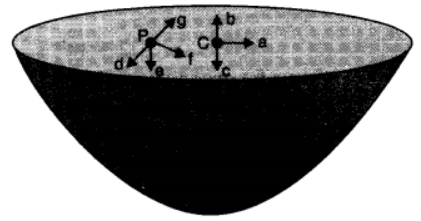
Question 10. Choose the correct answer from among the given ones:The gravitational intensity at the centre of a hemispherical shell of uniform mass density has the direction indicated by the arrow (see Fig 8.12) (i) a, (ii) b, (iii) c, (iv) O.
Solution :
Gravitational potential (V) is constant at all points in a spherical shell. Hence, the gravitational potential gradient (dV/dR) is zero everywhere inside the spherical shell. The gravitational potential gradient is equal to the negative of gravitational intensity. Hence, intensity is also zero at all points inside the spherical shell. This indicates that gravitational forces acting at a point in a spherical shell are symmetric.
If the upper half of a spherical shell is cut out (as shown in the given figure), then the net gravitational force acting on a particle located at centre O will be in the downward direction.
Since gravitational intensity at a point is defined as the gravitational force per unit mass at that point, it will also act in the downward direction. Thus, the gravitational intensity at centre O of the given hemispherical shell has the direction as indicated by arrow c.
Question 11. Choose the correct answer from among the given ones:
For the problem 8.10, the direction of the gravitational intensity at an arbitrary point P is indicated by the arrow (i) d, (ii) e, (iii) f, (iv) g.
Solution :
Gravitational potential (V) is constant at all points in a spherical shell. Hence, the gravitational potential gradient (dV/dR) is zero everywhere inside the spherical shell. The gravitational potential gradient is equal to the negative of gravitational intensity. Hence, intensity is also zero at all points inside the spherical shell. This indicates that gravitational forces acting at a point in a spherical shell are symmetric.
If the upper half of a spherical shell is cut out (as shown in the given figure), then the net gravitational force acting on a particle at an arbitrary point P will be in the downward direction.
Since gravitational intensity at a point is defined as the gravitational force per unit mass at that point, it will also act in the downward direction. Thus, the gravitational intensity at an arbitrary point P of the hemispherical shell has the direction as indicated by arrow e.
Hence, the correct answer is (ii).
Read More: NCERT Solutions for Class 11 Physics Chapter 4
Question 12. A rocket is fired from the earth towards the sun. At what distance from the earth’s centre is the gravitational force on the rocket zero? Mass of the sun = 2 ×10 30 kg, mass of the earth = 6 × 10 24 kg. Neglect the effect of other planets etc. (orbital radius = 1.5 × 10 11 m).
Solution :
Mass of the Sun, M s = 2 × 10 30 kg Mass of the Earth, M e = 6 × 10 24 kg
Orbital radius, r = 1.5 × 10 11 m
Mass of the rocket = m
Let x be the distance from the centre of the Earth where the gravitational force acting on satellite P becomes zero. From Newton’s law of gravitation, we can equate gravitational forces acting on satellite P under the influence of the Sun and the Earth as:
GmM s / (r - x) 2 = GmM e / x 2
[ (r - x) / x ] 2 = M s / M e
(r - x) / x = [ 2 × 10 30 / 60 × 10 24 ] 1/2 = 577.35
1.5 × 10 11 - x = 577.35x
578.35x = 1.5 × 10 11
x = 1.5 × 10 11 / 578.35 = 2.59 × 10 8 m.
Question 13.How will you ‘weigh the sun’, that is estimate its mass? The mean orbital radius of the earth around the sun is 1.5 × 10 8 km.
Solution :
Orbital radius of the Earth around the Sun, r = 1.5 × 10 11 m
Time taken by the Earth to complete one revolution around the Sun,
T = 1 year = 365.25 days
= 365.25 × 24 × 60 × 60 s
Universal gravitational constant, G = 6.67 × 10 –11 Nm 2 kg –2
Thus, mass of the Sun can be calculated using the relation,
M = 4π 2 r 3 / GT 2
= 4 × 3.14 2 × (1.5 × 10 11 ) 3 / [ 6.67 × 10 -11 × (365.25 × 24 × 60 × 60) 2 ]
= 2 × 10 30 kg
Hence, the mass of the Sun is 2 × 10 30 kg.
Question 14. A Saturn year is 29.5 times the earth year. How far is the Saturn from the sun if the earth is 1.50 ×10 8 km away from the sun?
Solution :
Distance of the Earth from the Sun, r e = 1.5 × 10 8 km = 1.5 × 10 11 m
Time period of the Earth = T e
Time period of Saturn, T s = 29. 5 T e
Distance of Saturn from the Sun = r s
From Kepler’s third law of planetary motion, we have
T = (4π 2 r 3 / GM) 1/2
For Saturn and Sun, we can write
r s 3 / r e 3 = T s 2 / T e 2
r s = r e (T s / T e ) 2/3
= 1.5 × 10 11 (29.5 T e / T e ) 2/3
= 1.5 × 10 11 (29.5) 2/3
= 14.32 × 10 11 m
Hence, the distance between Saturn and the Sun is 1.43 × 10 12 m.
Question 15. A body weighs 63 N on the surface of the earth. What is the gravitational force on it due to the earth at a height equal to half the radius of the earth?
Solution :
Weight of the body, W = 63 N
Acceleration due to gravity at height h from the Earth’s surface is given by the relation:
g' = g / [1 + ( h / R e ) ] 2
Where,
g = Acceleration due to gravity on the Earth’s surface
Re = Radius of the Earth
For h = R e / 2
g' = g / [(1 + (R e / 2R e ) ] 2
= g / [1 + (1/2) ] 2 = (4/9)g
Weight of a body of mass m at height h is given as:
W' = mg
= m × (4/9)g = (4/9)mg
= (4/9)W
= (4/9) × 63 = 28 N.
Question 16. Assuming the earth to be a sphere of uniform mass density, how much would a body weigh half way down to the centre of the earth if it weighed 250 N on the surface?
Solution :
Weight of a body of mass m at the Earth’s surface, W = mg = 250 N
Body of mass m is located at depth, d = (1/2)R e
Where,
R e = Radius of the Earth
Acceleration due to gravity at depth g (d) is given by the relation:
g' = (1 - (d / R e )g
= [1 - (R e / 2R e ) ]g = (1/2)g
Weight of the body at depth d,
W' = mg'
= m × (1/2)g = (1/2) mg = (1/2)W
= (1/2) × 250 = 125 N
Question 17. A rocket is fired vertically with a speed of 5 km s –1 from the earth’s surface. How far from the earth does the rocket go before returning to the earth? Mass of the earth = 6.0 × 10 24 kg; mean radius of the earth = 6.4 × 10 6 m; G= 6.67 × 10 –11 N m 2 kg – 2.
Solution :
Velocity of the rocket, v = 5 km/s = 5 × 10 3 m/s
Mass of the Earth, M e = 6 × 10 24 kg
Radius of the Earth, R e = 6.4 × 10 6 m
Height reached by rocket mass, m = h
At the surface of the Earth,
Total energy of the rocket = Kinetic energy + Potential energy
= (1/2)mv 2 + (-GM e m / R e )
At highest point h,
v = 0
And, Potential energy = -GM e m / (R e + h)
Total energy of the rocket = 0 + [ -GM e m / (R e + h) ]
= -GM e m / (R e + h)
From the law of conservation of energy, we have
Total energy of the rocket at the Earth’s surface = Total energy at height h
(1/2)mv 2 + (-GM e m / R e ) = -GM e m / (R e + h)
(1/2)v 2 = GM e [ (1/R e ) - 1 / (R e + h) ]
= GM e [ (R e + h - R e ) / R e (R e + h) ]
(1/2)v 2 = gR e h / (R e + h)
Where g = GM / R e 2 = 9.8 ms -2
∴ v 2 (R e + h) = 2gR e h
v 2 R e = h(2gR e - v 2 )
h = R e v 2 / (2gR e - v 2 )
= 6.4 × 10 6 × (5 × 10 3 ) 2 / [ 2 × 9.8 × 6.4 × 10 6 - (5 × 10 3 ) 2
h = 1.6 × 10 6 m
Height achieved by the rocket with respect to the centre of the Earth = R e + h
= 6.4 × 10 6 + 1.6 × 10 6 = 8 × 10 6 m.
Read More: NCERT Solutions for Class 11 Physics Chapter 6
Question 18. The escape speed of a projectile on the earth’s surface is 11.2 km s –1 . A body is projected out with thrice this speed. What is the speed of the body far away from the earth? Ignore the presence of the sun and other planets.
Solution :
Escape velocity of a projectile from the Earth, v esc = 11.2 km/s
Projection velocity of the projectile, v p = 3v esc
Mass of the projectile = m
Velocity of the projectile far away from the Earth = v f
Total energy of the projectile on the Earth = (1/2)mv p 2 - (1/2)mv esc 2
Gravitational potential energy of the projectile far away from the Earth is zero.
Total energy of the projectile far away from the Earth = (1/2)mv f 2
From the law of conservation of energy, we have
(1/2)mv p 2 - (1/2)mv esc 2 = (1/2)mv f 2
v f = ( v p 2 - v esc 2 ) 1/2
= [ (3v esc ) 2 - v esc 2 ] 1/2
= √8 v esc
Question 19. A satellite orbits the earth at a height of 400 km above the surface. How much energy must be expended to rocket the satellite out of the earth’s gravitational influence? Mass of the satellite = 200 kg; mass of the earth = 6.0 ×10 24 kg; radius of the earth = 6.4 ×10 6 m; G = 6.67 × 10 –11 N m 2 kg –2 .
Solution :
Mass of the Earth, M = 6.0 × 10 24 kg
Mass of the satellite, m = 200 kg
Radius of the Earth, R e = 6.4 × 10 6 m
Universal gravitational constant, G = 6.67 × 10 –11 Nm 2 kg –2
Height of the satellite, h = 400 km = 4 × 10 5 m = 0.4 ×10 6 m
Total energy of the satellite at height h = (1/2)mv 2 + [ -GM e m / (R e + h) ]
Orbital velocity of the satellite, v = [ GM e / (R e + h) ] 1/2
Total energy of height, h = (1/2)GM e m / (R e + h) - GM e m / (R e + h) = -(1/2)GM e m / (R e + h)
The negative sign indicates that the satellite is bound to the Earth. This is called bound energy of the satellite.
Energy required to send the satellite out of its orbit = – (Bound energy)
= (1/2) GM e m / (R e + h)
= (1/2) × 6.67 × 10 -11 × 6 × 10 24 × 200 / (6.4 × 10 6 + 0.4 × 10 6 )
= 5.9 × 10 9 J.
Question 20. Two stars each of one solar mass (= 2× 10 30 kg) are approaching each other for a head on collision. When they are a distance 109 km, their speeds are negligible. What is the speed with which they collide? The radius of each star is 104 km. Assume the stars to remain undistorted until they collide. (Use the known value of G).
Solution :
Mass of each star, M = 2 × 10 30 kg
Radius of each star, R = 10 4 km = 10 7 m
Distance between the stars, r = 10 9 km = 10 12 m
For negligible speeds, v = 0 total energy of two stars separated at distance r
= [ -GMM / r ] + (1/2)mv 2
= [ -GMM / r ] + 0 ....(i)
Now, consider the case when the stars are about to collide:
Velocity of the stars = v
Distance between the centers of the stars = 2R
Total kinetic energy of both stars = (1/2) Mv 2 + (1/2)Mv 2 = Mv 2
Total potential energy of both stars = -GMM / 2R
Total energy of the two stars = Mv 2 - GMM / 2R ....(ii)
Using the law of conservation of energy, we can write:
Mv 2 - GMM / 2R = -GMM / r
v 2 = -GM / r + GM / 2R
= GM [ (-1/r) + (1/2R) ]
= 6.67 × 10 -11 × 2 × 10 30 [ (-1/10 12 ) + (1 / 2 × 10 7 ) ]
~ 6.67 × 10 12
v = ( 6.67 × 10 12 ) 1/2 = 2.58 × 10 6 m/s.
Question 21. Two heavy spheres each of mass 100 kg and radius 0.10 m are placed 1.0 m apart on a
horizontal table. What is the gravitational force and potential at the mid point of the line joining the centers of the spheres? Is an object placed at that point in equilibrium? If so, is the equilibrium
stable or unstable?
Solution :
Grvitational field at the mid-point of the line joining the centres of the two spheres
= GM/(r/2) 2 (alog negative r) + GM/(r/2) (along r) = 0
Gravitational potential at the midpoint f the line joining the centres of the two spheres is
V = - GM/r/2 + (-GM/r/2) = -4GM/r = -4 × 6.67 × 10 -11 × 100/1.0
= -2.7 × 10 -8 J/Kg
As the effective force on the body placed at mid-point is zero, sso the body is in equilibrium. If the body is displaced a little towards either mass body from its equilibrium position, it will not return back to its inital position of equilibrium. Hence, the body is in unstable equilibrium.
Question 22. As you have learnt in the text, a geostationary satellite orbits the earth at a height of nearly 36,000 km from the surface of the earth. What is the potential due to earth’s gravity at the site of this satellite? (Take the potential energy at infinity to be zero). Mass of the earth = 6.0 × 10 24 kg, radius = 6400 km.
Solution :
Mass of the Earth, M = 6.0 × 10 24 kg
Radius of the Earth, R = 6400 km = 6.4 × 10 6 m
Height of a geostationary satellite from the surface of the Earth,
h = 36000 km = 3.6 × 10 7 m
Gravitational potential energy due to Earth’s gravity at height h,
= -GM / (R + h)
= - 6.67 × 10 -11 × 6 × 10 24 / (3.6 × 10 7 + 0.64 × 10 7 )
= -9.4 × 10 6 J/kg.
Question 23. A star 2.5 times the mass of the sun and collapsed to a size of 12 km rotates with a speed of 1.2 rev. per second. (Extremely compact stars of this kind are known as neutron stars. Certain stellar objects called pulsars belong to this category). Will an object placed on its equator remain stuck to its surface due to gravity? (Mass of the sun = 2 × 10 30 kg).
Solution :
A body gets stuck to the surface of a star if the inward gravitational force is greater than the outward centrifugal force caused by the rotation of the star.
Gravitational force, f g = - GMm / R 2
Where,
M = Mass of the star = 2.5 × 2 × 10 30 = 5 × 10 30 kg
m = Mass of the body
R = Radius of the star = 12 km = 1.2 ×10 4 m
∴ f g = 6.67 × 10 -11 × 5 × 10 30 × m / (1.2 × 10 4 ) 2 = 2.31 × 10 11 m N
Centrifugal force, f c = mrω 2
ω = Angular speed = 2πν
ν = Angular frequency = 1.2 rev s –1
f c = mR (2πν) 2
= m × (1.2 ×10 4 ) × 4 × (3.14) 2 × (1.2) 2 = 1.7 ×10 5 m N
Since f g > f c , the body will remain stuck to the surface of the star.
24. A spaceship is stationed on Mars. How much energy must be expended on the spaceship to launch it out of the solar system? Mass of the space ship = 1000 kg; mass of the Sun = 2 × 10 30 kg; mass of mars = 6.4 × 10 23 kg; radius of mars = 3395 km; radius of the orbit of mars = 2.28 × 10 8 kg; G= 6.67 × 10 –11 m 2 kg –2 .
Solution :
Mass of the spaceship, m s = 1000 kg
Mass of the Sun, M = 2 × 10 30 kg
Mass of Mars, m m = 6.4 × 10 23 kg
Orbital radius of Mars, R = 2.28 × 10 8 kg =2.28 × 10 11 m
Radius of Mars, r = 3395 km = 3.395 × 10 6 m
Universal gravitational constant, G = 6.67 × 10 –11 m 2 kg –2
Potential energy of the spaceship due to the gravitational attraction of the Sun = -GMm s / R
Potential energy of the spaceship due to the gravitational attraction of Mars = -GM m m s / r
Since the spaceship is stationed on Mars, its velocity and hence, its kinetic energy will be zero.
Total energy of the spaceship = -GMm s / R - GM m m s / r
= -Gm s [ (M / R) + (m m / r) ]
The negative sign indicates that the system is in bound state.
Energy required for launching the spaceship out of the solar system
= – (Total energy of the spaceship)
= Gm s [ (M / R) + (m m / r) ]
= 6.67 × 10 -11 × 10 3 × [ (2 × 10 30 / 2.28 × 10 11 ) + (6.4 × 10 23 / 3.395 × 10 6 ) ]
= 596.97 × 10 9 = 6 × 10 11 J.
Question 25. A rocket is fired ‘vertically’ from the surface of mars with a speed of 2 km s–1. If 20% of its initial energy is lost due to Martian atmospheric resistance, how far will the rocket go from the surface of mars before returning to it? Mass of mars = 6.4× 10²³ kg; radius of mars = 3395 km; G = 6.67× 10 -11 N m 2 kg –2 .
Solution :
Initial velocity of the rocket, v = 2 km/s = 2 × 10 3 m/s
Mass of Mars, M = 6.4 × 10 23 kg
Radius of Mars, R = 3395 km = 3.395 × 10 6 m
Universal gravitational constant, G = 6.67× 10 –11 N m 2 kg –2
Mass of the rocket = m
Initial kinetic energy of the rocket = (1/2)mv 2
Initial potential energy of the rocket = -GMm / R
Total initial energy = (1/2)mv 2 - GMm / R
If 20 % of initial kinetic energy is lost due to Martian atmospheric resistance, then only 80 % of its kinetic energy helps in reaching a height.
Total initial energy available = (80/100) × (1/2) mv 2 - GMm / R = 0.4mv 2 - GMm / R
Maximum height reached by the rocket = h
At this height, the velocity and hence, the kinetic energy of the rocket will become zero.
Total energy of the rocket at height h = -GMm / (R + h)
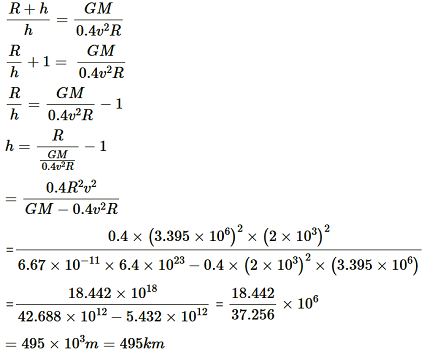
Applying the law of conservation of energy for the rocket, we can write: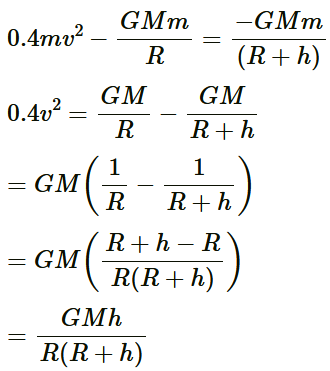
Check Out: Class 11th Question Banks
Important Topics in Class 11 Physics Chapter 8 Gravitation
Before diving into the gravitation class 11 NCERT solutions, it is important to look for the important chapter. Most class 11 Physics chapter gravitation NCERT solutions focus strongly on these core areas:
-
Newton’s Universal Law of Gravitation and the Principle of Superposition.
-
Kepler’s Three Laws of planetary motion.
-
Acceleration due to gravity (g):
-
Gravitational Field Intensity and Gravitational Potential.
-
Energy Dynamics: Gravitational Potential Energy and Escape Velocity.
-
Satellite Mechanics: Orbital velocity and the characteristics of Geo-stationary satellites.
-
Physical Constants: Determining the mass and mean density of the Earth.
What is Newton’s Universal Law of Gravitation?
This is one of the most important chapters because all masses in the universe create gravitational forces which draw every other mass toward them. The law of universal gravitation applies to all celestial objects which includes both falling apples and the movement patterns of planets and stars. Detailed explanations of this concept are clearly provided in class 11 Physics Chapter 7 gravitation NCERT solutions.
What Universal Formula of Gravitation mean?
Newton said that the force that pulls two bodies together depends on how far apart they are and how heavy each body is. When you multiply their masses together, you get the force, and when you square the space between them, you get the opposite force. These derivations are an essential part of class 11 Physics gravitation NCERT solutions and are frequently asked in exams.
Proportionality:
If masses are larger, the gravitational force is stronger.
Inverse Square for:
If the distance between the two bodies is doubled, the force does not merely decrease a little, it’s just a quarter of the original force.
The Constant (G):
The Universal Gravitational Constant is
6.67 × 10⁻¹¹ Nm²kg⁻², it’s a constant, it’s the same everywhere in the universe.
What Is Acceleration Due to Gravity?
While G is the same everywhere in the universe, g (acceleration due to gravity) is different from place to place. On Earth, its value is about 9.8 m/s². Class 11 Physics chapter gravitation NCERT solutions focus on how g varies:
-
With Altitude: Gravity decreases as you go higher above the Earth's surface.
-
With Depth: Gravity also decreases as you go deeper into the Earth, becoming zero at the centre.
-
Due to Shape: Because Earth is an oblate spheroid, g is slightly higher at the poles than at the equator.
These concepts are thoroughly explained in class 11 gravitation NCERT solutions for better conceptual clarity.
Kepler’s Three Laws of Planetary Motion
To solve class 11 Physics chapter gravitation NCERT solutions you must understand Kepler’s three observations regarding how planets behave in our solar system. These laws are frequently included in gravitation class 11 questions and answers sections for board preparation.
-
Law of Orbits: Planets do not move in perfect circles. They move in oval-shaped paths called ellipses, and the Sun is slightly off-centre in that path.
-
Law of Areas: When a planet is closer to the Sun, it moves faster. When it is farther away, it moves slower. This keeps the motion balanced.
-
Law of Periods: The bigger the orbit, the more time the planet takes to complete one round. In simple terms, planets that are farther from the Sun take longer to finish one full revolution.
Gravitational Potential Energy and Escape Velocity
One of the most frequent gravitation class 11 NCERT solutions involves the energy required to leave a planet.
Gravitational Potential Energy (V)
Unlike kinetic energy, gravitational potential energy is always negative. This signifies that the object is "bound" to the Earth's gravitational field. To move an object to infinity, you must provide enough energy to bring this potential to zero.
Escape Velocity (v_e)
Escape velocity is the slowest speed at which an object can get away from the pull of a planet's gravity without speeding up any further. Earth's escape speed is about 11.2 km/s.
These numerical problems are commonly discussed in class 11 Physics chapter 7 gravitation NCERTsolutions.
Orbital Velocity and Geostationary Orbits
Satellites are essentially projectiles in a constant state of free-fall around a body.
Orbital Velocity
This is the speed required to keep a satellite in its circular orbit. If the speed is too low, it crashes; if too high, it escapes. For a satellite close to Earth's surface, this is about 7.9 km/s.
Geostationary Satellites
These are special satellites used for communication.
-
Time Period: Exactly 24 hours (same as Earth’s rotation).
-
Direction: They rotate from West to East.
-
Position: They appear stationary when viewed from Earth, fixed above a specific point on the equator.
Important Gravitation Class 11 Questions and Answers
Using gravitation class 11 NCERT solutions effectively involves practicing specific problem types. Here are the core concepts often tested:
Question 1
If Earth looks spherical but its density is uneven inside, what happens to the acceleration due to gravity (g) on the surface?
Options:
(a) Points toward the centre but changes in value
(b) Same value but not toward the centre
(c) Same value and toward the centre
(d) It can never become zero anywhere
Answer: (d)
Even if the density is uneven, gravity will still act everywhere on the surface. So, g can never be zero at any point on Earth’s surface.
Question 2
Three masses 2M, m, and M are placed in a line. AB is shorter than BC. If mass m is very small, where will it move?
Options:
(a) Toward M
(b) It will not move
(c) Toward 2M
(d) It will move back and forth
Answer: (c)
Mass 2M is bigger, and it is also closer to m. A bigger mass pulls harder, and a shorter distance makes the pull stronger. So, m will slowly start moving toward 2M.
Comparison Table: G vs g
To avoid confusion between G and g, let’s compare them side by side in a simple table below.
|
Feature |
Universal Gravitational Constant (G) |
Acceleration Due to Gravity (g) |
|
Definition |
Force between two 1kg masses 1m apart. |
Acceleration gained by a falling body. |
|
Value |
6.67 \times 10^{-11} \text{ Nm}^2\text{kg}^{-2} |
9.8 \text{ m/s}^2 (Average on Earth) |
|
Nature |
Scalar quantity. |
Vector quantity. |
|
Variability |
Constant everywhere in the universe. |
Changes with location, height, and depth. |
There is more to gravity than just numbers in a book. It talks about how planets and satellites move in space and why things fall to Earth. The link between these ideas is easier to see when you regularly use NCERT answers For Class 11 Physics Chapter 8 Gravitation and look at class 11 Physics gravitation NCERT answers.
Also Check, CBSE Question Bank Class 11 Physics
NCERT Solutions For Class 11 Physics Chapter 8 FAQs
1. Why is ‘g’ zero at the centre of the Earth?
At the centre, gravity pulls equally from all sides. These forces cancel out, so g becomes zero.
2. Does escape velocity depend on the mass of the rocket?
No. Escape velocity depends only on the planet. Both a small stone and a rocket need about 11.2 km/s to leave Earth.
3. What is the period of a polar satellite?
A polar satellite takes about 100 minutes to complete one orbit around Earth. It is mainly used for weather monitoring and Earth imaging.
4. What is the relation between ‘g’ and ‘G’?
The relation is: g = GM/R².
It shows that g depends on the mass and radius of the planet.