NCERT Solutions For Class 12 Physics Chapter 6 Electromagnetic Induction
Electromagnetic induction class 12 NCERT solution explains how we can create electricity by moving a magnet near a wire. It covers the smart rules made by Faraday and Lenz that help us understand power. This chapter shows how a changing magnetic field leads to an induced emf, making it a very important part of your physics studies.
Check Out: CBSE Class 12 Books
NCERT Solutions For Class 12 Physics Chapter 6
Answer The Following Question Answer of NCERT Solutions For Class 12 Physics Chapter 6 Electromagnetic Induction:
Question 1. Predict the direction of induced current in the situations described by the following Figs. 6.18(a) to (f ). Solution : Lenz’s law shows the direction of induced current in a closed loop. In the given two figures they shows the direction of induced current when the North pole of a bar magnet is moved towards and away from a closed loop respectively.
 We can predict the direction induced current in different situation by using the Lenz’s rule. (i) The direction of the induced current is along qrpq. (ii) The direction of the induced current is along prqp. (iii) The direction of the induced current is along yzxy. (iv) The direction of the induced current is along zyxz. (v) The direction of the induced current is along xryx. (vi) No current is induced since the field lines are lying in the plane of the closed loop.
Question 2. Use Lenz’s law to determine the direction of induced current in the situations described by Fig. 6.19: (a) A wire of irregular shape turning into a circular shape; (b) A circular loop being deformed into a narrow straight wire.
Solution : According to Lenz’s law, the direction of the induced emf is such that it tends to produce a current that opposes the change in the magnetic flux that produced it. (a) When the shape of the wire changes, the flux piercing through the unit surface area increases. As a result, the induced current produces an opposing flux. Hence, the induced current flows along adcb. (b) When the shape of a circular loop is deformed into a narrow straight wire, the flux piercing the surface decreases. Hence, the induced current flows along adcba
Read More: NCERT Solutions For Class 12 Physics Chapter 1
Question 3. A long solenoid with 15 turns per cm has a small loop of area 2.0 cm2 placed inside the solenoid normal to its axis. If the current carried by the solenoid changes steadily from 2.0 A to 4.0 A in 0.1 s, what is the induced emf in the loop while the current is changing?
Solution : Number of turns on the solenoid = 15 turns/cm = 1500 turns/m Number of turns per unit length, n = 1500 turns The solenoid has a small loop of area, A = 2.0 cm2 = 2 × 10⁻⁴ m2 Current carried by the solenoid changes from 2 A to 4 A. Change in current in the solenoid, di = 4 − 2 = 2 A Change in time, dt = 0.1 s Induced emf in the solenoid is given by Faraday’s law as: e = dØ/dt Where, Ø= Induced flux through the small loop = BA ... (ii) B = Magnetic field = μ0ni μ0 = Permeability of free space = 4π×10−7 H/m Hence, equation (i) reduces to:.png) Hence, the induced voltage in the loop is 7.5 x 10 -6 v
Hence, the induced voltage in the loop is 7.5 x 10 -6 v
Question 4. A rectangular wire loop of sides 8 cm and 2 cm with a small cut is moving out of a region of uniform magnetic field of magnitude 0.3 T directed normal to the loop. What is the emf developed across the cut if the velocity of the loop is 1 cm s−1 in a direction normal to the (a) longer side, (b) shorter side of the loop? For how long does the induced voltage last in each case?
Solution : Length of the rectangular wire, l = 8 cm = 0.08 m Width of the rectangular wire, b = 2 cm = 0.02 m Hence, area of the rectangular loop, A = lb = 0.08 × 0.02 = 16 × 10−4 m2 Magnetic field strength, B = 0.3 T Velocity of the loop, v = 1 cm/s = 0.01 m/s (a) Emf developed in the loop is given as: e = Blv = 0.3 × 0.08 × 0.01 = 2.4 × 10⁻⁴ V.png) = 0.02/0.01 = 2s Hence, the induced voltage is 2.4 × 10⁻⁴ V which lasts for 2 s. (b) Emf developed, e = Bbv = 0.3 × 0.02 × 0.01 = 0.6 × 10⁻⁴ V
= 0.02/0.01 = 2s Hence, the induced voltage is 2.4 × 10⁻⁴ V which lasts for 2 s. (b) Emf developed, e = Bbv = 0.3 × 0.02 × 0.01 = 0.6 × 10⁻⁴ V.png) = 0.08/0.01 = 8s Hence, the induced voltage is 0.6 × 10⁻⁴ V which lasts for 8 s.
= 0.08/0.01 = 8s Hence, the induced voltage is 0.6 × 10⁻⁴ V which lasts for 8 s.
Read More: NCERT Solutions For Class 12 Physics Chapter 2
Question 5. A 1.0 m long metallic rod is rotated with an angular frequency of 400 rad s−1 about an axis normal to the rod passing through its one end. The other end of the rod is in contact with a circular metallic ring. A constant and uniform magnetic field of 0.5 T parallel to the axis exists everywhere. Calculate the emf developed between the centre and the ring.
Solution : Length of the rod, l = 1 m Angular frequency,ω = 400 rad/s Magnetic field strength, B = 0.5 T One end of the rod has zero linear velocity, while the other end has a linear velocity of lω. Average linear velocity of the rod,.png) Emf developed between the centre and the ring,
Emf developed between the centre and the ring,.png) = 100V Hence, the emf developed between the centre and the ring is 100 V.
= 100V Hence, the emf developed between the centre and the ring is 100 V.
Question 6. A circular coil of radius 8.0 cm and 20 turns is rotated about its vertical diameter with an angular speed of 50 rad s−1 in a uniform horizontal magnetic field of magnitude 3.0×10⁻² T. Obtain the maximum and average emf induced in the coil. If the coil forms a closed loop of resistance 10Ω, calculate the maximum value of current in the coil. Calculate the average power loss due to Joule heating. Where does this power come from?
Solution : Max induced emf = 0.603 V Average induced emf = 0 V Max current in the coil = 0.0603 A Average power loss = 0.018 W (Power comes from the external rotor) Radius of the circular coil, r = 8 cm = 0.08 m Area of the coil, A = πr2 = π × (0.08)2 m2 Number of turns on the coil, N = 20 Angular speed, ω = 50 rad/s Magnetic field strength, B = 3 × 10⁻² T Resistance of the loop, R = 10 Ω Maximum induced emf is given as: e = Nω AB = 20 × 50 × π × (0.08)2 × 3 × 10−2 = 0.603 V The maximum emf induced in the coil is 0.603 V. Over a full cycle, the average emf induced in the coil is zero. Maximum current is given as: I = e/R = 0.603/10 = 0.0603 Average power loss due to joule heating: P = eI/2 = 0.603 x 0.0603/2 = 0.018W The current induced in the coil produces a torque opposing the rotation of the coil. The rotor is an external agent. It must supply a torque to counter this torque in order to keep the coil rotating uniformly. Hence, dissipated power comes from the external rotor.
Read More: NCERT Solutions For Class 12 Physics Chapter 3
Question 7. A horizontal straight wire 10 m long extending from east to west is falling with a speed of 5.0 m s−1, at right angles to the horizontal component of the earth’s magnetic field, 0.30 × 10⁻⁴ Wb m−2. (a) What is the instantaneous value of the emf induced in the wire? (b) What is the direction of the emf? (c) Which end of the wire is at the higher electrical potential?
Solution : Wire’s Length, l = 10 m Speed of the wire with which it is falling, v = 5.0 m/s Strength of magnetic field, B = 0.3×10⁻⁴Wbm −2 (a) EMF induced in the wire, e = Blv =0.3×10 −4 ×5×10=1.5×10 −3 V (b) We can determine the direction of the induced current by using the Fleming’s right hand thumb rule, here the current is flowing in the direction from West to East. (c) In this case the eastern end of the wire will be having higher potential
Question 8. Current in a circuit falls from 5.0 A to 0.0 A in 0.1 s. If an average emf of 200 V induced, give an estimate of the self-inductance of the circuit.
Solution : Initial current, I1 = 5.0 A Final current, I2 = 0.0 A Change in current,dl = I 1 - I 2 = 5A Time taken for the change, t = 0.1 s Average emf, e = 200 V For self-inductance (L) of the coil, we have the relation for average emf as: e = L di/dt L = e/(di/dt) 200/(5/0.1) = 4H Hence, the self induction of the coil is 4 H.
Question 9. A pair of adjacent coils has a mutual inductance of 1.5 H. If the current in one coil changes from 0 to 20 A in 0.5 s, what is the change of flux linkage with the other coil?
Solution : Given, a pair of adjacent coils. Mutual inductance, M = 1.5 H Current in the coil, I = 20 A Time ,t = 0.5 s Using formula, Φ = MI we get, Φ = 1.5 x 20 = 30H Hence, the change in the flux linkage is 30 Wb.
Read More: NCERT Solutions for Class 12 Physics Chapter 4
Question 10. Calculate the difference in voltage developed between two ends of a jet plane, when the jet plane is travelling towards west with a speed of 1800 km/h and the wing of the plane is having a span of 25 m. We are given that the earth’s magnetic field are the location has a magnitude of 5×10 −4 T and the dip angle is 30 0 .
Solution : Speed of the plane with which it is moving, v = 1800 km/h = 500 m/s Wing span of the jet, l = 25 m Magnetic field strength by earth, B = 5 ×10 −4 T Dip angle, δ=30 ∘ Vertical component of Earth’s magnetic field, Bv=Bsin δ=5 ×10 −4 sin30 ∘=2.5 ×10 − 4 T Difference in voltage between both the ends can be calculated as: e=(Bv)× l × v = 2.5 × × 10 − 4 ×25 ×500 =3.123V Hence, the voltage difference developed between the ends of the wings is 3.125 V.
Question 11. Suppose the loop in Exercise 6.4 is stationary but the current feeding the electromagnet that produces the magnetic field is gradually reduced so that the field decreases from its initial value of 0.3 T at the rate of 0.02 T s−1. If the cut is joined and the loop has a resistance of 1.6 Ω how much power is dissipated by the loop as heat? What is the source of this power?
Solution : Sides of the rectangular loop are 8 cm and 2 cm. Hence, area of the rectangular wire loop, A = length × width = 8 × 2 = 16 cm2 = 16 × 10−4 m2 Initial value of the magnetic field, B' = 0.3 T Rate of decrease of the magnetic field, dB/dt = 0.02T/s Emf developed in the loop is given as: e = dΦ/dt Where, dΦ = Change in flux through the loop area = AB ∴ e = d(AB)/dt = AdB/dt Resistance of the loop, R = 1.6 Ω The current induced in the loop is given as: i = e/R = 0.32 x 10 -4 /1.6 Power dissipated in the loop in the form of heat is given as: P = i²R = (2 × 10 -5 ) x 1.6 = 6.4 x 10 -10 W The source of this heat loss is an external agent, which is responsible for changing the magnetic field with time.
Question 12. A square loop of side 12 cm with its sides parallel to X and Y axes is moved with a velocity of 8 cm s−1 in the positive x-direction in an environment containing a magnetic field in the positive z-direction. The field is neither uniform in space nor constant in time. It has a gradient of 10−3 T cm−1 along the negative x-direction (that is it increases by 10− 3 T cm−1 as one moves in the negative x-direction), and it is decreasing in time at the rate of 10−3 T s−1. Determine the direction and magnitude of the induced current in the loop if its resistance is 4.50 mΩ.
Solution : Side of the square loop, s = 12 cm = 0.12 m Area of the square loop, A = 0.12 × 0.12 = 0.0144 m2 Velocity of the loop, v = 8 cm/s = 0.08 m/s Gradient of the magnetic field along negative x-direction, And, rate of decrease of the magnetic field,
 Resistance of the loop, R = 4.5Ω = 4.5 x 10 - ³ Ω Rate of change of the magnetic flux due to the motion of the loop in a non-uniform magnetic field is given as:
 Rate of change of the flux due to explicit time variation in field B is given as:
 Since the rate of change of the flux is the induced emf, the total induced emf in the loop can be calculated as:
 ∴Induced current, i = e/R
 Hence, the direction of the induced current is such that there is an increase in the flux through the loop along positive z-direction.
Question 13. It is desired to measure the magnitude of field between the poles of a powerful loud speaker magnet. A small flat search coil of area 2 cm2 with 25 closely wound turns, is positioned normal to the field direction, and then quickly snatched out of the field region. Equivalently, one can give it a quick 90° turn to bring its plane parallel to the field direction). The total charge flown in the coil (measured by a ballistic galvanometer connected to coil) is 7.5 mC. The combined resistance of the coil and the galvanometer is 0.50 Ω. Estimate the field strength of magnet.
Solution : Area of the small flat search coil, A = 2 cm2 = 2 × 10⁻⁴ m2 Number of turns on the coil, N = 25 Total charge flowing in the coil, Q = 7.5 mC = 7.5 × 10⁻³ C Total resistance of the coil and galvanometer, R = 0.50

 Now, Initial flux/turnwhen coil is normal to the field ,Φ i = BA
 Hence, the field strength of the magnet is 0.75 T.
Read more: NCERT Solutions For Class 12 Physics Chapter 5
Question 14. Figure 6.20 shows a metal rod PQ resting on the smooth rails AB and positioned between the poles of a permanent magnet. The rails, the rod, and the magnetic field are in three mutual perpendicular directions. A galvanometer G connects the rails through a switch K. Length of the rod = 15 cm, B = 0.50 T, resistance of the closed loop containing the rod = 9.0 mΩ. Assume the field to be uniform. (a) Suppose K is open and the rod is moved with a speed of 12 cm s−1 in the direction shown. Give the polarity and magnitude of the induced emf. (b) Is there an excess charge built up at the ends of the rods when K is open? What if K is closed? (c) With K open and the rod moving uniformly, there is no net force on the electrons in the rod PQ even though they do experience magnetic force due to the motion of the rod. Explain. (d) What is the retarding force on the rod when K is closed? (e) How much power is required (by an external agent) to keep the rod moving at the same speed (=12 cm s−1) when K is closed? How much power is required when K is open? (f) How much power is dissipated as heat in the closed circuit? What is the source of this power? (g) What is the induced emf in the moving rod if the magnetic field is parallel to the rails instead of being perpendicular?
Solution : Length of the rod, l = 15 cm = 0.15 m Magnetic field strength, B = 0.50 T Resistance of the closed loop, R = 9 mΩ = 9 × 10⁻³ Ω (a) Induced emf = 9 mV; polarity of the induced emf is such that end P shows positive while end Q shows negative ends. Speed of the rod, v = 12 cm/s = 0.12 m/s Induced emf is given as: e = Bvl = 0.5 × 0.12 × 0.15 = 9 × 10⁻³ v = 9 mV The polarity of the induced emf is such that end P shows positive while end Q shows negative ends. (b) Yes; when key K is closed, excess charge is maintained by the continuous flow of current. When key K is open, there is excess charge built up at both ends of the rods. When key K is closed, excess charge is maintained by the continuous flow of current. (c) Magnetic force is cancelled by the electric force set-up due to the excess charge of opposite nature at both ends of the rod. There is no net force on the electrons in rod PQ when key K is open and the rod is moving uniformly. This is because magnetic force is cancelled by the electric force set-up due to the excess charge of opposite nature at both ends of the rods. (d) Retarding force exerted on the rod, F = IBl Where, I = Current flowing through the rod (e) 9 mW, No power will be expended when the key K will be opened. Speed of the rod, v = 12 cm/s = 0.12 m /s Hence, Power, P = Fv =75× 10 − 3 ×0.12 = 9× 10 − 3 W=9mW When the key K is opened no power is expended. (f) Power is provided by an external agent. Power loss in the form of heat = I2R 12×9×10 −3 = 9 mW (g) Zero There would be no emf induced in the coil. As the emf induces if the motion of the rod cuts the field lines. But in this case motion of the rod does not cut across the field lines.
Question 15. An air-cored solenoid with length 30 cm, area of cross-section 25 cm2 and number of turns 500, carries a current of 2.5 A. The current is suddenly switched off in a brief time of 10−3 s. How much is the average back emf induced across the ends of the open switch in the circuit? Ignore the variation in magnetic field near the ends of the solenoid.
Solution : Length of the solenoid, l = 30 cm = 0.3 m Area of cross-section, A = 25 cm2 = 25 × 10−4 m2 Number of turns on the solenoid, N = 500 Current in the solenoid, I = 2.5 A Current flows for time, t = 10−3 s Average back emf, e = dΦ/dt Where, dΦ = Change in flux = NAB … (2) Where, B = Magnetic field strength = μ0 NI/l Where, μ0 = Permeability of free space = 4π × 10−7 T m A−1 Using equations (2) and (3) in equation (1), we get =
= = 6.5 V Hence, the average back emf induced in the solenoid is 6.5 V.
Read More: NCERT Solutions For Class 12 Physics Chapter 9
Question 16. (a) Obtain an expression for the mutual inductance between a long straight wire and a square loop of side a as shown in Fig. 6.21. (b) Now assume that the straight wire carries a current of 50 A and the loop is moved to the right with a constant velocity, v = 10 m/s. Calculate the induced emf in the loop at the instant when x = 0.2 m. Take a = 0.1 m and assume that the loop has a large resistance.
Solution : (a) Take a small element dy in the loop at a distance y from the long straight wire (as shown in the given figure). Magnetic flux associated with element dØ = BdA = Bady Where, dA = Area of element dy = a dy B = Magnetic field at distance y B = μ0 I / 2πy I = Current in the wire μ0 = Permeability of free space = 4π × 10−7 T m A−1
 y tends from x to a + x
 for mutual inductunce M, the flux is given as : Φ = MI
 (b) Emf induced in the loop, e = B’av =
 Given, I = 50 A x = 0.2 m a = 0.1 m v = 10 m/s
 Question 17. A line charge λ per unit length is lodged uniformly onto the rim of a wheel of mass M and radius R. The wheel has light non-conducting spokes and is free to rotate without friction about its axis (Fig. 6.22). A uniform magnetic field extends over a circular region within the rim. It is given by, B = − B0 k (r ≤ a; a < R) = 0 (otherwise) What is the angular velocity of the wheel after the field is suddenly switched off?
Solution : Line charge per unit length Where, r = Distance of the point within the wheel Mass of the wheel = M Radius of the wheel = R Magnetic field,
 At distance r,the magnetic force is balanced by the centripetal force i.e.,
 ∴Angular velocity,
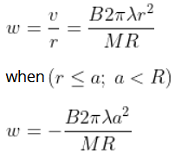 It is the angular velocity of the wheel when the field is suddenly shut off.
Simple Rules for Electromagnetic Induction Class 12
To understand this chapter, we first need to look at how magnets and electricity work together. Think of it like a magic trick where moving things produces power. The electromagnetic induction class 12 NCERT solutions break this down into easy steps.
-
Magnetic Flux: This is just a way to count how many magnetic lines go through a surface. If you tilt the surface, the count changes.
-
Faraday’s Law: He found that when the magnetic flux changes, it pushes electricity into the wire.
-
Induced EMF: This is the "push" or voltage that gets created.
-
Lenz’s Law: This rule says that the new electricity will always try to stop the change that created it. It is like a person who doesn't want things to change!
|
Concept |
What it means |
|
Flux ( \phi ) |
B \times A \times \cos(\theta) |
|
Faraday's Rule |
Changing flux = EMF |
|
Lenz's Rule |
Current opposes the change |
|
Unit of Flux |
Weber (Wb) |
Check Out: Class 12th Sample Papers
Faraday and Lenz in Electromagnetic Induction Class 12 NCERT Solutions
When you look for electromagnetic induction class 12 NCERT solutions pdf, you will see many problems about these two scientists. They are the heroes of this chapter.
Faraday’s Discovery
Faraday did a cool experiment. He took a coil of wire and moved a bar magnet toward it. He saw that the needle on a meter moved!
-
If the magnet stays still, nothing happens.
-
If the magnet moves fast, more electricity is made.
-
The push (EMF) is equal to how fast the magnetic lines are changing.
Lenz’s Direction Rule
This part of electromagnetic induction class 12 NCERT solutions 2025 helps you find the direction of the current. If you bring a North pole of a magnet closer, the coil will act like a North pole to push it away. It always tries to keep things the same as they were.
Self and Mutual Induction for 2025
These are two special ways electricity is made. You can find them in the electromagnetic induction class 12 NCERT solutions pdf download files.
-
Self-Induction: This happens when a coil makes its own electricity push because the current inside it is changing. It is like a coil talking to itself.
-
Mutual Induction: This happens between two coils. If you change the current in one coil, it makes a "push" in the second coil nearby. They are like two friends sharing energy.
Important Units to Remember
In electromagnetic induction class 12 NCERT solutions 2024, you must learn the unit called the Henry (H). This is how we measure induction.
-
1 Henry: This is a big unit for induction.
-
Eddy Currents: These are tiny loops of electricity that look like whirlpools in a metal block. They can make metal very hot!
Solving Problems in Electromagnetic Induction Class 12 NCERT Solution
To get good marks, you need to practice math. The electromagnetic induction class 12 NCERT solution uses simple formulas to solve big problems.
Motional EMF
If a rod moves through a magnetic field, it gets a voltage push. The formula is:
|
Symbol |
Definition |
|
ε |
B × l × v |
|
B |
Strength of the magnet. |
|
l |
Length of the rod. |
|
v |
Speed of the rod. |
AC Generator
This is a machine that turns movement into electricity. It uses the rules from the CBSE class 11 maths syllabus 2025-26 pdf download notes to calculate how a coil rotates. The rotating coil changes the flux, which makes the lights in our house turn on!
Study Tips for Electromagnetic Induction Class 12
If you are looking at the CBSE class 11 Maths syllabus 2024 25 or your current physics book, remember that these subjects often help each other. Here is how to study this chapter easily:
-
Watch the Signs: Faraday's formula has a minus sign. This minus sign represents Lenz's Law.
-
Draw the Flux: Imagine the magnetic lines as arrows. If more arrows go through a loop, the flux is increasing.
-
Practice Diagrams: Draw the magnet moving toward the coil. Use your right hand to show the direction of the current.
-
Check the Year: Use the CBSE class 11 Maths syllabus 2025 to see if your math skills are ready for these physics formulas.
Conclusion
At the end of the day, the electromagnetic induction class 12 NCERT solution shows us that magnets and electricity are just like two sides of the same coin. When we move a magnet, we create an invisible push that makes electrons jump through a wire to give us light and heat. By using the electromagnetic induction class 12 NCERT solutions, you can see how scientists figured out this secret to power our modern world. It is not just about passing a test; it is about knowing how your phone charger or a giant wind turbine actually works.
-
Main Goal: Learn how motion turns into power.
-
Key Tools: Use the electromagnetic induction class 12 NCERT solutions pdf for quick practice.
-
Exam Success: Focus on Lenz's Law and Faraday's math to get full marks in your 2025 boards.
-
Big Idea: Nature loves balance, which is why current always fights back against changes.
When it all boils down to it, this chapter is the foundation for all the technology we use every single day. If you can understand how a simple wire and a bar magnet create a spark, you have unlocked one of the biggest mysteries of the universe. Keep your electromagnetic induction class 12 NCERT solutions pdf download handy for revision, and you will find that physics becomes much more fun and less scary.
Check Out: Class 12th Question Banks
Class 12 Physics Chapter 6 FAQs
1. What is electromagnetic induction?
It is making electricity by changing the magnetic field around a wire or coil.
2. What is the unit of self-inductance?
The unit is the Henry, named after Joseph Henry.
3. What are eddy currents?
They are small circles of electricity that form inside a piece of metal when the magnet field changes. They usually make the metal warm.
4. Does a still magnet make electricity?
No. The magnet or the coil must be moving to change the flux and make a push.
5. Where can I find the electromagnetic induction class 12 NCERT solutions pdf?
You can find it on school help websites and apps to read on your phone or computer.