NCERT Solutions for Class 7 History Chapter 9 The Making of Regional Cultures
History is about more than just dates; it is about the traditions that make a region special. In NCERT solutions for class 7 History chapter 9, we look at how regional cultures developed over time. We often identify people by the language they speak or the food they eat, but these identities are a result of complex historical processes.
By using these class 7 History chapter 9 solutions, students can see how local traditions mixed with larger subcontinental influences. This chapter highlights how the Cheras, Rajputs, and the Bhakti movement shaped our heritage. Let’s look at how these distinct cultures emerged through centuries of exchange and patronage.
Check out: PW CBSE Class 7 Book
What is the Summary of The Making of Regional Cultures Class 7?
The NCERT solutions for class 7 History chapter 9 focus on how different parts of India developed unique cultural zones. During the medieval period, regions began to stand out because of their specific languages and customs. This happened because local tribal practices often blended with the ideas of ruling empires.
According to the class 7 sst chapter 9 summary, a great example is the Chera kingdom of Mahodayapuram in present-day Kerala. They were among the first to use a regional language, Malayalam, in their official inscriptions. This marked a shift from using only Sanskrit for important records and gave regional identity a major boost.
How Did Regional Languages Like Malayalam and Manipravalam Evolve?
In the NCERT solutions for class 7 History chapter 9, we learn that the Cheras balanced local pride with classical roots. While they used Malayalam for administration, their temple theatre borrowed heavily from Sanskrit epics. This "give-and-take" created a very rich cultural environment.
Students studying NCERT class 7 History notes chapter 9 will encounter the term Manipravalam. This was a literary style used in the 14th-century text Lilatilakam. The word means "diamonds and corals," representing the beautiful mixture of Sanskrit and the regional language. This style proves that regional cultures were not isolated but grew by learning from others.
Why are the Rajputs Associated with Heroism in Rajasthan?
Heroism is a central theme in the NCERT solutions for class 7 History chapter 9. In the 19th century, the British called the region Rajputana, but it was home to many groups. However, the Rajputs are famous for a culture that valued bravery, loyalty, and sacrifice above all else.
These stories were kept alive by minstrels who sang poems about Rajput heroes. The class 7 History important questions chapter 9 often highlight that these stories inspired common people as well. These tales also featured women who showed great courage, sometimes following their husbands even in death through the practice of sati, reflecting the intense values of that era.
Check Out: Class 7th Modules
Class 7 History Chapter 9 Question Answers
This section provides the primary class 7 History chapter 9 question answers based on the textbook exercises. These are written to help students prepare effectively for their social science exams.
-
1. Match the following : Anantavarnam – Kerala Jagannatha – Bengal Mahodayapurma – Orissa Lilatilakam – Kangra Mangalakavya – Puri Miniature – Kerala
Answer: Anantavarnam – Orissa Jagannatha – Kangra Mahodayapurma – Kerala Lilatilakam – Kerala Mangalakavya – Bengal Miniature – Kangra
-
2. What is Manipravalam? Name abook written in that language.
Answer: Manipravalam is a language. The book written in that language is Lilatilakam.
-
3. Who were the major patrons of Kathak?
Answer: The Mughals were the major patrons of Kathak.
-
4. What are the Important architectural features of the temples of Bengal?
Answer: Architectural features of the temples of Bengal:
- Double roofed or dochala, four roofed (chauchala).
- Comparative more complex-four roofed structures-four triangular roofs placed on four walls moved up to coverage on curved line or a point.
- Built on a square platform.
- Interior plain.
- Outer walls decorated with paintings, ornamental tiles or terracotta tablets.
Read More: NCERT Solutions for Class 7 Social Science History Chapter 2
5. Why did minstrels proclaim the achievements of heroes?
Answer: Minstrels used to recite poems and songs which depicted the stories of the ” Rajputs’ heroic deeds. By reciting such poems and songs these minstrels inspired others to follow the examples of Rajputs. Ordinary people were also attracted by these stories.
-
6. Why do we know much more about the cultural practices of rulers than about those of ordinary people?
Answer: We know much more about the cultural practices of rulers than about those of ordinary people because the ordinary people followed the cultural practices adopted by their kings/emperors. Moreover people had faith in their rulers. They could not adopt other cultural practices which their rulers did not practise.
-
7. Why did conquerors try to control the temple of Jagannatha at Puri?
Answer: The temple of Jagannatha at Puri gained importance as a centre of pilgrimage. Its authority in social and political matters also increased. Hence, conquerors tried to establish control over the temple. They felt that this would make their rule acceptable to the local people.
-
8. Why were temples built in Bengal?
Answer: Temples were built in Bengal because of the following reasons:
- Increase in religious faith.
- Mosques had already been built.
- Powerful people wanted to demonstrate their power and proclaim their piety.
- ‘Low’ people also participated in the temple building.
- New economic opportunities to people also helped in temple setting up.
- Support of Brahmanas to get idols placed in temples from huts.
9. Describe the most important features of the culture of your region, focussing on buildings, performing arts, and painting.
Answer: I live in Delhi. Right from the beginning, it has been a land of mixed cultures. In old days, it was invaded by a number of foreign rulers. Some of them stayed here for some time and some settle down permanently. They all affected its culture, language, religion, society, architecture, art and painting. Still we have buildings and monuments built by Mughal emperors, slave emperors, Rajput rulers and many more. We have temples, mosques and many other such places constructed by different rulers. Differences of cultures can still be seen in the areas of old Delhi and new Delhi.
-
10. Do you use different languages for (a) speaking, (b) reading, (c) writing? Find out about one major composition in language that you use and discuss why you find it interesting.
Answer: (a) For speaking I use Hindi and Punjabi. (b) For reading I use Hindi and English. (c) For writing I use Hindi and English. Thus, I use different languages for speaking, reading and writing.
Read More: NCERT Solutions for Class 7 Social Science History Chapter 3
-
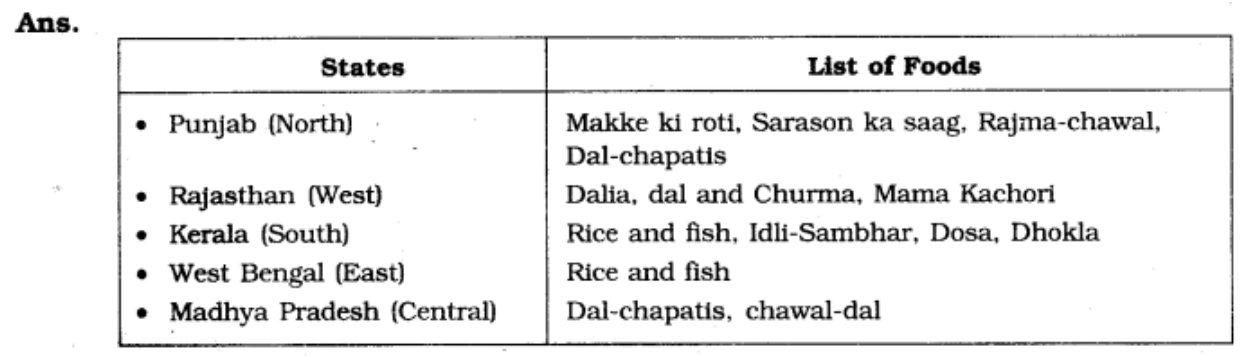
11. Choose one state each from north, west, south, east and central India. For each of these, prepare a list of foods that are commonly consumed, highlighting any differences and similarities that you notice.
-
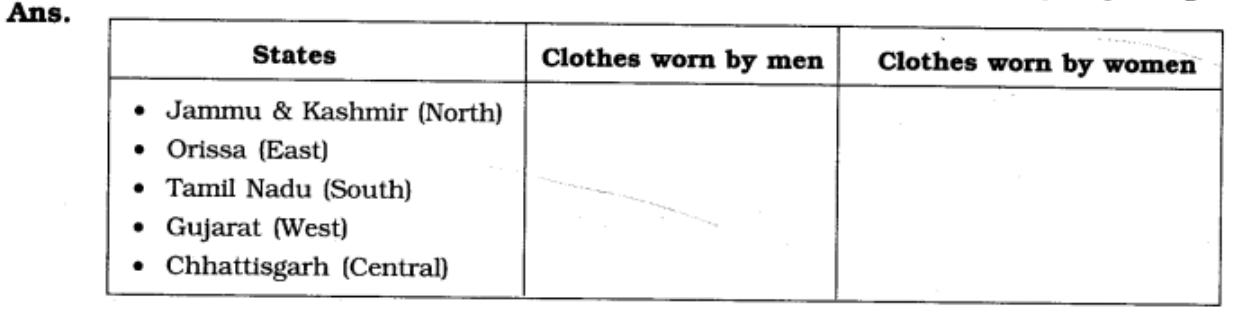
12. Choose another set of five states from each these regions and prepare a list of clothes that are generally worn by women and men in each. .
Very Short Answer Type Questions
1. Who was Anantavarman?
Answer: Anantavarman was one of the most important rulers of the Ganga dynasty in the 12th century.
2. Who did King Anangabhima III dedicate his kingdom to? What did he proclaim himself?
Answer: King Anangabhima III dedicated his kingdom to Purushottama Jagannath and proclaimed himself as the deputy of the god.
3. How were the Rajput rulers most distinctive?
Ans. The Rajput rulers were the apostles of bravery. They fought valiantly and often chose death on the battlefield rather than face defeat.
4. Define the term Kathak.
Answer: The term Kathak is derived from Katha, a word used in Sanskrit and other languages for the story.
5. Who were the Kathaks?
Answer: The kathaks were originally a caste of storytellers in temples of north India who beautified their performances with gestures and songs.
6. Where did Kathak develop?
Answer: Kathak developed in the courts of Rajasthan (Jaipur) and Lucknow.
7. Under whose patronage did kathak grow into a major art form?
Answer: Kathak grew into a major art form under the patronage of Wajid Ali Shah, the last Nawab of Awadh.
Read More: NCERT Solutions for Class 7 Social Science History Chapter 4
8. What distinguished Kangra painting from the paintings?
Answer: Soft colours including cool blues and greens, and lyrical treatment of themes distinguished Kangra painting from other paintings.
9. On what objects do we fiend paintings of ordinary people? Answer: We find paintings of ordinary people on pots, walls, floors, and cloth.
10. Who were the Naths?
Answer: The Naths were the ascetics who engaged in a variety of yogic practices.
11. Why was the second category of the early Bengali literature not written down?
Answer: The second category of the early Bengali literature was circulated orally and therefore it was not written down.
12. What are the chief food items of the Bengalis?
Answer: Rice and fish are the chief food items of the Bengalis.
13. What do terracotta plaques on the walls of temples and viharas depict?[V. Imp.]
Answer: They depict scenes of fish being dressed and taken to the market in baskets.
14. Why was the Bengal Brahmanas allowed to eat fish?
Answer: The Bengal Brahmanas were allowed to eat fish because fish was the main item in the local diet.
15. What is the Brihaddharma Parana?
Answer: It is a thirteenth-century Sanskrit text from Bengal.
Read More: NCERT Solutions for Class 7 History Chapter 5
Short Answer Type Questions
1. How did the Cheras draw upon Sanskritic traditions?
Answer: The temple theatre of Kerala borrowed stories from the Sanskrit epics. The first literary works in Malayalam, dated to about the 12t.h century, are directly indebted to Sanskrit. The Lilatilakam, a fourteenth-century text, dealt with grammar and poetics and was composed in Manipravalam – literally, ‘diamonds and corals’ referring to the two languages namely Sanskrit and the regional language.
2. How are women depicted in the stories about Rajput heroes?
Answer: Sometimes these stories depict women as the cause for conflict, as men fought with one another to either win or protect them (women). Women are also depicted as following their heroic husbands in both life and death. We are familiar with the stories about the practice of sati or the immolation of widows on the funeral pyre of their husbands. So. those who followed the heroic ideal often had to pay for it with their lives.
Read More: NCERT Solutions for Class 7 History Chapter 7
3. Mention all the six dance forms that are recognised as classical.
Answer: Six classical dances are :
- Kathak (North India)
- Bharatnatyam (Tamil Nadu)
- Kathakali (Kerala)
- Odissi (Orissa)
- Kuchipudi (Andhra Pradesh)
- Manipuri (Manipur).
4. Write a brief note on early Bengali literature.
Answer: There are two categories of early Bengali literature:
- The first includes translations of the Sanskrit epics, the Mangalakavyas, auspicious poems, dealing with local deities, and Bhakti literature such as the biographies of Chaitanyadeva, the leader of the Vaishnava Bhakti movement.
- The second includes Nath literature such as the songs of Maynamati and Gopichandra, stories concerning the worship of Dharma Thakur, and fairy tales, Folk tales and ballads. The texts belonging to the first category are written while those belonging to the second category circulated orally.
Check Out: CBSE Class 7 Combo Set of 5 Books
NCERT Solutions for Class 7 History Chapter 9 FAQs
Q1. What is the central theme of NCERT solutions for class 7 History chapter 9?
The chapter explores how regional identities were created through the interaction of local traditions with classical influences like Sanskrit and the Mughal court.
Q2. Where can I find the best class 7 History chapter 9 question answers?
You can find accurate and easy-to-read solutions right here. These are designed to match the NCERT syllabus and help with school revision.
Q3. How did the Bhakti movement affect regional art?
As seen in class 7 History bhakti movement notes, the movement inspired artists to depict religious themes, especially the stories of Krishna, in miniature paintings and local songs.
Q4. Why is the Jagannatha temple significant in regional culture?
It shows that religion and politics are linked. In Orissa, the local deity was identified with Vishnu, making the temple a symbol of regional identity and political control.
Q5. Can I download NCERT History class 7 chapter 9 pdf solutions?
Yes, many students use NCERT History class 7 chapter 9 pdf solutions to study on the go. These digital guides are great for checking important dates and definitions quickly.