Strategy to Score Good Marks in CBSE Class 10 Half-Yearly Exam

CBSE Class 10 Half-Yearly Exam:- The CBSE Class 10 Half-Yearly Exam is an important part of your school year and helps you get ready for the final board exams. Many students wonder, “Is half yearly exam important?” Yes, it is. It shows how well you have understood the chapters from the first half of the syllabus and helps you improve before the board exam. Knowing how to prepare for half yearly exam can make a big difference. Make a proper timetable, revise daily, read NCERT books, and practise writing answers.
As per the CBSE Curriculum 2025–26 Key Reforms, many changes are being introduced. Now, Class 10 board exams will be held twice a year, in February and April, which gives you two chances to improve your marks. Also, the paper will have more competency-based questions to check your understanding, not just memory. So, reading with understanding is very important.
CBSE is also making the revaluation process better and fairer. Subject-wise guidelines now include project work, practicals, and tech-based learning. So if you want to know how to score good marks in class 10, follow the new pattern, practise regularly, and take your half-yearly exam seriously. Check out the article below for knowing the Strategy to Score Good Marks in CBSE Class 10 Half-Yearly Exam.
Check Out: CBSE Class 10th Previous Year Papers
CBSE Class 10 2025-26
The CBSE Class 10 academic year 2025–26 is bringing some big changes for students. With new updates in the education system, CBSE aims to make learning more meaningful and student-friendly. Check out the CBSE Class 10 2025-26 details here:-
|
Category |
Details |
|
Board |
Central Board of Secondary Education (CBSE) |
|
Class |
10 |
|
Academic Year |
2025–26 |
|
Subjects (Main) |
English, Hindi, Mathematics, Science, Social Science |
|
Subjects (Optional) |
Computer Applications, Information Technology, Home Science, Sanskrit, etc. |
|
Assessment Structure |
Scholastic + Co-scholastic (as per NEP 2020 guidelines) |
|
Exam Pattern |
80 marks (Board Exam) + 20 marks (Internal Assessment) |
|
Internal Assessment |
Periodic Tests, Notebook Submission, Subject Enrichment Activities |
|
Grading System |
9-point grading scale (A1 to E) |
|
Board Exam Month |
February–March 2026 (tentative) |
|
Total Passing Marks |
33% in each subject (theory + internal combined) |
How to Study for Class 10?
To study well for Class 10, start with your NCERT books and understand each topic clearly. Make short notes and revise them often. Study a little every day and don’t leave things for the last moment. Use the CBSE Class 10 Question Bank based on the CBSE Class 10 syllabus 2025–26. It has solved papers, sample papers, and concept maps. After studying a chapter, solve questions from the book. Write answers yourself, then check. The concept maps help in quick revision. Stay regular, take breaks, sleep well, and stay confident. This will help you prepare better for exams.
CBSE Question Bank Class 10
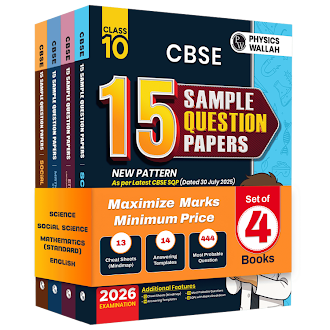
If you're thinking about how to study for Class 10, the CBSE Class 10 Question Bank is a great help. It includes solved papers and sample questions based on the CBSE Class 10 syllabus 2025–26. It also has easy concept maps for each chapter. For students wondering how to study in Class 10 and score well, this book makes revision simple and improves exam confidence.
|
CBSE Class 10 Question Bank |
|
|
CBSE Question & Concept Bank (QCB) Class 10 Science Question Bank |
|
|
CBSE Question & Concept Bank (QCB) Class 10 English Question Bank |
|
|
CBSE Question & Concept Bank (QCB) Class 10 Mathematics Question Bank |
|
|
CBSE Question & Concept Bank (QCB) Class 10 Social Science Question Bank |
|
|
PW Question Bank Class 10 |
|
Why Choose PW CBSE Class 10?
-
Know the Syllabus Well: Start by checking the CBSE Class 10 syllabus 2025–26. Understand what chapters are included, especially in subjects like the Class 10th English syllabus, so you can plan your study time better.
-
Use the Right Books: Always study from the official CBSE Class 10 books like NCERT. These are the base for most questions in your exams.
-
Use the CBSE Question Bank Class 10: After reading your textbook, practise with the CBSE Question Bank Class 10. It has past year papers, sample questions, and chapter-wise maps for easy revision.
-
Daily Study Routine: If you're thinking about how to study in Class 10, make a simple daily timetable. Study a little every day and revise regularly.
-
Practice Writing Answers: To understand how to study for Class 10 effectively, practise writing answers on your own. This helps improve speed, memory, and exam confidence.
Strategy to Score Good Marks in CBSE Class 10 Half-Yearly Exam
The half-yearly exam is not just a school test, it is a strong base for your CBSE Board Exam preparation. Check below to know the Strategy to Score Good Marks in CBSE Class 10 Half-Yearly Exam.
1. Understand the CBSE Class 10 Syllabus 2025–26
The first and most important step is to know the CBSE Class 10 syllabus 2025–26. Go through it carefully for every subject.
-
For English, check the full Class 10th English syllabus, including Reading, Writing, Grammar, and Literature sections.
-
For Science, focus on Physics, Chemistry, and Biology separately.
-
In Social Science, cover History, Geography, Civics, and Economics with full attention.
-
For Maths, note down all formulas and types of questions from each chapter.
2. Start with CBSE Class 10 Books (NCERT)
Your first source should always be the CBSE Class 10 books by NCERT. These are the most trusted and recommended books by CBSE.
-
Read each chapter fully and underline important points.
-
Solve all in-text and end-chapter questions.
-
Don’t skip activities and solved examples, they are often asked in exams.
3. Plan a Simple Daily Timetable
If you’re wondering how to study in Class 10 or how to study for Class 10 without stress, make a basic study timetable.
-
Give 1–2 hours daily to tough subjects like Maths and Science.
-
Keep 1 hour for lighter subjects like English or Hindi.
-
Always keep time for revision and practice questions.
-
On weekends, revise full chapters or practise writing full answers.
4. Use the CBSE Question Bank Class 10 for Practice
After reading and understanding from NCERT, practice questions from the CBSE Question Bank Class 10 (like the one from PW).
-
It includes Chapter-wise concept maps, mock tests, PYQs, and Sample Question Papers.
-
Solving from this book helps you understand the question style and improve speed and accuracy.
-
Try writing answers in your notebook, this helps you prepare for the board-style presentation.
5. Focus on Subject-Wise Strategy
1. Science
-
Revise all diagrams, experiments, and definitions.
-
Focus on concept clarity, especially in Physics (numericals) and Biology (labelled diagrams).
2. Mathematics
-
Make a formula chart and revise daily.
-
Solve at least 4–5 sums from each topic every day.
3. English
-
In the Class 10th English syllabus, practice writing letters, articles, and notice writing.
-
Learn grammar rules and revise formats.
-
Read stories and poems, understand the main idea and moral.
4. Social Science
-
Remember important dates, events, and map work.
-
Write short notes for quick revision.
-
Practice answer writing to improve explanation skills.
5. Hindi/Sanskrit
-
Focus on the grammar and writing sections.
-
Practice long and short answers from literature.
6. Regular Revision is the Key
-
Revise every chapter at least 2–3 times before the exam.
-
Make summary notes or use flashcards.
-
Use concept maps to revise topics quickly.
Read More: Top Scoring Subjects in CBSE Class 10 Board Exams
CBSE Class 10 Half-Yearly Exam FAQs
1. Is the half-yearly exam important for Class 10 students?
Yes, the half-yearly exam is important. It helps you check your preparation and build a strong base for the final board exam.
2. How to prepare for half yearly exam in Class 10?
Follow your CBSE Class 10 syllabus 2025–26, revise NCERT books, solve questions from the CBSE Question Bank Class 10, and practise writing answers daily.
3. How to score good marks in Class 10 half-yearly exams?
Be regular with studies, revise topics weekly, use concept maps, practise from CBSE Class 10 book, and solve mock papers.
4. What is the CBSE Class 10 syllabus 2025–26?
The new syllabus includes two board exams (Feb & April), more focus on conceptual and competency-based questions, and detailed subject guidelines.
5. What subjects are included in Class 10 half-yearly exams?
Usually, English, Hindi, Maths, Science, Social Science, and Sanskrit are covered.