SSC CGL Number System Questions with Solutions
SSC CGL number system questions are mathematical problems that test a student's grasp of number properties, divisibility rules, and arithmetic operations. These questions form the foundation of the Quantitative Aptitude section, covering topics like HCF, LCM, and remainders. Mastery of this subject is vital for scoring high in competitive government exams.
Check Out: PW SSC Books
What Are the Concepts of Number System?
Before diving into complex SSC CGL number system questions, you must build a solid foundation. Numbers are the building blocks of mathematics. The SSC exam frequently tests your ability to classify them quickly. If you don't know the difference between a rational and an irrational number, you'll likely struggle with advanced word problems later on.
The Number Hierarchy
We can classify numbers into several categories. Using this, you can eliminate wrong options in exam.
-
Natural Numbers (N): These are the numbers we use for counting, starting from 1 (1, 2, 3...).
-
Whole Numbers (W): This set is just natural numbers plus zero. Remember, zero is not a natural number.
-
Integers (Z): These include all whole numbers and their negative counterparts (..., -2, -1, 0, 1, 2, ...).
-
Rational Numbers (Q): Any number you can write as a fraction p/q where q is not zero.
-
Irrational Numbers: These cannot be written as simple fractions. Examples include the square root of 2 and Pi.
Quick Reference Table for Numbers
Look upon the table to have quick reference about the number category and its key characteristics:
|
Number Category |
Key Characteristic |
Examples |
|
Prime Numbers |
Exactly two factors: 1 and itself |
2, 3, 5, 7, 11, 13, 17 |
|
Composite Numbers |
More than two factors |
4, 6, 8, 9, 10, 12 |
|
Even Numbers |
Divisible by 2 |
2, 4, 6, 8, 10 |
|
Odd Numbers |
Not divisible by 2 |
1, 3, 5, 7, 9 |
|
Perfect Numbers |
Sum of factors equals the number |
6 (1+2+3), 28 |
Mentor Tip: Always remember that 2 is the only even prime number. All other prime numbers are odd. This small fact often helps in solving "find the odd one out"-style SSC CGL number system questions.
SSC Number System Questions PDF Links
SSC number system questions PDF links with solutions, practice sets, and exam-oriented problems to boost your preparation.
|
SSC Number System Questions PDF Links |
||
|---|---|---|
|
Resource |
PDF Link |
Description |
|
SSC Number System Questions PDF English |
Contains solved problems with step-by-step solutions for practice |
|
|
SSC Number System Questions PDF HindiSSC Number System Questions PDF Hindi |
Contains solved problems with step-by-step solutions for practice in hindi |
|
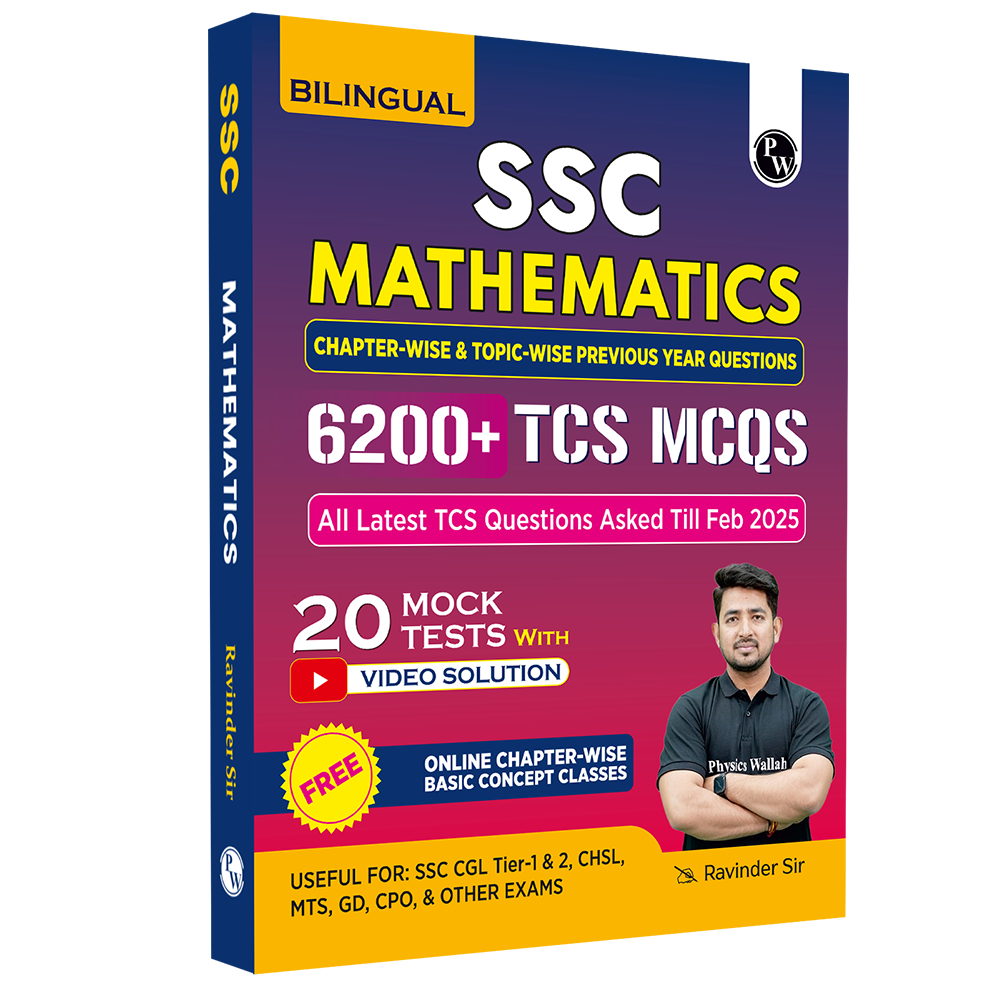
For more question, check out SSC Mathematics 6200+ Chapterwise & Topicwise Previous Year Question
How To Use SSC CGL Divisibility Rules For Numbers?
Divisibility rules are your best friend when solving SSC CGL number system questions with solutions. Instead of performing long division, which wastes precious seconds, you can use these shortcuts to check if a large number is divisible by another.
Standard Divisibility Shortcuts
-
Divisibility by 2: The last digit must be even (0, 2, 4, 6, 8).
-
Divisibility by 3: Add all the digits of the number. If the total is divisible by 3, the whole number is too.
-
Divisibility by 4: Look at the last two digits. If they are divisible by 4, the entire number is.
-
Divisibility by 5: The number must end in 0 or 5.
-
Divisibility by 8: The last three digits must be divisible by 8. This is common in SSC CGL number system questions pdf materials.
-
Divisibility by 9: Similar to 3, the sum of all digits must be divisible by 9.
-
Divisibility by 11: Subtract the sum of digits in even positions from the sum of digits in odd positions. If the result is 0 or a multiple of 11, the number is divisible.
Example for Divisibility Rules for Numbers
Question: Find the value of 'k' if 56k8 is divisible by 9.
-
Step 1: Use the rule for 9. Sum the digits: 5 + 6 + k + 8.
-
Step 2: The sum is 19 + k.
-
Step 3: The next multiple of 9 after 19 is 27.
-
Step 4: 19 + k = 27, which means k = 8.
Answer: The value of k is 8.
LCM and HCF Problems
Least Common Multiple (LCM) and Highest Common Factor (HCF) are vital parts of any SSC CGL number system questions pdf download..
The Difference between LCM and HCF
-
HCF: The largest number that divides two or more numbers without leaving a remainder.
-
LCM: The smallest number that is a multiple of two or more numbers.
Important Formulae for the Exam for LCM and HCF
When you are looking through SSC CGL number system questions with solutions, you'll see these formulas repeated:
-
Product of two numbers = HCF x LCM
-
HCF of Fractions = (HCF of Numerators) / (LCM of Denominators)
-
LCM of Fractions = (LCM of Numerators) / (HCF of Denominators)
Practical Application for LCM and HCF
Question: What is the greatest number that divides 122 and 243 leaving remainders 2 and 3 respectively?
-
Action: Subtract the remainders first. 122 - 2 = 120 and 243 - 3 = 240.
-
Action: Find the HCF of 120 and 240.
-
Result: The HCF is 120. That's your answer.
Check Out: SSC Previous year Papers
How To Calculate Unit Digits and Remainders?
Questions regarding the "Unit Digit" or "Remainder" can look scary because they involve massive powers. However, they follow specific patterns. You'll find these frequently in SSC CGL number system questions pdf in hindi and English.
The Concept of Cyclicity
The unit digit of a number raised to a power repeats in a cycle.
-
Digits (0, 1, 5, 6): The unit digit always stays the same regardless of the power.
-
Digits (4, 9): These have a cycle of 2. For 4, it is 4 and 6. For 9, it is 9 and 1.
-
Digits (2, 3, 7, 8): These have a cycle of 4.
Finding the Unit Digit
To find the unit digit of any number:
-
Divide the power by 4.
-
Find the remainder. If the remainder is 0, use 4 as the power.
-
Calculate the unit digit using that small remainder as the new power.
Remainder Theorem Basics
The Remainder Theorem helps you find remainders of large expressions. This trick saves you from calculating the actual power, making it a favorite for SSC CGL number system questions.
SSC CGL Numbers System Questions PDFs
To ace the exam, you need to practice. We highly recommend getting an SSC CGL number system questions pdf download to practice offline. This helps you study even without an internet connection.
Why Use Practice PDFs?
-
Exam Simulation: PDFs usually contain sets of 25-50 questions, helping you time yourself.
-
Bilingual Support: Many students prefer SSC CGL number system questions pdf in hindi to ensure they understand the terminology in their native language.
-
Previous Year Questions (PYQs): These are the gold standard. SSC often repeats patterns from previous years.
Important Arithmetic Progression (AP) Sums
Knowing these formulas helps you solve series-based number system questions instantly:
-
Sum of n natural numbers: n(n+1) / 2
-
Sum of squares of n natural numbers: n(n+1)(2n+1) / 6
-
Sum of cubes of n natural numbers: [n(n+1) / 2] squared
Strategy for Success in SSC CGL
Don't just solve the questions; analyze your mistakes. If you find a particular type of problem difficult, mark it in your SSC CGL number system questions pdf and return to it after revising the concept.
Read More: SSC CGL Maths Questions With Solutions for 2026 Exam
SSC CGL Number System Questions FAQs
What are twin prime numbers?
Twin primes are pairs of prime numbers that have a difference of exactly two. Examples include (3, 5), (5, 7), and (11, 13).
How can I find the number of factors of a number?
First, do the prime factorization of the number. Then, add one to each exponent and multiply those results together to get the total factors.
What is the difference between a digit and a number?
A digit is a single symbol from 0 to 9 used to make numbers. A number is a string of digits representing a specific value.
How do I find the unit digit of 2 raised to the power 40?
Divide 40 by the cyclicity of 2, which is 4. The remainder is 0. Since the remainder is 0, we calculate 2 to the power 4, which is 16. The unit digit is 6.
Where can I find SSC CGL number system questions pdf in hindi?
Most educational websites and exam preparation portals offer bilingual PDFs. Look for "SSC CGL Quantitative Aptitude" sections to find these downloads.