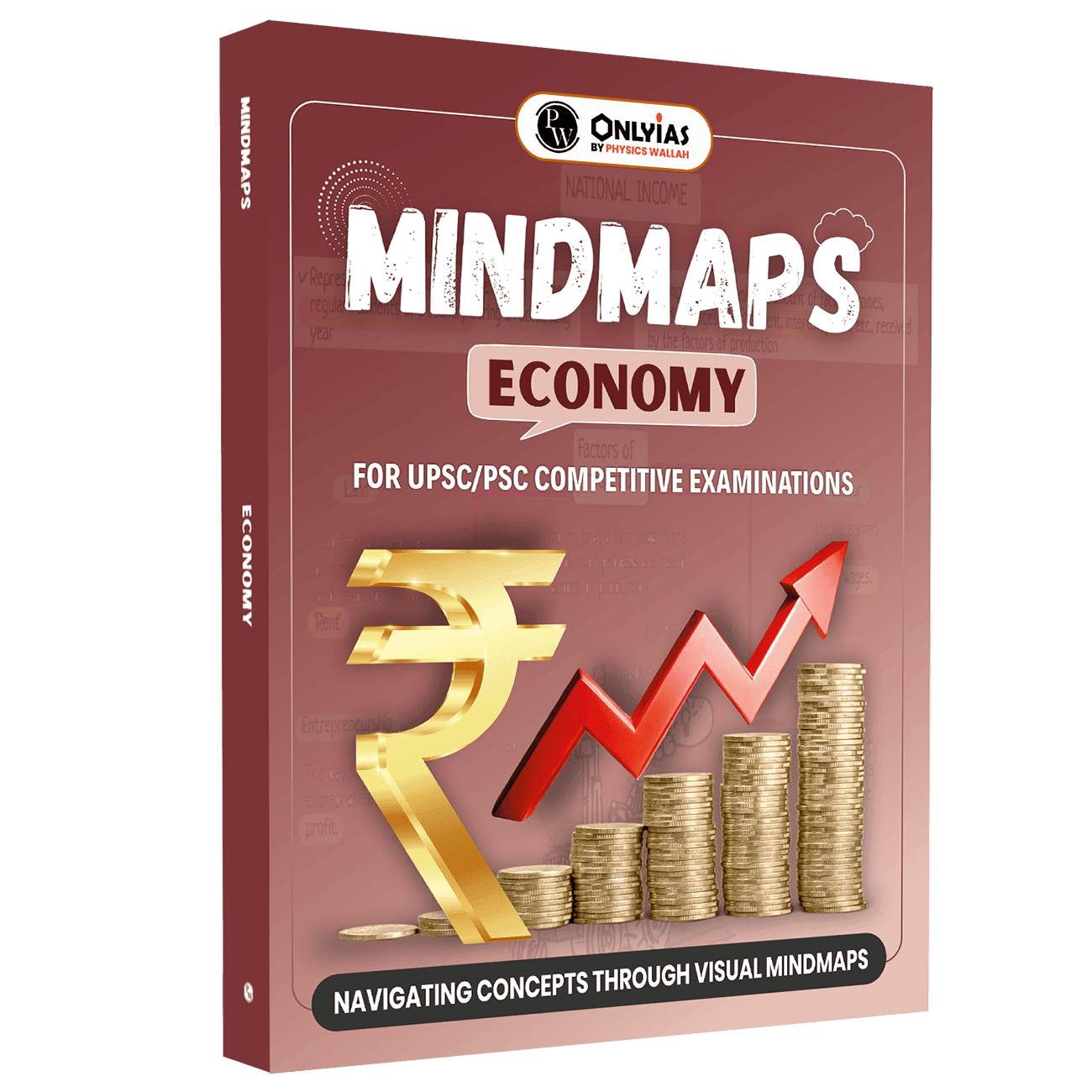
Score Better in UPSC Economy with Simple Mindmaps

UPSC economy mindmaps serve as a visual bridge between complex financial theories and the high-pressure environment of the Civil Services Exam. By condensing hundreds of pages of data into interconnected notes, these maps help aspirants retain core concepts like Fiscal Policy, Banking, and International Trade.
This article focuses on how to leverage UPSC economy mindmaps to streamline your preparation, ensuring you move beyond rote memorisation to a deeper, conceptual understanding of the subject.
Check out: UPSC CSE Books
Importance of UPSC Economy Mindmaps
The Indian economy is dynamic. Unlike static subjects, it requires an understanding of how one change in policy triggers a chain reaction across different sectors. Visual tools allow you to see these connections instantly.
-
Holistic Overview: A single page can cover the entire Budgeting process, from the Consolidated Fund of India to the Vote on Account.
-
Memory Retention: The brain processes images faster than text. Bold colours and branching lines create "mental hooks" that are easier to recall during the Mains answer writing.
-
Rapid Revision: In the final days before the Prelims, you cannot re-read a 700-page book for economy UPSC. Mindmaps allow you to revise a full module in minutes.
Right Book for Economics for UPSC
Choosing the right study material is the first step toward a high score. While mindmaps are great for revision, they must be backed by a solid foundation from a reliable basic economics book for UPSC.
-
NCERT Class 11 and 12: These are the gold standard for basic economics for UPSC. Focus on "Indian Economic Development" and "Macroeconomics."
-
Standard Reference Books: After the basics, you need a comprehensive book for economics for UPSC that covers contemporary issues, such as the Economic Survey and the Union Budget.
-
Monthly Current Affairs: The economy is 70% current-affairs based. Ensure your mindmaps include the latest updates from reputable news sources.
|
Category |
Recommended Resource |
|
Foundations |
NCERT Class 11 & 12 |
|
Comprehensive Theory |
Standard Reference Books |
|
Revision Tool |
UPSC economy mindmaps |
|
Current Updates |
Economic Survey & Budget |
Check Out: UPSC Revision Books
How to Use UPSC Economy Mindmaps Effectively
Simply owning a set of mindmaps is not enough; you must integrate them into your daily study routine. Here is a step-by-step approach to using them:
Step 1: Active Reading
Read a chapter from your UPSC economy mindmaps books. Once you understand the core logic—for example, how the GST Council functions—open the corresponding mindmap. Compare the text with the visual representation to see how the information is prioritised.
Step 2: Annotate and Customise
The best mindmaps are those that grow with your knowledge. If a new policy is announced by the RBI, add a small branch to your existing map. This keeps your resources updated without requiring you to buy a new book for economy UPSC every few months.
Step 3: Answer Writing Practice
During Mains preparation, use the central themes of the mindmap as your sub-headings. This ensures your answers are structured, logical, and cover all dimensions of the topic.
Topics to Cover in UPSC Economy Mindmaps
To score well, certain "high-yield" topics should be your priority. Creating or using UPSC economy mindmaps for these areas will yield the highest return on investment for your time.
-
National Income Accounting: GDP, GNP, NNP, and the methods of calculation.
-
Money and Banking: The role of the RBI, Monetary Policy Committee (MPC), and NPA management.
-
Public Finance: Tax structures (Direct vs Indirect), Deficit financing, and FRBM Act.
-
External Sector: Balance of Payments, Exchange Rates, and Foreign Direct Investment (FDI).
Check out: UPSC Previous Year Papers
Traditional Notes vs. UPSC Economy Mindmaps
The way you organise your notes for UPSC Economy can make a big difference in how fast you revise and how well you grasp the concepts. While many students still rely on traditional notes, the huge syllabus and the way topics are linked have made mindmaps a popular option for quick understanding and better recall.
Each method has its own benefits. Traditional notes give you detailed information for deep study, while mindmaps make it easier to see and remember complex topics, especially as exams approach. The table below compares the two so you can pick the one that best fits your study style.
|
Feature |
Traditional Linear Notes |
UPSC economy mindmaps |
|
Speed of Review |
Slow (requires reading every line) |
Very Fast (scan-based) |
|
Connectivity |
Limited (ideas are isolated) |
High (shows relationships) |
|
Engagement |
Low (can be monotonous) |
High (uses spatial memory) |
|
Updates |
Difficult to add new info |
Easy to add new branches |
How to Select the Right UPSC Economy Mindmaps
While there are many options in the market, the best book for economy UPSC is one that balances theory with application. Look for books that:
-
Use simple language.
-
Provide real-world examples of Indian economic scenarios.
-
Include previous years' question analysis.
-
Supplement the text with charts and tables.
If you have a strong foundation, you can rely more on UPSC economy mindmaps and current affairs. If you are starting from scratch, invest time in a basic economics book for UPSC before moving to condensed revision notes.
Prelims and Mains Study Strategy with UPSC Economy Mindmaps
Without a proper study strategy, you cannot do well in your examination, and so is the case with UPSC. You need to have a planned study strategy for both prelims and mains. Below is how you can do the same:
For Prelims
Focus on the "Branches" of the mindmap. Prelims questions often test your ability to distinguish between similar concepts. For instance, knowing whether the "Capital Account" or "Current Account" includes "Remittances" is easier when you have seen them categorized visually.
For Mains
Focus on the "Roots." Your answers need to explain why something is happening. Use the mindmap to remember the various impacts of a policy—social, environmental, and financial. This multi-dimensional approach is a hallmark of a top-scoring candidate.
Check Out: UPSC Test Series
Tips for UPSC Economy Mindmaps
Consistency beats intensity. Instead of trying to master the entire book for economics for UPSC in a week, break it down.
-
Morning: Read a fresh topic from your UPSC economy books.
-
Afternoon: Solve 10 MCQs related to that topic.
-
Evening: Review the UPSC economy mindmaps to solidify what you learned.
This cycle ensures that the information moves from your short-term memory to your long-term memory.
Read More: UPSC Economics Syllabus for 2026 Exam
UPSC Economy Mindmaps FAQs
Which are the right UPSC economy books for beginners?
Beginners should start with NCERT Class 11 and 12. These provide the necessary basic economics for UPSC before moving on to advanced reference manuals and yearly reports.
Can I rely solely on UPSC economy mindmaps for the exam?
Mindmaps are powerful revision tools, but they should complement a standard book for economy UPSC. Use textbooks to build an initial understanding, and mind maps to retain and revise that knowledge.
How do mindmaps help in solving economics MCQs?
MCQs often involve the "Elimination Method." Visual memory of UPSC economy mindmaps helps you quickly identify which sub-topics belong to a category, making it easier to spot incorrect options.
What is the most important basic economics book for UPSC?
"Macroeconomics" (Class 12 NCERT) is widely considered the most vital introductory economics book for UPSC, as it covers foundational concepts in national income and banking.
How often should I revise using UPSC economy mindmaps?
It is highly effective to review your mindmaps once a week. This "Spaced Repetition" ensures that the logical connections between economic variables stay fresh in your mind throughout the year.