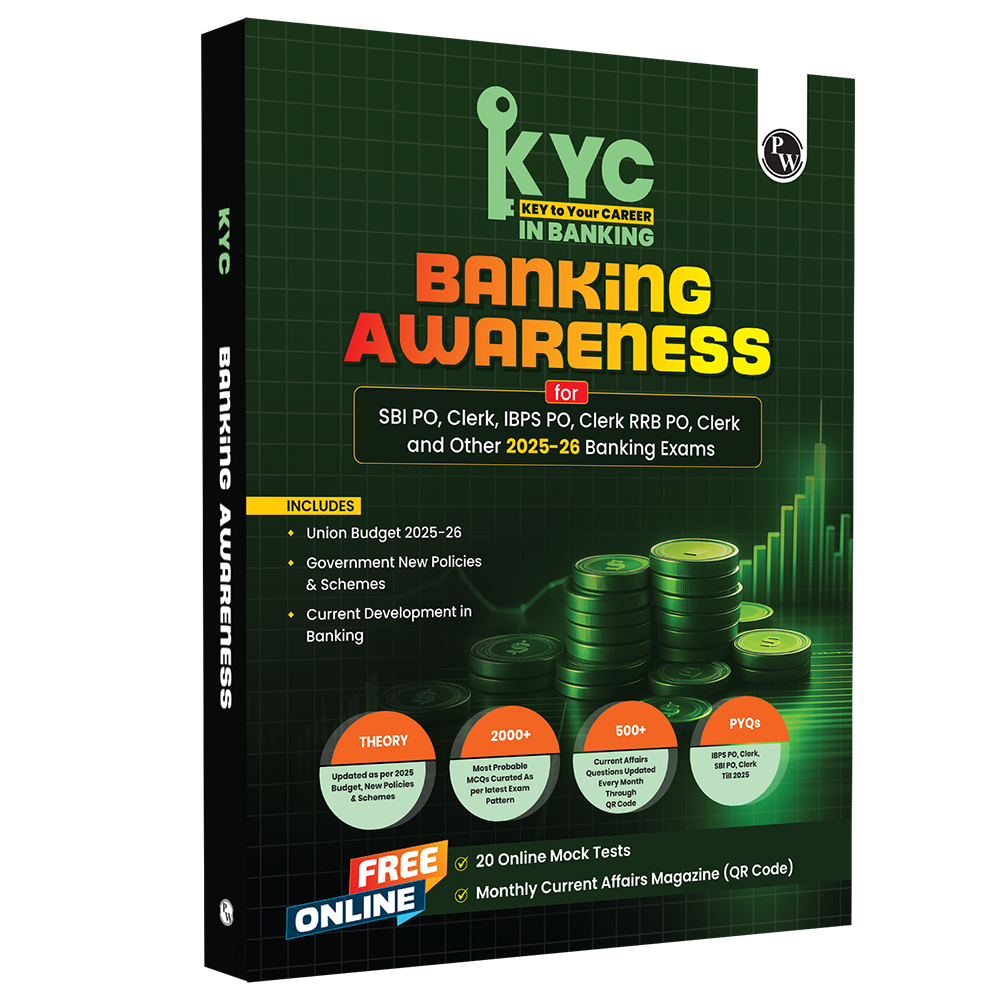
Improve Banking Exam Scores with KYC Banking Awareness PYQs

Competitive banking exams require a good general awareness but it can be difficult to keep up with such wide subjects as monetary policies, financial terms, and regulatory changes. PW Banking Awareness Book is well-structured to make preparation easy as they offer focused PYQs, updated concepts and brief explanations to help aspirants revise efficiently and boost their overall performance in the exam.
Check Out: Banking Books
Importance of PW Banking Awareness Book
To get a good score in Bank exams, you have to perform well in all the sections in a balanced way. Quantitative aptitude and reasoning test your analytical ability, while the general awareness section is often the decider for your final selection. A good grasp of financial concepts helps the candidates to pick up marks quickly without lengthy calculations.
Improve Your Merit Score
The general awareness section is given a lot of importance in the mains exams. Those students who practice with a dedicated bank General Knowledge book often have an edge over their peers. This section enables test-takers to go through a high number of questions in a short time, saving precious minutes for complex mathematical problems. It directly increases the overall merit list.
Managing Dynamic Financial Topics
Banking concepts evolve with new regulatory policies, economic changes and quarterly updates. Using old resources can lead to the wrong answer on exam day. A Banking Awareness latest book is designed for the learners to study relevant laws, statutory liquidity ratios and updated monetary policies.
Features of PW Banking Awareness Book
The right study materials will save you hours of pain. A well-written textbook simplifies complex economic language and provides data in an easy-to-understand format.
Topic-Wise Categorisation of PYQs
An effective study guide organises past year questions by topic rather than just by year. This allows students to complete a concept, like monetary policy, and immediately practice all related questions from previous papers. It builds concrete confidence before moving to the next chapter.
Detailed Explanations and Concept Clarity
In the modern pattern of exams, just knowing the right option is never enough. Good PW Banking Awareness Book explain the reason behind every correct answer. This method of learning reinforces the concept and prepares the students to deal with variations of the same question in future papers.
Important Topics Covered in PW Banking Awareness Book
To clear these competitive tests, one has to be crystal clear on basic banking terms. These areas are the central pillars of most financial awareness papers.
History and Evolution of Indian Banking
Every aspirant must know the evolution of the modern financial system. This includes nationalisation of banks, setting up of the Reserve Bank of India (RBI) and amalgamation of public sector institutions. In prelims and mains, you will often be asked about historical dates and milestones.
Monetary Policy and Regulatory Framework
The RBI governs the Indian economic system using various tools. Aspirants need to learn about quantitative instruments like repo rate, reverse repo rate, cash reserve ratio (CRR) and statutory liquidity ratio (SLR).
|
Monetary Policy Tool |
Primary Function |
Current Significance |
|
Repo Rate |
The rate at which the central bank lends money to commercial banks. |
Controls liquidity and inflation in the economy. |
|
Reverse Repo Rate |
The rate at which the central bank borrows money from commercial banks. |
Absorbs excess liquidity from the banking system. |
|
Cash Reserve Ratio |
A specific percentage of net demand and time liabilities held as cash with the RBI. |
Ensures the safety of consumer deposits. |
|
Statutory Liquidity Ratio |
The liquid assets that commercial banks must maintain before lending to customers. |
Regulates credit growth in the country. |
Digital Banking and Financial Technology
Modern exams put enormous pressure on electronic banking systems. Candidates should have a good understanding of platforms like Unified Payments Interface (UPI), National Electronic Funds Transfer (NEFT), Real Time Gross Settlement (RTGS) and Immediate Payment Service (IMPS). Questions often revolve around transaction limits, operating hours and managing organisations.
Study Plan for PW Banking Awareness Book
To cover the vast syllabus systematically, candidates should follow a structured timeline rather than studying randomly.
Phase 1: Conceptual Clarity (Weeks 1 to 2)
Focus entirely on learning the definitions and mechanisms of the financial sector. Read about inflation, capital markets, and priority sector lending. Avoid jumping straight into questions without knowing the fundamentals.
Phase 2: Topical Practice (Weeks 3 to 4)
Open your book and solve questions chapter by chapter. If you finish reading about money laundering, solve every past year's question related to KYC norms and the Prevention of Money Laundering Act (PMLA).
Phase 3: Full-Length Mock Testing (Weeks 5 to 6)
Solve mixed question sets containing miscellaneous financial awareness topics. This builds mental agility, training the brain to switch between different topics like negotiable instruments and international banking organisations instantly.
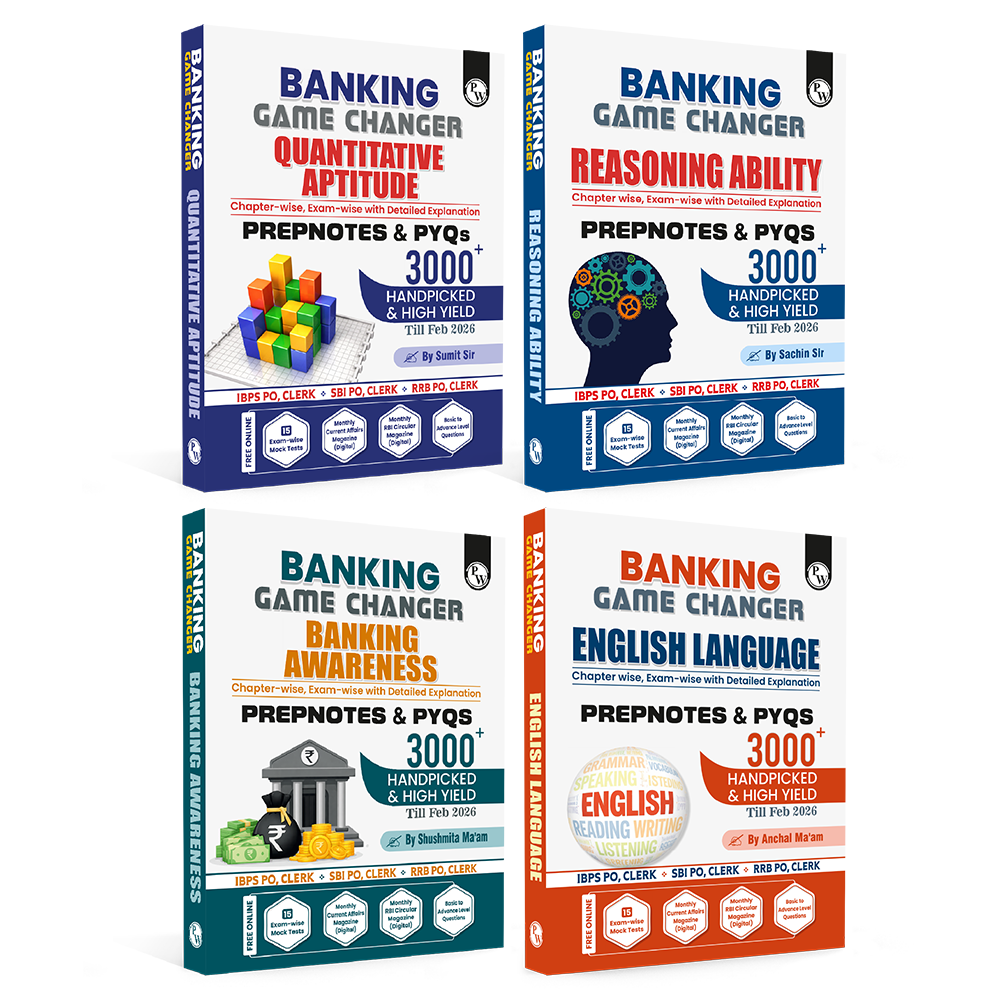
Check out: KYC Quantitative Aptitude, Reasoning Ability and English Language Combo Set of 3 Books
How to Revise with PW Banking Awareness Book
Blindly practising past year papers will not guarantee success. Students require a strategic approach to turn these questions into tools for active recall.
Identifying Common Trends
The exam pattern indicates that some core concepts keep coming back every year in different names. Students can analyse previous papers and identify high-yield sections and focus their energy on topics that fetch maximum marks through a comprehensive GK book for bank exams.
Practising Real Exam Conditions
Aspirants should practice past year questions with a strict timer. This practice develops speed and accuracy and reduces the anxiety felt on the actual exam day. Going through incorrect responses immediately after a mock session prevents repeating such mistakes.
Benefits of Using PW Banking Awareness Book
Static banking knowledge must connect seamlessly with dynamic current affairs. Merging these two components guarantees a comprehensive understanding of the current financial landscape.
-
Better Contextual Understanding: Reading about an RBI penalty makes more sense when you know the underlying Banking Regulation Act.
-
Improved Retention: Applying static concepts to real-world financial news helps memory retention.
-
Higher Interview Scores: Clear concepts assist candidates during the final interview rounds, where panel members test practical financial awareness.
How to Choose the Right Banking Awareness Book
The marketplace contains hundreds of publications, making it difficult for students to select the ideal resource. The right choice combines foundational theory with ample practice questions.
Checking for Regular Content Updates
Economic figures change during annual budget presentations and bi-monthly monetary policy reviews. When purchasing this book, ensure it reflects the latest financial guidelines and includes recent updates from the current financial year.
Evaluating Notes
Before selecting a guide, check the quality of the answer key. Superior books avoid one-word answers, opting instead to provide a holistic overview of the topic surrounding the question. This turns every practice question into a mini-revision lesson.
Common Mistakes to Avoid While Using PW Banking Awareness Book
Many brilliant candidates miss the cutoff mark due to minor strategic errors during their preparation journey.
Rote Memorisation Without Understanding
Memorising facts without understanding real-world application causes confusion when questions are twisted. Understand the “why” behind every economic policy and get the right answer to complex analytical questions.
Neglecting Static Banking Concepts
It is a common error to focus only on current events and to overlook static fundamentals. About half of the General Knowledge questions are based on fixed principles such as the history of banking, negotiable instruments and fundamental accounting terminologies.
Over-Relying on Low-Quality PDF Files
If you surf the Internet for summaries, you often find unverifiable data. A verified, professionally published book will keep your preparation accurate and efficient.
Read More: Crack Banking Exams Like a Topper with KYC Quant PYQ
PW Banking Awareness Book FAQs
-
Which is the right Banking Awareness book for competitive exams?
The PW Banking Awareness Book is highly focused on previous year questions, topic-wise, with a detailed conceptual breakdown. The book is fully aligned with the revised syllabus for major institutional examinations.
-
Can I prepare for Banking Awareness solely through current affairs?
Current affairs is only about current events. So you have to combine the static fundamentals from the book and the current updates. So to score well, you have to know the basics as well as the latest updates.
-
How many months of financial news should a candidate prepare?
Aspirants should cover around six to eight months of current financial developments prior to the exam date.
-
What digital banking topics appear most frequently in exams?
Questions frequently target payment settlement systems like UPI, NEFT, and RTGS. Candidates must know operational timings, transactional limits, structural protocols, and the roles of governing bodies like the National Payments Corporation of India (NPCI).
-
How do past year questions help in clearing sectional cutoffs?
Past year questions reveal structural patterns, expected difficulty levels, and core repeating concepts. Practising these questions directly through reliable books trains the mind to identify high-yield topics, improving speed and accuracy on exam day.