Human Reproduction NEET Notes 2026 Exam
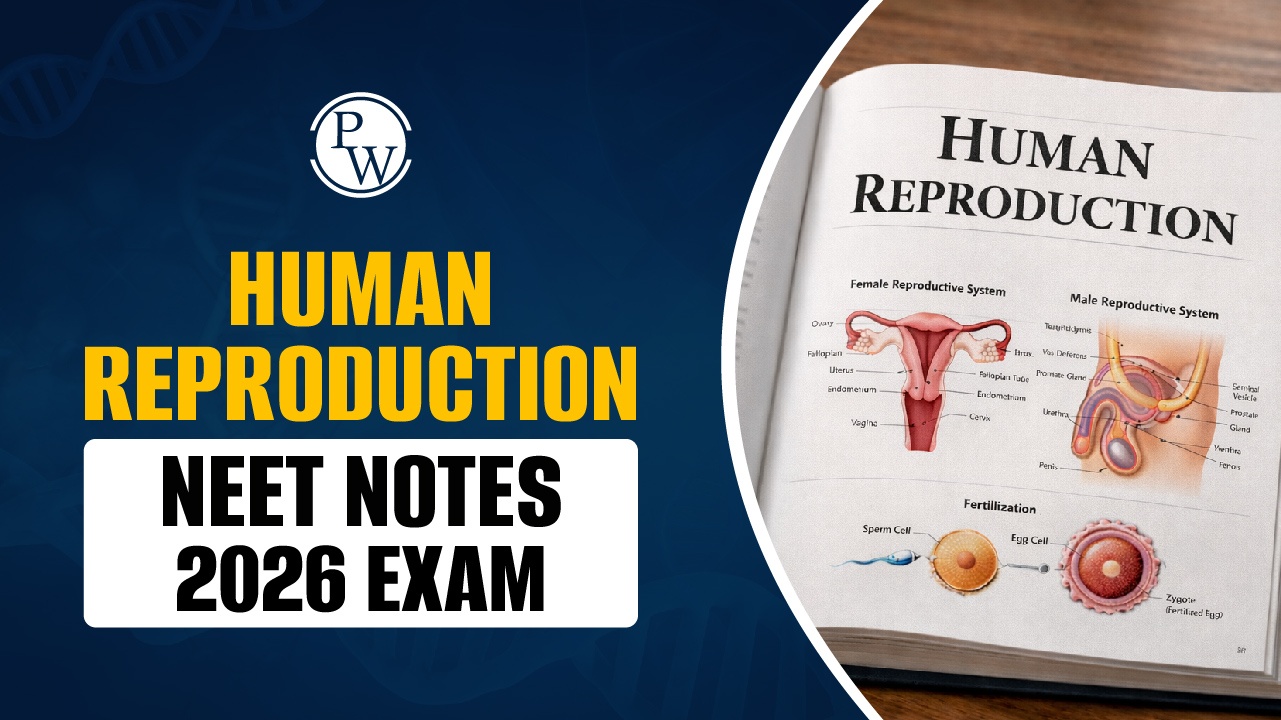
Preparing for the NEET 2026 exam can be difficult, especially when you hit the Biology syllabus. Among all the chapters, "Human Reproduction" stands out as one of the highest-weighted topics. It is a chapter that requires more than just rote memorisation; you also need to understand the "why" and "how" of life. Having structured human reproduction NEET notes is crucial for students who often struggle with the complexity of hormonal cycles and developmental stages. Whether you are revising at the last minute or starting your prep, breaking this chapter down into logical segments is the secret to retaining information long-term.
Check Out: NEET Books
The Male and Female Reproductive Systems
To understand sexual reproduction NEET notes, you must start with the anatomy. The exam frequently asks about the pathway of sperm and the structure of the ovarian follicles.
The Male System
The primary organs are the testes, in the scrotum to maintain a lower temperature (2–2.5°C below body temperature) necessary for spermatogenesis. Key structures to remember for your human reproduction NEET short notes include:
-
Rete Testis and Vasa Efferentia: The transport network for sperm.
-
Leydig Cells: Found in interstitial spaces, these produce androgens (testosterone).
-
Sertoli Cells: These provide nutrition to the developing germ cells.
The Female System
The female anatomy is more complex due to its role in gestation. It includes the ovaries, oviducts (Fallopian tubes), uterus, cervix, and vagina.
-
Ampulla: The specific site in the Fallopian tube where fertilisation occurs.
-
Endometrium: The inner glandular layer of the uterus that undergoes cyclic changes during the menstrual cycle.
Check Out: NEET Previous Year Papers
How Does Life Begin at the Cellular Level in Human Reproduction?
Gametogenesis is the process through which reproductive cells, or gametes, are formed. It is one of the most important topics in Human Reproduction and is frequently tested in NEET. To strengthen your understanding and practice exam-level questions from this chapter, you can use the 39 Years NEET PYQ Biology book, which includes chapter-wise previous year questions and detailed practice material.
-
Spermatogenesis: This is a continuous process starting at puberty. One primary spermatocyte leads to the formation of four functional spermatozoa.
-
Oogenesis: Unlike the male process, this starts during the embryonic stage. A female is born with all the primary oocytes she will ever have. The process is "arrested" at Prophase-I of meiosis until puberty.
What is the Menstrual Cycle?
If you are looking for a human reproduction NEET notes PDF download, ensure it has a detailed section on hormones. The cycle is divided into four main phases:
-
Menstrual Phase: Breakdown of the endometrial lining.
-
Follicular Phase: Primary follicles grow into Graafian follicles under the influence of FSH and LH.
-
Ovulatory Phase: A sudden surge in LH (LH Surge) causes the release of the ovum around day 14.
-
Luteal Phase: The remaining parts of the Graafian follicle transform into the Corpus Luteum, which secretes Progesterone to maintain the pregnancy.
Check out: PW NEET Test series Books
Notes on the Process of Pregnancy for NEET 2026
Once the sperm and ovum meet in the ampullary-isthmic junction, fertilisation occurs. This triggers the completion of Meiosis-II in the secondary oocyte. Questions related to fertilisation, implantation, and placental functions are frequently asked in NEET Biology. For focused preparation on such high-weightage topics, students can refer to the NEET Biology Most Wanted 2026 book, which covers important concepts and commonly asked questions.
-
Cleavage: The zygote undergoes rapid mitotic divisions to form a Morula (8–16 cells) and then a Blastocyst.
-
Implantation: The blastocyst embeds itself into the endometrium. The outer layer, called the trophoblast, eventually forms the placenta.
-
Placenta Functions: It acts as an endocrine tissue, secreting hormones like hCG, hPL, estrogens, and progestogens.
The Final Stages of Human Reproduction
The process of childbirth is called parturition. It is induced by a complex neuroendocrine mechanism.
-
Fetal Ejection Reflex: This begins with mild uterine contractions triggered by the fully developed fetus and placenta.
-
Oxytocin: Known as the "birth hormone," it acts on the uterine muscles to cause stronger contractions.
-
Colostrum: The milk produced during the initial days of lactation is rich in IgA antibodies, providing essential immunity to the newborn.
Check Out: NEET Question Banks
Human Reproduction NEET Short Notes for Revision
To summarise all the information, refer to the table below which includes major topics frequently seen in the NEET Biology section.
|
Process |
Location |
Key Hormones Involved |
|
Spermatogenesis |
Seminiferous Tubules |
FSH, LH, Testosterone |
|
Ovulation |
Ovary |
LH Surge, Estrogen |
|
Fertilisation |
Ampulla (Fallopian Tube) |
Progesterone (for maintenance) |
|
Implantation |
Uterus (Endometrium) |
hCG, Progesterone |
Read More: Most Repeated Questions in NEET Exam
Human Reproduction NEET Notes FAQs
Q1: Where can I find a reliable human reproduction NEET notes PDF?
You can access high-quality human reproduction NEET notes on the PW Store or official PW App, which are specifically tailored to the latest NCERT and NTA exam patterns for 2026.
Q2: What is the most important topic in sexual reproduction NEET notes?
While the whole chapter is vital, the Menstrual Cycle and Gametogenesis (specifically oogenesis) are historically the most frequently questioned areas in the NEET exam.
Q3: Is the human reproduction NEET notes PDF download enough for a 360/360 score?
These notes are an excellent revision tool. However, for a perfect score, you should pair these human reproduction NEET short notes with thorough NCERT reading and regular mock tests.
Q4: Why is the LH surge crucial in the reproductive cycle?
The LH surge is the primary trigger for ovulation. Without this sudden spike in Luteinizing Hormone, the Graafian follicle will not rupture to release the egg.
Q5: What are the primary hormones secreted by the placenta?
The placenta is a powerhouse of hormones. It secretes hCG (Human Chorionic Gonadotropin), hPL (Human Placental Lactogen), Estrogen, and Progesterone to support the growing fetus.