NEET Chemistry Chapter Wise Weightage 2026
NEET Chemistry Chapter wise Weightage 2026: The National Eligibility cum Entrance Test (NEET) is one of the most important exams for students who want to become doctors in India. The exam has three main subjects: Physics, Chemistry, and Biology. Biology carries the highest marks, but Chemistry and Physics also play a very big role in deciding the final score of a student. Among these, Chemistry is often seen as the most balanced subject because it has both theory-based and numerical-based questions.
The Chemistry section is divided into three parts: Physical Chemistry, Organic Chemistry, and Inorganic Chemistry. Topics like Thermodynamics, Chemical Bonding, Coordination Compounds, Hydrocarbons, Biomolecules, and p-Block Elements are very important for the exam. To prepare in a smart way, students should know the NEET Chemistry chapter wise weightage. This tells how many questions are usually asked from each chapter.
Knowing this helps students to focus more on high-weightage chapters and revise them properly. Many students also check the NEET Chemistry chapter wise weightage 2025 and compare it with the latest trend for 2026. This simple planning makes preparation stronger and increases the chance of scoring well in the Chemistry part of NEET.
Check Out: NEET Books
NEET Chemistry Chapter wise Weightage 2026
Check out the NEET Chemistry Chapter wise Weightage 2026 below:-
|
Chapter Wise NEET Weightage for Chemistry |
||
|
Class |
Chapter Name |
No. of Questions |
|
11th |
Structure of Atom |
2 |
|
11th |
Classification of Elements and Periodicity in Properties |
2 |
|
11th |
Hydrocarbons |
3 |
|
11th |
Some Basic Concepts of Chemistry |
2 |
|
11th |
Redox Reactions |
1 |
|
11th |
Organic Chemistry: Some Basic Principles and Techniques |
4 |
|
11th |
Equilibrium |
3 |
|
11th |
Chemical Bonding and Molecular Structure |
2 |
|
11th |
Thermodynamics |
1 |
|
12th |
Biomolecules |
2 |
|
12th |
Principles of Qualitative Analysis |
1 |
|
12th |
Coordination Compounds |
4 |
|
12th |
The p-Block Elements (XII) |
2 |
|
12th |
Chemical Kinetics |
3 |
|
12th |
Electrochemistry |
1 |
|
12th |
Solutions |
3 |
|
12th |
Amines |
2 |
|
12th |
Aldehydes, Ketones and Carboxylic Acids |
3 |
|
12th |
The d and f-Block Elements |
1 |
|
12th |
Haloalkanes and Haloarenes |
2 |
|
12th |
Alcohols, Phenols and Ethers |
1 |
|
|
Total |
45 |
Check Out: NEET Previous Year Papers
NEET Chemistry Most Weightage Chapters
In the NEET exam, not all Chemistry chapters carry the same importance. Some chapters are asked more frequently and carry higher weightage. Focusing on these high-weightage chapters can help students score better with less effort. From both Class 11 and Class 12 Chemistry, certain chapters like Organic Chemistry Basics, Coordination Compounds, Chemical Bonding, Hydrocarbons, and Aldehydes & Ketones are repeated often in the paper. These chapters include both conceptual and application-based questions, so preparing them properly can give a big boost to overall marks. Below is a table that shows some of the most important NEET Chemistry chapters with their weightage and key topics.
|
Sl. No. |
Chapter Name |
Weightage (Approx. No. of Questions) |
Important Topics to Focus On |
|
1 |
Organic Chemistry: Some Basic Principles and Techniques |
4 |
General organic chemistry, reaction mechanisms, isomerism |
|
2 |
Coordination Compounds |
4 |
Bonding, isomerism, important complexes, applications |
|
3 |
Hydrocarbons |
3 |
Alkanes, alkenes, alkynes, aromatic hydrocarbons |
|
4 |
Aldehydes, Ketones and Carboxylic Acids |
3 |
Nomenclature, properties, reactions, mechanism-based questions |
|
5 |
Equilibrium |
3 |
Ionic equilibrium, solubility product, buffer solutions |
Check Out: NEET Question Banks
How to Prepare for NEET Chemistry?
Preparing for Chemistry in NEET can become much easier if you follow a smart study plan. Chemistry is considered a scoring subject because it includes both theory and numerical questions. By knowing the NEET Chemistry chapter wise weightage, students can focus on the most important chapters first. Some topics are asked every year, so planning according to the weightage of chemistry chapters in NEET saves time and gives better results:
1. Know the Chapter Wise Weightage
Before starting preparation, students should first check the chemistry chapter wise weightage for NEET. Chapters like Coordination Compounds, Organic Chemistry Basics, and Chemical Bonding carry more marks compared to others. Looking at the NEET Chemistry chapter wise weightage 2025 also helps in understanding the trend. This way, students can give more time to high-weightage chapters.
-
Make a list of high-weightage chapters.
-
Revise them more frequently.
-
Don’t ignore smaller chapters, but focus more on the scoring ones.
2. Divide the Syllabus into Class 11 and Class 12 Parts
NEET Chemistry includes chapters from both Class 11 and 12. Many students find it confusing to balance them, so dividing the NEET syllabus is important. Understanding the chemistry NEET chapter wise weightage of both classes helps in planning. Usually, Class 12 chapters carry a little more importance.
-
Study Class 11 basics first, then move to Class 12 advanced topics.
-
Keep a balance between Physical, Organic, and Inorganic Chemistry.
-
Prepare Class 12 topics thoroughly as they have higher weightage.
3. Strengthen Physical Chemistry
Physical Chemistry is the numerical part of Chemistry. It includes chapters like Thermodynamics, Equilibrium, Solutions, and Electrochemistry. Many of these have good NEET Chemistry weightage.
-
Practice numerical questions daily.
-
Revise formulas and short tricks.
-
Use previous year NEET papers to understand question patterns.
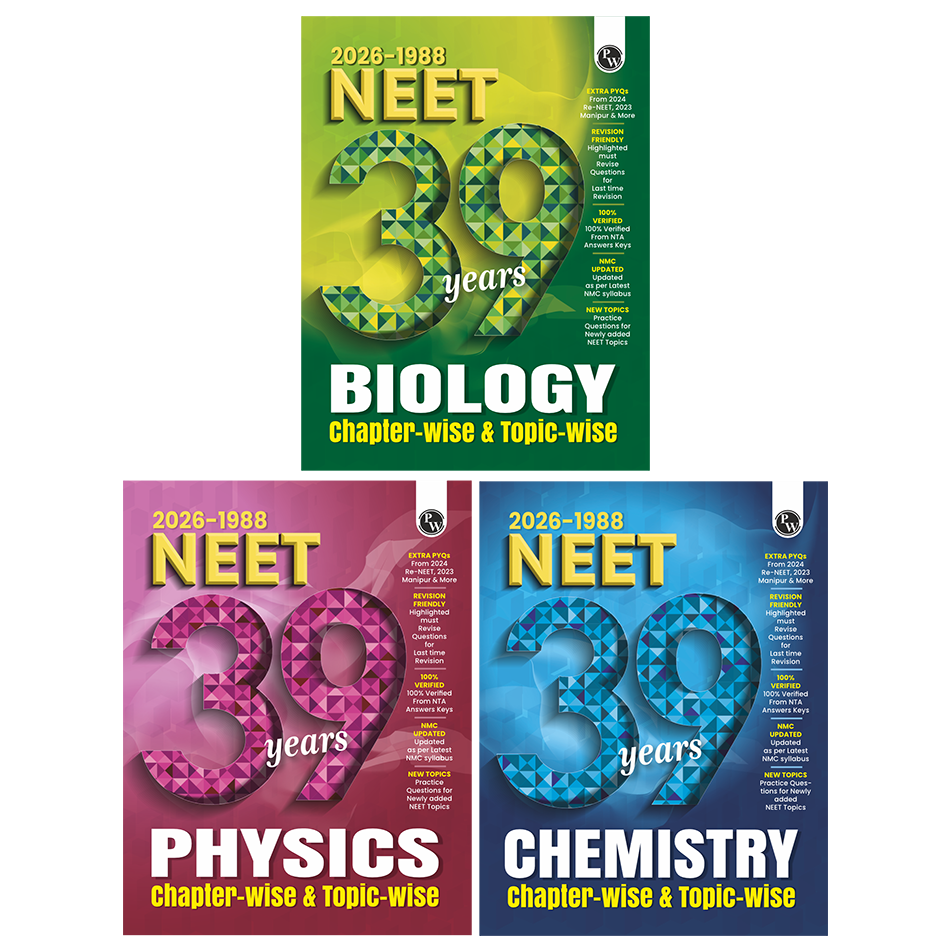
For focused practice, you can also use the 39 Years NEET PYQ Chemistry book, which provides chapter-wise previous year questions and helps you master the types of questions commonly asked in the NEET exam.
4. Focus More on Organic Chemistry
Organic Chemistry has a high chemistry weightage for NEET 2025. It includes chapters like General Organic Chemistry, Hydrocarbons, Alcohols, Aldehydes, Ketones, and Amines. Students often find it tricky, but it can give very good marks with the right preparation.
-
Learn reaction mechanisms step by step.
-
Prepare functional group reactions.
-
Revise named reactions and their applications.
5. Memorise Inorganic Chemistry with Smart Tricks
Inorganic Chemistry is full of facts, trends, and properties. It may feel boring, but it gives direct questions in NEET. Chapters like p-Block, d-Block, and Coordination Compounds have high chemistry chapter wise weightage for NEET.
-
Use NCERT tables and notes.
-
Revise trends in the periodic table regularly.
-
Focus more on high-weightage chapters like Coordination Compounds.
6. Use NCERT Books as the Main Source
NCERT is the most important book for NEET Chemistry. Almost all questions are directly or indirectly asked from it. Understanding NCERT thoroughly, along with the weightage of chemistry chapters in NEET makes preparation stronger.
-
Read every line of the NCERT.
-
Highlight important reactions and formulas.
-
Revise solved examples and in-text questions.
7. Practise Previous Year Papers and Mock Tests
Solving NEET past papers is one of the right ways to prepare. By practising NEET Chemistry chapter wise weightage 2025 papers, students can see which chapters repeat more. Mock tests also improve speed and accuracy.
-
Solve at least 10–15 years of NEET Chemistry PYQs.
-
Analyse mistakes and revise weak areas.
-
Take timed mock tests to build exam confidence.
For better revision of important Chemistry concepts, especially Inorganic Chemistry, students can also refer to the NEET Chemistry Notes Inorganic, which provides concise notes and quick revision material for exam preparation.
8. Make Revision Notes and Flashcards
Revision is very important for Chemistry because of so many reactions, formulas, and facts. Making short notes helps in quick revision. Flashcards are also useful for remembering the NEET Chemistry weightage chapters.
-
Write short notes for every chapter.
-
Keep a separate notebook for formulas and reactions.
-
Revise high-weightage chapters before the exam multiple times.
Read More: NEET Biology Chapter Wise Weightage 2026 Exam
NEET Chemistry Chapter wise Weightage FAQs
Q1. How can I prepare Organic Chemistry for NEET?
Learn reaction mechanisms, revise named reactions, and focus on functional groups. Organic Chemistry has good chemistry NEET chapter wise weightage.
Q2. Which chapters have the highest chemistry weightage for NEET 2025?
Chapters like Organic Chemistry Basics, Coordination Compounds, Chemical Bonding, Hydrocarbons, and Aldehydes & Ketones carry more marks.
Q3. Is NCERT enough for Chemistry preparation in NEET?
Yes, NCERT is the main source. Most questions come directly or indirectly from NCERT, but practice of PYQs is also important.
Q4. How many questions are asked from Chemistry in NEET?
Out of 200 questions, 45 questions are from Chemistry. Their distribution depends on the chemistry chapter wise weightage for NEET.
Q5. Should I prepare Class 11 or Class 12 Chemistry more?
Both are important, but Class 12 chapters usually have higher NEET Chemistry weightage compared to Class 11.