CBSE Class 10 Maths Chapter 10 Circles Notes

Class 10 circle notes provide a complete summary of geometry concepts involving a circle, which is a collection of all points in a plane at a constant distance from a fixed center. These notes cover key terms like tangents, secants, and chords, alongside important theorems that explain the relationship between a circle’s radius and its tangent lines.
Check out: CBSE Class 10th Books
CBSE Class 10 Maths Notes Chapter 10
Introduction to Circles
As is common knowledge, a circle is a closed, two-dimensional geometric object in which every point on its surface is equally spaced from the point known as its "centre." "Radius" is the measurement of the separation between a circle's centre and any point on its surface.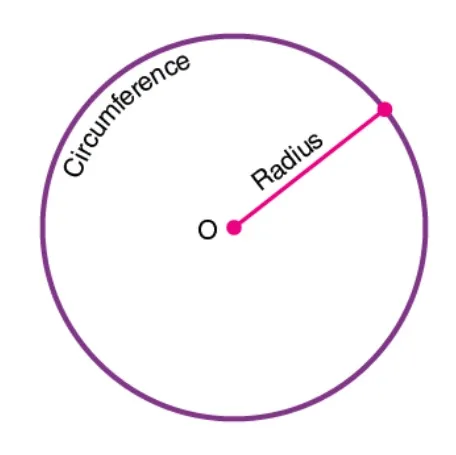
Circle and Line in a Plane
For a circle and a line on a plane, there can be three possibilities. i) they can be non-intersecting ii) they can have a single common point: in this case, the line touches the circle. ii) they can have two common points: in this case, the line cuts the circle.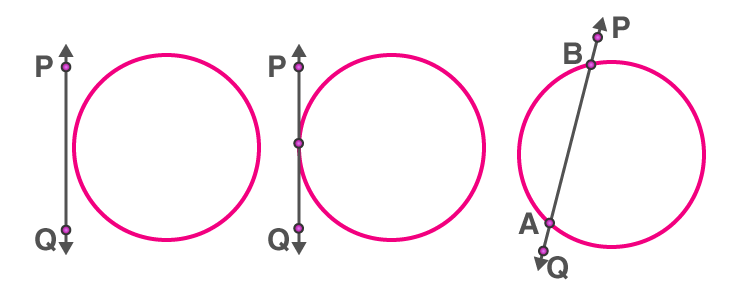
(i) Non-intersecting (ii) Touching (iii) Intersecting
Tangent
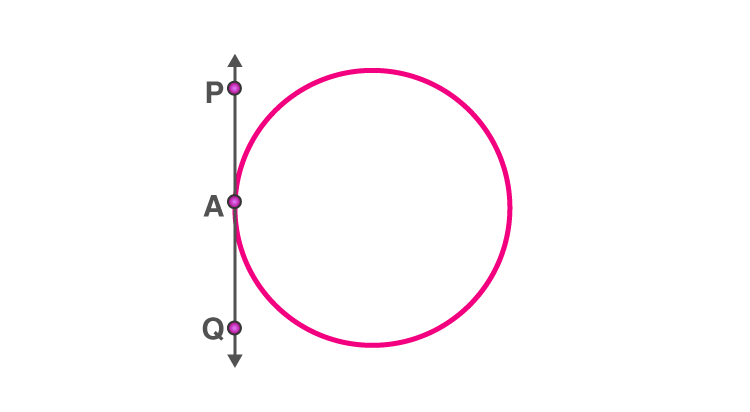
A line that touches a circle exactly once is called a tangent. Each point on the circle has a distinct tangent that goes through it.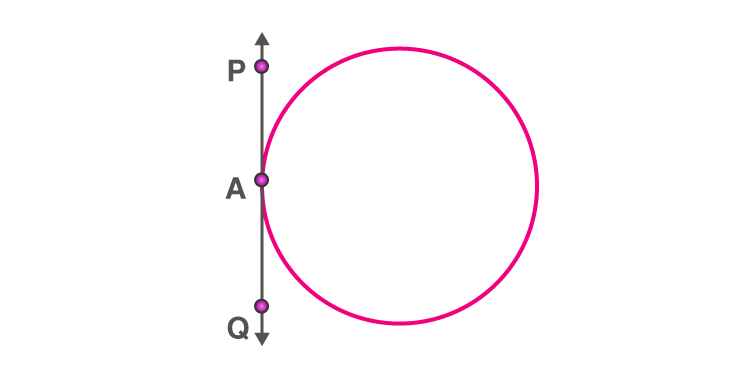
Secant
A line that shares two points with a circle is called a secant to the circle. It creates a chord of the circle by cutting it at two spots.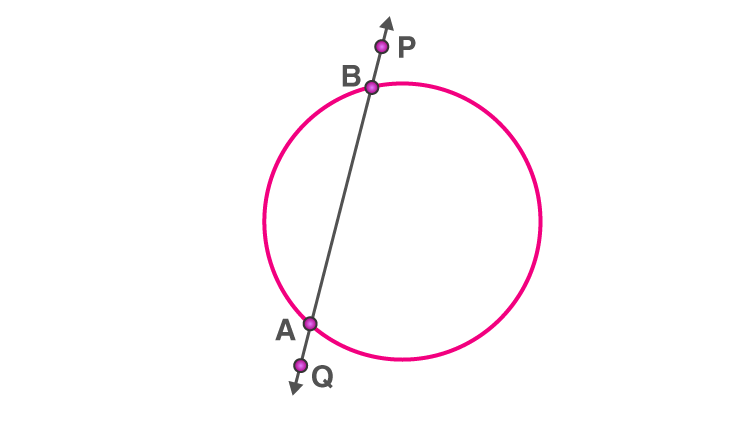
Tangent as a Special Case of Secant
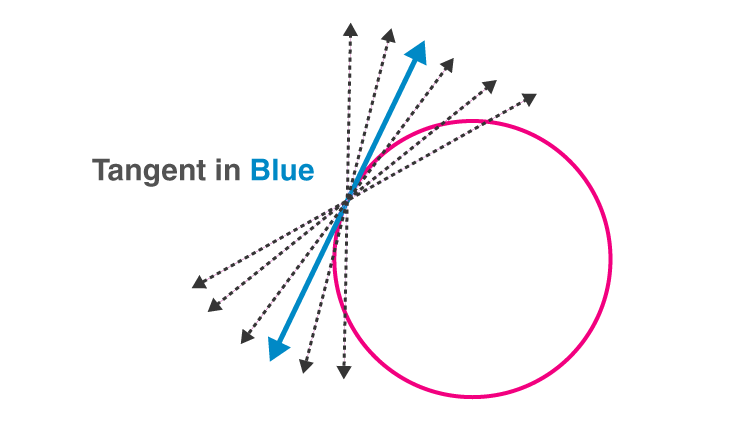
Two Parallel Tangents at most for a Given Secant
There are precisely two tangents that are parallel to a circle and touch it at two diametrically opposed locations for each secant of a circle.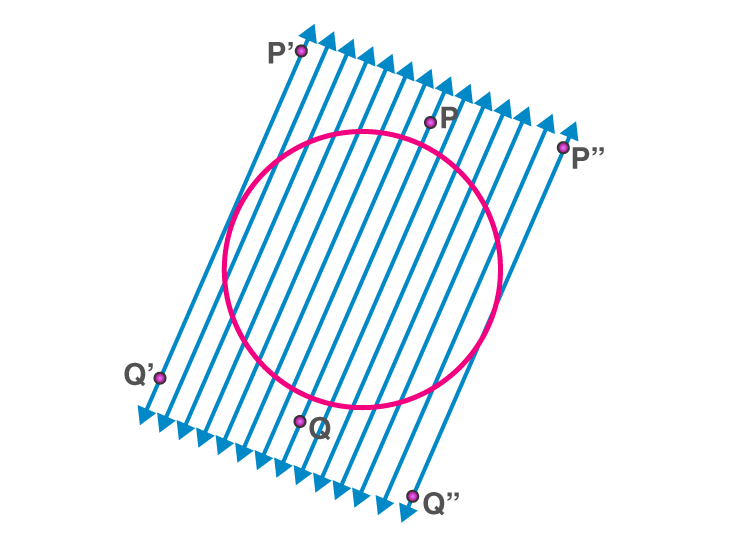 From the given diagram, we can observe the following points:
- PQ is the secant of a circle.
- P’Q’ & P”Q” are two tangents which are parallel to PQ.
Theorems
Tangent Perpendicular to the Radius at the Point of Contact
"The tangent to the circle at any point is the perpendicular to the radius of the circle that passes through the point of contact," according to the theorem.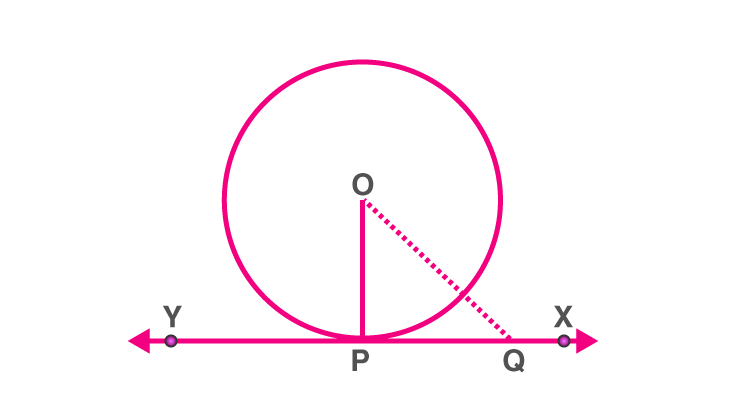
Here, O is the centre and O P ⊥ X Y .
Theorem Proof:
Let us consider a circle with centre "O" and tangent XY at point "P." We must now demonstrate that OP is perpendicular to the XY tangent. Now imagine a point Q different than P on the tangent line XY. As seen in the figure, join the OQ points. Point Q should be outside the circle in this instance. For XY will not be a tangent to the circle if the point Q is inside the circle. It implies that XY will join a circle as a secant. So, OQ should be greater than the radius of the circle OP. It means that OQ > OP Since all points on line XY, except P, comply with this requirement, the shortest distance between the centre of the circle "O" and the points on line XY should be found at OP. As a result, we can say that OP is not parallel to XY. The theorem is so demonstrated.
The Number of Tangents Drawn from a Given Point
i) Any line passing through the point will be a secant if it is located inside the circle. Therefore, if a circle passes through a point that is inside it, no tangent can be traced to it.
ii) When a point of tangency lies on the circle, there is exactly one tangent to a circle that passes through it.
Length of a Tangent
The segment of the tangent from the external point P to the point of tangency I with the circle is the length of the tangent from the point (say P) to the circle. The tangent length in this instance is PI.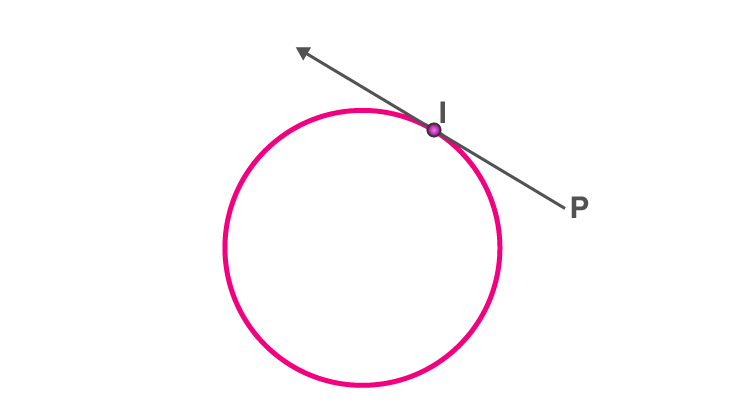
Check out: CBSE Class 10th Sample Papers
What Are Tangents in Class 10 Circle Notes?
When we study circles in Grade 10, we mainly look at how lines interact with the circular boundary. A tangent is a special line that touches the circle at exactly one point. This specific spot is known as the "point of contact." It's different from a secant, which is a line that cuts through the circle at two different points.
You can think of a tangent as a line that just grazes the edge of the circle without entering its interior. In the class 10 circle notes pdf as well you'll find that these definitions form the foundation of Chapter 10. Here is a quick breakdown of how lines and circles relate:
-
Non-intersecting Line: The line stays completely away and has no common points with the circle.
-
Secant: The line passes through the circle, intersecting it at exactly two points.
-
Tangent: The line touches the circle at only one single point.
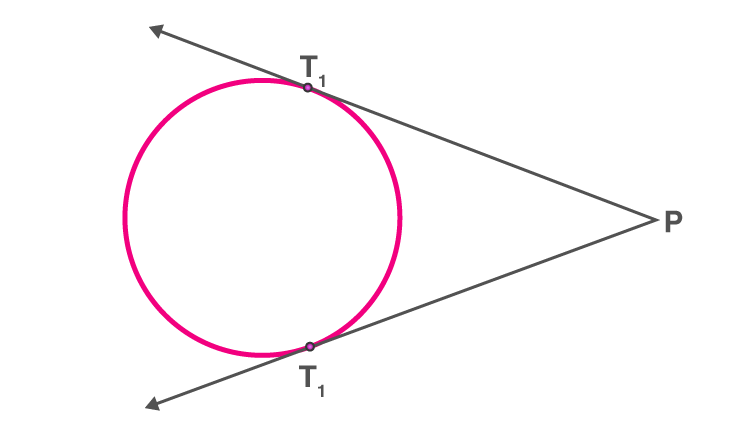
In your grade 10 circle notes, remember that you can't draw a tangent from a point inside the circle. If the point is on the circle, only one tangent exists. However, if the point is outside the circle, you can draw exactly two tangents to it.
Important Theorems for Class 10 Circles
To score well in your exams, you must master the two main theorems provided in the NCERT syllabus. These theorems help us solve most numerical problems involving lengths and angles. Many students prefer a class 10 circles notes pdf download to keep these proofs handy during revision sessions.
|
Theorem Name |
What it States |
Key Takeaway |
|
Theorem 10.1 |
The tangent at any point is perpendicular to the radius through the point of contact. |
The angle between radius and tangent is always 90°. |
|
Theorem 10.2 |
The lengths of tangents drawn from an external point to a circle are equal. |
If PA and PB are tangents from P, then PA = PB. |
When you're writing a proof for Theorem 10.1, we use the fact that the radius is the shortest distance from the center to the tangent line. Since the shortest distance is always perpendicular, the 90-degree relationship is proven. For Theorem 10.2, we usually use the RHS (Right angle-Hypotenuse-Side) congruence rule by joining the external point to the center.
Check Out: CBSE Class 10 Question Banks
Important Sections in Class 10 Circles Notes?
While Chapter 10 focuses on tangents, you also need to know the basic parts of a circle to solve complex geometry questions. Using a class 10 circles notes pdf chapter 1 or introductory guide helps you refresh these terms quickly. Circles aren't just round shapes; they're made of specific segments and areas.
-
Radius: The distance from the center to the boundary.
-
Diameter: The longest chord that passes through the center (d = 2r).
-
Chord: A line segment connecting any two points on the circle.
-
Arc: A portion of the circumference or boundary of the circle.
-
Sector: The region enclosed by two radii and an arc (like a pizza slice).
-
Segment: The region between a chord and its corresponding arc.
We don't just look at these parts individually. In your class 10 circle notes, we see how they work together. For instance, the perpendicular drawn from the center to a chord always bisects that chord into two equal halves. This is a vital part of solving "chord of a larger circle touching a smaller circle" problems.
Tangent Properties in Grade 10 Circle Notes
The behavior of tangents is the most "high-yield" topic for your board exams. In your grade 10 circle notes, you'll notice that the two tangents from an external point create a very symmetrical shape. This symmetry allows us to use triangles to find unknown lengths.
-
Equal Lengths: Tangents from the same external point are always the same length.
-
Angle Bisector: The line joining the external point to the center bisects the angle between the two tangents.
-
Supplementary Angles: The angle between the two tangents and the angle subtended by the radii at the center are supplementary (they add up to 180°).
-
Infinite Tangents: A circle can have an infinite number of tangents because it has infinite points on its circumference.
-
Parallel Tangents: A circle can have at most two parallel tangents at any given time (at the ends of a diameter).
Don't forget that the tangent is a "limiting case" of a secant. This happens when the two endpoints of the corresponding chord coincide at a single point. This theoretical link is often asked in "fill in the blanks" questions in CBSE papers.
Formulas and Calculations for Class 10 Circle Notes
Even though this chapter is mostly about theorems, you'll often need to use the Pythagoras Theorem. Since the radius and tangent meet at 90 degrees, they form a right-angled triangle with the line connecting the center to the external point.
Key Formula for Tangent Length:
If 'd' is the distance of the external point from the center and 'r' is the radius, the length of the tangent (L) is:
L = \sqrt{d^2 - r^2}
In your class 10 circle notes, we also look at "Areas Related to Circles." Here are the essential formulas:
-
Circumference: 2 * Pi * Radius
-
Area of Circle: Pi * Radius * Radius
-
Area of Sector: (Angle / 360) * Pi * Radius * Radius
-
Length of an Arc: (Angle / 360) * 2 * Pi * Radius
-
Area of Segment: Area of Sector - Area of the corresponding Triangle.
We often use 2 * Pi * = 22/7 or 3.14 depending on the question. When a circle is inscribed in a triangle, it touches all three sides. If a quadrilateral circumscribes a circle, the sum of its opposite sides is always equal (AB + CD = AD + BC). This is a common four-mark proof in board exams.
Check Out: CBSE Class 10 Previous Year Papers
Solved Questions for Class 10 Circle Notes
Practicing solved problems is the best way to understand how theorems work in real exams. These examples use the core logic found in your class 10 circle notes to solve common geometry puzzles.
Example 1: Finding the Length of a Tangent
Question: A point P is 13 cm away from the center of a circle. If the radius of the circle is 5 cm, find the length of the tangent drawn from point P to the circle.
Solution:
-
Identify the Shape: The radius, tangent, and the line from the center form a right-angled triangle.
-
Given Values: Distance from center (hypotenuse) = 13 cm; Radius (side) = 5 cm.
-
Apply Pythagoras Theorem: Tangent length squared = (Distance squared) - (Radius squared).
-
Calculation: 13 squared (169) minus 5 squared (25) equals 144.
-
Final Answer: The square root of 144 is 12. So, the tangent length is 12 cm.
Example 2: Tangents from an External Point
Question: Two tangents PA and PB are drawn to a circle with center O from an external point P. If angle APB is 60 degrees, find the measure of angle AOB.
Solution:
-
Understand the Geometry: The figure OAPB is a quadrilateral.
-
Identify Known Angles: The angles at points A and B are 90 degrees each (Theorem 10.1).
-
Angle Sum Property: The sum of all angles in a quadrilateral is 360 degrees.
-
Calculation: 360 - (90 + 90 + 60) = 120 degrees.
-
Final Answer: Angle AOB is 120 degrees. Note that the angle at the center and the angle between tangents are always supplementary (add up to 180).
Benefits of Using Class 10 Circle Notes
-
Class 10 circle notes help you revise Chapter 10 quickly with definitions, theorems, and key properties in one place.
-
They reduce confusion between tangent vs secant and strengthen concept clarity.
-
They make proof-writing easier by keeping steps and logic exam-ready.
-
They highlight the most repeated board patterns like tangent length and angle-based questions.
-
A class 10 circle notes pdf is useful for last-minute revision of Theorem 10.1 and Theorem 10.2 without re-reading NCERT.
Read More: NCERT Solutions Class 10 Maths Chapter 10 Circles
CBSE Class 10 Maths Chapter 10 Circles Notes FAQs
How many tangents can a circle have?
A circle can have an infinite number of tangents because it consists of infinite points on its boundary, and a tangent can be drawn through each point.
Are the two tangents from an external point always equal?
Yes, according to Theorem 10.2, the lengths of the two tangents drawn from any single external point to a circle are always equal in length.
What is the angle between a radius and a tangent?
The angle between a radius and a tangent at the point of contact is always 90 degrees. This creates a right-angled triangle used for many geometry problems.