NCERT Solutions for Class 10 Maths Chapter 15 Probability
The Probability Class 10 NCERT solutions make it easy to see how likely things are to happen in real life. These answers cover theoretical probability and help you figure out how to solve problems with dice, cards, and coins. This blog will act as an ideal guide for us. It will make it easy for us to learn the basic formulas and do well on the board exams.
Check Out: CBSE Class 10 Books
Probability Class 10 NCERT Solutions : Overview
Numbers are not the only thing that probability is about. It is also about thinking logically and applying this to our daily lives. When we figure out the odds, we are really measuring how uncertain something is in a systematic way. In real life, probability is useful for predicting the weather, planning for insurance, making sports predictions, and even testing for diseases.
To understand it better, here is a classic example: meteorologists use probability to figure out how likely it is that it will rain. Insurance companies also use probability models to figure out how much to charge for premiums.
In Class 10, the main focus is on theoretical probability, which says that all outcomes are equally likely. This assumption makes maths easier and helps you learn the basics of maths. Once you know how to correctly count all the possible outcomes, it becomes easy and quick to solve probability problems. It is important to learn this logical way of thinking not only for board exams but also for higher classes where probability gets more complicated and connects with statistics.
Core Concepts of the Probability Class 10 NCERT solutions
-
Theoretical Probability: This is defined as the ratio of the number of favourable outcomes to the total number of possible outcomes.
-
The Formula: P(E) = (Number of outcomes favourable to E) / (Number of all possible outcomes of the experiment).
-
Sure Events: An event that is certain to happen has a probability of 1.
-
Impossible Events: An event that cannot happen has a probability of 0.
Key Rules to Remember for Probability
1. The probability of any event always stays between 0 and 1.
2. The sum of probabilities of all elementary events in an experiment is always 1.
3. Complementary events: P(E) + P(not E) = 1. This is very helpful for quick calculations!
Check Out: CBSE Class 10 Sample Papers
NCERT Solutions for Class 10 Maths Chapter 15 Probability
1. Complete the following statements.
(i) Probability of an event E + Probability of the event ‘not E’ = ___________.
(ii) The probability of an event that cannot happen is __________. Such an event is called ________.
(iii) The probability of an event that is certain to happen is _________. Such an event is called _________.
(iv) The sum of the probabilities of all the elementary events of an experiment is __________.
(v) The probability of an event is greater than or equal to _____ and less than or equal to __________.
Solution:
(i) Probability of an event E + Probability of the event ‘not E’ = 1 . (ii) The probability of an event that cannot happen is 0 . Such an event is called an impossible event . (iii) The probability of an event that is certain to happen is 1 . Such an event is called a sure event . (iv) The sum of the probabilities of all the elementary events of an experiment is 1 . (v) The probability of an event is greater than or equal to 0 and less than or equal to 1 .
2. Which of the following experiments have equally likely outcomes? Explain.
(i) A driver attempts to start a car. The car starts or does not start.
(ii) A player attempts to shoot a basketball. She/he shoots or misses the shot.
(iii) A trial is made to Solution: a true-false question. The Solution is right or wrong.
(iv) A baby is born. It is a boy or a girl.
Solution:
(i) There are no equally likely possibilities to this statement because there are a number of variables, such fuel, that could cause the automobile to start or not. (ii) There are not equal chances for even this statement because the athlete could make the shot or miss it. (iii) This statement has equally likely outcomes, as it is known that the solution is either right or wrong. (iv) This statement also has equally likely outcomes, as it is known that the newly-born baby can either be a boy or a girl.
3. Why is tossing a coin considered to be a fair way of deciding which team should get the ball at the beginning of a football game?
Solution: Flipping a coin has two possible outcomes—head or tail—so it's a fair method of decision-making. Tossing is regarded as totally impartial and unpredictable because there is an equal chance of these two outcomes.
Read More: NCERT Solutions for Class 10 Maths Chapters 1
4. Which of the following cannot be the probability of an event?
(A) 2/3 (B) -1.5 (C) 15% (D) 0.7
Solution: The probability of any event (E) always lies between 0 and 1, i.e., 0 ≤ P(E) ≤ 1. So, from the above options, option (B) -1.5 cannot be the probability of an event.
5. If P(E) = 0.05, what is the probability of ‘not E’?
Solution: We know that, P(E)+P(not E) = 1 It is given that, P(E) = 0.05 So, P(not E) = 1-P(E) Or, P(not E) = 1-0.05 ∴ P(not E) = 0.95
6. A bag contains lemon-flavoured candies only. Malini takes out one candy without looking into the bag. What is the probability that she takes out
(i) an orange-flavoured candy?
(ii) a lemon-flavoured candy?
Solution:
(i) We know that the bag only contains lemon-flavoured candies. So, The no. of orange-flavoured candies = 0 ∴ The probability of taking out orange-flavoured candies = 0/1 = 0 (ii) As there are only lemon-flavoured candies, P(lemon-flavoured candies) = 1 (or 100%)
Read More: NCERT Solutions for Class 10 Maths Chapter 2 Polynomials
7. It is given that in a group of 3 students, the probability of 2 students not having the same birthday is 0.992. What is the probability that the 2 students have the same birthday?
Solution:
Let the event wherein 2 students having the same birthday be E. Given, P(E) = 0.992 We know, P(E)+P(not E) = 1 Or, P(not E) = 1–0.992 = 0.008 ∴ The probability that the 2 students have the same birthday is 0.008.
8. A bag contains 3 red balls and 5 black balls. A ball is drawn at random from the bag. What is the probability that the ball drawn is
(i) red?
(ii) not red?
Solution:
The total number of balls = No. of red balls + No. of black balls So, the total no. of balls = 5+3 = 8 We know that the ratio of the number of favourable outcomes to the total number of outcomes determines the probability of an event. P(E) = (Number of favourable outcomes/ Total number of outcomes) (i) Probability of drawing red balls = P (red balls) = (no. of red balls/total no. of balls) = 3/8 (ii) Probability of drawing black balls = P (black balls) = (no. of black balls/total no. of balls) = 5/8
9. A box contains 5 red marbles, 8 white marbles and 4 green marbles. One marble is taken out of the box at random. What is the probability that the marble is taken out will be
(i) red?
(ii) white?
(iii) not green?
Solution:
The total no. of balls = 5+8+4 = 17 P(E) = (Number of favourable outcomes/ Total number of outcomes) (i) Total number of red balls = 5 P (red ball) = 5/17 = 0.29 (ii) Total number of white balls = 8 P (white ball) = 8/17 = 0.47 (iii) Total number of green balls = 4 P (green ball) = 4/17 = 0.23 ∴ P (not green) = 1-P(green ball) = 1-(4/7) = 0.77
10. A piggy bank contains hundred 50p coins, fifty ₹1 coins, twenty ₹2 coins and ten ₹5 coins. If it is equally likely that one of the coins will fall out when the bank is turned upside down, what is the probability that the coin
(i) will be a 50 p coin?
(ii) will not be a ₹5 coin?
Solution:
Total no. of coins = 100+50+20+10 = 180 P(E) = (Number of favourable outcomes/ Total number of outcomes)
(i) Total number of 50 p coins = 100
P (50 p coin) = 100/180 = 5/9 = 0.55
(ii) Total number of ₹5 coins = 10
P (₹5 coin) = 10/180 = 1/18 = 0.055 ∴ P (not ₹5 coin) = 1-P (₹5 coin) = 1-0.055 = 0.945
Read More: NCERT Solutions for Class 10 Maths Chapter 3
11. Gopi buys a fish from a shop for his aquarium. The shopkeeper takes out one fish at random from a tank containing 5 male fish and 8 female fish (see Fig. 15.4). What is the probability that the fish taken out is a male fish?

Solution:
The total number of fish in the tank = 5+8 = 13 Total number of male fish = 5 P(E) = (Number of favourable outcomes/ Total number of outcomes) P (male fish) = 5/13 = 0.38
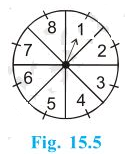
12. A game of chance consists of spinning an arrow which comes to rest, pointing at one of the numbers 1, 2, 3, 4, 5, 6, 7, 8 (see Fig. 15.5), and these are equally likely outcomes. What is the probability that it will point at
(i) 8?
(ii) an odd number?
(iii) a number greater than 2?
(iv) a number less than 9?
Solution:
Total number of possible outcomes = 8 P(E) = (Number of favourable outcomes/ Total number of outcomes) (i) Total number of favourable events (i.e., 8) = 1 ∴ P (pointing at 8) = ⅛ = 0.125 (ii) Total number of odd numbers = 4 (1, 3, 5 and 7) P (pointing at an odd number) = 4/8 = ½ = 0.5 (iii) Total numbers greater than 2 = 6 (3, 4, 5, 6, 7 and 8) P (pointing at a number greater than 4) = 6/8 = ¾ = 0.75 (iv) Total numbers less than 9 = 8 (1, 2, 3, 4, 5, 6, 7, and 8) P (pointing at a number less than 9) = 8/8 = 1
Read More: NCERT Solutions for Class 10 Maths Chapter 4
13. A die is thrown once. Find the probability of getting
(i) a prime number
(ii) a number lying between 2 and 6
(iii) an odd number
Solution:
Total possible events when a dice is thrown = 6 (1, 2, 3, 4, 5, and 6) P(E) = (Number of favourable outcomes/ Total number of outcomes)
(i) Total number of prime numbers = 3 (2, 3 and 5)
P (getting a prime number) = 3/6 = ½ = 0.5
(ii) Total numbers lying between 2 and 6 = 3 (3, 4 and 5)
P (getting a number between 2 and 6) = 3/6 = ½ = 0.5
(iii) Total number of odd numbers = 3 (1, 3 and 5)
P (getting an odd number) = 3/6 = ½ = 0.5
14. One card is drawn from a well-shuffled deck of 52 cards. Find the probability of getting
(i) a king of red colour
(ii) a face card
(iii) a red face card
(iv) the jack of hearts
(v) a spade
(vi) the queen of diamonds
Solution:
Total number of possible outcomes = 52 P(E) = (Number of favourable outcomes/ Total number of outcomes)
(i) Total number of kings of red colour = 2
P (getting a king of red colour) = 2/52 = 1/26 = 0.038
(ii) Total number of face cards = 12
P (getting a face card) = 12/52 = 3/13 = 0.23
(iii) Total number of red face cards = 6
P (getting a king of red colour) = 6/52 = 3/26 = 0.11
(iv) Total number of jack of hearts = 1
P (getting a king of red colour) = 1/52 = 0.019
(v) Total number of kings of spade = 13
P (getting a king of red colour) = 13/52 = ¼ = 0.25
(vi) Total number of queens of diamonds = 1
P (getting a king of red colour) = 1/52 = 0.019
15. Five cards, the ten, jack, queen, king and ace of diamonds, are well-shuffled with their face downwards. One card is then picked up at random.
(i) What is the probability that the card is the queen?
(ii) If the queen is drawn and put aside, what is the probability that the second card picked up is (a) an ace? (b) a queen?
Solution:
Total number of cards = 5 P(E) = (Number of favourable outcomes/ Total number of outcomes)
(i) Numbers of queens = 1
P (picking a queen) = ⅕ = 0.2
(ii) If the queen is drawn and put aside, the total number of cards left is (5-4) = 4
(a) Total number of aces = 1 P (picking an ace) = ¼ = 0.25 (b) Total number of queens = 0 P (picking a queen) = 0/4 = 0
16. 12 defective pens are accidentally mixed with 132 good ones. It is not possible to just look at a pen and tell whether or not it is defective. One pen is taken out at random from this lot. Determine the probability that the pen taken out is a good one.
Solution:
Numbers of pens = Numbers of defective pens + Numbers of good pens ∴ Total number of pens = 132+12 = 144 pens P(E) = (Number of favourable outcomes/ Total number of outcomes) P(picking a good pen) = 132/144 = 11/12 = 0.916
Read More: NCERT Solutions for Class 10 Maths Chapter 10
17. (i) A lot of 20 bulbs contain 4 defective ones. One bulb is drawn at random from the lot. What is the probability that this bulb is defective?
(ii) Suppose the bulb drawn in (i) is not defective and is not replaced. Now one bulb is drawn at random from the rest. What is the probability that this bulb is not defective?
Solution:
(i) Number of defective bulbs = 4
The total number of bulbs = 20 P(E) = (Number of favourable outcomes/ Total number of outcomes) ∴ Probability of getting a defective bulb = P (defective bulb) = 4/20 = ⅕ = 0.2
(ii) Since 1 non-defective bulb is drawn, then the total number of bulbs left is 19
So, the total number of events (or outcomes) = 19 Number of non-defective bulbs = 19-4 = 15 So, the probability that the bulb is not defective = 15/19 = 0.789
18. A box contains 90 discs which are numbered from 1 to 90. If one disc is drawn at random from the box, find the probability that it bears
(i) a two-digit number
(ii) a perfect square number
(iii) a number divisible by 5
Solution:
The total number of discs = 90 P(E) = (Number of favourable outcomes/ Total number of outcomes)
(i) Total number of discs having two digit numbers = 81
(Since 1 to 9 are single-digit numbers, so total 2-digit numbers are 90-9 = 81) P (bearing a two-digit number) = 81/90 = 9/10 = 0.9
(ii) Total number of perfect square numbers = 9 (1, 4, 9, 16, 25, 36, 49, 64 and 81)
P (getting a perfect square number) = 9/90 = 1/10 = 0.1
(iii) Total numbers which are divisible by 5 = 18 (5, 10, 15, 20, 25, 30, 35, 40, 45, 50, 55, 60, 65, 70, 75, 80, 85 and 90)
P (getting a number divisible by 5) = 18/90 = ⅕ = 0.2
19. A child has a die whose six faces show the letters as given below:

The die is thrown once. What is the probability of getting
(i) A?
(ii) D?
Solution:
The total number of possible outcomes (or events) = 6 P(E) = (Number of favourable outcomes/ Total number of outcomes)
(i) The total number of faces having A on it = 2
P (getting A) = 2/6 = ⅓ = 0.33
(ii) The total number of faces having D on it = 1
P (getting D) = ⅙ = 0.166
20. Suppose you drop a die at random on the rectangular region shown in Fig. 15.6. What is the probability that it will land inside the circle with a diameter of 1m?

Solution:
First, calculate the area of the rectangle and the area of the circle. Here, the area of the rectangle is the possible outcome, and the area of the circle will be the favourable outcome. So, the area of the rectangle = (3×2) m 2 = 6 m 2 and, The area of the circle = πr 2 = π(½) 2 m 2 = π/4 m 2 = 0.78 ∴ The probability that die will land inside the circle = [(π/4)/6] = π/24 or, 0.78/6 = 0.13
21. A lot consists of 144 ball pens, of which 20 are defective, and the others are good. Nuri will buy a pen if it is good but will not buy if it is defective. The shopkeeper draws one pen at random and gives it to her. What is the probability that
(i) She will buy it.
(ii) She will not buy it.
Solution:
The total number of outcomes, i.e., pens = 144 Given, the number of defective pens = 20 ∴ The number of non defective pens = 144-20 = 124 P(E) = (Number of favourable outcomes/ Total number of outcomes) (i) Total number of events in which she will buy them = 124 So, P (buying) = 124/144 = 31/36 = 0.86 (ii) Total number of events in which she will not buy them = 20 So, P (not buying) = 20/144 = 5/36 = 0.138
Read More: NCERT Solutions for Class 10 Maths Chapter 14
Probability Class 10 NCERT Solutions
In the updated curriculum, some topics were renumbered. You might see these as probability class 10 NCERT solutions in newer textbooks. This section covers the foundational exercise where you complete statements and solve basic logic problems.
These beginner-friendly problems, most of which are designed to be conceptual and not primarily focused on numbers, will help you to build a better understanding of basic probability before delving into numerical problem-solving. Students are asked to determine if a situation is certain, impossible, or equally likely to expand their conceptual thinking. The objective here is not only to solve problems but also to understand how the concept of probability works in various real-life situations and mathematical experiments.
Highlights of Exercise of Probability
-
Equally Likely Outcomes: Not every event is equally likely. For example, a car starting depends on many factors, so it isn't a simple 50-50 chance.
-
Fair Deciders: Tossing a coin is considered fair because getting a head or a tail is equally likely.
-
Range of Values: You'll learn that a probability can't be negative or greater than 1. This means a value like -1.5 is impossible.
Simple Calculation Table for Probability
|
Event Type |
Probability Value |
Name of Event |
|
Certain to happen |
1 |
Sure/Certain Event |
|
Cannot happen |
0 |
Impossible Event |
|
Any General Event |
0 ≤ P(E) ≤ 1 |
Elementary/Compound |
How to Use NCERT Solutions for Class 10 Maths Chapter 15 Probability PDF
Having a probability class 10 ncert solutions pdf is great for studying on the go. It allows you to check steps for complex problems like drawing cards from a deck or picking marbles from a bag. Many students use these to verify their homework and find where they made a mistake.
Benefits of the PDF Format of Probability
Step-by-Step Logic: Each solution is broken down so you don't get lost in the maths.
Visual Aids: PDFs often include diagrams of card decks or spinning wheels.
Quick Revision: You can quickly scroll to the specific question you're stuck on.
|
Object |
Total Outcomes |
Details |
|
Single Die |
6 |
1,2,3,4,5,6 |
|
Pair of Dice |
36 |
(1,1) through (6,6) |
|
Deck of Cards |
52 |
4 suits, 13 cards each |
Check Out: CBSE Class 10 Previous Year Papers
NCERT Solutions for Class 10 Maths Chapter 15 Probability- Step by Step Answers
The probability class 10 ncert solutions exercise 15.1 contains many practical questions. You'll deal with bags of candies, defective pens, and games of chance. These questions teach you how to apply the P(E) formula in different scenarios.
Common Problems for Probability
-
The Candy Problem: If a bag has only lemon candies, the chance of picking an orange one is 0. This is an impossible event.
-
The Birthday Problem: If the chance of two students not sharing a birthday is 0.992, then the chance they do share it is 1 - 0.992 = 0.008.
-
Defective Items: When items are mixed, we find the total first. If there are 12 bad pens and 132 good ones, the total is 144. The chance of a good pen is 132/144.
Study Tips for Success in Class 10 Maths
-
Always write the formula before starting the calculation.
-
Simplify your fractions to the lowest terms.
-
Don't forget that "not E" is just 1 minus the probability of E.
Updated NCERT Solutions for Class 10 Maths Chapter 15 Probability 2026
The probability class 10 ncert solutions 2025 reflect the latest changes in the CBSE syllabus. Some optional exercises might be dropped, and the chapter numbering could shift from 15 to 14. It's vital to stay updated with these changes so you study the right material.
What is New in 2026 in Class 10 Maths?
-
Renumbered Chapters: Probability is now often listed as Chapter 14.
-
Focus on Core Logic: The exams focus more on understanding concepts than just memorizing steps.
-
Practice Material: Modern solutions include more "case-study" style questions which are common in board exams now.
Check Out: CBSE Class 10 Question Banks
NCERT Solutions for Class 10 Maths Chapter 15 FAQs
1. What is the range of a probability value?
The probability of any event always lies between 0 and 1. It can be a fraction, a decimal like 0.7, or a percentage like 15%, but it can't be negative or over 1.
2. What is an elementary event?
An elementary event is an event that has only one outcome of the experiment. The sum of all such events in an experiment is always 1.
3. How do I calculate the probability of "not" an event?
You use the complementary rule: P(not E) = 1 - P(E). For example, if the chance of rain is 0.3, the chance of no rain is 0.7.
4. Why is tossing a coin fair?
Tossing a coin is fair because there are only two possible outcomes, heads and tails, and both are equally likely. This makes the result unpredictable and unbiased.
5. How many face cards are in a standard deck?
There are 12 face cards in a deck of 52 cards. These include the King, Queen, and Jack of each of the four suits.