NCERT Solutions for Class 10 Maths Chapter 8 Introduction to Trigonometry
With our complete NCERT Class 10 Maths Chapter 8 solutions, you can learn the basics of ratios and identities. This tutorial gives you step-by-step answers for Exercises 8.1 to 8.4. It will help you make hard trigonometric problems easier and get better grades on your board exams.
Trigonometry is often the first "real" challenge for students because it introduces a completely new way of looking at triangles. If you find yourself staring at sine and cosine formulas without knowing where to start, these NCERT solutions for class 10 maths chapter 8 trigonometry are built to clear that confusion. We break down each problem into easy-to-follow steps so you may get ready for your board exams with confidence.
Check Out: CBSE Class 10 Books
Introduction to Trigonometry: Chapter Overview
Trigonometry is a part of math that looks at how the angles and side lengths of triangles are related to each other. The phrase comes from the Greek terms "trigonon," which means "triangle," and "metron," which means "measure." It may look like a bunch of abstract calculations, but it's actually an extremely useful tool for finding heights and distances that are otherwise hard to measure directly in astronomy, navigation, and even construction.
This chapter is all about the right-angled triangle. You will learn how to tell the difference between the "Side Opposite" (Perpendicular) and the "Side Adjacent" (Base) when looking at an acute angle. The NCERT Class 10 Maths Chapter 8 solutions help you move from simple ratios like sine and cosine to more complicated proofs that use trigonometric identities.
|
Ratio Name |
Abbreviation |
Relation to Sides |
Reciprocal |
|
Sine |
sin |
Perpendicular / Hypotenuse |
1 / cosec |
|
Cosine |
cos |
Base / Hypotenuse |
1 / sec |
|
Tangent |
tan |
Perpendicular / Base |
1 / cot |
|
Cosecant |
cosec |
Hypotenuse / Perpendicular |
1 / sin |
|
Secant |
sec |
Hypotenuse / Base |
1 / cos |
|
Cotangent |
cot |
Base / Perpendicular |
1 / tan |
Check out: CBSE Class 10th Sample Papers
Ncert Solutions Class 10 Maths Chapter 8
Here are some important questions from the NCERT textbook that come up a lot in tests. To help you write perfect answers, these NCERT class 10 maths chapter 8 solutions follow the official marking scheme.
Class 10 Maths Chapter 8 Introduction to Trigonometry Exercise 8.1 Solutions
(i) sin A, cos A
(ii) sin C, cos C
Answer:
Let us draw a right-angled triangle ABC, right-angled at B. Using Pythagoras' theorem


(ii)

 ,
,
Answer:


Answer:
Given: A triangle ABC in which
Answer:

Let ΔABC be a right-angled triangle, right-angled at B.
(Given). Let AB be 8k, and BC will be 15k, where k is a positive real number.
5. Given sec θ = 13/12, calculate all other trigonometric ratios.
Answer:
Consider a triangle ABC in which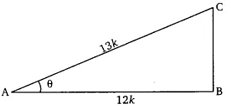
We know that the sec function is the reciprocal of the cos function, which is equal to the ratio of the length of the hypotenuse side to the adjacent side
Let us assume a right-angled triangle ABC, right-angled at B
sec θ =13/12 = Hypotenuse/Adjacent side = AC/AB
Let AC be 13k and AB will be 12k
Where k is a positive real number.
According to the Pythagoras theorem, the square of the hypotenuse side is equal to the sum of the squares of the other two sides of a right-angle triangle, and we get,
AC2=AB2 + BC2
Substitute the value of AB and AC
(13k)2= (12k)2 + BC2
169k2= 144k2 + BC2
169k2= 144k2 + BC2
BC2 = 169k2 – 144k2
BC2= 25k2
Therefore, BC = 5k
Now, substitute the corresponding values in all other trigonometric ratios
So,
Sin θ = Opposite Side/Hypotenuse = BC/AC = 5/13
Cos θ = Adjacent Side/Hypotenuse = AB/AC = 12/13
tan θ = Opposite Side/Adjacent Side = BC/AB = 5/12
Cosec θ = Hypotenuse/Opposite Side = AC/BC = 13/5
cot θ = Adjacent Side/Opposite Side = AB/BC = 12/5
6. If ∠A and ∠B are acute angles such that cos A = cos B, then show that ∠A = ∠B.

Answer:

Answer:

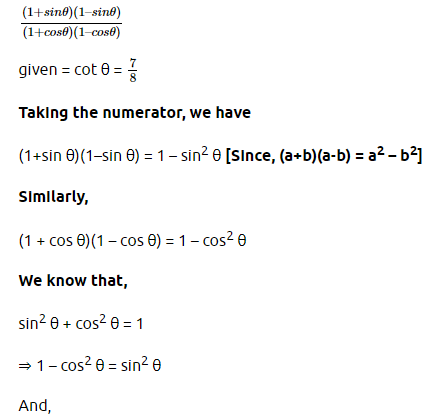 (ii)
(ii)

Read More: NCERT Solutions for Class 10 Maths Chapter 2 Polynomials
Answer:
Consider a triangle ABC AB=4cm, BC= 3cm
 .
. And
And


9. In triangle ABC, right-angled at B, if tan A =1/√3 find the value of:
(i) sin A cos C + cos A sin C
(ii) cos A cos C – sin A sin C
Answer:
Consider a triangle ABC in which .
.(i)

(ii)

10. In Δ PQR, right-angled at Q, PR + QR = 25 cm and PQ = 5 cm. Determine the values of sin P, cos P and tan P.
Answer:
Given that, PR + QR = 25 , PQ = 5. Let PR be x. ∴ QR = 25 - x By Pythagoras theorem , PR2 = PQ 2 + QR 2 x 2 = (5)2 + (25 - x) 2 x 2 = 25 + 625 + x 2 - 50x 50x = 650 x = 13 ∴ PR = 13 cm QR = (25 - 13) cm = 12 cm sin P = QR/PR = 12/13 cos P = PQ/PR = 5/13 tan P = QR/PQ = 12/511. State whether the following are true or false. Justify your answer.
(i) The value of tan A is always less than 1.
(ii) sec A = 12/5 for some value of angle A. "
(iii) cos A is the abbreviation used for the cosecant of angle A.
(iv) cot A is the product of cot and A. (v) sin θ = 4/3 for some angle θ.
Answer:
i) False. In ΔABC in which ∠B = 90º, AB = 3, BC = 4 and AC = 5 Value of tan A = 4/3 which is greater than. The triangle can be formed with sides equal to 3, 4 and hypotenuse = 5 as it will follow the Pythagoras theorem. AC 2 = AB 2 + BC 2 5 2 = 3 2 + 4 2 25 = 9 + 16 25 = 25(ii) True. Let a ΔABC in which ∠B = 90º,AC be 12k and AB be 5k, where k is a positive real number. By Pythagoras' theorem, we get, AC 2 = AB 2 + BC 2 (12k) 2 = (5k) 2 + BC 2 BC 2 + 25k 2 = 144k 2 BC 2 = 119k 2 Such a triangle is possible as it will follow the Pythagoras theorem.
(iii) False. Abbreviation used for cosecant of angle A is cosec A.cos A is the abbreviation used for cosine of angle A.
(iv) False. cot A is not the product of cot and A. It is the cotangent of ∠A. (v) False. sin θ = Height/Hypotenuse. We know that in a right-angled triangle, the Hypotenuse is the longest side. ∴ sin θ will always less than 1 and it can never be 4/3 for any value of θ.
Class 10 Maths Introduction to Trigonometry Exercise 8.2
Solve the following Questions.
1. Evaluate the following:
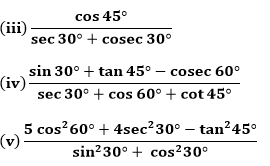
(i) sin 60° cos 30° + sin 30° cos 60°
(ii) 2 tan2 45° + cos2 30° – sin2 60
Solution:
(i) sin 60° cos 30° + sin 30° cos 60°
First, find the values of the given trigonometric ratios
sin 30° = 1/2
cos 30° = √3/2
sin 60° = 3/2
cos 60°= 1/2
Now, substitute the values in the given problem
sin 60° cos 30° + sin 30° cos 60° = √3/2 ×√3/2 + (1/2) ×(1/2 ) = 3/4+1/4 = 4/4 =1
(ii) 2 tan2 45° + cos2 30° – sin2 60
We know that the values of the trigonometric ratios are:
sin 60° = √3/2
cos 30° = √3/2
tan 45° = 1
Substitute the values in the given problem
2 tan2 45° + cos2 30° – sin2 60 = 2(1)2 + (√3/2)2-(√3/2)2
2 tan2 45° + cos2 30° – sin2 60 = 2 + 0
2 tan2 45° + cos2 30° – sin2 60 = 2
(iii) cos 45°/(sec 30°+cosec 30°)
We know that,
cos 45° = 1/√2
sec 30° = 2/√3
cosec 30° = 2
Substituting the values, we get
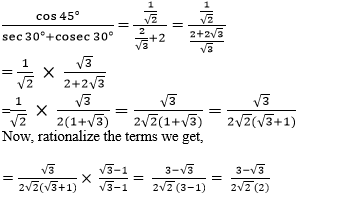
Now, multiply both the numerator and denominator by √2 , we get

Therefore, cos 45°/(sec 30°+cosec 30°) = (3√2 – √6)/8
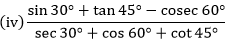
We know that,
sin 30° = 1/2
tan 45° = 1
cosec 60° = 2/√3
sec 30° = 2/√3
cos 60° = 1/2
cot 45° = 1
Substituting the values in the given problem, we get
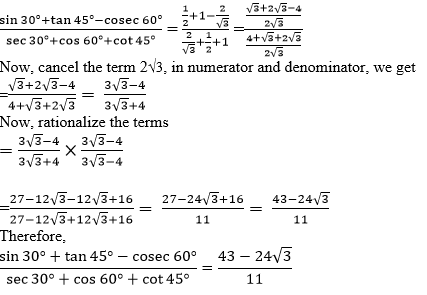
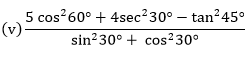
We know that,
cos 60° = 1/2
sec 30° = 2/√3
tan 45° = 1
sin 30° = 1/2
cos 30° = √3/2
Now, substitute the values in the given problem, we get
(5cos260° + 4sec230° – tan245°)/(sin2 30° + cos2 30°)
= 5(1/2)2+4(2/√3)2-12/(1/2)2+(√3/2)2
= (5/4+16/3-1)/(1/4+3/4)
= (15+64-12)/12/(4/4)
= 67/12
2. Choose the correct option and justify your choice :
(i) 2tan 30°/1+tan 2 30° = (A) sin 60° (B) cos 60° (C) tan 60° (D) sin 30°
(iii) sin 2 A = 2 sin A is true when A = (A) 0° (B) 30° (C) 45° (D) 60°
(iv) 2tan30°/1-tan 2 30° = (A) cos 60° (B) sin 60° (C) tan 60° (D) sin 30°
Answer:
(i) 2tan 30°/1+tan 2 30° = (A) sin 60° (B) cos 60° (C) tan 60° (D) sin 30° =

(iii) sin 2 A = 2 sin A is true when A = (A) 0° (B) 30° (C) 45° (D) 60°


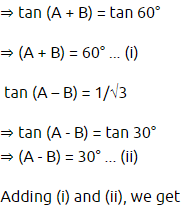
3. If tan (A + B) = √3 and tan (A – B) = 1/√3; 0° < A + B ≤ 90°; A > B, find A and B.
Answer:


(i) sin (A + B) = sin A + sin B.
(ii) The value of sin θ increases as θ increases.
(iii) The value of cos θ increases as θ increases.
(iv) sin θ = cos θ for all values of θ.
(v) cot A is not defined for A = 0°.
Answer:
(i) False. Let A = 30° and B = 60°, then sin (A + B) = sin (30° + 60°) = sin 90° = 1 and, sin A + sin B = sin 30° + sin 60° = 1/2 + √3/2 = 1+√3/2(ii) True. sin 0° = 0 sin 30° = 1/2 sin 45° = 1/√2 sin 60° = √3/2 sin 90° = 1 Thus the value of sin θ increases as θ increases.
(iii) False. cos 0° = 1 cos 30° = √3/2 cos 45° = 1/√2 cos 60° = 1/2 cos 90° = 0 Thus the value of cos θ decreases as θ increases.
(iv) True. cot A = cos A/sin A cot 0° = cos 0°/sin 0° = 1/0 = undefined.
Class 10 Maths Introduction to Trigonometry Exercise 8.3 Solutions
Solve the following Questions.
(i) sin 60° cos 30° + sin 30° cos 60°
Answer:
(i) sin 60° cos 30° + sin 30° cos 60

(ii) 2 tan 2 45° + cos 2 30° – sin 2 60°

(iii) cos 45°/(sec 30° + cosec 30°)


(v) (5cos 2 60° + 4sec 2 30° - tan 2 45°)/(sin 2 30° + cos 2 30°

2. Choose the correct option and justify your choice :
(i) 2tan 30°/1+tan 2 30° = (A) sin 60° (B) cos 60° (C) tan 60° (D) sin 30°
Answer:
(i) 2tan 30°/1+tan 2 30° = (A) sin 60° (B) cos 60° (C) tan 60° (D) sin 30°(ii) 1-tan 2 45°/1+tan 2 45° = (A) tan 90° (B) 1 (C) sin 45° (D) 0
(iii) sin 2 A = 2 sin A is true when A = (A) 0° (B) 30° (C) 45° (D) 60°
Answer:
4. State whether the following are true or false. Justify your answer.
Answer:
(i) False. Let A = 30° and B = 60°, then sin (A + B) = sin (30° + 60°) = sin 90° = 1 and, sin A + sin B = sin 30° + sin 60° = 1/2 + √3/2 = 1+√3/2Why Use NCERT Class 10 Maths Chapter 8 Solutions?
Many students have problems in trigonometry because they try to prove things without first learning the basic ratios. These NCERT Class 10 Maths Chapter 8 solutions help you learn one step at a time. Using the class 10 maths chapter 8 solutions makes sure that you aren't only duplicating answers but that you also grasp how the stages relate to each other logically. We explain why we chose certain formulas, which is the main reason students have trouble with this chapter.
Check out: CBSE Class 10th Previous Year Papers
NCERT Class 10 Maths Chapter 8 Solutions FAQs
What is the most important identity in the NCERT Class 10 Maths Chapter 8 solutions?
The identity sin^2 \theta + cos^2 \theta = 1 is the basis for most of the proofs in Exercise 8.4 and is often checked on tests.
Can I use any angle in the complementary angle formulas?
Not at all. These formulas ($sin(90-A) = cos A$) only work when the two angles are complementary, which means they sum up to exactly $90^\circ$.
How do I avoid mistakes in class 10 maths trigonometry solutions?
Always label your triangle's base and perpendicular relative to the angle you are calculating. Swapping these is the most common reason for incorrect answers.
Why is tangent sometimes called 'Not Defined' in the table?
The value of tan 90 degrees is sin 90 degrees divided by cos 90 degrees, which is 1 divided by 0. The value is not defined because it is impossible to divide by zero.
Are these NCERT Class 10 maths solutions chapter 8 helpful for Class 11?
Yes. Trigonometry is the most important part of higher math and calculus. If you learn these class 10th Maths Chapter 8 NCERT solutions now, you'll save hundreds of hours next year.