Polity Test Series Strategy for UPSC Prelims

The Indian Polity section is often considered the "backbone" of the UPSC Civil Services Preliminary Examination. Because the syllabus is relatively defined compared to subjects like History or Environment, many aspirants expect to score 100% accuracy here. However, modern questions often shift from simple factual recall to deep conceptual application, leading to unexpected errors.
A well-structured UPSC test series is not just a tool for self-evaluation; it is a critical part of your learning process. Without a clear strategy for your UPSC prelims test series, you risk memorising facts without understanding how the Union Executive, Judiciary, or Constitutional Bodies actually function in real-world scenarios.
Why Polity Matters in UPSC Test Series?
Recently, about 15–20% of questions in the GS Paper come from this area. If you master your UPSC mock test performance in polity, you essentially secure a massive chunk of the cut-off marks.
-
Conceptual vs. Factual: UPSC has moved beyond asking just for article numbers. They now test the "logic" of the Constitution, such as the difference between constitutionalism and a written constitution.
-
Dynamic Content: Issues like federalism, the role of the governor, and recent Supreme Court judgements are frequently integrated into the UPSC test series 2026 to match the latest trends.
-
Negative Marking: Because many Polity options look "almost correct", students often lose marks here. Constant practice helps you identify these traps.
Check Out: UPSC CSE Books
UPSC Test Series Polity Strategy for 2026
To excel in the 2026 attempt, you need a strategy that moves from the basics to advanced full-length papers.
1. The Foundation: Sectional Tests
Do not jump into full-length papers immediately. Start with sectional tests in your test series for UPSC.
-
Subject Focus: Divide Polity into blocks (e.g., Block 1: Preamble & FRs; Block 2: Parliament; Block 3: Judiciary).
-
Target: Solving a UPSC Prelims mock test specifically on "Parliament" helps you catch minute details about bills, motions, and committees that you might miss in a general reading.
2. Integration of Previous Year Questions (PYQs)
A good test series will always include or refer to PYQs.
-
Analyse the Language: Notice how UPSC phrases questions. Keywords like "only", "shall", and "exclusive jurisdiction" are often the difference between a right and wrong answer.
-
Identify Themes: Topics like Fundamental Rights, DPSP, and the President are recurring themes you must master before the final exam.
3. Simulating the Exam Environment
Preparation is as much about nerves as it is about knowledge.
-
Time Management: Set a timer for 120 minutes. Polity questions usually take less time than Economy or CSAT, so use this subject to "save" time for tougher sections.
-
OMR Practice: Always use a physical OMR sheet. Small bubbling errors can cost you an entire year.
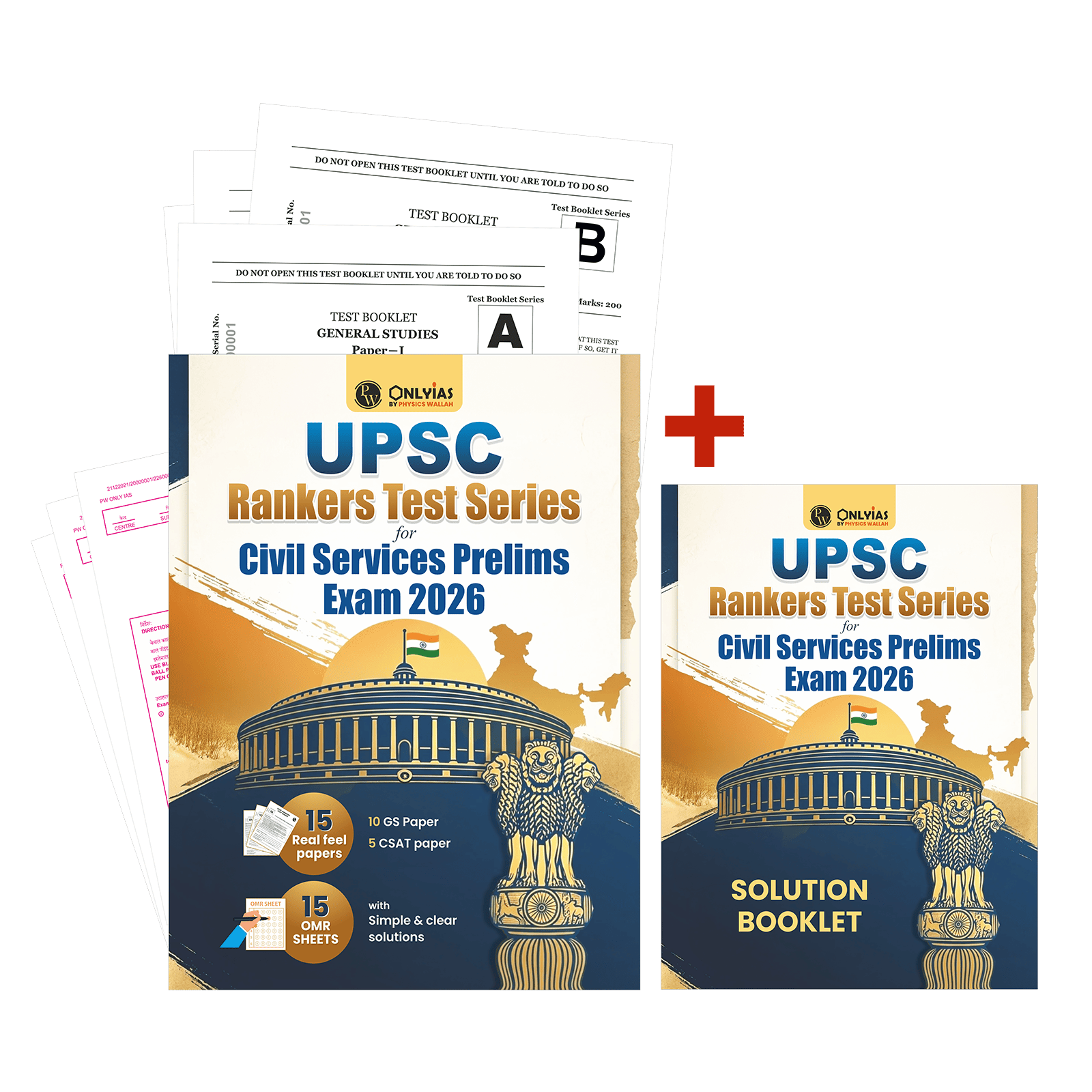
Check Out: 15 UPSC Rankers Test Series 2026 Civil Services Prelims Exam
Mistakes to Avoid In Polity UPSC Test Series
Even the most well-prepared aspirants can falter in Polity due to small, avoidable errors. Recognising these patterns in your test series is the only way to ensure they don't occur during the actual exam.
1. Ignoring the "Subtle" Keywords
Polity questions are renowned for their wordplay. Students often rush through a upsc mock test and miss words like exclusive, original, absolute, or prior recommendation.
-
The Mistake: Treating "The President can..." and "The President must..." as the same thing.
-
The Fix: Underline the operative verbs and adjectives in every question of your upsc prelims mock test.
2. Over-Reliance on a Single Source
While standard textbooks are excellent, many aspirants stop there.
-
The Mistake: Failing to track recent Supreme Court judgements or constitutional amendments mentioned in current affairs.
-
The Fix: Ensure your UPSC test series 2026 includes updated questions on dynamic topics like the Delimitation Commission, the National Judicial Appointments Commission (NJAC) debates, or changes in Union Territory administration.
3. Mixing Up Procedures for Different Bodies
A common trap in a Test Series for UPSC is to confuse the removal process of a Supreme Court judge with that of the Chief Election Commissioner or the Comptroller and Auditor General (CAG).
-
The Mistake: Assuming "similar process" means "identical process".
-
The Fix: Create a comparative table for all constitutional and statutory bodies, focusing on their appointment, tenure, and removal.
4. Falling for "Absolute" Statements
UPSC often uses extreme words to create "trap" options.
-
The Mistake: Believing statements like "The Governor has no discretionary powers" or "Parliament has unlimited power to amend the Constitution."
-
The Fix: In your UPSC prelims test series, be extra cautious of options containing "all", "never", "only", or "none". These are statistically more likely to be incorrect.
5. Neglecting the Preamble and Basic Structure
Aspirants often spend months on the "Parliament" chapter but skip the "Preamble" or "Philosophy of the Constitution".
-
The Mistake: Treating the conceptual parts of the Constitution as "too easy" to revise.
-
The Fix: Treat the conceptual questions in your PW UPSC test series with the same respect as the technical ones. Understanding the intent of the makers is often more important than knowing the Article number.
Check Out: UPSC Previous Year Papers
Analyse Polity UPSC Test Series Performance
Most students make the mistake of checking only the final score. The real value of the UPSC Prelims test series lies in the "Post-Test Review."
|
Error Type |
What it Means |
Strategic Solution |
|
Conceptual Gap |
You didn't understand the "Why" (e.g., Why the President is part of Parliament). |
Re-read the specific chapter in NCERT-based books |
|
Factual Slip |
You forgot an Article number or a specific year. |
Update your short notes and revise them every Sunday. |
|
Reading Error |
You missed the word "not" or "incorrect" in the question. |
Practise "active reading" by underlining keywords during the test. |
|
Elimination Failure |
You were stuck between two options and chose the wrong one. |
Review the video solutions for the test series to learn the logic of elimination. |
Read More: How to Study Current Affairs for UPSC Exam
Polity Test Series FAQs
1. When should I start my first test series for Polity?
You should start as soon as you finish the first reading of a major block (like the Preamble and Fundamental Rights). Do not wait to finish the entire subject; start with sectional mocks immediately.
2. How many polity-specific mocks are enough for UPSC 2026?
Ideally, you should solve at least 5–8 sectional Polity tests followed by 10–15 full-length upsc prelims mock test papers that include a mix of all subjects.
3. Are books enough to solve all questions in a UPSC mock test?
While books are a good place to begin, modern tests also require knowledge of current affairs and landmark Supreme Court judgements. A high-quality UPSC test series will cover these dynamic updates for you.
4. How do I improve my score if I am stuck at 80–90 marks?
Focus on your "silly mistakes" and "logical guessing". Often, the jump from 90 to 110 marks comes from refining your elimination techniques rather than reading new books.
5. Should I revise the entire book or just the test solutions?
After an UPSC prelims test series, first read the solutions. If you encounter a topic you completely misunderstood, go back and revise that specific chapter in your core textbook.