13 CA Inter MCQ Books: How Should You Actually Use Them?
Many candidates collect extensive study materials but struggle to convert that content into top-tier exam performance. The objective sections, which carry 30% of the overall weightage across papers, demand rapid recall, sharp conceptual clarity, and rigorous practice.
Having a full suite of 13 specialized resources helps structure your study plan, but simply skimming through pages will not deliver success. You must know how to integrate objective evaluation alongside main theoretical preparation.
In this article, we will show you how to structure your routine and use CA Inter MCQ books to maximize your score.
What Are CA Inter MCQ Books?
CA Inter MCQ books are specialized learning modules designed to cover the objective portion of the Intermediate syllabus. They feature case scenarios, direct multiple-choice questions, and standalone practice sets that align directly with official exam specifications.
These publications serve distinct functional purposes during preparation:
-
Concept Application Tools: They allow you to test your understanding of complex laws, tax provisions, and accounting standards through targeted practice.
-
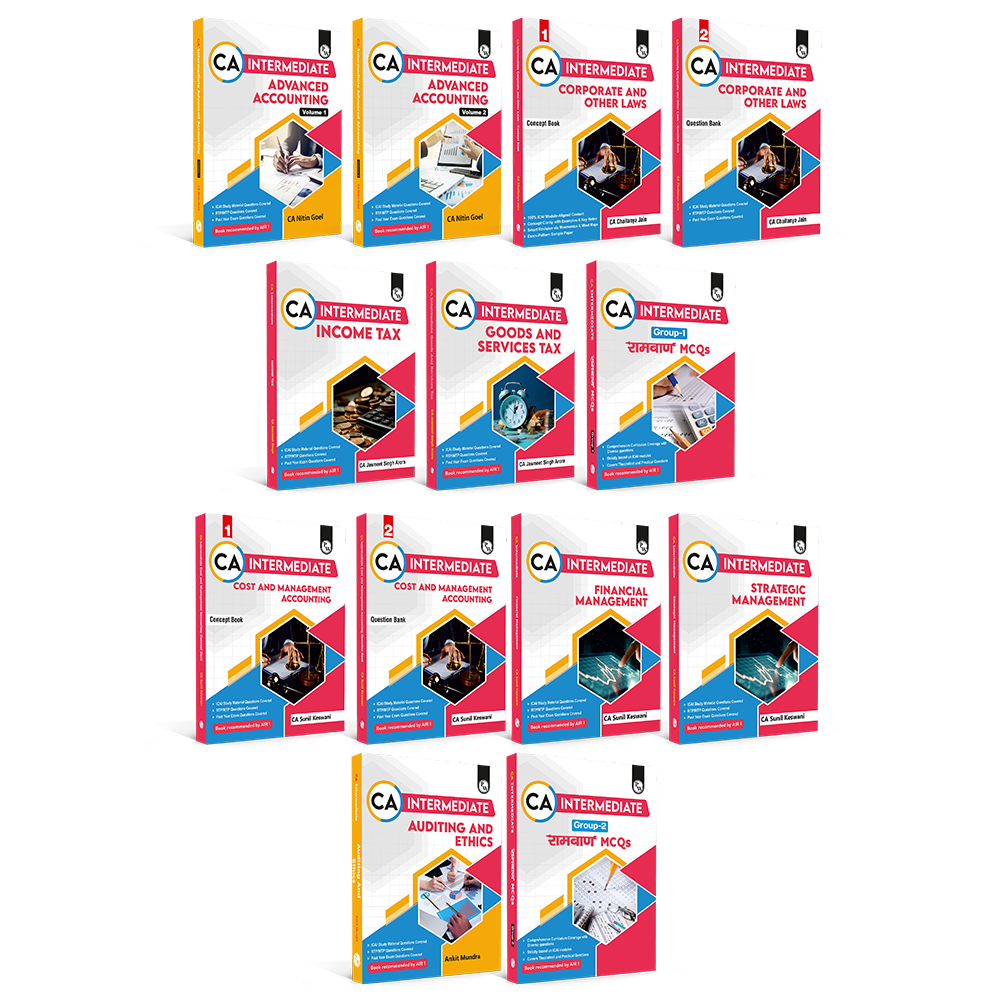
Dedicated Objective Sets: Resources like the Rambaan Group 1 and Group 2 books focus specifically on multiple-choice items across all subjects.
-
Integrated Comprehensive Kits: The complete 13-book collection combines detailed concept books, extensive question banks, and dedicated objective volumes.
Unlike traditional textbooks that only cover theoretical definitions, a CA Intermediate MCQ book forces active recall. This ensures you identify conceptual gaps immediately while working through subject modules.
Why Use CA Inter MCQ Books?
Using targeted CA Inter MCQ books shifts your preparation strategy from passive reading to active problem-solving. Objective assessment requires precision; a small misInterpretation of a tax rule or auditing standard can lead to an incorrect choice.
Key advantages include:
-
Building Speed and Accuracy: Solving CA Inter MCQs under timed conditions improves your decision-making speed during actual test sessions.
-
Comprehensive Syllabus Alignment: Quality CA Inter practice books are structured according to the latest ICAI curriculum, ensuring complete alignment with prescribed topics.
-
Real Exam Pattern Exposure: Including updated Revision Test Papers (RTP) and Mock Test Papers (MTP) helps you become familiar with current question formats and difficulty levels.
-
Strengthening Conceptual Foundation: Detailed solutions help clarify complex application-based problems, giving you full confidence before exam day.
How to Use CA Inter MCQ Books for Preparation?
To get the best results from your CA Inter question bank, follow a systematic method rather than attempting questions randomly.
Phase 1: Read Theory First
Never attempt objective questions without studying the core concepts. Read the primary topic-wise notes from your concept volumes, such as Corporate & Other Laws or Income Tax, before opening your practice sets.
Phase 2: Solve Topic-Wise Items Immediately
Once you finish a chapter, turn to the relevant section in your practice book. Working through CA Intermediate practice questions right after reviewing theory solidifies facts, tax thresholds, and legal provisions in your long-term memory.
Phase 3: Analyze Every Incorrect Response
Do not simply verify whether your selected option was right or wrong. Read the provided step-by-step solutions to understand the logical rationale behind every correct option.
Subjects Covered in CA Inter MCQ Books
|
Group |
Book Name / Subject |
Primary Focus & Feature |
|
Group 1 |
Advanced Accounting Vol 1 |
Comprehensive Theory & Accounting Standards Practice |
|
Group 1 |
Advanced Accounting Vol 2 |
Advanced Financial Statement Concepts & Examples |
|
Group 1 |
Corporate & Other Laws (Concept Book) |
In-depth Legal Provisions, Acts & Rules |
|
Group 1 |
Corporate & Other Laws (Question Bank) |
Case Study Application & Practical Practice |
|
Group 1 |
Income Tax |
Direct Tax Provisions, Computations & Rules |
|
Group 1 |
Goods & Services Tax |
Indirect Tax Framework, Input Tax Credit & GST Rules |
|
Group 1 |
Rambaan Group 1 MCQ |
Specialized Objective Questions for Group 1 Papers |
|
Group 2 |
Cost & Management Accounting (Concept Book) |
Costing Principles, Formulas & Methodologies |
|
Group 2 |
Cost & Management Accounting (Question Bank) |
Numerical Problem-Solving & Prototype Questions |
|
Group 2 |
Auditing & Ethics |
Standards on Auditing, Audit Execution & Ethics |
|
Group 2 |
Financial Management |
Financial Decisions, Ratios & Capital Structure |
|
Group 2 |
Strategic Management |
Strategic Analysis, Implementation & Frameworks |
|
Group 2 |
Rambaan Group 2 MCQ |
Targeted Objective Practice for Group 2 Subjects |
Having specialized books for each subject ensures that no part of the syllabus is left unpracticed.
Study Strategy Plan With CA Inter MCQ Books
To finish all 13 books effectively, you need a balanced schedule. I recommend dividing your schedule into three main phases using your CA Inter preparation books:
Phase 1: First Learning Pass (Months 1–3)
Focus on building core understanding using your main conceptual volumes. Finish the chapter-end practice questions right after reading each topic to ensure proper comprehension.
Phase 2: Targeted Objective Practice (Month 4)
Shift your main attention to the Rambaan Group 1 MCQ and Rambaan Group 2 MCQ volumes. Solve 40 to 50 objective items daily across different subjects to improve speed and retention.
Phase 3: Final Revision and Testing (Month 5)
Use previous exam questions, RTPs, and MTPs included within the question banks. Work through full-length practice sets under timed exam conditions to build stamina.
Practice Sheets With CA Inter MCQ Books
Working through practice sheets is an efficient way to evaluate your readiness. Instead of marking answers directly inside your books, use CA Books alongside dedicated practice sheets to reinforce concepts, track mistakes, and make your revision more structured.
-
Simulate Real Test Conditions: Use an OMR-style answer sheet or a separate notebook to record your responses.
-
Track Your Time: Set a time limit of 1 to 1.5 minutes per objective question to mirror actual test pace.
-
Mark Questions for Review: During your first attempt, highlight difficult items so you can revisit them during final revision.
-
Log Common Errors: Maintain a dedicated error notebook to document mistakes caused by conceptual confusion or rushed reading.
Common Mistakes to Avoid While Using the CA Inter MCQ Books
Many candidates miss out on potential marks by using their study resources incorrectly. Avoid these common pitfalls during your preparation:
-
Memorizing Answers: Avoid memorizing correct options. Focus on understanding the core concept and technical logic behind every answer.
-
Ignoring Detailed Solutions: Skipping the explanatory text provided in the solutions prevents you from learning why alternative options were incorrect.
-
Delaying Objective Practice: Waiting until the last month to start solving objective items causes unnecessary stress. Practice objective questions continuously alongside your daily theoretical reading.
-
Skipping Past Year Papers: Neglecting past year papers, RTPs, and MTPs makes it harder to recognize recurring exam trends and question patterns.
Read More: Effective Study Tips for CA Inter Strategic Management Paper
CA Inter MCQ Books FAQs
How do objective questions help in clearing Intermediate papers?
Objective questions account for 30% of the overall marks in every paper, helping you score quick points if your underlying concepts are clear.
Can I prepare for objective items using only theoretical textbooks?
While theory provides the necessary foundation, dedicated practice books help you adapt to complex case scenarios and tricky options under timed conditions.
How often should I practice objective questions daily?
You should dedicate at least 45 to 60 minutes daily to solving objective questions alongside your regular theory studies.
Are past exam questions included in these practice sets?
Yes, quality preparation sets include past year questions, Revision Test Papers (RTPs), and Mock Test Papers (MTPs) to mirror actual exam trends.
What is the best way to revise objective questions before exams?
Revisit the difficult items you marked during your initial preparation pass, and review your error log to reinforce weak areas quickly.