How to Use the CA Audit Question Bank After Completing a Chapter
Many students face significant difficulty when attempting to translate textbook knowledge into structured, exam-grade answers that satisfy strict evaluation standards. Reading through complex professional standards often gives a false sense of security, which quickly vanishes when faced with application-based CAse scenarios.
Incorporating a targeted CA final audit question bank directly into your post-chapter study routine bridges this critical gap. This comprehensive guide provides actionable strategies, structured revision schedules, and practical techniques to maximize your question bank practice after completing every chapter.
What Is the CA Final Audit Question Bank?
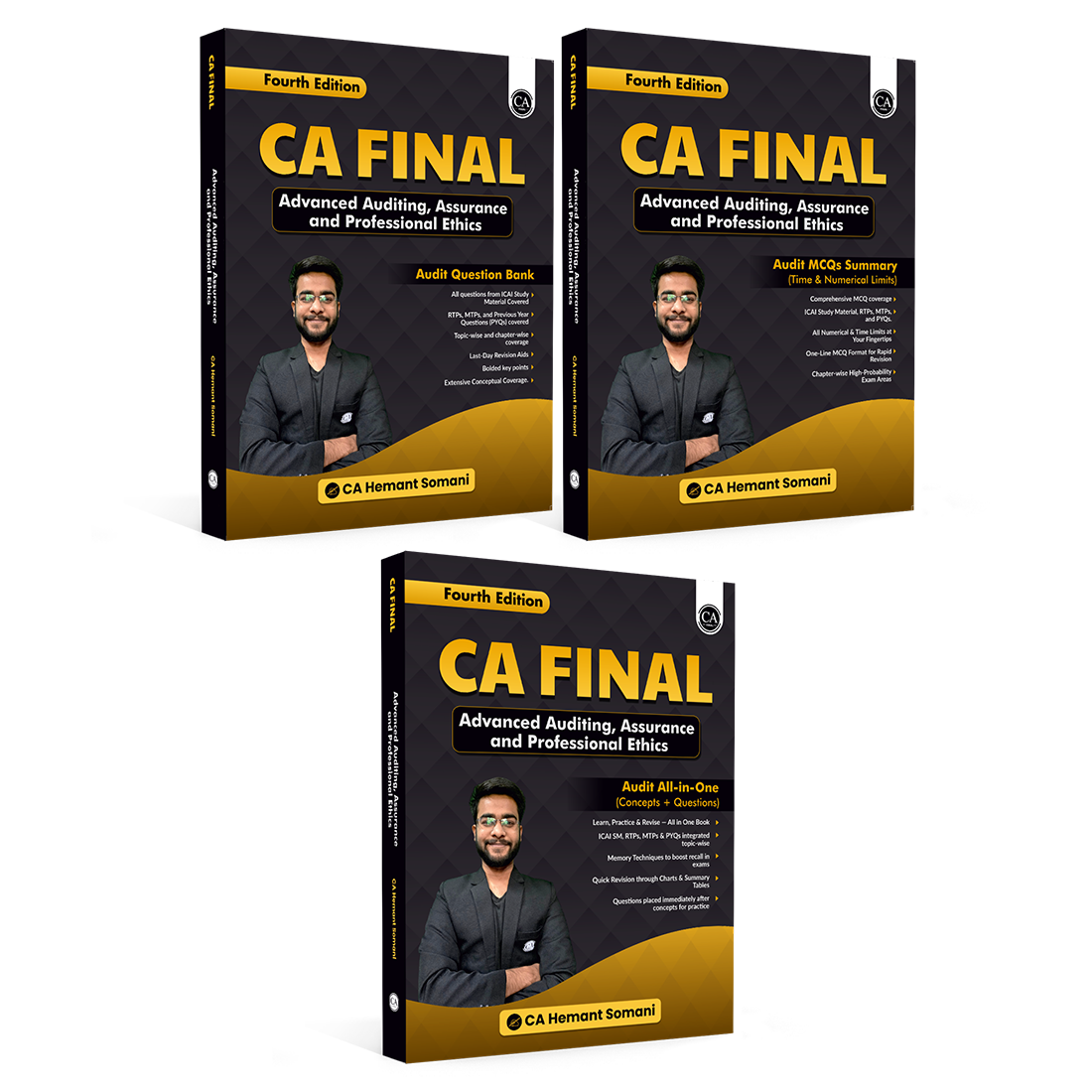
A CA final audit question bank is an essential practice resource designed to consolidate learning right after completing individual chapter theory. Rather than forcing students to navigate through disparate past papers or unorganized test collections, this structured tool brings together descriptive problems, CASE scenarios, and objective assessments into a single aligned resource.
Using a dedicated CA final audit question bank book allows CAndidates to immediately test their application skills on the exact concepts they just studied. It transforms passive textbook reading into active retention, ensuring that technical provisions, reporting requirements, and statutory clauses are properly understood and retained.
Features of the CA Final Audit Question Bank
A well-structured CA final audit question bank incorporates specific tools to simplify preparation and accelerate your revision speed.
Complete ICAI Coverage
-
Official Material Integration: Gather problems from Study Material (SM), Revision Test Papers (RTPs), Mock Test Papers (MTPs), and past examination papers.
-
Old Course Relevance: Features clearly identified old course questions that remain relevant for current testing standards.
Learning & Retention Tools
-
Concepts & Questions Together: Combines theoretical explanations directly alongside relevant practice problems for seamless learning.
-
Charts & Tabular Formats: Simplifies intricate auditing provisions using structured charts and tables for rapid conceptual clarity.
-
Tricks & Mnemonics: Employs memory aids to help retain lengthy statutory lists, audit procedures, and reporting frameworks.
-
Priority-Based Marking: Highlights essential concepts and high-yield questions to guide focused, high-priority study sessions.
-
Integrated Objective Summaries: Features standalone CA final audit mcqs with clean, one-line solutions to test granular details.
How to Use the CA Final Audit Question Bank After Each Chapter
To build strong exam technique, follow this step-by-step workflow with CA Final Books every time you complete a new chapter. These books can help reinforce concepts, practise exam-oriented questions, and develop a structured approach to CA Final preparation.
-
Immediate Self-Assessment: Close your primary concept book and open your CA final audit question bank book. Attempt descriptive CA final audit questions without looking at the solutions first.
-
Practice Objective Items: Solve dedicated CA final audit mcqs to evaluate your understanding of key limits, timeframes, and specific statutory thresholds.
-
Compare Presentation Standards: Cross-check your written answers with the standard solutions. Pay close attention to technical keywords, statutory references, and overall answer structure.
-
Tag Difficult Problems: Mark challenging questions with high-priority flags for quick identification during upcoming revision passes.
-
Leverage Memory Aids: Use the provided charts, tables, and mnemonics to lock in tricky clauses or complex procedural steps.
When to Start Using the CA Final Audit Question Bank
Timing is critical to effective CA final audit preparation. Starting your practice too late creates an overwhelming backlog of unsolved papers.
|
Preparation Stage |
Recommended Focus Area |
Strategic Goal |
|
First Reading Phase |
Chapter-wise descriptive questions & core concepts |
Build fundamental appliCAtion skills right after theory |
|
Mid-Syllabus Phase |
Objective summaries & CA final audit mcqs |
Test reCAll of specific limits and key statutory terms |
|
Final Revision Phase |
Priority-marked problems & past exam scenarios |
Sharpen speed, accuracy, and overall answer presentation |
Integrate your CA books immediately after finishing your first chapter rather than saving all practice questions for the end of the term.
Study Plan With the CA Final Audit Question Bank
A structured schedule ensures balanced coverage of theoretical study, active problem-solving, and continuous review.
Recommended Weekly Revision Routine
-
Days 1–4 (Concept & Practice): Study primary chapter theory and immediately solve the corresponding chapter problems in your CA final audit question bank.
-
Day 5 (Objective Evaluation): Work through CA final audit mcqs and case scenarios to test technical accuracy.
-
Day 6 (Gap Analysis): Compare your written answers against standard responses, noting missing technical terminology or structural errors.
-
Day 7 (Visual Review): Revise using summary tables, charts, and mnemonics found inside your CA final audit revision book.
Common Mistakes to Avoid With the CA Final Audit Question Bank
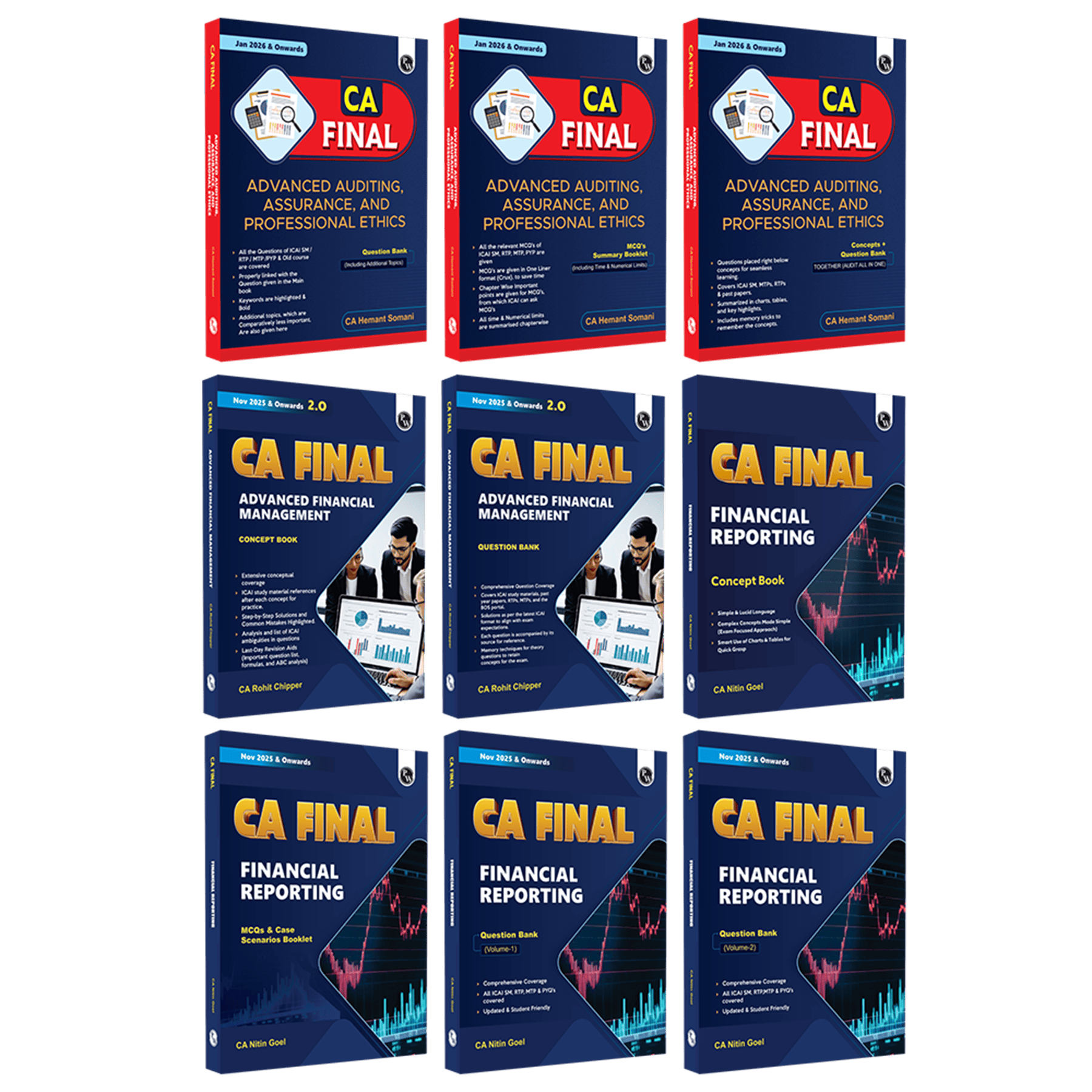
Steer clear of these common study errors during your CA Final Audit preparation. Using the CA Final Group 1 Combo Set 9 as part of your study routine can help you follow a structured approach, strengthen subject preparation, and practise consistently.
-
Reading Answers Passively: Treating problem-solving as a reading exercise instead of independently writing out complete answers.
-
Ignoring Objective Assessment: Neglecting short objective items and CA final audit mcqs, which carry significant weight in the final assessment.
-
Skipping ICAI Formatting: Focusing solely on reaching the final conclusion while ignoring proper answer presentation, headers, and legal references.
-
Postponing Practice: Delaying question solving until the entire syllabus is finished, which reduces long-term retention.
Tips to Revise With the CA Final Audit Question Bank
Speed up your final revision passes with these targeted study methods:
-
Use embedded tricks and mnemonics to reCAll lengthy audit procedures and statutory points effortlessly.
-
Focus heavily on priority-marked concepts to optimize your study time during final preparation rounds.
-
Re-solve previously flagged high-difficulty questions to ensure past conceptual weaknesses are fully resolved.
-
Utilize quick revision points, tables, and charts to review key limits and standards right before exams.
Read More: Common Mistakes to Avoid in CA Exam Preparation
CA Final Audit Question Bank FAQs
Q1. When should I start using the CA final audit question bank?
Start using the CA final audit question bank immediately after finishing your first chapter to reinforce concepts and test application skills early.
Q2. Does the CA final audit practice book cover official ICAI content?
Yes, standard practice resources fully align with official Study Material (SM), past examination papers, RTPs, and MTPs.
Q3. How do CA final audit mcqs help during post-chapter study?
Solving CA final audit mcqs right after a chapter tests your reCAll of specific regulatory limits, key thresholds, and objective details.
Q4. How do charts and tables in the CA final audit revision book speed up review?
Visual charts and summary tables present complex auditing standards in structured, digestible formats, allowing rapid visual review during revision rounds.
Q5. Why is writing practice important during CA final audit preparation?
Writing out solutions helps master techniCAl answer presentation, legal terminology, and structuring responses according to professional evaluation standards.