10 Fun Slime Experiments and Activities Kids Can Try at Home

Parents often struggle to find engaging, screen-free educational tasks that keep children entertained at home while teaching fundamental science concepts. Performing practical slime activities for kids solves this challenge by combining creative play with real scientific principles like polymer cross-linking and non-Newtonian fluid dynamics.
In this article, you will discover ten straightforward experiments that turn household items into exciting chemistry lessons.
Importance of Slime Activities for Kids
Slime activities for kids make learning fun and interactive. They help children improve fine motor skills through stretching, mixing, and shaping slime. These activities also encourage creativity, observation, and simple problem-solving skills. At the same time, kids can learn basic science concepts such as textures, materials, and changes in matter while enjoying screen-free play.
Features of Slime Activities Kit for Kids
Give children a fun way to play, create, and explore with colourful slime activities. Suitable for kids aged 4 years and above, this set supports sensory play, creativity, imagination, and hands-on learning while keeping children engaged without screens.
6 Fruity Scents: Enjoy six different fruity scents that make slime play more fun. The fragrances also encourage children to explore and identify different smells during play.
Bright Colours & Glitter: Colourful slime and glitter create a fun visual experience. Children can stretch, twist, squeeze, and shape the slime while using their imagination and creativity.
6 Fun Molded Lids: Six specially designed molded lids add more ways to play and create. Children can make different shapes and patterns while improving their hand control and fine motor skills.
Safe, Stretchy & Non-Sticky Slime: The slime is soft, stretchy, and easy to handle. Its non-sticky texture makes it comfortable to stretch, squeeze, shape, and play with while helping reduce mess.
Portable & Resealable Containers: Easy-to-carry containers allow children to enjoy slime play anywhere. The compact design is suitable for travel, holidays, classroom activities, playdates, and outdoor trips.
Non-Toxic & Child-Safe: Made with child-safe and non-toxic materials for a safe and enjoyable play experience. The materials are designed for children aged 4 years and above.
Encourages Independent Play: Slime activities allow children to enjoy creative play independently. They can explore colours, shapes, textures, and different ways to play at their own pace.
Supports Sensory & Skill Development: Squeezing, stretching, and shaping slime can support hand strength, fine motor skills, touch-based learning, concentration, coordination, creativity, and imagination.
Perfect Gift for Kids: A fun choice for birthdays, return gifts, holidays, or special occasions. It works as a sensory toy, slime toy, and creative activity kit for boys and girls aged 4+ years.
Why Are Slime Activities for Kids Beneficial for Primary Science?
Hands-on learning plays a crucial role in early childhood science education. Children absorb complex abstract concepts far more effectively when they can touch, stretch, and manipulate materials in real time.
Engaging in slime activities for kids fosters essential STEM skills through simple home experiments:
-
Observational Skills: Children track how liquid glue converts into a flexible solid when combined with an activator.
-
Measurement Accuracy: Measuring liquids in millilitres helps build practical mathematics and laboratory techniques.
-
Hypothesis Testing: Children learn to predict how altering activator ratios changes slime viscosity.
-
Tactile Stimulation: Manipulating squishy textures builds fine motor skills and offers soothing sensory input.
10 Exciting Slime Activities for Kids
These ten step-by-step slime experiments for kids offer unique physical properties, colour transformations, and texture variations.
1. Classic Fluffy Cloud Slime
Fluffy slime uses shaving foam to introduce gas entrapment into liquid polymer solutions.
-
Materials Required: 100 ml white PVA glue, 100 ml shaving foam, 1 teaspoon baking soda, 1 tablespoon saline solution, food colouring.
-
Step-by-step Instructions:
-
Pour white PVA glue into a clean mixing bowl.
-
Fold in the shaving foam until the mixture forms soft peaks.
-
Stir in your chosen food colouring and baking soda thoroughly.
-
Add the saline solution slowly while stirring continuously until the mixture pulls away from bowl edges.
-
Knead the mass with your hands for two minutes until smooth.
-
Scientific Explanation: Shaving foam contains trapped air bubbles. Adding it to PVA glue creates a lightweight matrix with reduced overall density.
2. Glow-in-the-Dark Night Slime
This activity uses phosphorescent pigment to teach children about light energy absorption and emission.
-
Materials Required: 100 ml clear PVA glue, 1 tablespoon glow-in-the-dark powder or paint, 1/2 teaspoon baking soda, 1 tablespoon contact lens solution.
-
Step-by-step Instructions:
-
Combine clear PVA glue with glow powder in a bowl.
-
Mix thoroughly to disperse phosphorescent particles evenly.
-
Add baking soda and blend well.
-
Gradually pour in contact solution while stirring briskly.
-
Charge under a bright lamp for one minute, then turn off the lights to observe luminescence.
-
Scientific Explanation: Phosphorescent compounds absorb photon energy from light sources and release it slowly over time as visible light.
3. Magnetic Iron Filings Slime
Magnetic slime demonstrates force fields and attraction using fine iron particles mixed directly into a polymer base.
-
Materials Required: 100 ml black PVA glue or clear glue with black dye, 2 tablespoons iron filings, borax activator solution, strong neodymium magnet.
-
Step-by-step Instructions:
-
Mix glue and black colouring in a glass container.
-
Add iron filings into the glue mixture and stir thoroughly.
-
Add activator slowly until the mixture becomes firm yet flexible.
-
Place a neodymium magnet near the surface to watch the polymer stretch toward the magnetic field.
-
Scientific Explanation: Iron filings suspended within the polymer matrix react to external magnetic fields, causing the entire mass to move toward the magnet.
4. Heat-Sensitive Thermochromic Slime
Thermochromic slime changes colour when exposed to warmth from hands or warm water.
-
Materials Required: 100 ml clear glue, 1 teaspoon thermochromic pigment powder, baking soda, saline activator, warm water cup.
-
Step-by-step Instructions:
-
Dissolve thermochromic pigment into clear glue until uniform.
-
Add baking soda and stir until completely integrated.
-
Slowly incorporate saline activator until proper elasticity develops.
-
Touch the batch with warm hands or rest it near warm water to watch the colour shift instantly.
-
Scientific Explanation: Thermochromic pigments alter their molecular arrangement when temperature rises, changing the wavelengths of light they reflect.
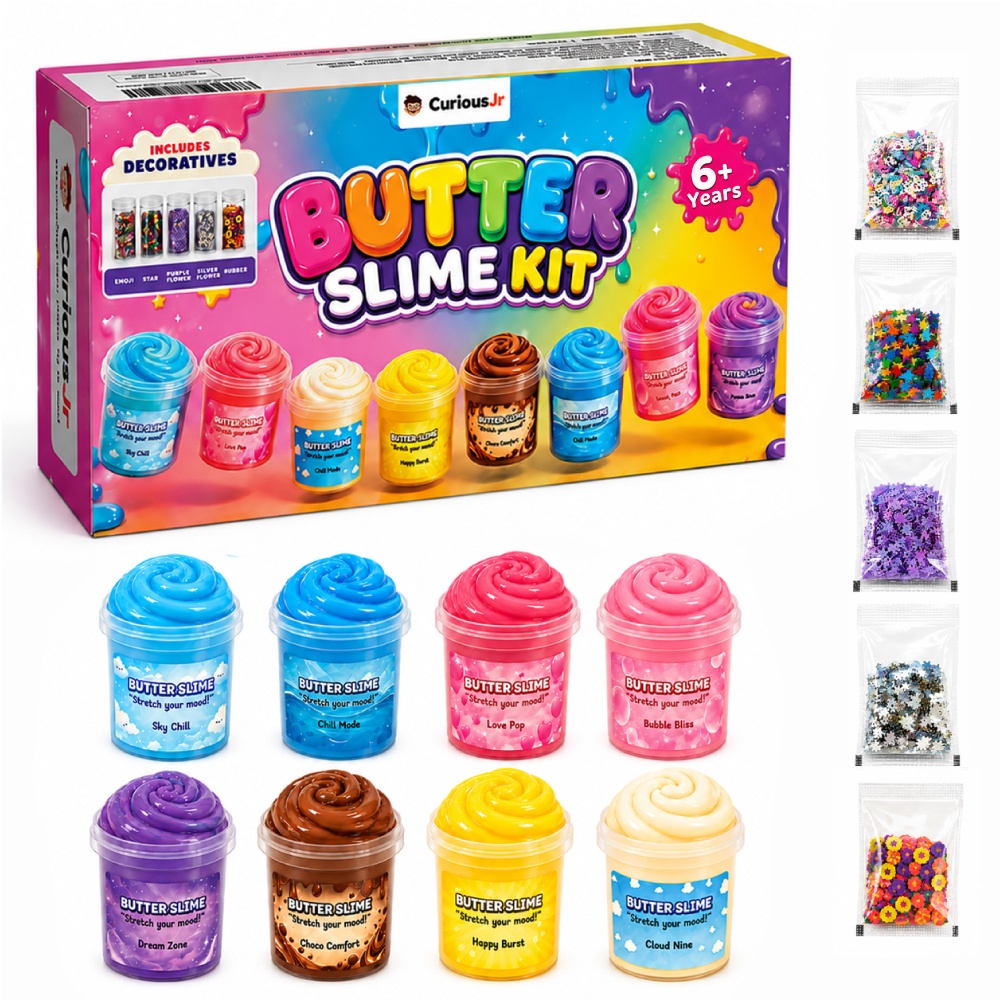
5. Butter Slime Tactile Activity
Butter slime offers a smooth, spreadable texture created by blending soft model clay into a standard polymer matrix.
-
Materials Required: 100 ml white PVA glue, 1/2 cup soft air-dry clay, 1/2 teaspoon baking soda, 1 tablespoon contact solution.
-
Step-by-step Instructions:
-
Prepare a standard slime base by mixing white glue, baking soda, and contact solution.
-
Flatten the base on a smooth table surface.
-
Place air-dry clay on top of the base.
-
Knead the clay into the mixture until uniform, smooth, and spreadable with a toy knife.
-
Scientific Explanation: Clay particles fill micro-gaps within cross-linked polymer chains, yielding a buttery, non-sticky texture.
6. Crunchy Foam Bead Slime
Adding Styrofoam beads creates a textured material that produces auditory popping sounds during play.
-
Materials Required: 100 ml clear glue, 1 cup micro foam beads, baking soda solution, contact lens activator.
-
Step-by-step Instructions:
-
Blend clear glue with baking soda in a mixing bowl.
-
Add activator to form a firm slime base.
-
Gently fold foam beads into the mixture until evenly distributed throughout the batch.
-
Squeeze the batch to test auditory crunch responses.
-
Scientific Explanation: Styrofoam beads remain suspended within elastic polymer networks without dissolving, adding texture and acoustic feedback.
7. Deep Space Galaxy Slime
Galaxy slime combines multiple dark-tinted batches with metallic glitters to model nebulae and astronomical phenomena.
-
Materials Required: Clear PVA glue, purple, blue, and black food dyes, fine silver glitter, liquid activator solution.
-
Step-by-step Instructions:
-
Divide clear glue equally into three separate bowls.
-
Add blue dye and glitter to bowl one, purple to bowl two, and black to bowl three.
-
Activate each bowl independently until firm.
-
Twist the three coloured strands together without fully blending them to maintain a galaxy pattern.
-
Scientific Explanation: High viscosity prevents rapid pigment diffusion, allowing distinct colour bands to remain separate during gentle manipulation.
8. Crystal Clear Window Slime
Clear window slime lets children inspect light transmission through transparent polymer networks.
-
Materials Required: 100 ml clear PVA glue, 1/2 teaspoon baking soda, 1 tablespoon saline solution, airtight storage container.
-
Step-by-step Instructions:
-
Mix clear glue and baking soda gently to minimise air bubble formation.
-
Add saline solution slowly, stirring smoothly in one direction.
-
Place the fresh batch into an airtight container.
-
Allow it to sit undisturbed for 48 hours until trapped air bubbles escape completely.
-
Scientific Explanation: Removing air bubbles restores clarity, allowing light rays to pass directly through cross-linked polymer chains.
9. Calming Lavender Scented Slime
Scented slime adds olfactory input to tactile sensory play, creating a relaxing educational experience.
-
Materials Required: 100 ml white PVA glue, 2 drops lavender essential oil, purple food dye, baking soda, contact solution.
-
Step-by-step Instructions:
-
Pour white glue into a bowl and stir in purple food dye.
-
Add two drops of lavender essential oil and mix well.
-
Add baking soda and stir until completely dissolved.
-
Mix in contact solution slowly until soft, stretchy dough forms.
-
Scientific Explanation: Essential oils bind to polymer molecules, releasing soothing aromatic compounds slowly as children work the dough.
10. Classic Non-Newtonian Oobleck Activity
Oobleck offers a quick liquid-to-solid phase transition without using traditional glue or borax activators.
-
Materials Required: 200 g cornflour, 100 ml water, drop of food dye.
-
Step-by-step Instructions:
-
Add cornflour into a wide tray or shallow bowl.
-
Mix food dye into the water.
-
Pour water into cornflour slowly, mixing gently with fingers.
-
Tap the surface rapidly to observe a firm solid layer, then rest your hand gently to watch it flow like a liquid.
-
Scientific Explanation: Cornflour suspensions act as non-Newtonian fluids. Applying pressure locks starch particles together into a temporary solid structure.
Also Check - Mini Butter Slime Kit for Kids
Safety Guidelines for Slime Activities for Kids
Maintaining safety standards ensures that conducting slime activities for kids at home remains fun, clean, and educational.
-
Adult Supervision: Ensure an adult oversees all measurement and mixing steps.
-
Skin Care: Wash hands thoroughly before and after playing with chemical mixtures.
-
Eye Protection: Avoid touching eyes or face while handling contact solution or baking soda.
-
Toxicity Safety: Never consume slime ingredients. Keep supplies away from toddlers and pets.
-
Surface Protection: Cover wooden tables with washable mats or tray setups to prevent surface staining.
Read More - 5-Minute Science Projects
Slime Activities for Kids FAQs
What makes slime stretch and bounce?
Slime stretches because PVA glue contains long polymer chains. Adding an activator cross-links these chains into flexible networks that stretch under tension and snap back when compressed.
How do you remove slime from clothes or carpets?
Apply warm white vinegar directly to affected fabric areas. Vinegar breaks down polymer bonds quickly, allowing you to wipe away residues with a clean cloth.
How long does home-made slime usually last?
When stored in an airtight container at room temperature, home-made batches stay fresh and pliable for up to two weeks without drying out.
Are all slime activators safe for young children?
Saline contact solution paired with baking soda provides a gentle, kid-safe alternative to concentrated borax powder while delivering excellent elasticity.
Can cornflour replace glue in slime experiments?
Yes, mixing cornflour with water creates oobleck, a non-Newtonian fluid that demonstrates liquid and solid properties without needing glue or harsh chemicals.