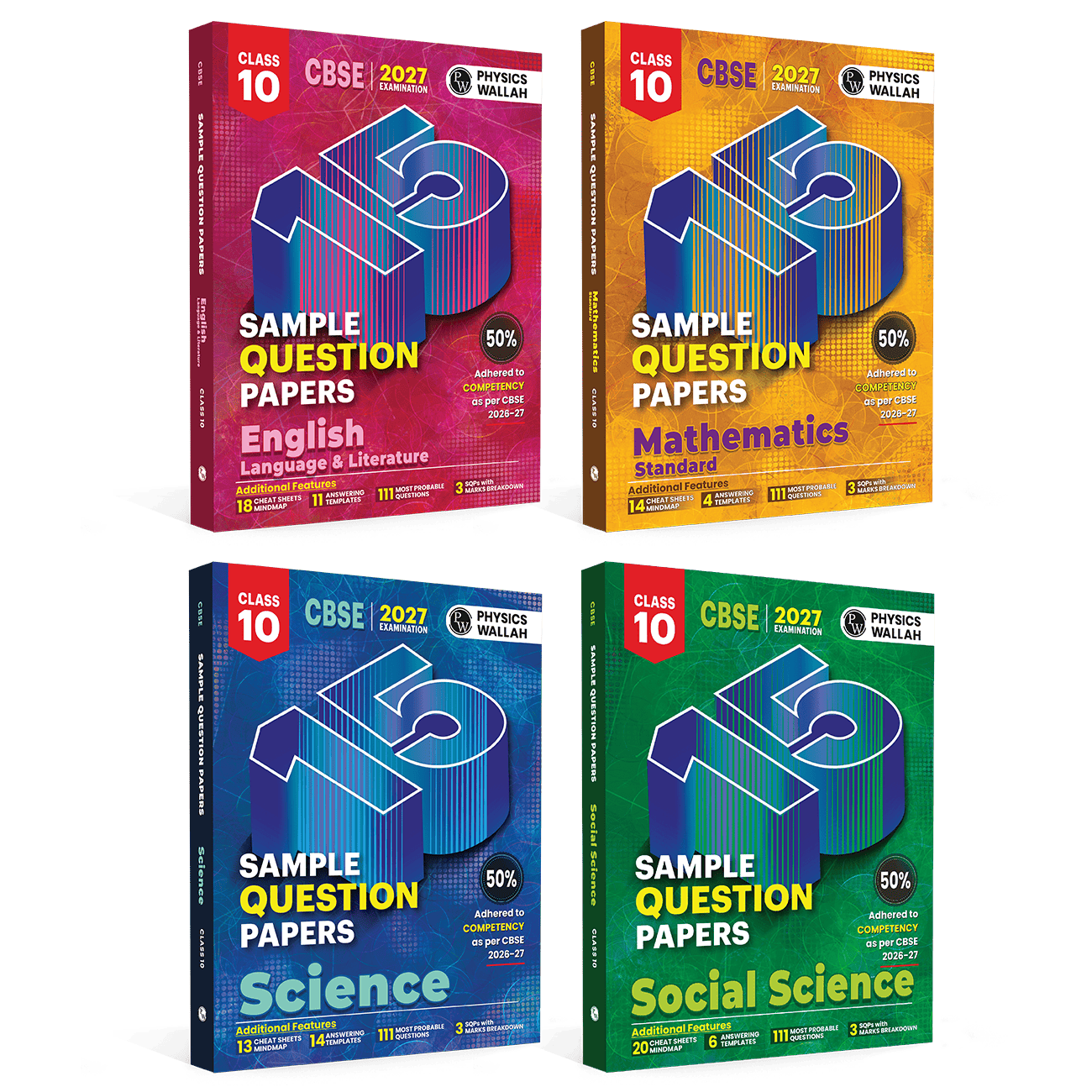
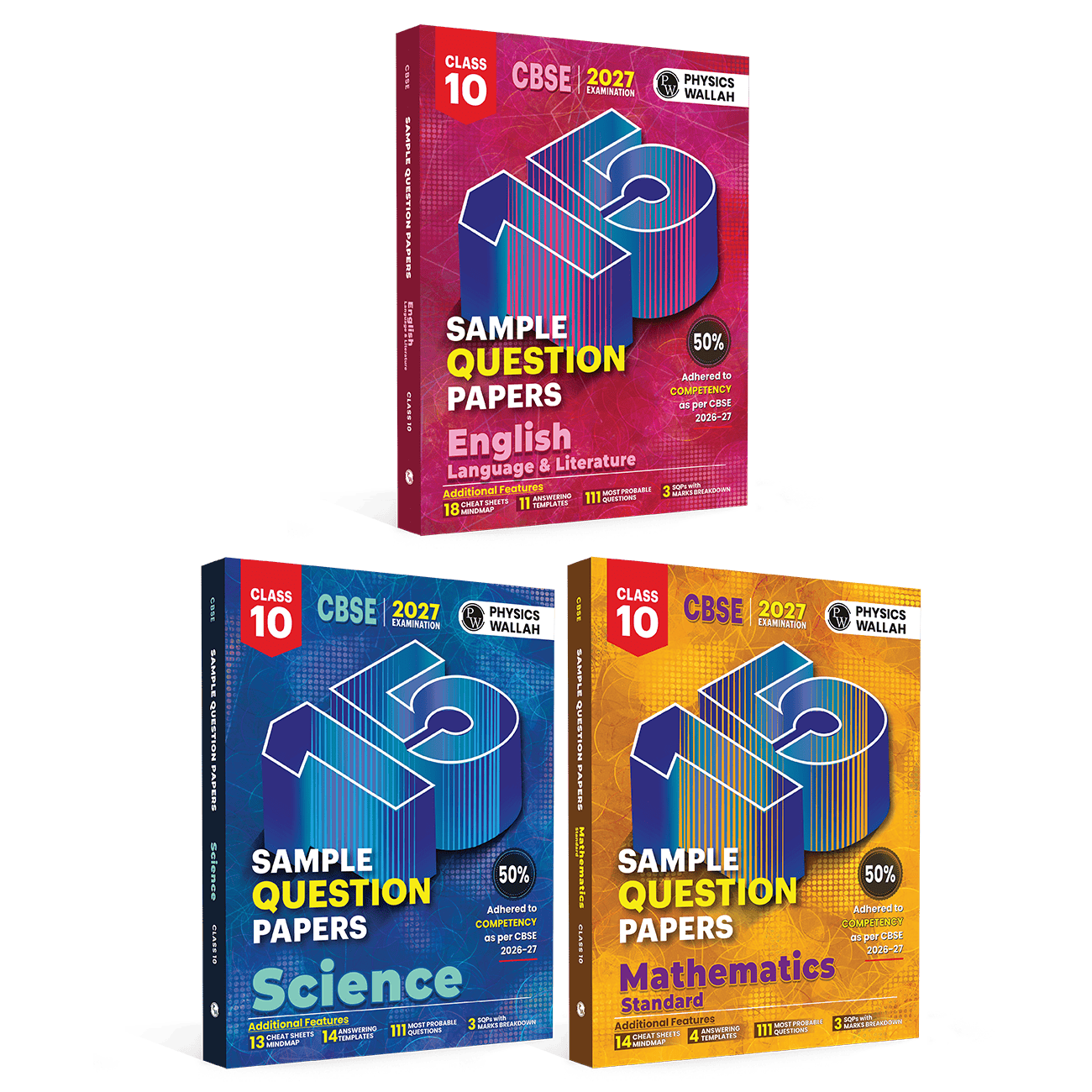
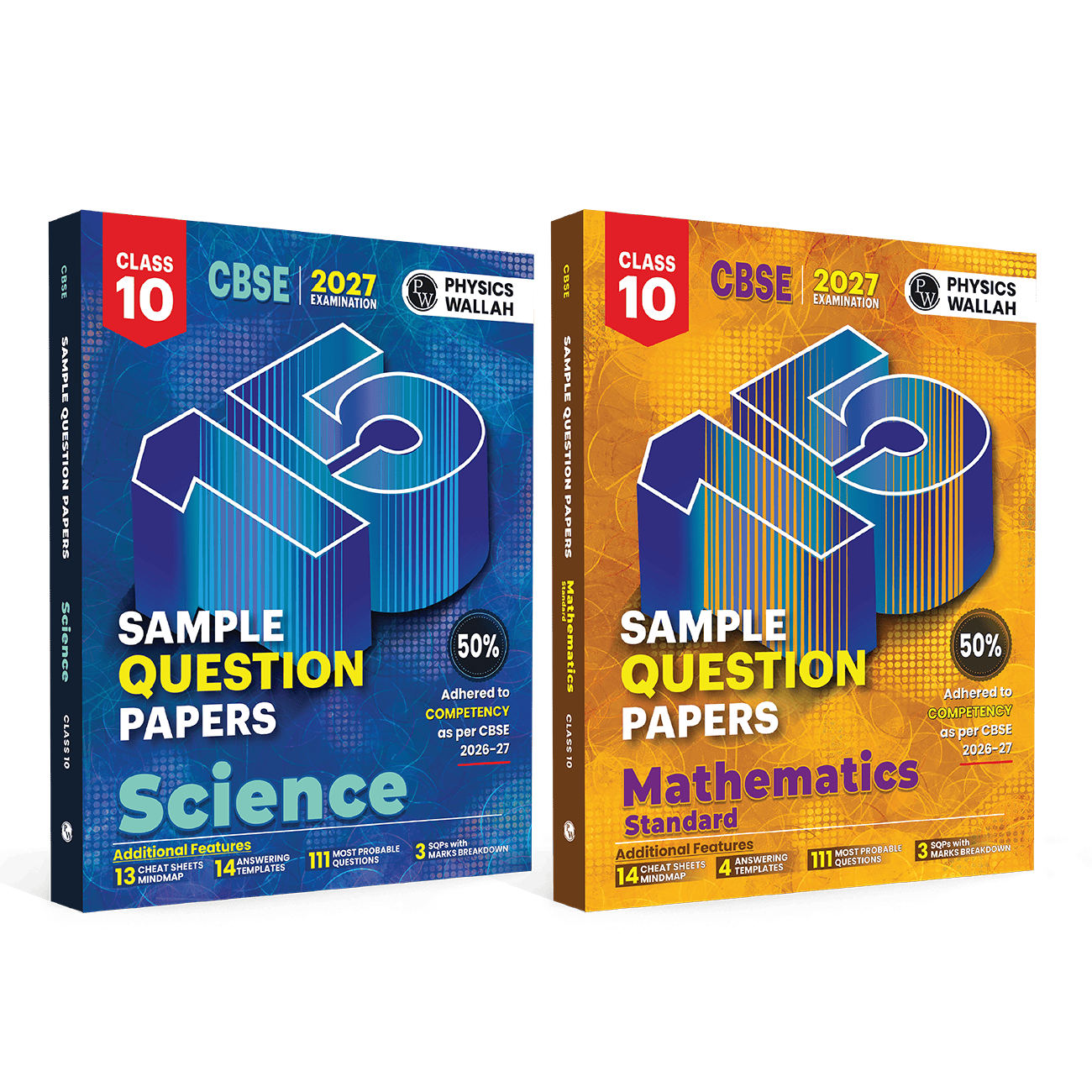
CBSE Sample Papers Class 10 2026-27 (Released) for Board Exams
CBSE Sample Papers Class 10 2026-27 (Released) for Board Exams: CBSE has released the official sample papers for Class 10 for the 2026-27 academic session for students preparing for the 2027 Board Exams. These sample papers are an important resource for understanding the latest exam pattern, marking scheme, question types, and paper structure. In this article, students can find the official CBSE Class 10 Sample Papers 2026-27, subject-wise sample papers, and PW Sample Papers prepared according to the CBSE syllabus.
Practising these sample papers helps students become familiar with the actual examination format and understand how questions can be framed from different topics. Regular practice can also improve time management, answer-writing skills, speed, and accuracy. Students can analyse their performance after solving each paper and identify the topics that require more revision.
For the CBSE Class 10 Board Exams 2027, students should prepare according to the latest CBSE syllabus, curriculum, and examination guidelines for the 2026-27 academic session. Once the syllabus is covered, solving the released sample papers under exam-like conditions can help students assess their preparation and become more confident about attempting the Board Exam.
|
CBSE Sample Papers Class 10 2026-27 |
|
|
Class 10 Science Sample Question Paper |
|
|
Class 10 Maths Sample Question Paper |
|
|
Class 10 Maths Standard Sample Question Paper |
|
|
Class 10 Social Science Sample Question Paper |
|
|
Class 10 English Sample Question Paper |
|
|
Class 10 Hindi A Sample Question Paper |
|
|
Class 10 Hindi B Sample Question Paper |
|
For more subject CBSE Sample Papers Class 10, click here
Balancing extensive syllabus coverage with accurate answer presentation creates tremendous pressure during end-term preparation. Practicing with reliable CBSE class 10 sample papers provides an authentic simulation of the actual examination environment.
It breaks down complex syllabus requirements into manageable practice units, highlighting exact marking distributions and section structures.
By working through these curated papers under timed conditions, candidates systematically pinpoint knowledge gaps, refine answer-writing strategies, and build necessary exam confidence.
What Are CBSE Class 10 Sample Papers?
CBSE class 10 sample papers are official model question papers curated according to the updated syllabus, evaluation guidelines, and design structure issued by the board. These practice papers mirror the layout, typology, and marking distribution of final end-term examination papers.
Key characteristics of these question sets include:
-
Official Blueprint Alignment: Every paper follows the exact question distribution, section splits, and word limits prescribed for the end-term assessments.
-
Competency-Based Focus: Papers incorporate higher-order thinking skill questions, analytical tasks, and real-world case studies.
-
Integrated Solutions: Comprehensive step-by-step marking schemes accompany the sets to demonstrate ideal answer presentation.
-
Variety of Formats: Practice sets feature multiple-choice questions (MCQs), short-answer responses, long-answer prompts, and integrated case studies.
Why CBSE Class 10 Sample Papers Matter for Board Exams
Solving authentic CBSE class 10 sample papers 2026-27 plays a critical role in end-term revision, transforming theoretical knowledge into actual test-taking performance.
|
Preparation Aspect |
Traditional Syllabus Reading |
Practice with Sample Papers |
|
Exam Familiarity |
Passive understanding of topics. |
Direct exposure to real paper layout and question styles. |
|
Time Management |
No tracking of writing speed. |
Timed practice to allocate specific minutes per section. |
|
Mistake Identification |
Mistakes remain hidden until the final exam. |
Immediate detection of silly errors and conceptual gaps. |
|
Anxiety Reduction |
High uncertainty about paper difficulty. |
High confidence through repeated mock testing. |
Regular practice with a reliable CBSE sample paper class 10 set ensures candidates understand exact evaluator expectations. By studying standard marking schemes, learners understand how marks are allocated step-by-step in numerical problems, short definitions, and descriptive answers.
Subjects Covered in CBSE Class 10 Sample Papers
Comprehensive preparation requires balanced attention across all major subjects. Quality class 10 sample papers cover the full spectrum of core subjects mandated by the board:
-
Mathematics (Standard & Basic): Features section-wise divisions including 20 MCQs, short-answer questions, long-form calculations, and case-based application problems. Practising CBSE Class 10 Maths Sample Papers helps students become familiar with these question formats, improve time management, and strengthen their problem-solving skills.
-
Science: Includes balanced questions across Physics, Chemistry, and Biology, focusing on numerical evaluation, chemical reactions, diagram labelling, and experimental analysis. Regular practice with CBSE Class 10 Science Sample Papers helps students understand the exam pattern, improve accuracy, and become familiar with different question formats.
-
Social Science: Combines History, Geography, Political Science, and Economics with map-pointing exercises, analytical paragraph writing, and source-based questions. Practising CBSE Class 10 Social Science Sample Papers helps students understand these question formats, improve answer-writing skills, and prepare effectively for the board examination.
-
English (Language & Literature / Communicative): Focuses on reading comprehension passages, formal letter writing, analytical writing templates, and textbook literature questions. Regular practice with CBSE Class 10 English Sample Papers helps students become familiar with the exam pattern, improve writing skills, manage time effectively, and build confidence for the board examination.
-
Hindi (Course A & Course B): Covers grammar application, unseen reading passages, formal letter drafting, and prescribed prose and poetry questions.
How to Use CBSE Class 10 Sample Papers for Preparation
To gain maximum benefit from Class 10 Board Sample Papers, students should follow a systematic methodology rather than treating them as passive reading material. Using CBSE Class 10 Books alongside sample papers can help strengthen concepts, revise important topics, practise different question types, and improve overall exam readiness.
-
Simulate Real Test Conditions: Sit in a quiet room, remove textbooks, and strict adherence to the 3-hour limit without interruptions.
-
Read Instructions Thoroughly: Use the initial 15-minute reading time to scan the question paper, mark internal choices, and plan section priorities.
-
Practice OMR Sheet Filling: Complete objective MCQ sections carefully to prevent bubbling errors or misalignments during actual exams.
-
Conduct Honest Self-Assessment: Evaluate answers strictly using official solution keys to understand exact mark deductions.
-
Maintain an Error Log: Record recurring mistakes, formula lapses, or weak chapters in a dedicated notebook for quick final revision.
Using structured tools like level-wise sets (Easy, Medium, Hard) allows students to build problem-solving capabilities progressively.
Furthermore, studying handwritten topper-style solutions provides clear insight into clean page formatting, diagram placement, and concise answer writing.
When to Start Solving CBSE Class 10 Sample Papers
Timing is vital during end-term board preparation. Beginning too early without full topic knowledge causes confusion, while starting too late leaves insufficient time for revision.
-
Early Phase (Syllabus Completion Stage): Attempt chapter-wise questions and basic paper sections alongside regular classroom learning to reinforce theoretical concepts.
-
Mid Phase (Pre-Board Stage): Begin attempting full-length CBSE class 10 question papers once 70-80% of the syllabus is complete. Focus on identifying weak topics and speed building.
-
Final Phase (Last 60 Days Before Board Exams): Solve 1 full-length sample paper every 2 to 3 days under strict 3-hour exam conditions. Use remaining days purely for revising mind maps, cheat sheets, and formula notes.
Study Strategy Plan With CBSE Class 10 Sample Papers
A structured weekly schedule ensures balanced coverage across all subjects without causing burn-out during the final preparation phase.
-
Monday - Mathematics Focus: Solve 1 full Standard or Basic Math paper. Spend 1 hour reviewing step-by-step solutions and calculation errors.
-
Tuesday - Science Focus: Attempt a complete Science model paper. Focus specifically on competency-based Physics numerical tasks and Biology diagrams.
-
Wednesday - Revision & Error Analysis: Review mistakes made on Monday and Tuesday. Re-read weak NCERT chapters and revise quick formula cheat sheets.
-
Thursday - Social Science Focus: Practice 1 Social Science paper. Pay special attention to map work, key historical dates, and structured long answers.
-
Friday - English & Hindi Focus: Alternate weekly between English and Hindi papers. Practice analytical paragraph templates, grammar exercises, and literature responses.
-
Saturday - Weak Area Drills: Focus entirely on "Mistake 101" logs. Re-solve all questions missed during the week's sample paper attempts.
-
Sunday - Full Mock & Rest: Take a timed full-length mock paper in your hardest subject. Spend the evening relaxing to recharge for the coming week.
Also Check - CBSE Class 10th Previous Year Papers
Tips to Score Better With CBSE Class 10 Sample Papers
Executing an effective strategy on exam day requires combining domain knowledge with smart test-taking techniques. Incorporating proven practical habits into class 10 board exam preparation ensures maximum mark recovery.
-
Use Answering Templates: Structure long-form responses using clear headings, bullet points, and brief conclusions to make grading simple for evaluators.
-
Leverage Mind Maps and Cheat Sheets: Utilize summary mind maps for quick 15-minute topic revisions right before attempting mock tests.
-
Analyze Past 5-Year Trends: Review trends from previous board exams alongside model papers to identify recurring question patterns.
-
Master Time Allocation: Allocate roughly 1.5 minutes per mark. Spend 30 minutes on MCQs, 45 minutes on short answers, and 60 minutes on long/case-based questions, saving 15 minutes for final review.
-
Avoid Silly Errors: Double-check unit conversions in Physics and Math, re-verify map locations in Geography, and ensure accurate grammar in language papers.
Read More: CBSE Class 10 Study Timetable
CBSE Class 10 Sample Papers FAQs
Q1. Are CBSE class 10 sample papers sufficient for final board exam preparation?
Sample papers are essential for testing exam readiness, understanding paper patterns, and improving speed. However, candidates must first complete their core NCERT textbooks thoroughly before solving practice sets.
Q2. How many sample papers should I solve per subject before board exams?
Solving 8 to 15 full-length papers per subject provides optimal exposure to varying difficulty levels, competency questions, and time constraints.
Q3. Do questions from sample papers directly appear in final board exams?
While exact questions may vary, the structural design, marking weightage, and core concepts match official board papers closely. Practising them helps predict question patterns accurately.
Q4. Why are marking scheme solutions important when solving sample sets?
Marking schemes show exact step-wise mark distribution. Reviewing them teaches students how to present answers concisely to secure full step marks.
Q5. How do sample papers help with competency-based questions?
Sample papers include modern case studies, assertion-reason items, and real-world application questions, helping students move beyond simple memorization to conceptual clarity.