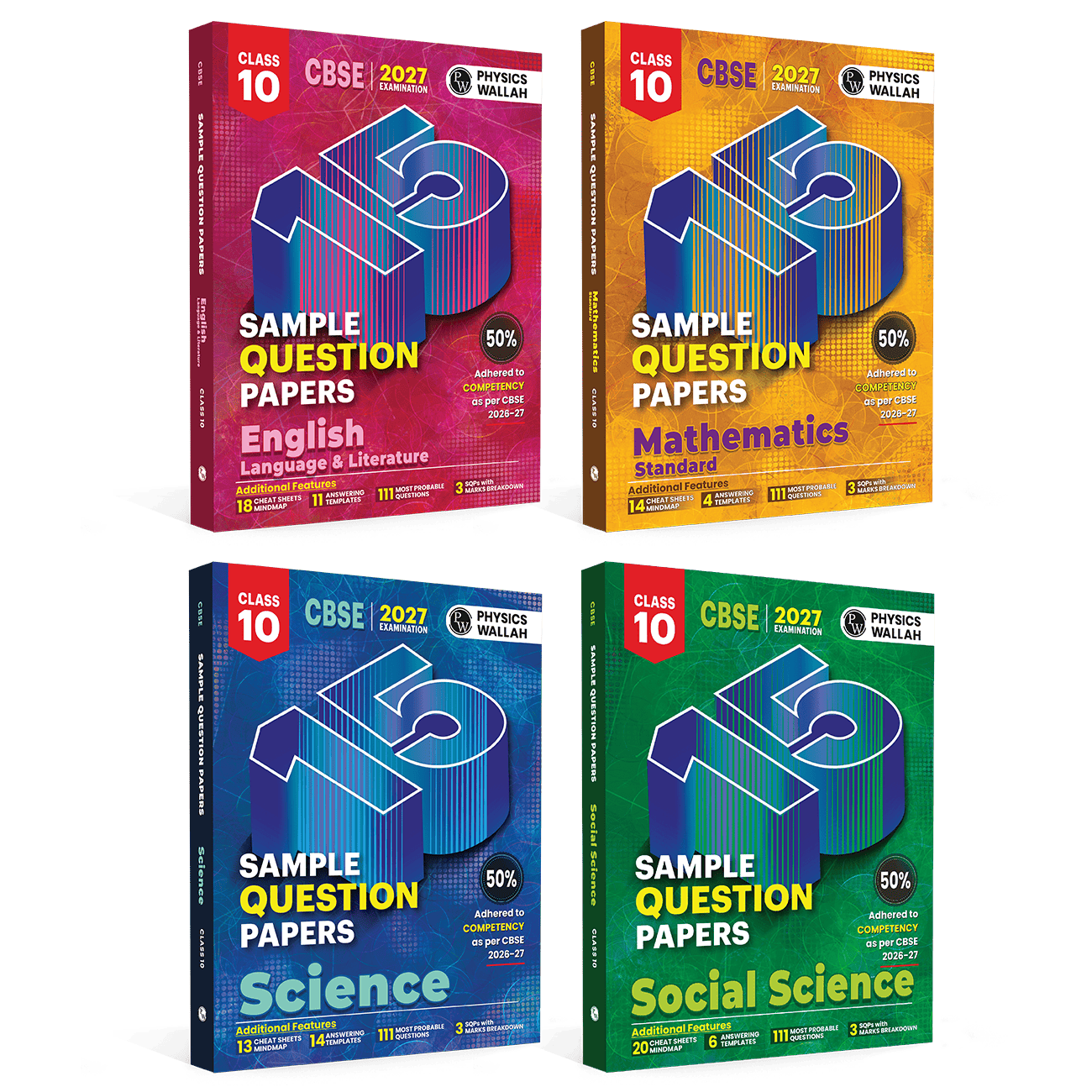
Class 10 SST Map-Based Question Practice with Sample Papers Book

The large syllabus of Class 10 Social Science (History, Geography, Political Science and Economics) makes the preparation of Board examinations of Class 10 Social Science overwhelming. One of the major reasons why students lose vital marks in map work is due to lack of targeted preparation and often struggle with time management. The best technique to remove the exam fear and know the exact marking scheme is by doing a proper CBSE SST sample paper class 10. Dedicated practice material helps you learn map-pointing activities, enhance answer presentation and get 100% accuracy in your final examinations.
Importance of CBSE SST Sample Paper Class 10
Systematic preparation is more than just reading passively. Solving a specific example paper class 10 offers you with a clear insight into the official exam pattern, marking scheme and time management needs.
Exam Structure
The Social Science question paper assesses a range of skills from quick objective memory to sophisticated analytical writing. Solving CBSE Class 10 sample papers offers you a clear idea about the distribution of questions in different sections:
-
Objective & MCQs: Test basic conceptual clarity and rapid memory retrieval across all four subjects.
-
Short Answer Questions: Require direct, point-wise explanations that focus on specific causes, definitions, or impacts.
-
Long Answer Questions: Demand structured responses using clear headings, bullet points, and analytical arguments.
-
Case-Based Questions: Test your ability to analyze source passages and apply concepts to real-world scenarios.
-
Map-Based Questions: Test spatial awareness through historical identification and geographical location marking.
Strategic Benefits of Regular Practice
-
Pinpointing Weak Areas: Solving a Class 10 SST sample paper early reveals specific chapters or topics where you lose marks.
-
Improving Speed and Accuracy: Writing complete three-hour tests builds mental stamina and prevents last-minute rushing.
-
Learning Step-Marking: Reviewing official-style marking schemes helps you structure answers to secure maximum marks for every point.
CBSE SST Sample Paper Class 10 Exam Pattern and Marking Scheme
To maximize your score, you must understand how marks are distributed across question types and subjects. A reliable Class 10 social science sample paper mirrors the exact structure set by the board.
|
Section / Question Type |
Target Cognitive Skill |
Primary Strategy for Scoring |
|
Multiple Choice (MCQs) |
Rapid recall and concept clarity |
Read options carefully; rule out incorrect options quickly |
|
Short Answer (2–3 Marks) |
Concise explanation |
Write direct, point-wise answers without unnecessary length |
|
Long Answer (5 Marks) |
Analytical & structured writing |
Use distinct sub-headings and underline key terms |
|
Case-Based (4 Marks) |
Passage interpretation |
Read source text thoroughly before attempting questions |
|
Map Work (5 Marks) |
Spatial placement & recognition |
Learn official location lists and practice on blank maps |
How to Practise Map Questions With a CBSE SST Sample Paper Class 10
History Map Work Strategy (2 Marks)
History map questions focus on identifying marked features related to the Indian National Movement. You must recognize the location and write its correct name on the line provided.
Key locations to remember include:
-
Indian National Congress Sessions:
-
Calcutta (September 1920): Held in West Bengal.
-
Nagpur (December 1920): Held in Maharashtra.
-
Madras (1927): Held in Tamil Nadu.
-
Important Centres of the Indian National Movement:
-
Amritsar (Punjab): Site of the Jallianwala Bagh incident.
-
Champaran (Bihar): Centre of the Indigo Planters Satyagraha.
-
Kheda (Gujarat): Site of the Peasant Satyagraha.
-
Ahmedabad (Gujarat): Centre of the Cotton Mill Workers Satyagraha.
-
Chauri Chaura (Uttar Pradesh): Place where the Non-Cooperation Movement was called off.
-
Dandi (Gujarat): Starting point of the Civil Disobedience Movement via the Salt March.
Geography Map Work Strategy (3 Marks)
Geography map questions require both identification and locating/labelling items using appropriate symbols. Practising regularly with class 10 SST map questions ensures you do not confuse adjacent states or cities.
Key Geography mapping categories include:
-
Water Resources (Dams):
-
Salal (Jammu & Kashmir)
-
Bhakra Nangal (Punjab/Himachal Pradesh)
-
Tehri (Uttarakhand)
-
Rana Pratap Sagar (Rajasthan)
-
Sardar Sarovar (Gujarat)
-
Hirakud (Odisha)
-
Nagarjuna Sagar (Telangana/Andhra Pradesh)
-
Tungabhadra (Karnataka)
-
Energy Resources (Power Plants):
-
Thermal: Namrup (Assam), Singrauli (Madhya Pradesh), Ramagundam (Telangana).
-
Nuclear: Narora (Uttar Pradesh), Kakrapara (Gujarat), Tarapur (Maharashtra), Kalpakkam (Tamil Nadu).
-
Agriculture (Major Producing States):
-
Rice and Wheat major regions.
-
Major producers of Sugarcane, Tea, Coffee, Rubber, Cotton, and Jute.
-
Manufacturing Industries:
-
Cotton Textile Clusters: Mumbai, Indore, Surat, Kanpur, Coimbatore.
-
Iron and Steel Plants: Durgapur, Bokaro, Jamshedpur, Bhilai, Vizag, Salem.
-
Software Technology Parks: Noida, Gandhinagar, Mumbai, Pune, Hyderabad, Bengaluru, Chennai, Thiruvananthapuram.
-
Lifelines of National Economy:
-
Major Ports: Kandla, Mumbai, Marmagao, New Mangalore, Kochi, Tuticorin, Chennai, Visakhapatnam, Paradip, Haldia.
-
International Airports: Amritsar (Raja Sansi), Delhi (Indira Gandhi), Mumbai (Chhatrapati Shivaji), Chennai (Meenambakkam), Kolkata (Netaji Subhash Chandra Bose), Hyderabad (Rajiv Gandhi).
How to Prepare Each Subject With a CBSE SST Sample Paper Class 10
A comprehensive CBSE SST sample paper class 10 covers all four sub-disciplines balanced according to the official syllabus guidelines.
History: Learning Narratives and Chronology
History demands a strong grasp of sequence, cause-and-effect relationships, and terminology.
-
Focus on key events in The Rise of Nationalism in Europe and Nationalism in India.
-
Memorize exact dates and event sequences using timeline charts.
-
Practice writing 5-mark answers using bullet points rather than long running paragraphs.
Geography: Understanding Patterns and Resources
Geography requires conceptual clarity combined with spatial memory.
-
Create summary charts for crop conditions (temperature, rainfall, soil type).
-
Practice resource classification and conservation methods.
-
Link geographical concepts directly to map locations for double retention.
Political Science: Grasping Democratic Principles
Political Science evaluates your understanding of governance structures and constitutional values.
-
Review key terms like power-sharing, federalism, gender issues, and political parties.
-
Learn to write comparative answers (e.g., horizontal vs. vertical power sharing).
-
Practice source-based case studies to prepare for analytical questions.
Economics: Applying Real-World Concepts
Economics tests practical understanding of economic development, banking, and globalization.
-
Understand core concepts such as Per Capita Income, Gross Domestic Product (GDP), and Credit.
-
Differentiate clearly between formal and informal sources of credit.
-
Learn how globalization impacts different sectors of the Indian economy.
Important Questions to Practise With a CBSE SST Sample Paper Class 10
Incorporate these sample exercises into your study routine to evaluate your current level of preparation. The CBSE Class 10 Sample Papers Combo of 4 Books 2027 can help you practise different question formats, assess your performance, identify weak areas, and improve time management before the board examinations.
Short Answer Questions (3 Marks Each)
-
Explain any three factors that led to the rise of nationalism in Europe during the nineteenth century.
-
How do formal sources of credit differ from informal sources of credit in India? Give three points.
-
Describe any three measures implemented in India to conserve forest and wildlife resources.
Long Answer Questions (5 Marks Each)
-
Explain the course of the Non-Cooperation Movement in urban and rural areas. Why did Mahatma Gandhi decide to withdraw the movement?
-
What is federalism? Explain any four key features of the federal system in India.
-
Examine the role of the tertiary sector in the development of the Indian economy. Why is its importance growing?
Map Practice Exercises From a CBSE SST Sample Paper Class 10
Attempt these self-assessment map tasks on a blank outline map of India to build mapping accuracy under exam-like conditions.
Exercise 1: History Identification
Identify the locations marked on the outline map of India based on the following clues:
-
Point A: The location where the Indian National Congress session was held in September 1920.
-
Point B: The site of the Indigo Planters Movement in Bihar.
-
Point C: The place where the Civil Disobedience Movement commenced.
Exercise 2: Geography Location and Labelling
Locate and label the following items on the map with appropriate symbols:
-
Sardar Sarovar Dam
-
Narora Nuclear Power Plant
-
Kandla Major Port
-
Bengaluru Software Technology Park
How to Score Better With a CBSE SST Sample Paper Class 10
To get the best results from your Class 10 SST important questions and practice tests, follow this step-by-step evaluation method:
-
Simulate Real Exam Conditions: Sit in a quiet room, set a 3-hour timer, and solve the paper without checking textbook notes.
-
Strict Self-Evaluation: Compare your answers against official solution keys. Check whether you included all necessary key phrases and points.
-
Analyze Map Errors: If you misplace a city or port by a few millimeters, mark it down and redraw it immediately on a fresh map.
-
Maintain a Revision Register: Maintain a notebook specifically for recording repeated mistakes, missed dates, and complex definitions.
Read More: How to Write Answers in Board Exams
CBSE SST Sample Paper Class FAQs
How many marks are allocated to map work in the Class 10 Social Science exam?
The map task is worth 5 marks in total in the final exam. 2 marks are for History identification and 3 marks for Geography locating and labeling.
What is the most efficient way to practice map questions using a SST sample paper?
The most efficient approach is to keep a pack of blank political maps handy while solving sample papers. Mark and label locations manually rather than simply reading solved answers.
Are full solutions provided in Class 10 SST sample paper books?
Yes, good practice paper books do have step by step solutions, key point breakdowns and sample map answers to help students correctly assess their own performance.
How often should I attempt a complete Class 10 SST practice paper?
In the latter period of your preparation, practicing at least one full-length practice paper per week can help you improve your time management, speed of writing and your general confidence.
Can I secure full marks in Class 10 SST map questions?
Yes, map work will give you sure shot full marks provided you remember the official syllabus location list and practice charting the objects correctly on blank Indian maps.