What Kind of Questions Should You Expect in Class 10 Sample Paper Book?
Class 10 board exams are a very essential phase in every student’s academic life. Facing board papers is generally a matter of anxiety as pupils have no idea of what specific question patterns will come. Many students find it difficult to distribute time for study in the right way without a proper roadmap for board test format. A complete sample paper book for class 10 assists in bridging this gap. In this article, we will discuss all the question categories in regular sample paper sets so that you can prepare strategically and increase your overall exam score.
Question Types in a Class 10 Sample Paper Book
A well-structured sample paper book features a variety of question formats designed to test basic recall, application skills, and analytical thinking. Understanding these specific question formats ensures that you do not face any surprises on exam day.
Here’s a summary of the main question formats in modern practice papers:
-
Objective Type Questions: These are multiple choice questions (MCQs), fill in the blanks and one word answers to test direct recollection and basic concepts.
-
Short Answer Questions: These questions demand brief explanations, formulae or brief derivations. Usually, these questions yield 2 or 3 marks.
-
Long Answer Type Questions : These questions are designed to assess detailed comprehension and carry higher points. Detailed solutions, diagrams or proofs are required.
-
Application-Oriented Questions: These test your ability to apply theoretical concepts to real-life situations or numerical problems.
Objective Questions in a Class 10 Sample Paper Book
Objective sections make up a significant portion of the initial exam paper. Practising these class 10 question types builds speed and prevents silly mistakes that lower overall percentage.
When solving objective sections in a sample paper book, expect the following variations:
-
Direct Definition-Based Questions: Test your memory of basic terminology, laws, and units.
-
Formula Application Questions: Require quick calculations using standard mathematical or scientific formulas.
-
Diagram Identification: Ask you to label parts of a biological system or identify ray diagrams in Physics.
-
Grammar and Vocabulary MCQs: Test sentence correction, tense usage, and reading comprehension in language papers.
Regular practice with these items teaches you how to eliminate incorrect options quickly.
Competency-Based Questions in a Class 10 Sample Paper Book
Educational boards have shifted focus toward assessing deep understanding rather than simple memorisation. Including competency based questions class 10 in practice material ensures students learn how to analyse situations critically.
These questions measure how well you adapt textbook knowledge to novel contexts:
-
Real-World Problem Solving: Scenarios where you apply scientific principles or mathematical models to everyday problems.
-
Experimental Skill Testing: Questions centered on laboratory setups, chemical reactions, and physical observations.
-
Data and Graph Interpretation: Analyzing bar charts, tables, or graphs to draw logical conclusions.
Case Based Questions in a Class 10 Sample Paper Book
Practising case based questions class 10 prepares you for passages accompanied by visual or tabular data. These tasks test comprehension, analytical ability, and quick extraction of relevant facts.
Standard case-based problems generally present:
-
Passage-Based Scenarios: A brief descriptive paragraph introducing a scientific phenomenon, historical event, or mathematical model.
-
Visual Data Sources: Diagrams, statistical graphs, or tables that contain essential data points needed to solve sub-questions.
-
Multiple Linked Sub-questions: A series of short sub-questions based directly on the provided context, ranging from direct factual checks to deep analytical evaluations.
-
Analytical Paragraphs: Tasks requiring you to write a structured summary or interpretation based on given data charts or survey results.
Solving these regularly improves your reading speed and helps you spot necessary data quickly during time-bound exams.
Assertion-Reason Questions in a Class 10 Sample Paper Book
Evaluating assertion reason questions class 10 requires sharp logical reasoning and a crystal-clear understanding of core concepts. These questions present two statements: an Assertion (A) and a Reason (R).
To tackle these questions effectively, keep these standard response options in mind:
-
Both A and R are true, and R is the correct explanation of A.
-
Both A and R are true, but R is NOT the correct explanation of A.
-
A is true, but R is false.
-
A is false, but R is true.
Working through these in a quality CBSE class 10 sample paper conditions your brain to verify facts independently before determining their causal link.
Subject-Wise Questions in a Class 10 Sample Paper Book
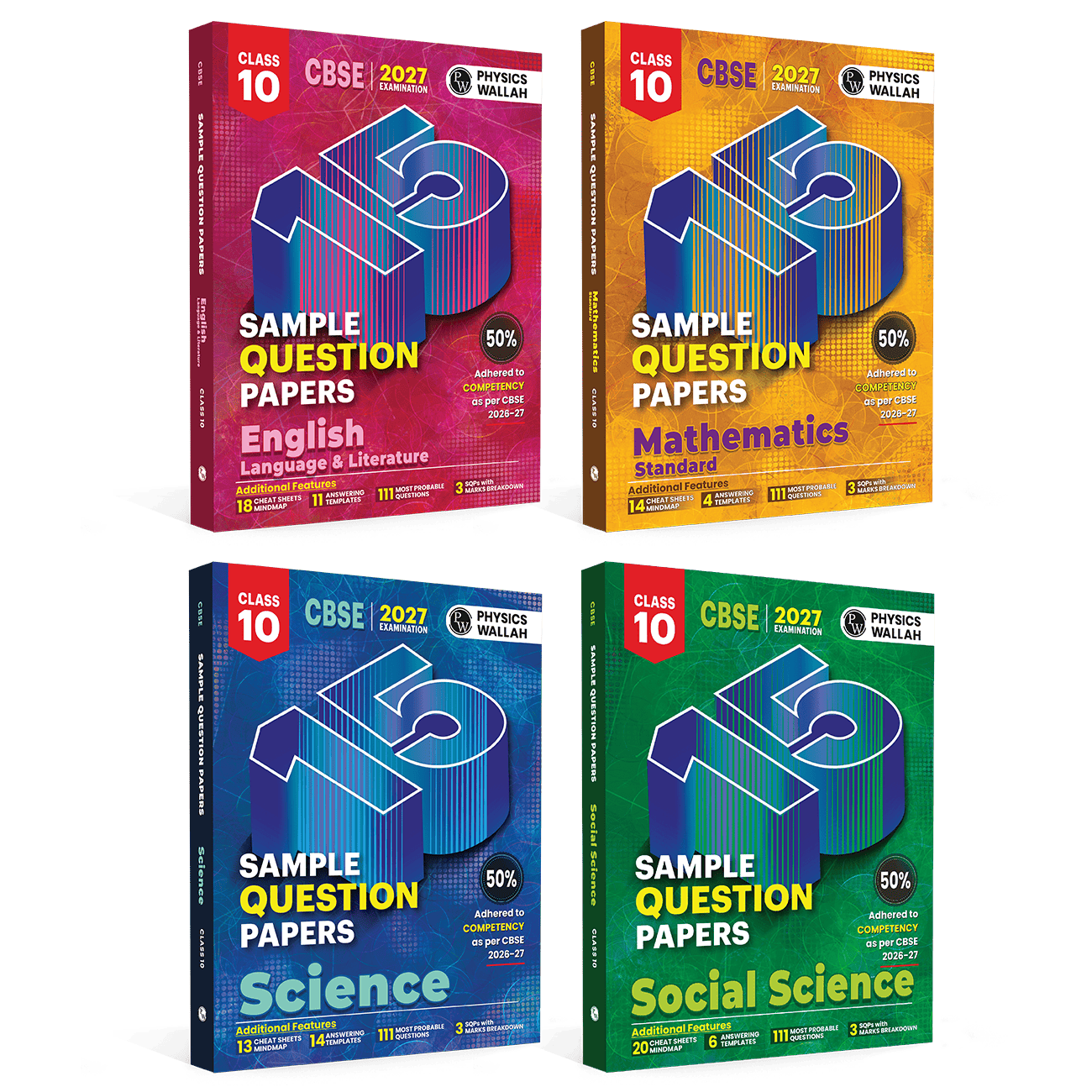
Every subject tests different competencies, meaning the distribution of class 10 board exam questions varies significantly across subjects. A comprehensive four-book combo set addresses these subject-specific nuances directly.
Science (Physics, Chemistry, Biology)
-
Physics: Numerical problems on electricity and light, ray diagram constructions, and conceptual questions on energy.
-
Chemistry: Balancing chemical equations, identifying unknown compounds from reaction sequences, and property comparisons.
-
Biology: Labeled diagram questions, process flowcharts, and reasoning items on genetics and life processes.
Mathematics (Standard and Basic)
-
Algebra & Calculus Basics: Multi-step algebraic simplifications, quadratic equation applications, and arithmetic progressions.
-
Geometry & Trigonometry: Geometric proofs, coordinate geometry distance formulas, and height-and-distance word problems.
-
Statistics & Probability: Calculating mean, median, mode from grouped data, and evaluating event probabilities.
Social Science
-
History & Civics: Map-based identification, source-based passage questions, and multi-mark historical summaries.
-
Geography & Economics: Map location plotting, resource classification, and case-based economic sector analyses.
English Language & Literature
-
Reading Skills: Discursive and case-based unseen passages with objective and short-answer items.
-
Writing & Grammar: Formal letters, analytical paragraphs based on charts, and integrated grammar editing tasks.
-
Literature: Extract-based questions from prose and poetry, alongside long character sketches and thematic analyses.
Class 10 Sample Paper Pattern and Practice Tools
Understanding the overall sample paper pattern gives you a massive tactical advantage. Quality sample books provide built-in learning aids alongside standard question sets to streamline your study routine.
Key features and tools found in modern practice book sets include:
-
Level-Wise Practice Sets: Sample papers categorized into Easy, Medium, and Hard difficulty levels for progressive learning.
-
Topper-Style Handwritten Solutions: Access to expert-formatted answers (often via QR codes) that illustrate ideal exam presentation.
-
Cheat Sheets and Mind Maps: Visual revision tools designed for quick last-minute reviews of formulas and key concepts.
-
Answering Templates: Structured layout guides that show precisely how to present steps to secure full marks.
-
Common Mistake Analysis: Dedicated sections highlighting common student errors and showing how to avoid them.
-
Self-Assessment Sheets: Evaluation scorecards that help you track performance, timing, and accuracy across practice attempts.
How to Score Better With a Class 10 Sample Paper Book
Just buying a CBSE class 10 books is not enough, using it systematically decides your final result.
Follow the below step-by-step technique to get the most out of your practice sets:
-
Set Actual Exam Conditions: Find a quiet area and set a strict timer for 3 hours. Write answers without looking at textbook solutions.
-
Practice Filling OMR Sheet: Practice OMR sheet filling for objective type questions to avoid bubble filling mistakes in the real exam.
-
Evaluate via Official Marking Schemes: Compare your answers against provided step-by-step marking schemes to see where you lose partial credit.
-
Review Common Errors: Study dedicated mistake-analysis sections to identify weak areas and refine your answer presentation.
-
Improve time management: Keep track of how long you spend on the long-answer part versus the case studies to ensure you have enough time to write the entire report.
Class 10 Sample Paper Book FAQs
What type of questions are included in a sample paper book?
A complete book includes multiple-choice questions, short and long answer items, competency-based problems, case studies, assertion-reason sets, and official solved board papers.
How do competency based questions class 10 differ from traditional questions?
Traditional questions test direct textbook recall, whereas competency based questions assess your ability to apply core concepts to novel real-world situations, data graphs, and practical scenarios.
Why are assertion reason questions class 10 difficult to solve?
These questions trip up students because both statements may be individually correct, yet one might not be the correct logical explanation for the other. Practising them builds analytical clarity.
How does understanding the CBSE sample paper questions pattern help in exams?
Knowing the pattern helps you manage your time effectively, understand section-wise mark distributions, and approach different question formats with confidence.
What is the best way to practice case based questions class 10?
The best approach for these questions is to read the provided source passage or chart carefully, highlight key data points first, and then answer the attached sub-questions systematically.