Is One Banking Quantitative Aptitude Book Enough for Complete Preparation?
The right banking quantitative aptitude book can make your exam preparation easier by providing comprehensive syllabus coverage, clear concepts, and exam-level practice in one place. A good banking quantitative aptitude book blends updated theory, topic-wise questions, previous-year trends, and mock tests. It helps candidates to prepare for IBPS, SBI, and RRB exams in a hassle-free manner without using numerous study resources.
Importance of the Banking Quantitative Aptitude Book
Candidates generally become confused while selecting study resources for banking quant preparation. The plethora of choices in the market results in resource overload, insufficient syllabus coverage, and lost preparation time.
Why Multiple Reference Guides Cause Confusion
-
Inconsistent Solution Methods: Switching among different authors causes confusion when practicing with different shortcut formulas in timed practice.
-
Repetitive Practice Sets: Studying several books often leads to repeating the same fundamental questions over and again, without moving to higher application.
-
Loss of study focus: Trying to follow three or four guides at once means your daily study time is divided, leaving you with little opportunity to improve your speed and analyze your mock tests.
-
Irrelevant Question Patterns: Old study material is of obsolete question patterns that are no longer in tune with the changing difficulty level of the present online exams.
Selecting a single, all-inclusive banking maths book eliminates these hurdles by offering a unified methodology from fundamental principles to advanced problem-solving techniques.
Features of the Banking Quantitative Aptitude Game Changer Book
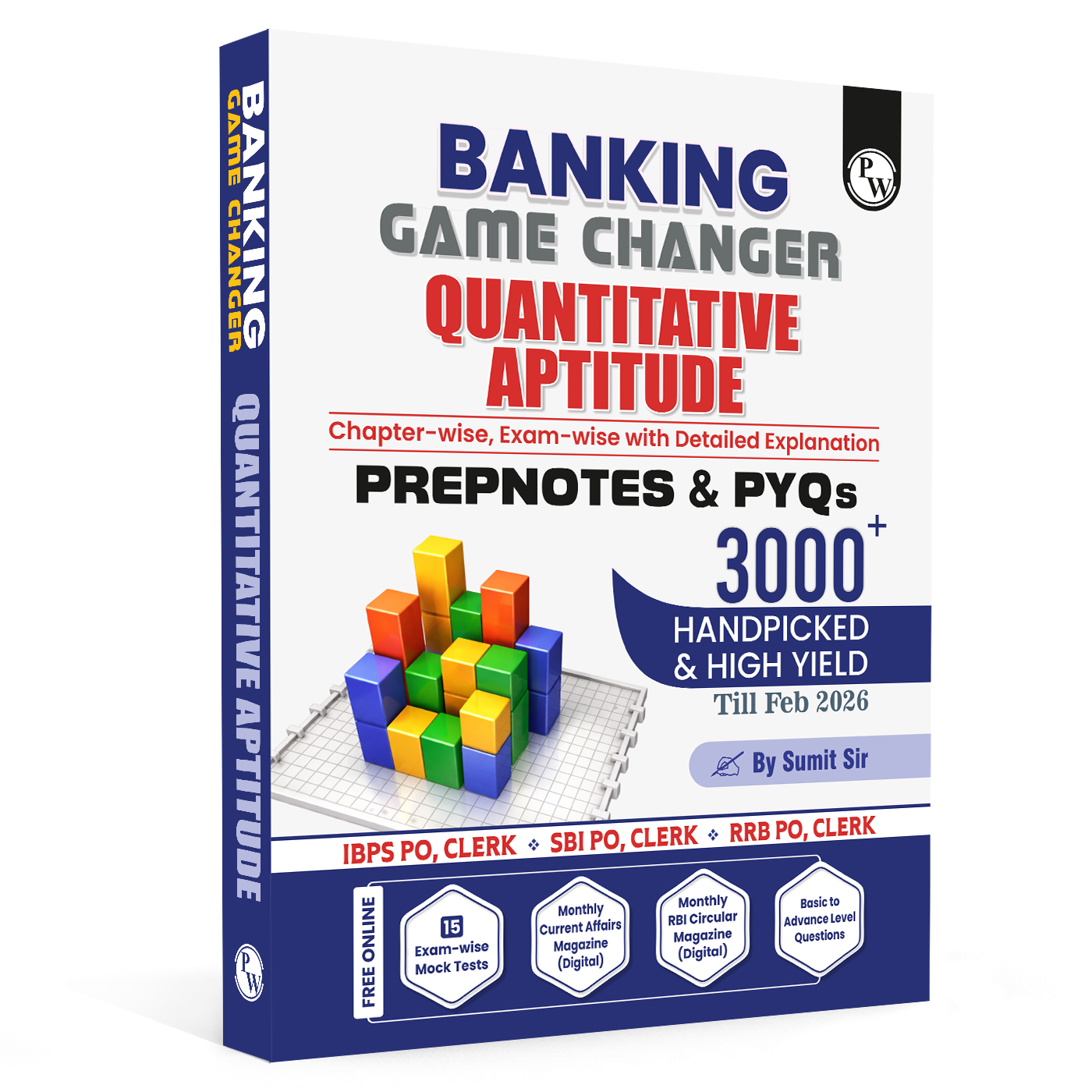
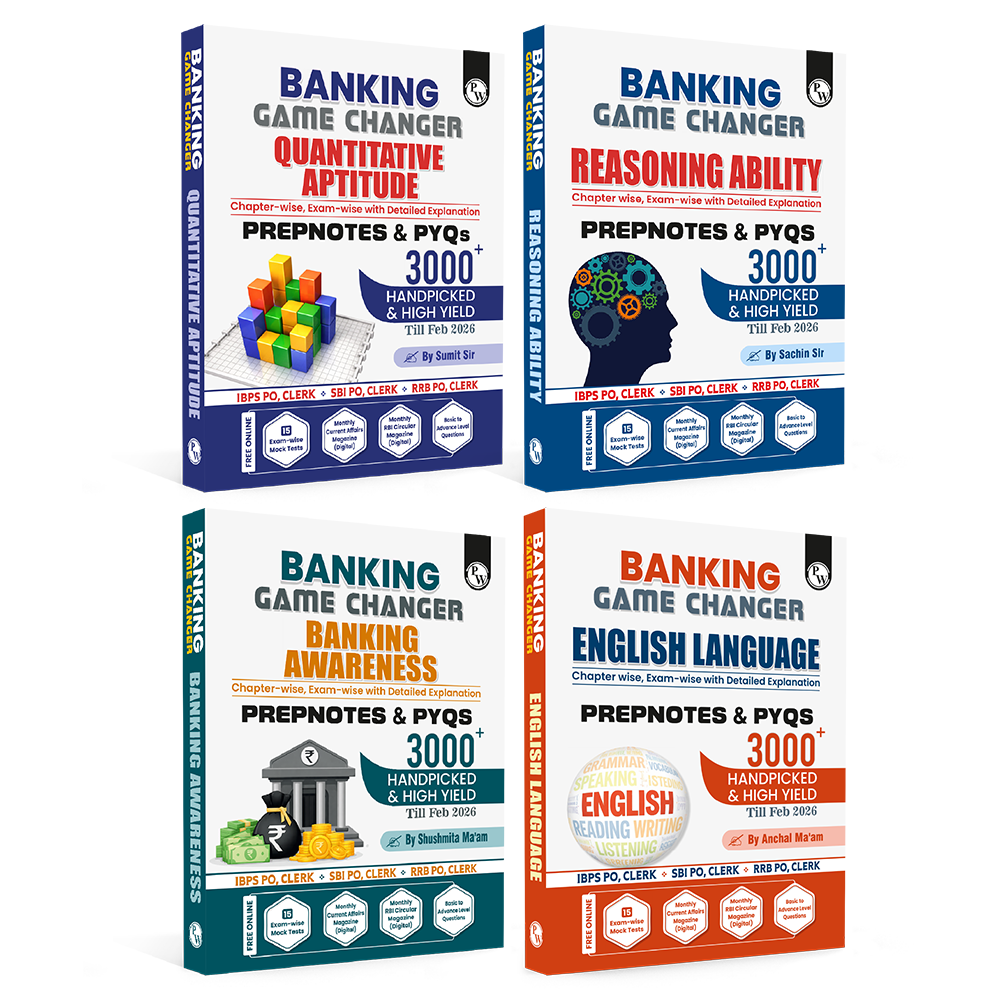
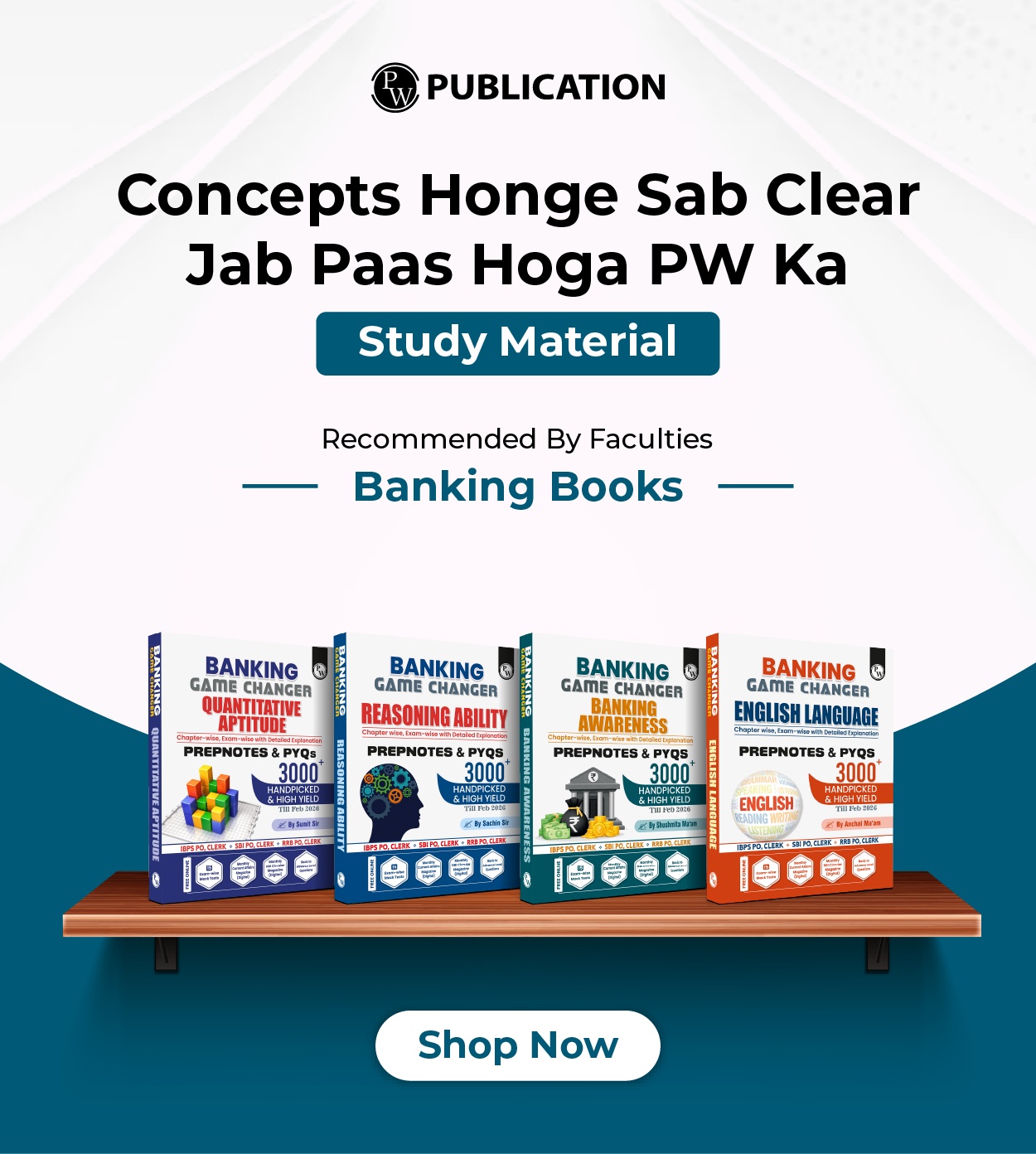
To determine if one resource can meet all learning objectives, let us evaluate a modern all-in-one resource designed specifically for banking aspirants: the PW Banking Quantitative Aptitude Game Changer Book by Sumit Sir.
|
Feature / Resource |
Key Benefits & Details |
|
Chapterwise Theory |
Clear, student-friendly concept explanations |
|
3000+ PYQ MCQs |
Real exam trend practice & detailed solutions |
|
15 Online CBTs |
Simulated computer-based speed tests |
|
Current Affairs |
Monthly QR access & general awareness support |
Comprehensive Features Breakdown
-
Chapter-Wise Prepnotes & Theory: Clear explanations build strong fundamentals from scratch, making complex arithmetic concepts approachable for beginners.
-
Practical Examples: Step-by-step solved examples follow every theoretical concept, demonstrating exact application techniques before candidates move to practice sets.
-
3000+ PYQ-Based MCQs: Solving authentic banking quant PYQs allows candidates to understand actual difficulty levels, question distributions, and subtle traps set by exam bodies.
-
15 Online CBT Tests: Real computer-based test experiences help students build time-management skills, reduce exam anxiety, and improve digital screen reading speed.
-
Detailed Exam Trend Analysis: Chapter-level insights highlight high-weightage topics across IBPS PO, SBI PO, IBPS Clerk, SBI Clerk, RRB PO, and RRB Clerk exams.
-
Integrated Current Affairs Support: Includes dedicated coverage for Banking Awareness along with QR-code access to monthly current affairs digital magazines.
How the Game Changer Book Replaces Multiple Guides
|
Traditional Study Approach |
Game Changer Book Strategy |
|
• Book 1: Theory & Formulae • Book 2: Practice Exercise Sets • Book 3: Previous Year Papers • Book 4: Separate Online Mocks |
Single Integrated Reference Text (Theory + 3000+ PYQs + 15 CBTs) |
What Should a Banking Quantitative Aptitude Book Cover?
One preparatory Banking book would have to cover every single topic tested in preliminary and main tests. Bank exams test candidates on speed, conceptual clarity and data interpretation skills.
|
Exam Category |
Core Quantitative Aptitude Topics Included |
Primary Skill Evaluated |
|
Speed Mathematics |
Simplification, Approximation, Number Series, Quadratic Equations |
Calculation speed, mental arithmetic, and pattern recognition |
|
Arithmetic Ability |
Percentage, Profit & Loss, Ratio & Proportion, Simple & Compound Interest, Averages, Time & Work |
Deep conceptual clarity, formula application, and word problem decoding |
|
Advanced Arithmetic |
Speed Distance Time, Boats & Streams, Mixtures & Alligations, Ages, Partnership, Probability |
Multi-step problem solving and logical derivation |
|
Data Interpretation (DI) |
Bar Graphs, Line Charts, Pie Charts, Tabular DI, Caselets, Missing DI |
Data analysis, quick calculation, and trend estimation |
|
Data Sufficiency |
Statement-based sufficiency problems combining arithmetic concepts |
Logical deduction and concept verification |
Key Modules Required for Full Preparation
|
Module |
Key Topics & Focus Areas |
|
1. Speed Maths |
Fast calculations, approximation, number series |
|
2. Arithmetic |
Percentages, ratios, profit & loss, time & distance |
|
3. Data Analysis |
Tables, graphs, pie charts, caselet interpretation |
|
4. Sufficiency |
High-level statement checks & comparative quantities |
1. Speed Mathematics Module
Speed maths forms the backbone of preliminary exams. Aspirants need to solve 10 to 15 questions within five to seven minutes.
-
Simplification & Approximation: Learn quick mental arithmetic techniques, BODMAS application, square roots, cube roots, and fraction-to-percentage conversions.
-
Number Series: Identify missing and wrong number patterns, including polynomial differences, geometric progressions, and alternate series logic.
-
Quadratic Equations: Learn factorisation shortcuts and sign-comparison methods to solve binary algebraic equations rapidly without full expansion.
2. Comprehensive Arithmetic Module
Arithmetic carries significant weightage in both Prelims and Mains. A strong foundational text must break down each topic into clear sub-types.
-
Base Principles: Mastery over Percentages and Ratio & Proportion is essential, as these two concepts drive Data Interpretation calculations.
-
Commercial Maths: Detailed explanations on Profit, Loss & Discount, alongside Simple and Compound Interest calculations using ratio methods rather than lengthy formulas.
-
Kinematics & Work Logic: Systematic breakdowns of Time, Speed & Distance, Train Problems, Boats & Streams, and Pipe & Cistern word problems.
3. Advanced Data Interpretation (DI) Module
Data Interpretation accounts for a major chunk of marks in the Mains examination stage.
-
Basic & Combination Charts: Comprehensive coverage of Bar Diagrams, Line Graphs, Pie Charts, and Data Tables.
-
Caselet DI: Paragraph-based data sets that test reading comprehension and quick table formation.
-
Modern DI Patterns: Missing Data Tables, Radar Graphs, and Arithmetic-based DI (e.g., Time & Work or Speed DI), which are frequently featured in recent exam cycles.
Importance of Mock Tests with a Banking Quantitative Aptitude Book
While a comprehensive Banking PYQs book provides complete conceptual mastery, print resources must be supported by digital test simulation to ensure real-world readiness.
The Role of Online CBT Practice
-
Adapting to Screen Reading: Banking exams are strictly computer-based. Transitioning from paper reading to screen analysis is crucial for maintaining reading speed.
-
Timer Management: Students practice questions using a live countdown timer to learn how to skip long questions and still get high accuracy.
-
Sectional Navigation: Online examinations allow candidates to practice good question selection, and they can take the high-scoring speed math questions first.
-
Performance Analytics: Digital platforms generate instant percentile reports, accuracy metrics, and time-spent analysis per question.
Banking Quantitative Aptitude Book vs Multiple Study Books
Here is a direct comparison table to help you decide between buying one all-inclusive resource or putting together a collection of multiple guides:
|
Evaluation Criterion |
Relying on One Comprehensive Book |
Using Multiple Fragmented Books |
|
Conceptual Consistency |
High; single unified teaching method across all chapters |
Low; conflicting shortcut methods and formula styles |
|
Time Efficiency |
Maximum; structured linear path saves daily planning time |
Low; time wasted sorting through overlapping exercises |
|
Previous Year Coverage |
Structured access to banking maths previous year questions |
Unorganized, duplicate questions scattered across texts |
|
Exam Simulation |
Includes online CBT access to mirror actual exam interfaces |
Requires separate purchases of online test series |
|
Cost Effectiveness |
Economical single purchase covering all preparation needs |
Expensive cumulative investment across multiple authors |
|
Revision Suitability |
Quick and easy revision using concise chapter prepnotes |
Difficult to revise during the final weeks before exams |
How to Use a Banking Quantitative Aptitude Book Effectively?
Maximising results from a single book requires a disciplined, step-by-step study strategy rather than passive reading.
Step 1: Learn Theoretical Concepts First
-
Read the chapter prep notes carefully before tackling the exercise sets.
-
Memorize not the processes of arithmetic but the gist of the logic of every formula.
-
Work through every solved practical example using pen and paper to reinforce step-by-step application.
Step 2: Solve Topic-Wise Previous Year Questions
-
Begin solving past exam questions divided by chapter to notice recurring patterns.
-
Categorise questions into three types: Easy (instant attempt), Moderate (requires calculation), and Difficult (requires strategic skipping practice).
-
Review solutions carefully for any question that took longer than 60 seconds to solve.
Step 3: Build Speed and Mental Arithmetic
-
Memorise tables up to 30, squares up to 50, and cubes up to 30 for rapid calculation.
-
Practice fraction-to-percentage conversions daily to speed up Data Interpretation sets.
-
Apply sign-comparison shortcuts for quadratic equations to save time during prelims.
Step 4: Integrate Online CBT Tests
-
When you have completed every two or three major units, take frequent computer-based examinations.
-
Review mock exam scores to identify weak chapters. Re-read theoretical prep notes.
-
Practice Question Selection Strategy: Begin with Speed Maths, then standalone Arithmetic, and then Data Interpretation.
Read More: SBI Clerk Quantitative Aptitude Questions with Solutions
Banking Quantitative Aptitude Book FAQs
Is one banking quantitative aptitude book sufficient to clear IBPS PO and SBI PO?
Yes, one whole book is plenty if it has chapter-wise theory, solved practical problems, a large question bank with past papers, and digital mock test help. To look up one book in its whole will be more accurate than scanning a number of guides.
How many practice questions should a good banking maths book contain?
A complete study guide should have at least 2500 to 3000 practice questions based on the latest exam patterns. With this volume, you can practice basic, intermediate, and difficult problem types without needing any other supplements.
Are previous year questions important for banking quant preparation?
Previous year questions are important since they reflect repeating exam patterns, difficulty level, and topic weightage in IBPS, SBI, and RRB exams. Going through past questions enables candidates to shape their preparation toward what to expect in the real test.
Does the PW Banking Quantitative Aptitude Game Changer Book include mock tests?
Yes. The book contains access to 15 Online Computer-Based Tests (CBTs). Aspiring candidates can use these tests to practice under authentic digital examination conditions to improve their calculation speed, time management, and overall confidence when taking the test.
Can beginners start their preparation directly with this quantitative aptitude guide?
Absolutely. The book is structured specifically for all learning levels. It begins with easy-to-understand conceptual theory and step-by-step practical examples before progressing to advanced PYQ-based MCQs and practice sets.