Benefits of Solving Banking Reasoning PYQs Regularly
Banking Reasoning PYQs assist the candidates to learn the latest exam pattern, develop logical thinking and solving speed on a regular basis. Previous Year Questions helps in finding themes of high weightage, strengthening puzzle solving skills and weak areas thru real test practice. Regular Banking Reasoning PYQ practice enhances accuracy, confidence, and time management for SBI, IBPS, and RRB exams.
Why Banking Reasoning PYQ Is Important for Exam Preparation?
Regular practice with actual test papers of major banks’ recruitment exams helps in getting a clear picture of the varying difficulty levels. Candidates that work through past test items have direct exposure to how examiners frame problems, merge ideas and impose strict time constraints.
Know Real Exam Patterns and Structure
Bank recruitment examinations for IBPS PO, IBPS Clerk, SBI PO, SBI Clerk, RRB PO, and RBI Assistant have distinct testing formats. Solving past papers helps candidates observe these structural variations:
-
Pattern Recognition: Identifies how seating arrangements, multi-variable puzzles, and blood relations are integrated in preliminary and main stages.
-
Weightage Analysis: Highlights high-scoring topics such as syllogism, inequality, and coding-decoding.
-
Trend Tracking: Shows changes in the difficulty & structure of questions over the last few exam cycles.
Eliminating Surprise Elements During Live Exams
Computer-based timed tests often induce anxiety and panic because of unfamiliarity with the question formats. Candidates who practice PYQs daily are well prepared to face practically all permutations of questions before they enter the examination hall. This familiarity turns unexpected puzzle configurations into routine problem-solving jobs.
Important Topics Covered in Banking Reasoning PYQ
A structured banking reasoning practice routine must cover every core section found in modern recruitment exams.
Understanding how specific topics are framed in past papers allows aspirants to structure their study sessions productively.
-
Puzzles and Seating Arrangement: Linear, circular, square, floor-based, box-based, and scheduling puzzles.
-
Logical and Analytical Reasoning: Statement and assumptions, course of action, cause and effect, and strong/weak arguments.
-
Miscellaneous Topics: Direct syllogism, reverse syllogism, coded inequalities, blood relations, and direction testing.
-
Advanced Machinery: Input-output steps, data sufficiency, and advanced coding-decoding patterns.
How to Analyse Your Banking Reasoning PYQ Performance?
Simply solving questions without review leads to repeated mistakes. A structured post-practice evaluation is essential for continuous improvement.
Step-by-Step Analysis Checklist
To extract maximum value from every banking previous year papers session, follow this step-by-step strategy:
-
Categorise Errors: Group mistakes into conceptual gaps, calculation errors, or misread instructions.
-
Track Time per Question: Identify puzzles that took longer than three minutes and evaluate whether they should have been skipped initially.
-
Review Solutions: Compare your method with expert shortcut techniques to discover faster approaches.
-
Maintain a Mistake Notebook: Log tricky puzzle conditions and review them weekly to prevent repeating the same errors.
Benefits of Solving Banking Reasoning PYQ
Systematic daily practice with real questions yields several distinct advantages that theoretical study alone cannot deliver.
|
Benefit Area |
Theoretical Study Alone |
Daily PYQ Practice Impact |
|
Speed & Accuracy |
Focuses on basic steps |
Develops rapid shortcut application |
|
Puzzle Strategy |
Explains rules |
Builds step-by-step decoding speed |
|
Time Allocation |
Uniform time per item |
Teaches quick skip/attempt decisions |
|
Error Reduction |
Misses common traps |
Highlights recurring mistake patterns |
Developing Speed and Accuracy Under Pressure
Reasoning measures your capacity to think on your feet , not your ability to memorize . Candidates must be able to rapidly and accurately deal with complicated conditions.
-
Shortcut Implementation: Solves inequalities and syllogisms within seconds using direct elimination rules.
-
Reduced Calculation Loops: Minimises rough-sheet work through systematic visual representation.
-
Instant Rule Recall: Strengthens memory of direction sense and input-output rules.
Learning Time Management Strategies
Time constraints are often the biggest barrier to clearing sectional cut-offs. Working through banking reasoning previous year questions teaches candidates how to divide their allotted time effectively across different sections.
-
Phase 1 (First 5-7 Minutes): Tackle standalone topics like inequalities, syllogisms, direction sense, and simple coding-decoding.
-
Phase 2 (Next 8-10 Minutes): Attempt moderate-level floor, box, or linear seating arrangement puzzles.
-
Phase 3 (Final Minutes): Address complex multi-variable puzzles or data sufficiency questions.
How to Choose the Best Banking Reasoning PYQ Book?
Selecting the right banking books is vital for focused banking aptitude preparation. A reliable guide should offer comprehensive coverage, detailed explanations, and authentic exam-aligned questions.
Features of an Ideal Preparation Resource
When choosing a banking reasoning book, candidates should ensure it includes:
-
Chapter-wise Theory: Comprehensive conceptual summaries accompanied by illustrative examples.
-
Extensive Question Bank: Thousands of practice items derived directly from recent exam papers.
-
Shortcut Explanations: Clear step-by-step methods and time-saving tricks for complex puzzles.
-
Computer-Based Mock Support: Full-length online tests to simulate real exam environments.
Read More: Reasoning Ability for Bank Exams - Syllabus, Weightage, Books
Banking Reasoning PYQ Book FAQs
How many years of banking reasoning PYQs papers should I solve?
Solving past papers from the last 5 to 7 years is recommended. This covers a wide variety of puzzle formats and reflects recent changes in exam patterns across IBPS, SBI, and RRB tests.
Is daily banking reasoning practice necessary for preliminary exams?
Yes, daily practice is essential. Regular practice sharpens analytical thinking, improves puzzle-decoding speed, and helps maintain high accuracy under strict timer constraints.
How does a dedicated banking reasoning book help compared to free online PDFs?
A structured book provides organised chapter-wise theory, verified solutions, shortcut techniques, and error-free explanations that scatter-shot online PDFs often lack.
How can I improve my puzzle-solving speed using past questions?
Analyse the initial conditions of each puzzle carefully, use neat grid diagrams, practise shortcut techniques, and review detailed solutions to learn efficient variable placement strategies.
Does the PW Banking reasoning ability game changer book include online mock tests?
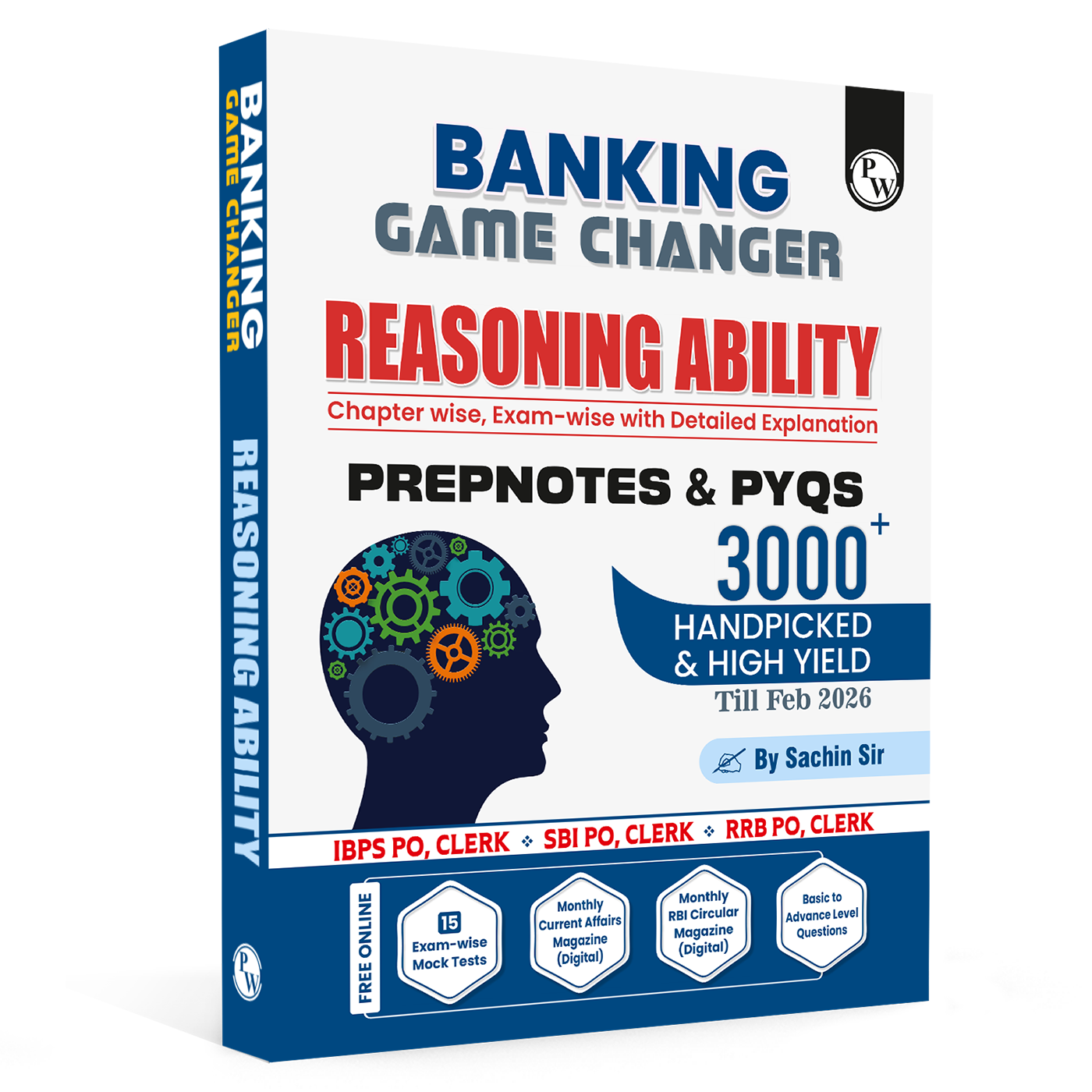
Yes, this book includes 15 online CBT (Computer-Based Test) mock papers to provide real exam-like practice alongside its 3000+ PYQ practice bank.