Quantitative Aptitude PYQs Every SBI Clerk Aspirant Should Solve

Regular practice of SBI Clerk Quantitative PYQs enables candidates to comprehend the latest exam format, identify high-weightage topics, increase calculation speed, and manage time effectively.
Solving last year's problems is the best way to improve your accuracy, increase your confidence, and develop problem-solving abilities needed to perform better in SBI Clerk Prelims and Mains exams.
Importance of SBI Clerk Quantitative PYQ for Exam Preparation
Practicing PYQ sets shifts your preparation from passive reading to active, targeted drill work. Past papers serve as a blueprint for what the exam authorities demand.
-
Spot Exam Patterns: In the prelims and mains phases, previous-year sets had recurrent mathematical patterns.
-
Sharpen speed of solving: Working through past papers strengthens the rapid mental math skills needed to ace a 20-minute test session.
-
Find Weak Spots – Working through real sets rapidly shows you straight away where you are dropping marks or taking too long.
-
Reduce Exam Stress: Being aware of the original paper formats reduces the stress of exams on the day of the exam.
High-Weightage Topics in SBI Clerk Quantitative PYQ
To score well in SBI Clerk quantitative aptitude, focus your Banking study materials around topics that carry the highest mark weightage every year.
|
Section Category |
Prelims Questions |
Primary Skill Tested |
|
Simplification & Approximation |
10 to 15 Questions |
Fast calculation and mental arithmetic |
|
Data Interpretation (DI) |
5 to 10 Questions |
Rapid table reading and average calculations |
|
Number Series |
5 Questions |
Quick logical pattern recognition |
|
Quadratic Equations |
5 Questions |
Variable comparison and factorisation |
|
Arithmetic Word Problems |
10 Questions |
Core concept clarity and formula speed |
Simplification and Approximation
This section carries the maximum weightage in preliminary papers. Questions check how fast you can evaluate complex expressions using BODMAS rules, percentage-to-fraction conversions, squares, and cubes.
Data Interpretation Sets
Data Interpretation evaluates your skills to analyze numerical data under duress. Common to both exam periods are line graphs, pie charts, tabular sets, and bar diagrams.
Number Series and Quadratic Comparison
Number series questions test missing or wrong number identification. Quadratic equations require quick factorisation to compare variables X and Y accurately.
Types of Questions Covered in SBI Clerk Quantitative PYQ
Solving SBI Clerk Maths PYQs gives a realistic preview of actual exam questions.
1. Speed Calculation Problems
Simplification tests raw speed, while approximation tests your ability to estimate values close to the right answer quickly.
Pro Tip: Convert percentages to fraction equivalents (for example, 12.5% = 1/8 or 37.5% = 3/8) to skip tedious multiplication steps.
2. Data Interpretation Diagrams
-
Tabular DI: Requires fast additions, subtractions, and average calculations.
-
Pie Chart DI: Features degree-to-percentage conversions.
-
Caselet DI: Directs you to convert short text paragraphs into structured tables.
3. Number Series Patterns
Frequently spotted logic in SBI clerk previous year questions includes:
-
Double-difference sequences.
-
Multiplicative series with alternating addition and subtraction.
-
Square and cube difference variations.
4. Arithmetic Word Problems
Arithmetic tests foundational mathematical concepts:
-
Profit and Loss: Markups, successive discounts, and fake weight scenarios.
-
Interest Calculations: Multi-year Simple Interest (SI) and Compound Interest (CI) differences.
-
Time, Speed, and Distance: Train intersections, relative speed, and boat-stream questions.
-
Partnership and Ages: Capital ratio investments and changing age ratios.
How to Practice SBI Clerk Quantitative PYQ Effectively?
Working through PW SBI Clerk PYQ books requires a systematic approach to gain maximum score improvement.
Step 1: Topic-wise Solves ➔ Learn individual concepts first
Step 2: Timed Drill Mode ➔ Work under 20-minute timer limits
Step 3: Error Log Tracking ➔ Eliminate repeated calculation mistakes
Step 4: Year-wise Sets ➔ Attempt complete full-length papers
Stage 1: Topic-Based Practice
Focus on one topic at a time. Solve at least 100 questions of Simplification or Quadratic Equations to build pattern recognition before moving on.
Stage 2: Timed Practice Drills
When engaging in SBI Clerk quant practice, always use a timer. Try completing 10 Simplification questions within 3 to 4 minutes to save time for complex arithmetic word problems.
Stage 3: Thorough Solution Review
Reviewing Banking previous year papers helps you learn shorter execution tricks, smart elimination methods, and quicker calculation shortcuts.
SBI Clerk Quantitative PYQ for Prelims vs Mains
Although the Quantitative Aptitude section appears in both the SBI Clerk Prelims and Mains examinations, the level of difficulty and question types vary significantly. Understanding these differences through PYQ practice helps candidates plan their preparation more effectively and allocate time according to the demands of each stage.
|
Feature |
SBI Clerk Prelims Quant |
SBI Clerk Mains Quant |
|
Total Questions |
35 Questions |
50 Questions |
|
Time Allotted |
20 Minutes |
45 Minutes |
|
Difficulty Level |
Easy to Moderate |
Moderate to High |
|
Core Focus |
Speed & Mental Math |
Data Sufficiency, Caselets & Advanced Math |
How Does SBI Clerk Quantitative PYQ Improve Exam Accuracy?
Regular practice with PYQs not only improves speed but also increases accuracy. Many candidates lose marks because of simple calculation mistakes, incorrect formula application, or poor time management rather than difficult questions. Solving authentic previous year papers helps you recognise common question patterns and avoid these errors before the actual exam.
While practising, focus on understanding why an answer is correct instead of simply checking the final solution. Review every incorrect attempt, note the reason behind the mistake, and revise the related concept. Maintaining an error notebook allows you to track recurring weaknesses and prevents you from repeating the same mistakes in future practice sessions. Over time, this habit improves both confidence and overall performance.
How to do Daily SBI Clerk Quantitative PYQ Practice?
A consistent routine is the key to scoring well in the quantitative aptitude section. Instead of solving large sets randomly, divide your practice into small, focused sessions covering different topics each day. This approach strengthens concepts while gradually improving speed and accuracy.
A simple daily practice routine can include:
-
Spend 30 minutes revising formulas, shortcuts, and calculation techniques.
-
Solve 20 to 30 PYQ questions from one topic.
-
Attempt a 20-minute timed sectional test to improve speed.
-
Analyse every incorrect answer and update your error notebook.
-
Revise difficult questions at the end of the week to strengthen retention.
Following this planned approach allows the candidates to study the whole curriculum in a proper manner and also develop speed of calculations essential for the SBI Clerk Prelims and Mains test. Regular practice of previous year papers along with revision of concepts makes applicants more confident to tackle different types of questions and time constraints during the test.
Read more: SBI Clerk Syllabus 2026 for Prelims and Mains Exams
SBI Clerk FAQs
How many years of SBI Clerk quantitative PYQs should I solve?
Solving 5 to 10 years of past papers provides adequate practice across changing paper trends and difficulty levels.
Is the SBI Clerk quantitative aptitude section hard?
The section is moderate in difficulty. However, high cut-offs mean accuracy and calculation speed are more important than solving lengthy problems.
Where can I find organized SBI Clerk previous year questions?
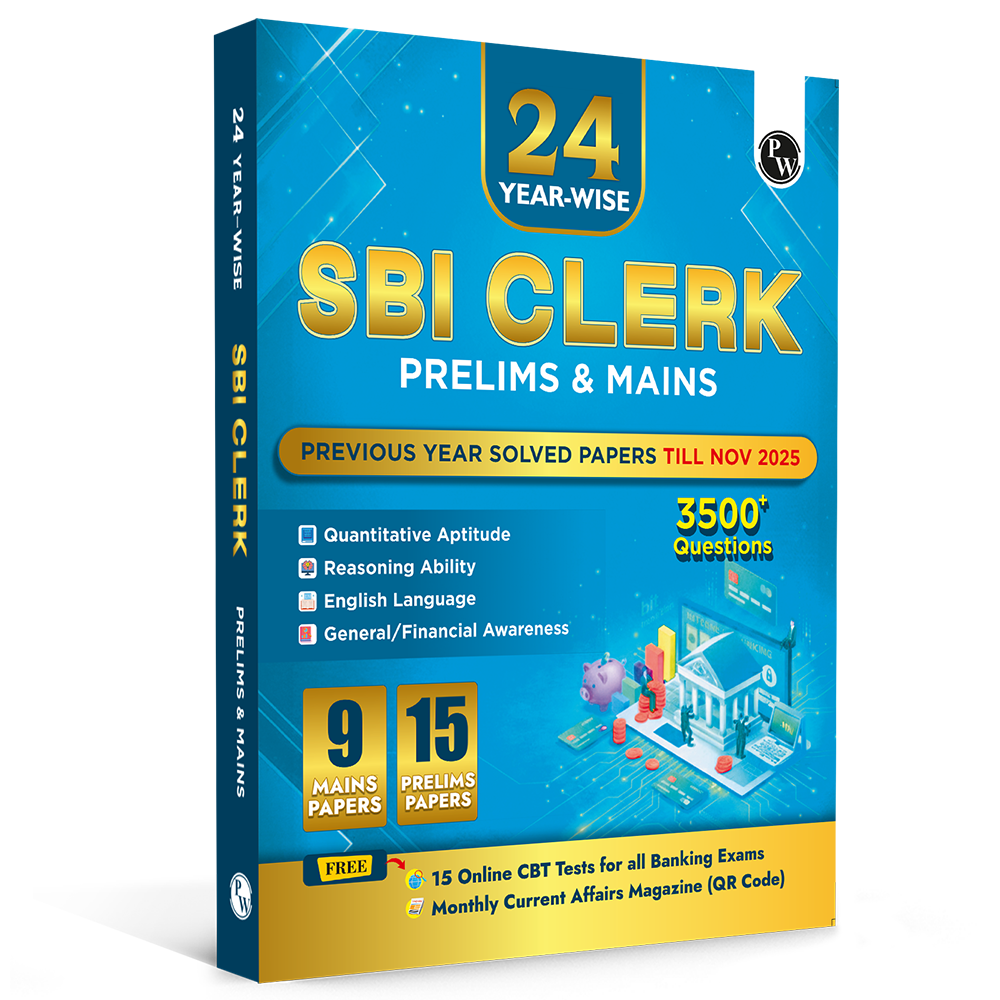
You can find year-wise and topic-wise organized collections in comprehensive study guides, such as the SBI Clerk 24 Years-Wise Solved Paper.
How much time should I dedicate daily to SBI Clerk quant practice?
Spending 2 to 3 hours daily on concept revision, calculation drills, and past papers ensures steady score improvement.
Do questions from SBI Clerk math PYQs repeat in new exams?
Exact values hardly ever repeat themselves, but the basic computation logic, pattern structures and concepts are the same year after year.