How PYQs Improve Quantitative Aptitude Preparation for CAT
Mastering past exams is the absolute secret to clearing the Common Admission Test. Using targeted question banks with complete solutions bridges the huge gap between learning math concepts and applying them correctly under strict exam time limits.
Effective quantitative aptitude preparation for CAT becomes easier when candidates regularly solve actual exam-level questions.
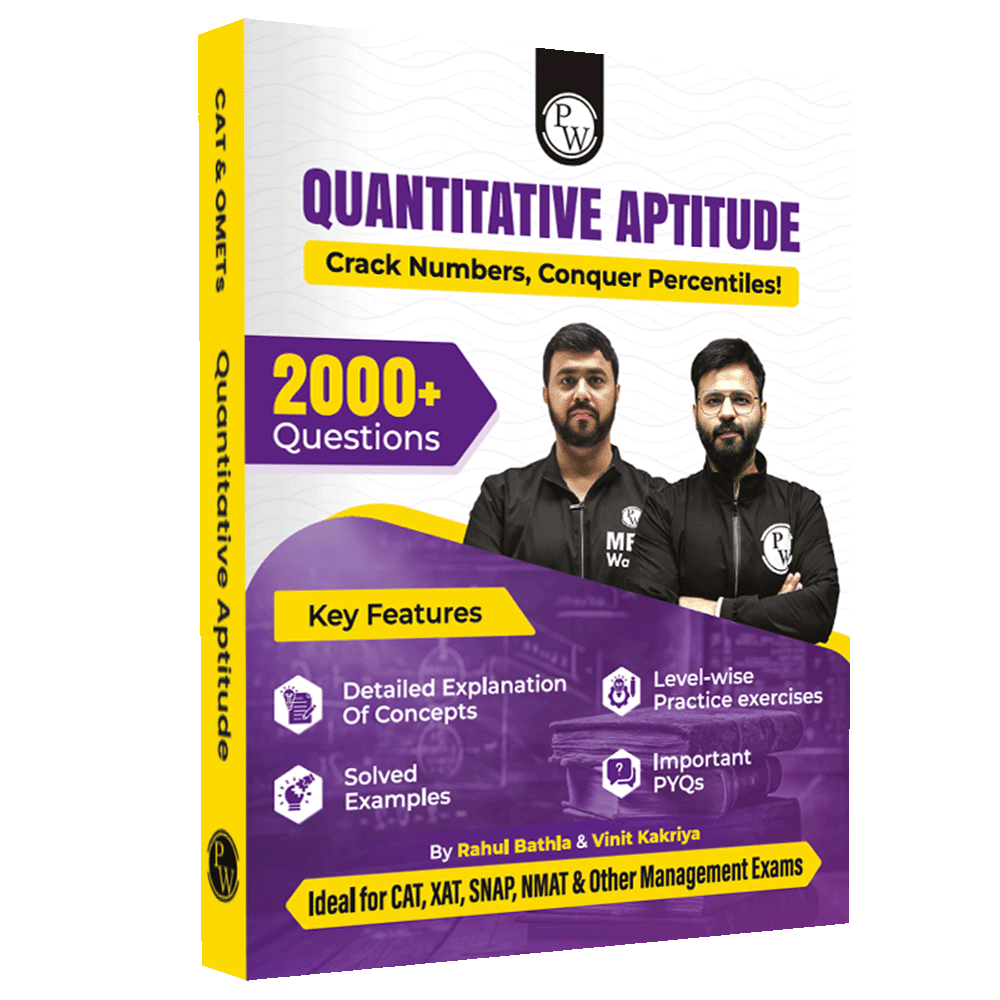
Check Out: PW MBA Books
Importance of PYQ in Quantitative Aptitude Preparation for CAT
Practising past papers is the ultimate way to understand the mind of the examiner. It changes how you study by showing you exactly which topics are worth your time and which ones you can scan quickly. Instead of guessing what might show up, you get a clear look at the actual depth of the exam.
-
Spotting Core Themes: Past papers show you that topics like Arithmetic and Algebra always carry huge weight.
-
Understanding Question Formats: You learn to recognize how simple mathematical properties are twisted into tricky word problems.
-
Setting Realistic Benchmarks: Working through real questions tells you exactly where you stand compared to the actual test standard.
When you base your CAT quantitative aptitude preparation on real exam data, you stop wasting hours on irrelevant, overly complex puzzles that never show up in the actual exam.
The mix of questions changes slightly every few years, but the main pillars stay steady. Reviewing papers from the last decade highlights that Arithmetic (such as percentages, profit and loss, ratios, and mixtures) and Algebra make up the largest chunk of the quantitative section.
Geometry and Number Systems follow close behind, while Modern Math appears in smaller, specific amounts. Recognizing this layout allows you to plan your daily schedule perfectly, ensuring you spend your energy where it rewards you with the highest marks.
Many mock tests available online are artificially difficult, which can destroy your confidence. Real past exams provide the most accurate measure of difficulty. They prove that you do not need to memorize obscure theorems to score well; instead, you need a flawless command of fundamental concepts and the ability to apply them to clever situations.
How to Solve Quantitative Aptitude CAT PYQ
Simply reading through past questions will not improve your percentile. You need a structured, deliberate method to get the maximum value out of every single problem you solve.
Step 1: Learn the Theoretical Foundations First
Never dive straight into past papers without knowing your basic formulas. Start by reviewing the core theory of a chapter, such as Time, Speed, and Distance. Understand the derivations, the exceptions, and the fundamental properties thoroughly before looking at past exams.
Step 2: Begin with Category-Wise Practice
Once your theory is solid, open your CAT quantitative aptitude PYQ collection and filter for that specific topic. Solve every question from that chapter from the last ten years. This isolated focus helps you see all the different ways the exam can test a single concept, like relative speed or averages.
Step 3: Solve Problems Without a Stopwatch Initially
When you first start, hide the timer. Focus entirely on accuracy and understanding the underlying logic. Analyse why a certain step was taken and how the question was framed. Speed develops naturally once your accuracy becomes consistent.
Step 4: Analyze the Provided Solutions Thoroughly
Even if you get an answer correct, always check the CAT quant PYQ with the solutions section. Compare your method with the book's approach. Often, the author will show an alternative shortcut, an elimination trick, or a digital root method that saves you two minutes of manual calculation.
How to Practice CAT Quantitative Aptitude Questions Daily
Consistency beats short bursts of intense studying every single time. To master your CAT quantitative aptitude preparation, you must set up a daily routine that balances new learning with regular revision.
Setting Daily Problem Targets
Aim to solve at least 25 to 30 CAT quantitative aptitude practice questions every single day. Divide this set into 15 past paper questions and 15 fresh practice problems from your preparation books. This balance ensures you stay familiar with the exam style while challenging your mind with brand-new situations.
Maintaining a Dedicated Error Log
Every single time you make a mistake, skip a question, or take too long to solve a problem, write it down in a separate notebook. Copy the question, note down the formula you missed, and write out the correct step-by-step solution. Review this error log every Sunday morning to stop yourself from making the exact same mistakes in future tests.
Simulating Exam Environments With Mixed Sections
As you get closer to the test date, move away from topic-based practice and start solving mixed question sets. Take a random collection of 22 questions from past papers, set a strict 40-minute timer, and try to replicate the real exam environment. This builds the mental stamina needed to switch quickly between a geometry problem and a probability question.
Benefits of Question Bank for Quantitative Aptitude Preparation for CAT
Relying on random internet searches for past papers is highly inefficient. A properly curated CAT quant question bank keeps you organised and focused on scoring.
-
Zero Time Wasted: You do not have to hunt for answer keys or worry if an online forum solution is accurate.
-
Proper Calibration: The questions match the exact difficulty shifts seen in recent computer-based testing cycles.
-
Comprehensive Coverage: It ensures you do not accidentally skip minor topics like logs, sequences, or coordinate geometry.
By using a single reliable guide, you create a seamless loop of learning, testing, analysing, and improving your CAT quantitative aptitude preparation.
How to Use Visualisation in Quantitative Aptitude Preparation for CAT
Reviewing past papers teaches you that the exam is not a pure test of math skills; it is a test of decision-making.
Data Substitution
Many algebra questions use abstract variables like x, y, and z. Instead of working through long polynomial expansions, replace those variables with simple integers like 1, 2, or 3 that satisfy the initial conditions. This turns an intimidating algebraic proof into a quick arithmetic check.
Geometry and Progressions
A significant number of coordinate geometry and mensuration questions become incredibly easy if you draw a rough, proportionally accurate diagram. Visualizing the problem helps you eliminate impossible options immediately based on scale alone, saving valuable time.
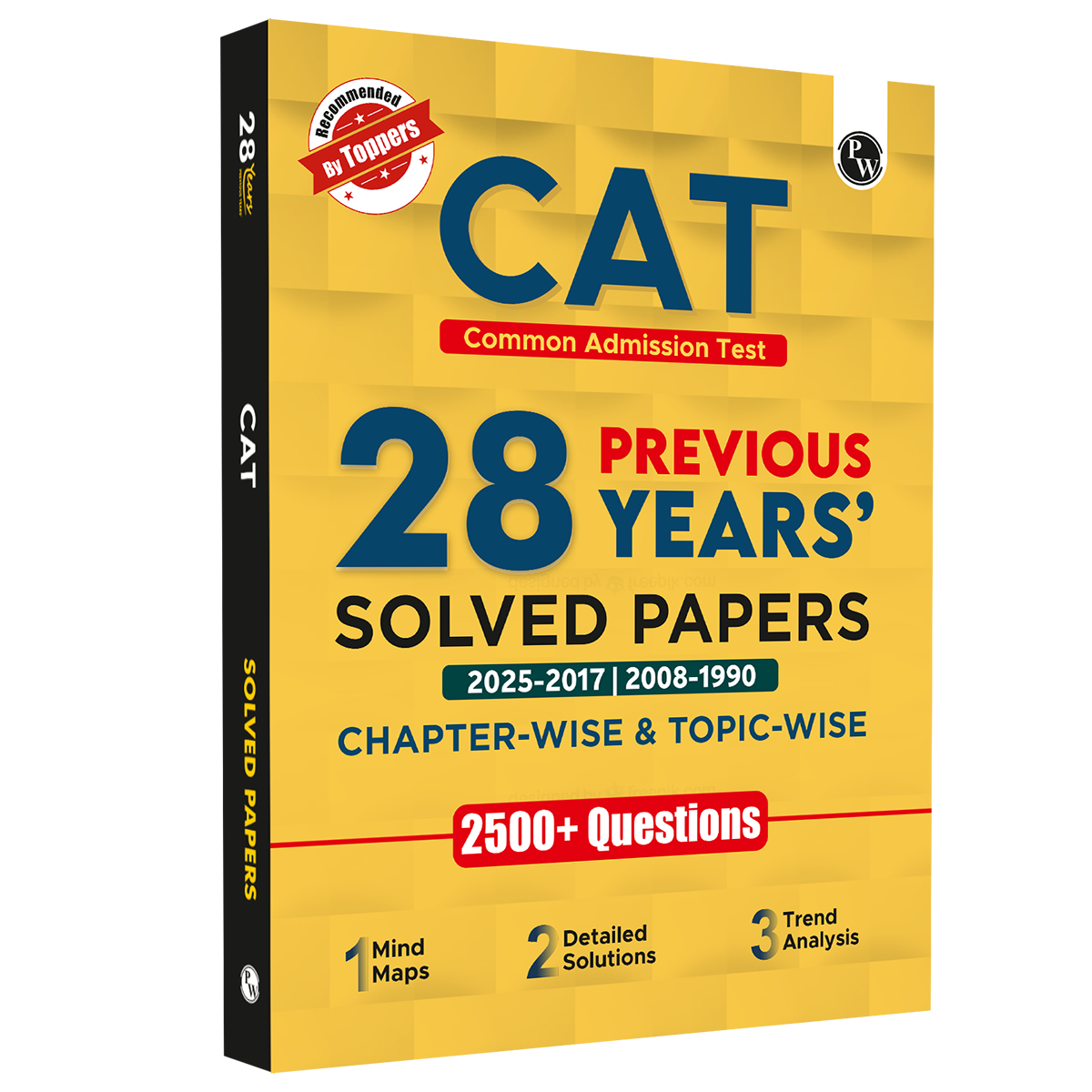
Check Out: CAT 28 Years Chapterwise & Topicwise Previous Years Solved Papers
How to Handle Weak Areas in Quantitative Aptitude Preparation for CAT
It is completely normal to struggle with certain topics during your CAT maths preparation for the CAT exam. The key to success is identifying these weak areas early and fixing them systematically using past papers.
Step 1: Diagnose the Exact Failure Point
Look closely at your error log to find patterns in your mistakes. Are you failing to solve geometry questions because you forgot the theorem, or are you simply making silly calculation errors in the final steps? Knowing the root cause tells you exactly what to fix.
Step 2: Drill Down with Foundational Examples
If a topic like Permutations and Combinations confuses you, pause your timed practice. Go back to the basic solved examples. Work through easy problems until the core principle of counting makes complete sense to you.
Step 3: Re-Solve Past Questions Under Supervision
Go back to the specific questions you got wrong in your previous attempts. Try to solve them completely on your own without looking at the solutions. If you get stuck again, read just one line of the answer key to get a hint, then try to finish the calculation yourself. This hands-on process builds real muscle memory for the exam day.
How to Choose the Right Quantitative Aptitude Preparation for CAT PYQ
Not all question compilations are created equal. To make your practice truly effective, you need a resource that arranges questions systematically rather than just dumping them in a random list.
|
Book Feature |
Why It Matters for Your Preparation |
|
Topic-Wise Sorting |
Lets you master one specific topic completely before moving to the next. |
|
Level-Wise Exercises |
Builds your confidence from basic appliCATion up to advanced problems. |
|
Detailed Explanations |
Teaches you the step-by-step logic behind every single answer. |
|
Shortcuts and Tips |
Helps you save precious seconds during the actual time-capped exam. |
Tips for Quantitative Aptitude Preparation for CAT Strategy
Balancing speed and accuracy is the hardest part of the exam. A great CAT quant preparation strategy focuses on smart question selection and recognizing structural patterns in the test paper.
-
The Three-Round Strategy: Read through the section and group questions into three CATegories: immediate solves, lengthy but doable, and completely unfamiliar.
-
Option Elimination Tactics: Learn to plug the given multiple-choice options back into the question equations to find answers without solving the full algebra.
-
Using Ratios and Units: Simplify heavy arithmetic calculations by converting numbers into simple ratios or checking the last digit of the options.
Using this structured framework keeps you from getting stuck on a single difficult puzzle, which is the main reason many well-prepared candidates miss their target percentile.
Read More: CAT Exam Syllabus for 2026 Exam
CAT Quantitative Aptitude PYQ FAQs
How many past years of questions should I solve for my quantitative aptitude preparation for CAT?
You should ideally focus on the last 10 to 15 years of exam papers. This gives you a clear understanding of how the test style has changed while providing a massive library of high-quality practice problems.
Can I get a high percentile by only studying the CAT quantitative aptitude PYQ sets?
While past papers are essential, they work right when combined with solid concept books. Use theory books to build your foundational knowledge first, then use past papers to sharpen your speed and appliCATion skills.
What should I do if the CAT quant PYQs with solution manuals are too complicated?
If a textbook solution seems too complex, look for alternative methods like picking numbers for variables, using option elimination, or breaking the problem down into simple ratios.
How much time should I spend analyzing a single CAT quant previous year questions paper?
You should spend at least double the amount of time analyzing a paper as you did writing it. If you spend 40 minutes solving a set of questions, dedicate at least 80 minutes to reviewing every single answer, mistake, and shortcut.
Which chapters should I prioritise during my CAT maths preparation for the CAT exam?
You should give the highest priority to Arithmetic and Algebra. Together, these two core areas make up more than half of the entire quantitative section, making them the most important topics for boosting your final percentile.